Dry collectors use air and filters to capture particles, while wet collectors combine airflow, water, and particle separation; the better choice depends on dust loading, particle size, fire risk, and waste handling [S2][S3].
What Each Collection Method Actually Does
Dry dust collectors use air-only filtration and can capture fine airborne particles with up to 99.9% efficiency [S2].
Wet dust filtration systems use water and air pressure to remove dust from the air and drive it through a water spray or stream [S3].
The mechanisms are not equivalent: suppression adds liquid to airborne particles or deposited dust, whereas collection captures and concentrates particulate material in a filter or separator [S1][S2]. A dry collector is more efficient for smaller particulate, smoke, and welding fumes [S4].
Measured Performance and Test Limits
A Bureau of Mines study tested 3 water-application methods using instantaneous dust sampling at a bagging machine and inside a railroad boxcar [S1].
These arrangements differ in where moisture is applied, how much liquid reaches the dust, and whether the product itself can tolerate added water.
That result concerns surface cleaning and condensation-assisted removal, not general workplace capture efficiency, so it should not be transferred directly to a dust-collector selection [S5].
Side-by-Side Selection Criteria

Dry dust collectors use air-only filtration and can capture fine airborne particles with up to 99.9% efficiency, while wet dust collectors use air and water and are specifically engineered for combustible or explosive metal dusts [S2].
Wet dust collectors use air and water and are specifically engineered for combustible or explosive metal dusts [S2].
On collected waste, dry dust remains a dry solid, whereas wet collection transfers captured material into a liquid stream that requires disposal [S2][S3].
Where Water Spray Fits
Water spray is less suitable as the sole control for fine airborne particulate, smoke, or welding fumes, where dry filtration is described as more efficient [S4].
At transfer points, crushers, milling operations, and other dust-generating equipment, local suppression can complement an engineered collection system rather than replace it. The related engineering comparison of cold milling dust collection and water spray provides a process-specific framework for combining those functions.
Why Suppression Performance Can Fall Short
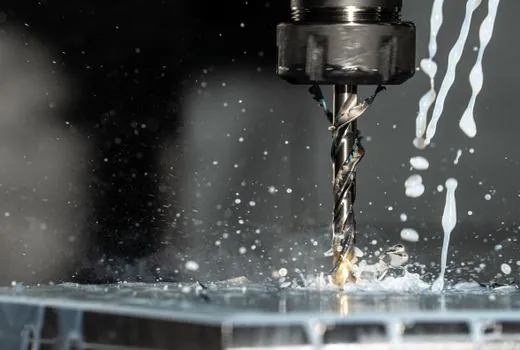
Spray performance depends on delivery, not simply on the presence of water. The 1982 Bureau of Mines report examined three water-spray methods for controlling dust during bagging [S1].
Dust type also changes the result. A 2022 technical discussion explains that adding water increases the weight of each dust particle and can promote settling, but this does not guarantee equivalent capture of every particle size or every discharge condition [S6]. The weight of each dust particle is increased by spraying water over the body of the fugitive dust material [S6].
Specification and Acceptance Criteria
Specify the basis of collection performance before comparing systems: particle size, airflow, dust loading, moisture level, collection point, operating temperature, and the measurement location all affect the result [S1][S2]. A 50% reduction at a worker location and 99.9% filter efficiency describe different tests and cannot be treated as interchangeable performance claims [S1][S2].
For a wet system, specify the water supply, nozzle or scrubber arrangement, liquid-to-dust loading, separation method, sludge-disposal route, and cleaning requirements [S2][S3]. For a dry system, specify filter type, airflow, pressure drop, replacement criteria, hazardous-dust rating where applicable, and installed collection efficiency under the actual dust condition [S2].
Both routes still require appropriate dust and fire protection. If the dust can burn or explode, the collection architecture must be matched to the material and facility conditions rather than selected only from published efficiency figures [S2].
A practical trial should measure baseline and treated dust concentrations at defined worker and discharge points, under comparable airflow, load, and operating conditions. For spray applications, record water rate, nozzle condition, product moisture, temperature, and downstream handling effects; for dry collection, record pressure drop, filter loading, and clean-versus-loaded performance [S1][S2].