
A luffing jib tower crane usually handles a constrained urban site better than a hammerhead because changing the jib angle reduces the horizontal footprint and limits oversailing adjacent property [S1][S2].
A hammerhead tower crane provides a fixed horizontal jib, consistent lift capacity, exceptional working radius, and 360-degree rotation, making it suitable for open projects where maximum reach and lift capacity are important [S3][S4].
How Radius and Oversail Control Differ
A luffing crane changes working radius by raising or lowering its pinned jib: raising the jib draws the hook closer, while lowering it extends the hook farther from the crane center [S4]. A hammerhead crane instead travels the trolley in and out beneath a fixed horizontal jib, so the complete jib and counter-jib rotate through a much larger swept area [S4].
That geometry makes a luffing crane the stronger option where a horizontal jib would sweep over streets, railway lines, neighboring buildings, restricted air rights, or power lines [S2][S4]. Luffing jibs can also be raised to clear one another on multi-crane jobs, whereas horizontal-jib cranes generally need height staggering, operating zones, and controlled overlap [S4].
The trade is geometric rather than simply “small versus large.” A luffing crane may occupy less operating space, but its load path depends on jib angle. Every candidate pick must still be checked against the manufacturer’s load chart for radius, hook height, configuration, and permissible wind conditions [S2][S4].
Decision Criteria for Tight-Site Selection
Space control is the decisive advantage of a luffing jib tower crane: its compact counter-jib, adjustable working radius, and ability to avoid neighboring structures make it more suitable for dense urban construction [S1][S5]. A hammerhead crane provides only moderate space control because its horizontal jib and counter-jib remain in the operating envelope throughout slewing [S2][S4].
The correct comparison is the total installed operating cost, including transport, foundation work, assembly, maintenance, operator time, and lost cycle time, rather than rental rate alone [S3].
Where Luffing Jib Cranes Are the Better Fit
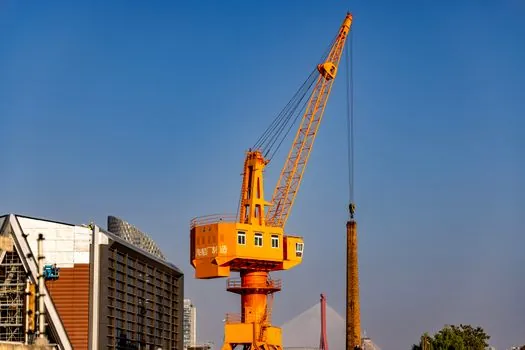
Luffing jib cranes fit high-rise urban construction when the building fills most of the lot and a horizontal jib would cross property boundaries or public space [S2][S4]. They are also suited to projects where neighbors will not grant swing or oversail agreements, overhead obstacles restrict jib movement, and several cranes must operate within one congested skyline [S4].
The short-radius configuration can also suit heavy picks close to the tower, including precast work and high-rise core construction. Published guidance identifies heavy picks at short and medium radii as a typical luffing-crane use case [S4].
This configuration is not automatically superior for every city project. If the crane must place material on long horizontal runs, operate beside unrestricted streets, or sustain a high sequence of repeated picks, the fixed horizontal jib may deliver better production. Site geometry must be mapped against the building footprint, access routes, neighboring structures, and planned material yards [S1][S2].
Where Hammerhead Cranes Remain the Better Fit
Hammerhead tower cranes suit open, spacious projects where maximum reach, fixed-jib consistency, and fast trolley movement are priorities [S1][S3]. Their established operating pattern supports standard building work, general construction, and projects with broad material laydown areas where a 360-degree slewing envelope is acceptable [S2][S3].
The horizontal jib provides consistent geometry at each trolley position, while long jib lengths can deliver substantial reach without changing jib angle [S3]. A flat-top variant removes the tall tower head above the jib, reducing top height and simplifying transport, assembly, and erection relative to a traditional hammerhead arrangement [S2][S3].
Hammerhead equipment is not the right choice simply because it is familiar. If the proposed swing circle overlaps a public road, an adjacent structure, railway infrastructure, overhead utilities, or an occupied neighboring lot, its apparent reach and speed may be unusable. A nominal load chart does not resolve boundary, access, and sequencing conflicts [S2].
Comparison by Cycle Speed, Reach, Space, and Cost
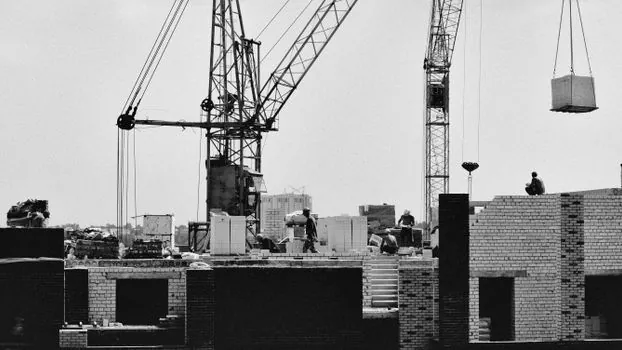
On space control, the luffing crane normally wins because its adjustable jib and shorter counter-jib reduce oversail and interference risk [S2][S4].
For long reach, the hammerhead configuration is generally more suitable because the load travels along a fixed horizontal jib without changing jib angle [S3]. The luffing crane is usually more appropriate for heavy picks at short or medium radius and for confined work areas, while its reach is controlled through the jib angle [S2][S4].
For cost, hammerhead cranes are generally the less expensive option for standard open-site work, whereas luffing cranes carry higher erection, rental, operation, and dismantling costs [S2][S4]. These are directional comparisons, not a machine-selection threshold. The winning configuration is the one that satisfies the required radius, load, hook height, boundary, lift sequence, and operating envelope without creating a slower or more expensive lift plan.
Limitations, Failure Modes, and Lift-Plan Checks
The principal luffing-crane failure mode is treating a compact footprint as proof of superior productivity. Adjusting jib angle changes hook height as well as radius on most tower luffers, forcing the operator to coordinate hoist and luff movements [S4]. The resulting cycle time can undermine a precast or floor-by-floor production schedule even when the crane clears neighboring buildings.
The principal hammerhead-crane failure mode is allowing the theoretical jib length to define the operating envelope. A fixed jib may oversail public streets or neighboring buildings, create conflicts with several cranes, and require permissions or zoning that are unavailable on the development program [S2][S4].
Selection should therefore begin with the heaviest and most frequent pick, map its required radius and hook height, and test it against the crane’s load chart and site plan [S2]. The plan must also cover the foundation, erection and dismantling space, power supply, operating radius, slew circle, material routes, multiple-crane separation, wind limits, and neighboring-property constraints. Jib length affects footprint coverage as well as reach, making the separate sizing rules for tower-crane jib length a relevant part of the site study.
Procurement Decision for Urban Tower-Crane Work

Choose a luffing jib tower crane when restricted air rights, adjacent buildings, a small site boundary, or multi-crane interference outweigh the value of fast trolley cycles. Choose a hammerhead crane when the site permits unrestricted slewing, long reach is valuable, and sustained pick rate is more important than minimizing oversail [S1][S2][S4].
For a defensible procurement decision, obtain 3 quantities from each proposed configuration: required radius, required hook height, and the maximum lift mass. Add the planned cycle count per shift, then compare that production requirement with the crane’s load chart and operating restrictions. The next trackable signals are the approval status for oversail and the site plan showing the actual slew or luffing envelope.