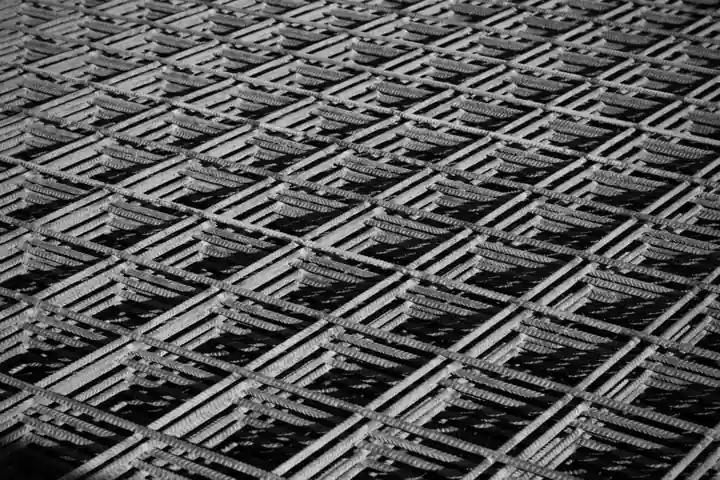
Welded steel mesh for residential jobs is split by weight class: light mesh uses 3-12 mm wire, heavy mesh uses 12 mm and above, per Wennian product data (2026-07) [S2]. Residential slab, foundation, and plastering applications are dominated by the light class, while retaining walls and ground beams fall into the heavy class.
Common residential sheet sizes cluster at 6.0 m × 2.4 m, 4.8 m × 2.4 m, 3.6 m × 2 m, and 2 m × 4 m, with roll-form mesh for floor slabs capped near 2 m length for transportability [S2]. The dominant residential wire materials are stainless steel rebar and galvanized steel rod, both with documented corrosion and rust resistance for embedded concrete use [S2].
Wire Diameter and Mesh Opening Ranges for Houses
Residential welded mesh wire diameter runs 3 mm to 12 mm in the light class, and 12 mm to 40 mm in the heavy class, per manufacturer spec sheets [S2]. Opening sizes for residential applications most often sit in the 50 mm to 250 mm range, with 100 mm, 200 mm, 300 mm, 400 mm, and 500 mm as the standard spacings offered off the shelf [S2].
For road, driveway, and outbuilding slabs, openings of 50 × 50 mm, 100 × 100 mm, 125 × 125 mm, and 150 × 150 mm are typical, paired with 3 mm, 4 mm, or 5 mm stainless wire [S2]. The 3 mm to 5 mm window is the practical residential plastering and masonry band, where thinner wire reduces weight on vertical wall assemblies [S2].
Residential Sheet Sizes, Coils, and Trench Mesh
Standard residential panel widths run 0.65 m to 3.8 m; lengths start at 0.85 m and step through 6 m, 9 m, and 12 m for transport and site handling [S2]. Floor-slab mesh is frequently supplied in roll form rather than sheets when wire diameter is small, because roll packaging trims handling cost on site [S2].
Trench mesh, long narrow sheets sized for strip footings and utility trenches, is a separate residential SKU and is widely used where standard rectangular sheets waste material [S2]. Insteel Industries, the largest U.S. producer of steel wire reinforcement for concrete construction, lists welded wire reinforcement, engineered structural mesh, and standard welded wire reinforcement among its residential and commercial product lines, with stock listed on NYSE under IIIN (2026-07) [S7].
Material Selection: Carbon, Galvanized, Stainless for Residential Exposures

Residential specification splits cleanly on corrosion exposure. Standard carbon-steel welded mesh, made from cold-rolled ribbed wire, is the default for interior slab and wall reinforcement encased in sound concrete cover [S6]. Hot-dipped galvanized welded mesh is the typical upgrade for perimeter beams, garage slabs, and any zone with intermittent moisture or chloride exposure, with a flat even surface and firm weld structure documented by Chinese exporters [S3].
Stainless steel welded wire mesh (304 and 316L grades) is the residential choice for coastal builds, basement walls with water exposure, and architectural soffits where surface appearance matters; the stainless steel welded wire mesh family offers strong anti-oxidative capacity, solid solder joints, high tensile strength, and resistance to rust when partially cut [S8]. For carbon steel welded mesh sold into structural roles, the difference between as-welded and galvanized condition drives the coating choice, and buyers should confirm the welding method (resistance spot welding is the residential default). For steel mesh used in slab-on-grade, a galvanized or epoxy-coated upgrade is standard where capillary moisture is expected.
Galvanized and Stainless Residential Welded Mesh: Spec Comparison
Galvanized welded mesh panels for residential construction use hot-dipped or electro-galvanized finishes on superior-quality steel wire, supplied as fencing panels, steel grating panels, and construction reinforcing panels with square or rectangular openings [S3]. Stainless steel welded mesh uses 304 or 316L alloys for higher corrosion resistance, with surface brightness and uniform weld integrity as the visible quality markers [S4].
The decision criteria between the three residential grades line up as: cost (carbon-steel lowest, galvanized mid, stainless highest), corrosion resistance (stainless 316L highest, stainless 304 next, hot-dip galvanized next, electro-gal galvanized lower, carbon-steel lowest if uncoated), weld integrity (factory resistance spot welding across all three), and residential application fit (carbon for encased slab, galvanized for perimeter and damp zones, stainless for exposed and coastal) [S3][S4][S8]. Mesh panel weight for residential welded grating runs from 3 lb/sq ft to 7 lb/sq ft in expanded carbon steel, which is heavier than typical residential plastering mesh but applies to driveway and walkway grating [S3].
Residential Welded Mesh vs. Tied Rebar: Productivity and Crack Control
Factory-welded residential mesh reduces on-site labour for slab and wall reinforcement, with manufacturer data showing up to 50% to 70% work saving compared to hand-tied rebar on road, building, bridge, and pipeline projects [S2]. The same source documents a 75% reduction in crack occurrence versus tied rebar mesh for road, building, bridge, airport runway, water dam foundation, and pipeline tunnel structures [S2]. These figures are not residential-specific, but the productivity and crack-control mechanism applies to house slabs, driveways, and outbuilding foundations built on the same principle.
For residential procurement, welded mesh also reduces the variability of bar spacing, which is the main crack-initiation factor in slab-on-grade pours. Buyers specifying welded mesh should still confirm cover, lap length, and chair spacing to the project engineer's notes, because mesh alone does not substitute for proper detailing. For alloy steel wire variants, residential demand is thin and most house-builders stay with carbon or stainless grades.
Residential Sourcing and Standards: B2B Supply Notes for 2026
Alibaba lists more than 15,906 reinforcing mesh wire SKUs from global suppliers as of 2026-07-26, including galvanized reinforcing wire mesh for plastering construction materials, with minimum order quantities that start at negotiable 10 ton lots for export buyers [S5]. ISO 9001-certified welded wire mesh manufacturers, such as Tatall, supply galvanized welded wire mesh, Dutch wire mesh, and fencing panels globally with 15+ years of documented export experience [S4]. Hebei Taide, established 2011, supplies cold-rolled ribbed steel wire mesh, hot-rolled ribbed steel mesh, coal-mine supporting mesh, bridge steel mesh, and construction steel mesh with negotiable 10-ton MOQ for export [S6].
For residential buyers in 2026, the practical spec pack to demand from any welded mesh supplier covers: wire diameter with tolerance, opening size, sheet or roll size, material grade (carbon / galvanized / 304 / 316L), welding method (resistance spot welding is the residential standard), surface finish, and compliance documents for the destination market. Insteel's investor disclosures confirm that welded wire reinforcement is sold primarily to manufacturers of concrete products, which is the same supply channel that serves residential tract builders and large home developers in North America [S7]. Track for 2026 also the relative pricing of galvanized versus stainless residential mesh, and any project-engineer shifts toward higher-grade ribbed wire in seismic residential zones.
Component reference pages worth checking: steel mesh, mesh belt conveyor, and alloy steel.
This topic is covered further in Stacker Crane Selection for Automotive Parts Logistics.