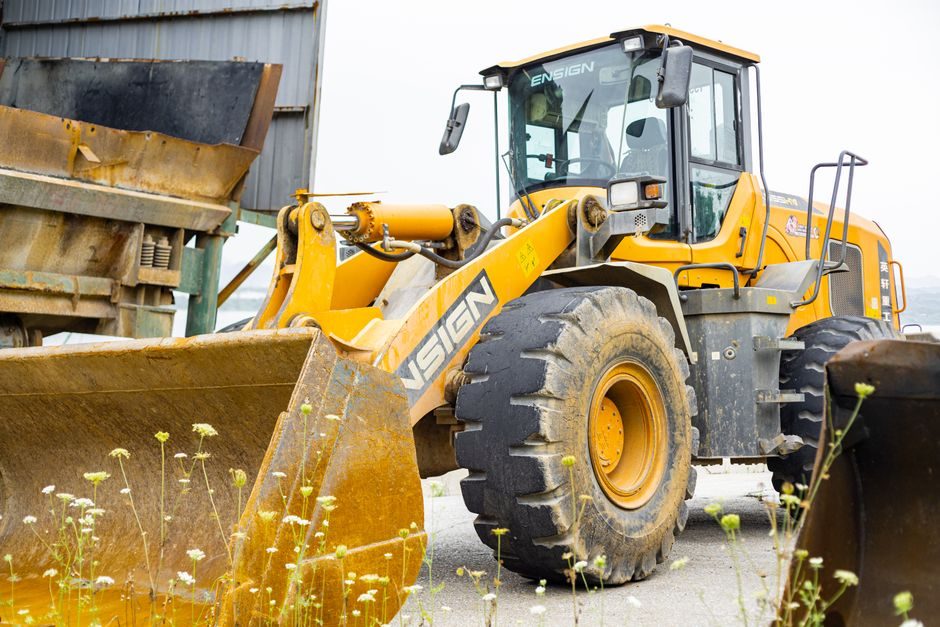
Wheel loader classes are anchored to operating weight: compact machines below 2 t, small machines 2-5 t, medium 5-10 t, and large machines from 10 t upward, with bucket volumes ranging from roughly 0.3 m³ on a 0.6 t mini to 3 m³ or more on a 5 t production loader [S1][S3].
Current Chinese supplier line-ups exposed on made-in-china and goldsupplier in 2026-07 span the full envelope — ZL06F (0.6 t) through ZL50F (5 t) under the Fumei catalogue, plus dedicated telescopic-arm models such as Wolf's WL816T and WL825T 2 t class [S1]. For a working definition of the machine itself, see the wheel loader reference.
Compact and Mini Wheel Loaders (under 2 t)
Compact wheel loaders typically weigh 0.6-1.6 t, run 25-50 hp engines, and carry 0.3-0.6 m³ buckets aimed at landscaping, nursery, livestock, and tight urban sites [S1]. Wolf's 2026-06 product video feed lists the 0.6 t Mini750 / Min750T, 1.0 t Min780H / Min780HT, and Mini780T in Russia variants, plus the 1.0 t WL100 — the entire sub-1.6 t bracket under a single Qingdao OEM [S1].
Tier-defining constraint: machine width and tipping load. Sub-1 t units like the Mini750 and Min750T are narrow enough to pass through standard 900 mm garden gates, but their rated operating load rarely exceeds 500 kg, so a 1 m³ bulk pile has to be worked in multiple passes [S1]. Buyers often cross-shop these against skid-steer loaders for the same envelope — skid-steers win on turning radius, mini wheel loaders win on ride comfort and travel speed.
Small Wheel Loaders (2-5 t) and Telescopic Variants
Small wheel loaders occupy the 2-5 t operating weight band, typically 80-160 hp, with 1.0-2.0 m³ buckets and 1.5-3.0 t tipping loads for general construction and aggregate handling [S3]. The 5 t LG953 platform, still listed on made-in-china, is a representative mid-range benchmark: cycle time under 20 s and total lift time under 9.5 s on a 3 m³-class bucket [S3].
A distinct sub-class is the telescopic wheel loader (also called a tele wheel loader), which substitutes a telescopic boom for the standard Z-bar linkage to add 1-2 m of dump height. Schäffer markets this format in the UK alongside its compact and conventional loader ranges for construction, landscaping, and municipal buyers, and Wolf's 1.6 t WL816T plus 2 t WL825T sit in the same niche from the Chinese supply side [S1]. Compared to a true telehandler, telescopic wheel loaders keep the articulated steering chassis and use the boom primarily for reach rather than full material-handling lift height.
Medium and Large Wheel Loaders (5-10 t and above)
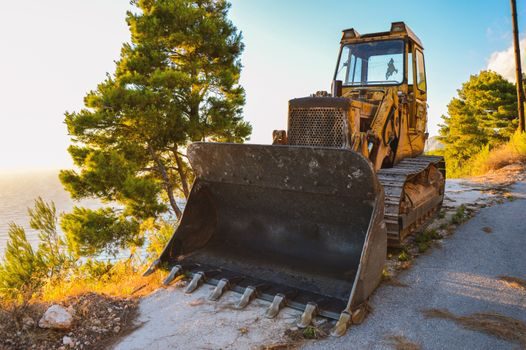
Medium wheel loaders (5-10 t) target quarry face, port bulk, and large infrastructure; large loaders above 10 t — the Caterpillar 980 class sits at roughly 30 t with bucket volumes in the 4-5 m³ range — are the domain of dedicated mining and aggregate fleets [S6]. At the upper end of the Chinese supply chain, ZL50F 5 t units mark the practical top of the small/medium band commonly exported; machines above 10 t are typically procured from global OEMs rather than the small Qingzhou and Weifang factory lines.
Selection gate at this size is no longer bucket volume but drivetrain: most 5 t+ loaders are four-wheel drive with torque-proportioning differentials, and articulated steering angles of ±35-40° remain standard across the class [S1]. Specifying this size also overlaps with backhoe loader procurement decisions, since 5-8 t backhoes compete for the same fleet slot when trenching work is mixed with bucket loading.
Criteria-Based Comparison of the Main Loader Types
Four decision criteria separate the main types: operating weight / bucket capacity, turning radius, lift height / reach, and unit cost band. [S1]
Compact (sub-2 t): bucket 0.3-0.6 m³, tightest turning radius, 2.5-3 m standard lift hinge pin, lowest unit cost. Best for landscaping, nurseries, small farms [S1]. Small (2-5 t): bucket 1.0-2.0 m³, articulated steering with wider radius, 3-3.5 m lift, mid-cost — the default for general construction [S3]. Telescopic wheel loader (1.6-3 t, extended boom): bucket 0.8-1.5 m³, 4-4.5 m dump height, premium over equivalent small loader [S1]. Medium and large (5 t and up): bucket 2-5 m³, longest wheelbase, 3.5-4.5 m standard lift, highest unit cost, dedicated to quarry / port / mining [S6].
Standards, Certification and Sourcing Reality
CE marking and ISO 9001 quality-system certification are the two certifications that Chinese wheel loader factories consistently display in 2026 supplier listings; Qingzhou Shiji Kaiwei, Weifang Fumei, Wolf-Qingdao Zongjin, and World Heavy Industry all reference international quality-system certification alongside CE on their public pages [S2][S5]. Tier-1 Chinese OEM and SDLG/LiuGong spare-parts supply chains — parts like the 19D1097 / 19D1127 right/left support, gear selector 3901000049, and front-axle reducer 8235020 — are openly quoted at unit prices from US $5.69 to US $100 per piece on made-in-china, indicating the active aftermarket for these classes [S4].
For buyer-side risk control, the practical gate on a wheel loader purchase is the matched combination of rated operating load, engine emission tier, and hydraulic cycle time. The LG953 spec sheet giving lift time under 9.5 s and full cycle under 20 s is the kind of measurable performance gate that translates across Chinese OEM catalogues and should be asked for in any RFQ [S3]. Comparable, related work on backhoe loader selection walks through the same gates for the backhoe-loader cousin class.
Application Gates and Failure Modes
Operating weight determines which site a loader can enter: sub-2 t units work finished surfaces, soft ground, and turf; 2-5 t units need a stable haul-road surface; above 5 t the machine is generally limited to dedicated quarry or stockpile yards [S1]. A common failure mode at the small end is bucket-hinge pin wear accelerated by side-dump loading — selecting a Z-bar linkage over a parallel lift is the usual mitigation, and is the default linkage on most 2 t+ Chinese OEM machines [S1].
Buyer checklist before RFQ: confirm rated operating load at full articulation, verify emission tier for the destination market, request measured cycle time on a 1 m³ standard aggregate load, and cross-check part numbers against the SDLG / LiuGong / XCMG aftermarket catalogues rather than only the OEM's own branded list [S3][S4]. Buyers sizing a wider fleet should also review the telehandler selection criteria, since reach height is the most common reason a wheel loader specification is upgraded to a telehandler or tele wheel loader.
Trackable signal: Chinese OEM video-channel updates from Wolf-Qingdao Zongjin (Chunyang Road factory, Qingdao) and Qingzhou Shiji Kaiwei are being refreshed on a roughly monthly cadence through 2026-06 and 2026-07, with the WL825 2 t conventional loader and WL825T telescopic variant both featured in operation videos dated within the last 30 days [S1].