
An order picker is a class of electric material-handling truck designed to lift an operator (and a platform or fork) to the second or third level of a rack so single items can be picked by hand, rather than pallet-load quantities moved on a forklift. Selection is driven by four hard gates: maximum lift height, minimum aisle width, rated load on the platform/fork, and duty cycle / power source [S1].
For warehouses under 3 m of storage height, a low-level electric order picker (sometimes called a "stock picker" or "cherry picker") typically delivers the lowest cost-per-pick. For racking between 4 m and 6 m, mid-level platform trucks with 24 V or 48 V DC drive dominate. For very narrow aisle (VNA) and rack heights above 6 m, wire- or rail-guided "man-up" or "man-down" high-level units are the standard, with the operator rising with the load. Chinese OEM listings on Made-in-China.com show entry-level battery-operated aerial order pickers (TH-series) starting at US$3,000 per piece MOQ from Qingdao Olift Equipment Co., Ltd. (2026-05 listing, [S2]).
Order Picker Categories and Where Each Fits
Low-level / floor order pickers travel at ground level and use a small elevating platform (typically 0-2 m of lift) to reach the first rack level; they are suited to pallet breakdown zones, picking 50-200 lines per hour in 2-3 m storage [S1]. Mid-level platform order pickers carry the operator up 4-6 m on an elevating chassis, the dominant SKU in European 3PL and pharma distribution centres [S1]. High-level VNA man-up / man-down order pickers guide in 2.5-3.0 m aisles and reach 6-12 m lift, used where pick-face density and rack height both need to be maximised [S1].
For typical 1.0 t / 1.2 t rated capacity on the platform or fork and 9-12 m lift, expect a duty rating of 4-6 hours per battery shift, with 24 V / 280-465 Ah traction packs on smaller units and 48 V on higher-capacity machines. The "man-up" variant puts the operator at the pick face with the platform, halving stop-and-go cycles; the "man-down" variant is cheaper, faster in transit, and chosen when pick density per pick-face is low.
Selection Criteria: Lift, Aisle, Load, Power
Four gates, in order, decide model: (1) Maximum pick height — measure top-of-product, add 100-150 mm clearance to the operator's reach. (2) Aisle width — VNA man-up units run in aisles of 2.5-3.0 m; mid-level units need 3.2-3.6 m; floor pickers run alongside standard pedestrian aisles. (3) Rated load — typical platform picks are 100-250 kg; pallet-on-fork picks reach 1.0-1.5 t. (4) Power source — lead-acid traction is still the budget default at the 24-48 V level; lithium-ion is increasingly specified for opportunity charging and indoor cold-store use where ventilation of hydrogen off-gassing must be eliminated. According to Toyota Material Handling Europe's premium-truck guidance, these are the four specification pillars on which the OEM sizes each proposal [S1].
Across these four gates, the four main options line up as follows: (a) Floor picker — lowest cost, <3 m lift, no rack guidance needed, pedestrian-aisle friendly, but the operator is constantly stepping on/off; (b) Mid-level platform picker — best $/lift up to 6 m, fits 3.2-3.6 m aisles, accepts standard VNA guidance rails; (c) High-level VNA man-up — highest picks/hour per operator at 6-12 m, requires wire/rail guidance and a racking partner that can guarantee plumb and level; (d) High-level VNA man-down — same lift envelope as (c), but higher throughput in transit and lower unit cost, at the price of a 1-2 second pick-time penalty per stop. The Chinese TH-series battery-operated aerial order picker is a representative low- to mid-level unit in this matrix [S2].
Power, Battery and Charging Architecture
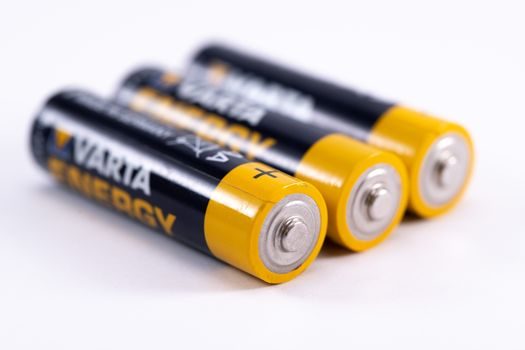
Most electric order pickers below 1.0 t rated capacity use 24 V DC traction, while 1.0-2.5 t units step up to 48 V. Lead-acid traction batteries in the 280-465 Ah range remain the budget baseline, with 8-hour shift life and a watering-and-equalisation maintenance overhead. Lithium-ion (LFP) traction packs are now offered as a factory option on most premium SKUs; the operational case is opportunity charging (15-30 minute top-ups during breaks) and zero H2 off-gassing, which simplifies cold-store ventilation. [S1]
Charging hardware is generally 3-phase 380-480 V input on-board or wall-box chargers, sized at 30-50 A for an overnight cycle. For multi-shift operations, the typical spec is a side-extraction or roller-bed battery exchange rather than opportunity charging, because cumulative cycle wear on a single Li-ion pack is the cost gate, not the charger. For mid-platform units in a 24 V system, a 24 V / 210 Ah Li-ion swap pack typically replaces a 24 V / 465 Ah lead-acid pack at roughly 1/3 the mass and 2-3x the cycle life, at a higher capex. The TH-series entry-level aerial order picker on Made-in-China.com ships battery-powered as standard [S2].
Who an Order Picker Is — and Is Not — For
An order picker is for: distribution centres and 3PL warehouses that run piece-pick or case-pick into a tote; pharmaceutical and electronics plants that need selective rack access; cold-store and high-bay operations that want to combine elevated pick with very narrow aisles. The mid- and high-level platform unit is also the workhorse for e-commerce fulfilment where orders are picked by SKU rather than by pallet. [S2]
An order picker is not for: full-pallet moves (use a reach truck selection guide or counterbalance forklift), bulk warehouse receiving at ground level (use a pallet jack), or any zone where the operator is not certified to ride on an elevated platform. High-level VNA man-up units are also not a fit for general warehouses without wire or rail guidance installed in the floor, and a racking partner that can guarantee 3.0 m / 12 m vertical tolerances. In operations that mix bulk pallet moves with piece-pick, the typical fleet is pallet jack + reach truck + low-level order picker, not a high-level VNA man-up alone.
Safety, Standards and Operator Training Gates
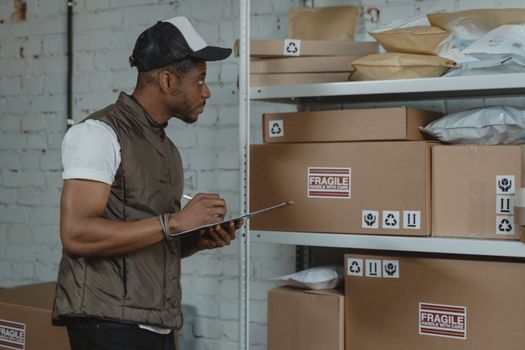
Order pickers in the EU fall under EN ISO 3691-1 (industrial truck safety, with EN ISO 3691-2 / -6 amendments for the operator-platform variants) and the Machinery Directive 2006/42/EC. Battery electric units in flammability-rated zones must additionally satisfy the EN 1175 / EN 16307 family on electrical requirements. For North American deployment, ANSI/ITSDF B56.1 is the baseline, and CSA B335 is the Canadian twin. Operator riding controls (mast interlock, platform-gate interlock, anti-crush devices on the overhead guard) are mandatory on units above a 1.8 m lift, regardless of region. [S3]
For the racking itself, EN 15620 / EN 15629 govern the VNA aisle tolerances that the picker assumes; if the racking does not meet them, even a correctly specified picker will rack-rattle, increasing tip risk and accelerating mast wear. A common field defect is order pickers rated for 1.2 t being overloaded to 1.5 t during peak season; the mast deflection under overload is roughly linear, but the tip-over margin on a man-up unit collapses quickly above 110% of rated load. In a related class of equipment, the same mast-rigidity logic applies to aerial work platform selection, where reach and capacity interact through the same tipping-moment equation.
Common Failure Modes and Sourcing Signals
Three failure modes dominate warranty data on mid- and high-level order pickers: (1) mast-rail wear, accelerated by racking out of plumb; (2) drive-motor controller faults from chronic opportunity-charge cycles that exceed the regen-braking design envelope; (3) platform-gate interlock switches failing because operators step around, not through, the gate. The first is solved at install time with a racking survey, not at truck delivery. The second is solved by matching charger profile to controller firmware, which is an OEM-side spec gate, not a buyer decision. The third is solved by training and gate-latching discipline. [S4]
Sourcing signals to watch on the public record: Qingdao Olift Equipment Co., Ltd. lists a battery-operated aerial order picker in the TH-series on Made-in-China.com at US$3,000 / piece MOQ with steel structural materials and electromagnetic crane type, packaged in wooden box (2026-05 listing, [S2]). Hangzhou Linlift Machinery Co., Ltd. appears on the same platform as a Chinese lift-table and mini-winch supplier, with a 360 Mansion office on Hangxing Road, Hangzhou, exporting to North America among other markets (2026-07 listing, [S5]). The OEM premium-truck guidance on Toyota Material Handling Europe treats lift height, aisle width, load and power as the four size-defining pillars [S1].
Next node: when the warehouse racking is already in service and the aisles cannot be rebuilt, the realistic selection window shrinks to mid-level platform units in 3.2-3.6 m aisles; when the racking is being designed in parallel, the VNA man-up option opens up and typically halves the pick-time per line. Trackable signal 1 — confirm racking tolerance class per EN 15620 before signing the picker PO. Trackable signal 2 — match the battery chemistry to the charging pattern (lead-acid for one-shift opportunity-charge, Li-ion for multi-shift opportunity-charge) so the 5-year battery TCO is a known number, not a surprise.
For component-level specifications, see order picker, linear guide, and crossed roller guide.