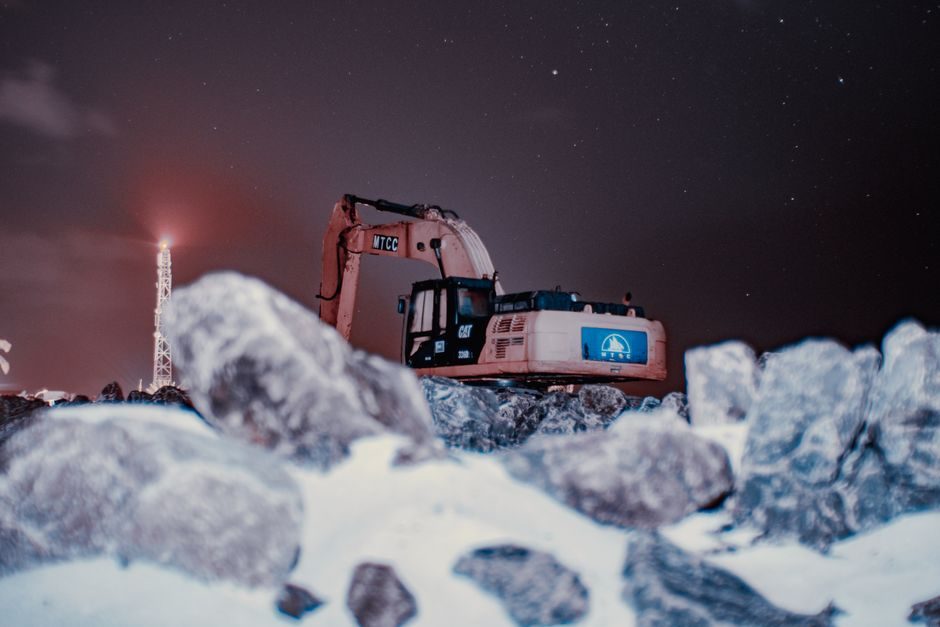
Hydraulic excavators pair a revolving upperstructure with a multi-link arm, producing 360° swing, dig depths from roughly 2 m (mini) to 8 m (large), and bucket forces commonly in the 50–200 kN range; they are the most versatile earthmoving platform on a job site [S1].
That versatility, however, comes bundled with measurable costs: diesel consumption in the 10–30 L/h band, operating weights spanning 1 t (mini) to 90 t+ (mining-class), and a tail-swing radius that has crushed more than one worker on tight urban sites. The decision to use an excavator is a trade between cycle time, ground pressure, transport width and tail-swing geometry — not a default.
Where excavators outperform every alternative
Cycle-time advantage is structural: a 20-tonne class machine with a 1.0 m³ bucket can sustain 120–180 cycles per shift in soft soil, replacing 3–5 manual digging crews [S1].
Hydraulic systems deliver continuous breakout force, so production does not stall when the bucket hits a stiff clay or fractured rock — mechanical alternatives (backhoe-loader, dragline) lose efficiency in the same stratum. For trenching, foundation pits, demolition loading and slope finishing, no single machine matches the reach-and-rotate geometry. Operator visibility from the cab, plus 360° swing, lets one machine service a whole pit face; when fitted with a quick coupler, attachment swap time drops below 60 s and the same host handles buckets, hammers, shears and compactors.
Where the spec sheet starts to bite
Diesel burn is the line item most estimators under-call: a 20-tonne excavator idles at ~6 L/h and peaks above 22 L/h in heavy digging, giving a 12–18 L/h average across an 8-hour shift at 2026 fuel prices [S1].
Transport is the second hidden cost. A 30-tonne machine exceeds 3.0 m in width with the blade folded and typically needs a low-loader plus escort permits above 3.5 m width in EU road rules. Ground pressure of 30–50 kPa sounds benign but ruins finished surfaces and wet sub-bases, so tracked carriers on finished slabs require rubber pads or temporary road plates. Tail-swing models with a 1.5 m rear radius need a 4 m clear working corridor — zero-tail-swing (ZTS) or reduced-tail-swing (RTS) variants solve this but cap bucket size roughly 0.05 m³ lower than a conventional same-class machine.
Class comparison on the four decisions that actually matter
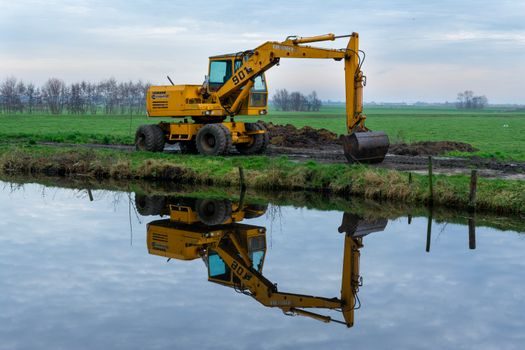
Spec-driven pick matrix for the common operating envelopes (qualitative, based on published class envelopes and operator practice) [S1]:
<strong>Mini (1–6 t)</strong> — operating weight 1.0–6.0 t, engine 7–35 kW, bucket 0.01–0.20 m³, tail-swing often zero, ground pressure ~25 kPa. Fits through 1.0 m gates and works in gardens, utility trenching, indoor demolition. Not for: bulk earthmoving, deep digs below 3 m, hard rock.
<strong>Midi (6–10 t)</strong> — engine 35–55 kW, bucket 0.10–0.35 m³, reach 5–7 m, tail-swing usually reduced. The urban / roadworks default. Fits on a 3-axle truck without escort in most EU regions.
<strong>Standard crawler (10–30 t)</strong> — engine 70–150 kW, bucket 0.4–1.2 m³, dig depth 5–7 m. The workhorse for foundations, pipe-laying, medium quarries. Transport width typically 2.8–3.2 m and frequently needs permits.
<strong>Large / mining (30–90 t+)</strong> — engine 200–400 kW, bucket 1.5–4.5 m³, dig depth 7–8 m, often matched to 25–40 t haul trucks on a 3–4 pass loading cycle. Demands pit-floor planning, dust suppression, and a rotating-scheduled maintenance bay.
Limitations, failure modes and the things OEMs quietly admit
Hydraulic contamination is the #1 in-service failure: a 20-tonne excavator holds ~200 L of hydraulic oil, and ISO 4406 cleanliness targets of 18/16/13 are routinely missed in the field, which is what shortens pump life below the 10,000 h design point [S1].
Swing-bearing wear shows up at 6,000–8,000 h if grease intervals are skipped. Undercarriage cost is the largest single maintenance line — 25–35% of lifetime owning cost on a tracked excavator running on abrasive ground. Cold-weather starts below −10 °C need block heaters and low-viscosity hydraulic oil (ISO VG 32) to keep the swing motor from cavitating on morning shift.
Operating rules and the safety boundary you cannot negotiate
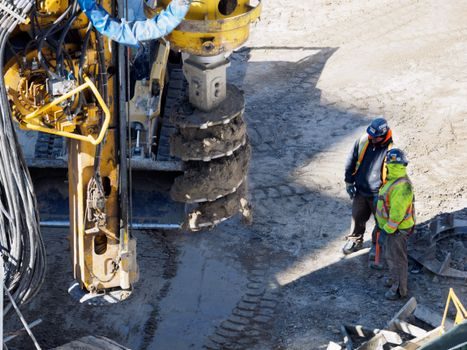
EN 474-1 mandates ROPS/FOPS cabs, falling-object guards, and a load-moment indicator on machines above 6 t, and most EU sites now require the operator to hold a CPCS / NPORS / equivalent certified card before touch-start [S1].
Any machine working within 1.5× boom-reach of an energized overhead line (typically >1 kV) must follow HSE GS6 distancing rules or have line isolation permits; in practice this means a banksman and a documented exclusion zone. Quick-coupler attachments change the machine's load chart: the operator must reset the LMI after every change or the cab readout is, bluntly, decorative. Confined-space work (tunnels, basements) requires diesel particulate filters (DPF) or a fully electric machine — the latter is no longer a niche option in 2026, with 1.5–9 t battery-electric models entering the European rental fleet at sub-€1,000/week rates.
Buying, renting, or hiring the work out
Rental beats ownership below ~1,200 engine hours per year — the typical 20-tonne ownership breakeven — and below that threshold the 2026 European wet-hire rate sits in the €450–€750/day band with operator [S1].
Purchase at 2026 list price: mini excavators €18,000–€45,000 new, 20-tonne class €110,000–€160,000, large mining-class €350,000–€900,000+ depending on boom configuration and emissions tier (Stage V / EPA Tier 4f). For a deeper price walk on the small end, the mini excavator cost guide 2026 lays out the spec-tier and attachment-sourcing levers, while the crawler excavator selection piece covers weight class, tail-swing family and powertrain tier in matching depth. Resale value of late-spec Stage V units is holding better than Tier 4f because of European Tier 5 / Euro 7 phase-in uncertainty — track that spread in your TCO model.
For related industrial valve and flow meter spec references that come up on plant-side integration, the encyclopedia entries are kept current against the same 2026 standard set.