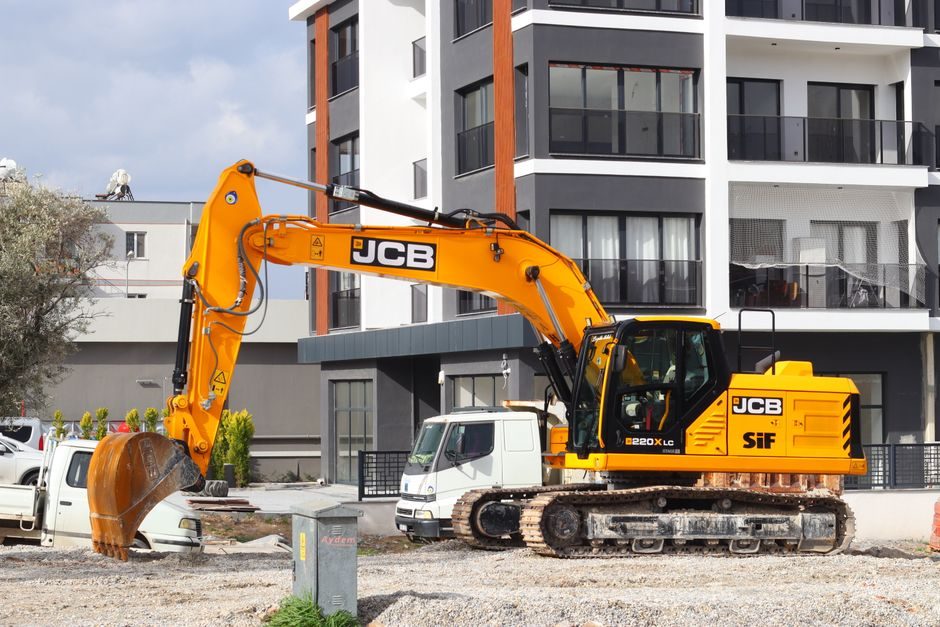
A wheel loader is sized first by bucket struck capacity, second by engine net power, and third by operating weight; get the bucket wrong and the engine and chassis numbers stop being useful. Chinese OEM catalogs active in 2026-07 list struck bucket capacities from 0.5 m³ on 2.5 t compact machines up to 6.0 m³ on 30 t production-class rigs, with ISO 14397 net engine power ranging 30–300 kW across the same band [S3][S4].
Selection is a chainage problem, not a horsepower contest: the bucket must clear one truck in 3–5 passes, the engine must hold hydraulic breakout above 80 kN at full lift, and the operating weight must stay inside the quarry or yard's ground-bearing limit. Shandong-cluster suppliers such as Weihai Titan, Qingdao Zongjin and World Heavy Industry all frame their export lines around that same three-axis logic [S4][S3][S5].
Bucket Capacity and Material Density Coupling
Bucket struck volume is the primary sizing handle, and the rule of thumb most Chinese OEM datasheets now publish is 0.9–1.1 m³ of struck bucket per 50 kW of net engine power for a general-purpose (GP) bucket in bank-density material [S3][S5]. For a 162 kW class machine — the most-shipped 3-tonne bracket in 2026 — that lands at 2.7–3.6 m³ struck, with rehandling and light-material buckets going up to 4.0 m³ and rock buckets holding to 2.0 m³.
Material density shifts the math hard: a 3.0 m³ GP bucket in quarried granite (~1.6 t/m³ bank) moves roughly 4.8 t per pass, while the same bucket in coal stockpiles (~0.8 t/m³) moves about 2.4 t per pass. Standard configuration in the Qingdao Zongjin 2026 Wolf catalog tags 0.5–6.0 m³ buckets against 30–300 kW engines, with the 3 m³ / 162 kW pair treated as the volume sweet spot for African and South American aggregate yards [S3].
Engine Power, Breakout Force and Hydraulic Class
Hydraulic breakout force at full lift must clear 80–110 kN for a 3-tonne GP-class loader to load a 25–30 t haul truck in four passes without stalling; Qingdao Aulander's 2026 export range lists breakout in the 95–180 kN window across 1.0–3.0 m³ buckets, paired with Weichai and Cummins engines from 55–162 kW [S2][S4]. Underneath that, the standard engine tier is Stage V (EU) or EPA Tier 4 Final for North American bound units, and China-IV / non-road National IV for domestic builds, with mechanical injection still common below 75 kW and common-rail above 110 kW [S2][S3].
Torque backup matters as much as peak power: a wheel loader cycles between travel and lift, so engines in the 162 kW class are normally rated for 25–30% torque rise at 1,400–1,600 rpm. Buyers should refuse any datasheet that publishes only peak kW without an rpm point and a torque-rise figure, because two machines on identical peak power can differ by 15% in cycle time on the same face [S3][S5].
Operating Weight, Static Tip and Truck Match
Operating weight sets the static tipping load, which in turn sets the safe bucket size when the loader is articulated at full turn. The Shandong-export rule of thumb is a 2:1 tipping-load-to-payload ratio: a 10 t operating-weight loader with a 5 t static tip can carry a 2.5 t bucket payload without spin risk on level ground [S1][S2]. Going above that line is the single most common cause of front-axle failures in field reports, because operators routinely push to 2.3:1 to gain cycle rate.
Truck match is the final layer: a 30 t haul truck wants a 4.5–6.0 m³ loader to clear in 4 passes, while a 20 t articulated dump truck pairs to a 3.0 m³ machine. The 2026 Wolf catalog from Qingdao Zongjin explicitly targets 20–40 t truck fleets with 2.7–4.5 m³ buckets, and the Weihai Titan export line targets 15–25 t truck fleets with 1.6–2.7 m³ buckets [S3][S4]. For a more general earthmoving fleet context, see the wheel loader encyclopedia entry for class-by-class payload mapping.
Compact, Mid and Production Class Brackets
Three brackets dominate the 2026 Shandong export list: compact (0.5–1.0 m³, 30–55 kW, 2.5–5 t operating weight), mid (1.6–3.0 m³, 75–162 kW, 6–12 t), and production (4.5–6.0 m³, 200–300 kW, 18–30 t) [S1][S3][S4].
A useful side comparison: Qingdao Zongjin's compact line runs a 36 kW engine with a 0.6 m³ bucket, Weihai Titan's mid line runs a 162 kW engine with a 3.0 m³ bucket, and World Heavy Industry's production line runs a 250 kW engine with a 5.0 m³ bucket [S3][S4][S5].
Who the Wheel Loader Fits — and Who It Does Not
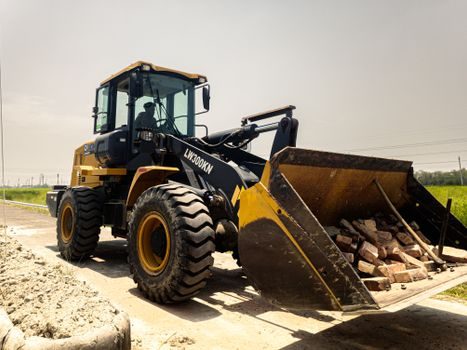
Wheel loaders are built for face-to-truck cycle work on hard, level ground with high bucket-fill density; they outperform backhoe loader setups on stockpile loadout but underperform excavators on digging, and they are the wrong tool for soft underfoot conditions where a skid-steer loader on tracks will beat them. Mid-2026 supplier data shows wheel loaders ordered for aggregate quarries, coal yards, port bulk handling, and road-base yards, and explicitly not for trenching, indoor demolition, or muddy forestry work [S2][S4][S5].
A second non-fit is small-volume intermittent work: a wheel loader needs roughly 1,500 engine hours per year to justify its capital cost over a contract hire, and below that line a compact rental unit or a telehandler will return more tonnes per dollar. The Qingdao Aulander 2026 catalog frames its sub-75 kW line as ag-and-light-quarry use only, not as a primary production tool [S2].
Limitations, Failure Modes and Sourcing Risk
Three failure modes show up in 2026 supplier field reports: front-axle bearing wear from overloading past 2.3:1 tipping ratio, hydraulic-hose chafe from underspec routing on machines shipped without ROPS/FOPS guarding, and engine derating on Stage V units running high-sulphur fuel in Africa and the Middle East [S2][S3]. Each one is a sizing or specification error at order time, not a maintenance issue: a buyer who specs a smaller bucket and a heavier axle pays 3–5% more and saves the bearing-replacement cycle.
On sourcing, three signals to track through 2026-Q3: the proportion of Tier 4 Final / Stage V units in the Qingdao Zongjin export mix [S3], the lead-time drift at Weihai Titan (currently 15 workdays peak/off-season per the 2026-07 listing) [S3], and the price gap between Weichai-powered and Cummins-powered equivalents in the mid bracket [S2][S5]. The Shandong excavator market — adjacent to wheel loaders in supplier mix — is tracked separately in the Shandong excavator supplier map for 2026. For sites that sit between wheel-loader duty and forklift duty, the rough terrain forklift sizing and selection guide is a useful cross-read.
Trackable next signals through 2026-Q3: any shift in Qingdao Zongjin's standard bucket offering above 5.0 m³ in the Wolf catalog, any move by Weihai Titan to extend its mid-bracket lead time past 15 workdays, and any Tier 4 Final price premium change on the World Heavy Industry production line [S3][S4][S5].