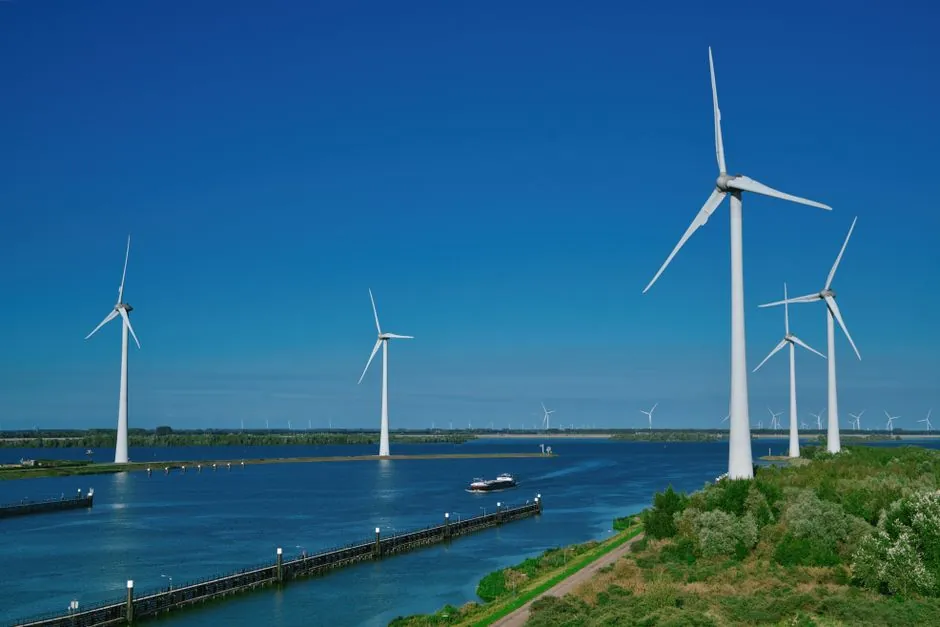
A modern utility-scale wind turbine blade priced between USD 150,000 and USD 250,000 per piece for a 60 m, ~20 t onshore unit [S7], with the global blade market estimated at USD 103.5 billion in 2025 and projected to grow at an 8.4% CAGR through 2035 [S8].
Blades account for roughly 20% of total turbine cost, and the per-kilogram cost of finished blade hardware sits near the low end of structural composites because of the vacuum infusion process used to make them [S1]. For cost engineers, the relevant decision is not the headline number but the split between raw composite materials, infused and finished part labor, the mold and capital depreciation pool, and the logistics tail that grows nonlinearly with blade length.
Material Cost Drivers: Glass, Carbon, Resin, Core
Composite materials (fiberglass, resin systems, coatings, and balsa or PET foam core) make up 35–40% of blade cost, the largest single line on the bill of materials [S5]. Standard utility blades use E-glass reinforcement with epoxy or polyester resin; once blade length passes ~70 m, carbon fiber spar caps and shear webs enter the laminate to control tip deflection and tower clearance, which is the single largest material-driven cost step change [S4].
Carbon fiber carries a price premium roughly an order of magnitude over E-glass per kilogram, so even partial substitution (typically the spar cap, sometimes the leading-edge root) lifts material cost per blade well above the 35–40% baseline. The tradeoff is mass: substituting carbon in the spar cap of a 90+ m blade can cut blade weight by 10–20% versus an all-glass design, reducing tower and foundation loads downstream [S4]. Resin, core, adhesive, and gelcoat remain secondary lines but are sensitive to crude-oil derivatives, so they swing with petrochemical cycles rather than with wind deployment.
Labor, Overhead, and Cycle Time
Labor and manufacturing overhead account for 25–30% of blade cost, with direct labor, indirect labor, consumables, and scrap labor modelled separately in design-driven cost models [S3][S5]. The NLR/NREL blade cost model (Bortolotti et al., 2019) breaks the workforce into direct layup/infusion crews, indirect support, consumables handling, and rework, and ties labor hours to blade length on a per-meter basis for 30–100 m blades [S2].
Cycle time scales with blade volume and with the number of root and trailing-edge operations, not just length: a 100 m SNL-100-03 blade carries a fundamentally different labor profile than a 33 m WindPACT blade, even after normalising per metre. The 2019 NLR/NREL reference explicitly computes costs for the 33 m WindPACT, 63 m IEA Wind Task 37 land-based reference, and 100 m SNL-100-03 designs so engineers can bracket man-hours at their own blade length [S2]. For plants running 500–2,000 MW per year of finished turbine output, raw materials dominate the cost stack at 70–80% of total plant cost, with utilities at 10–15% of operating expense and gross margin sitting at 25–35% [S6].
Tooling, Capital, and Vacuum Infusion Infrastructure

Tooling, molds, and equipment depreciation sit alongside materials and labor as a major cost bucket, because each blade family needs its own root and shell tooling [S5]. The dominant process is vacuum-assisted resin transfer molding (VARTM), the same baseline assumed in the NLR/NREL model, which fixes the major capital line items: layup molds, root-preform fixtures, infusion consumables, heated curing halls, and finishing stations [S2].
For a 90+ m blade, a single root-and-shell tooling set runs into the low millions of USD, and amortisation is sensitive to annual blade count. Doubling the model price of every component on the bill of materials roughly doubles the model cost of energy, and tooling cost is roughly linear in blade length, so bigger blades push both capex per unit and capex amortisation per blade up at the same time [S2]. Factory buildings, cranes, and climate-controlled cure halls are typically depreciated over decades, but the mold itself is usually amortised over the production run of a single blade design, which is the line item most exposed to platform changes.
Cost Comparison: Glass vs Hybrid vs Full Carbon
Three blade architectures dominate the cost conversation: all-glass (typical ≤60 m onshore), glass shell with carbon spar cap (the workhorse for 70–90 m onshore and most offshore), and full-carbon or carbon-rich laminates (reserved for the longest 100+ m offshore prototypes and demonstration units) [S4].
On the four decision criteria that matter to a procurement engineer, the picture is consistent: all-glass blades anchor material cost at the 35–40% line and keep $/kg low, but limit length because tip deflection and tower clearance become binding; glass + carbon spar cap hybrid lifts material cost noticeably while keeping blade mass in check, which is why it dominates 70–90 m designs; full-carbon or carbon-heavy laminates push material cost well above 40% but enable the 100+ m class where mass reduction pays back across the tower and foundation [S4][S5]. For plants running 500–2,000 MW/year, raw materials dominate the cost stack at 70–80% of total plant cost, so the hybrid step is where the procurement trade is actually made [S6].
Transport, Installation, and Hidden TCO
Transport, installation, and downtime losses sit outside the per-blade factory gate price but routinely add a double-digit-percentage surcharge to total installed cost, especially past 70 m blade length [S5]. Specialized trailers, escort vehicles, route surveys, and crane-days scale with blade mass and oversize-load handling, and offshore installation adds marine spread and weather-window costs on top.
Total cost of ownership therefore splits into purchase price, transport, installation, and an operations bucket covering scheduled maintenance, leading-edge erosion repair, and downtime losses. A 60 m onshore blade at USD 150,000–250,000 per piece [S7] can carry a lifetime operations cost that approaches the original purchase price if leading-edge protection is neglected, which is why erosion-resistant coatings and condition-based maintenance are part of the cost conversation from day one rather than an aftermarket add-on [S5]. The wider turbine-level economics matter too: a complete utility-scale turbine is dominated by the turbine itself, with blades around 20% of total turbine cost and the rest in the tower, nacelle, drivetrain, and grid-side balance of plant [S1].
Signals to Track: Recycling, Carbon Fiber, and Plant Scale
Trackable signals for the next planning cycle: the global blade market growth rate of 8.4% CAGR through 2035 [S8]; the maturity curve of pyrolysis and solvolysis recycling routes, which are still flagged as developmental in 2024 industry analysis and which could eventually credit end-of-life value back into the cost model [S4]; and the adoption pace of Industry 4.0 digital process control on blade lines, which directly targets the 25–30% labor and overhead bucket by cutting cycle time and scrap.
For the relevant spec sheets and selection criteria, see additive manufacturing material, turbine flowmeter, and pressure transmitter.