
AI-assisted defect detection on wind turbine blades has crossed 90% classification accuracy in controlled experimental work, with multimodal sensor setups outperforming single-sensor baselines by roughly 20% [S3]. Additive manufacturing of blade tooling and small components reached a USD 1.2 billion global market in 2024, on a published trajectory toward USD 3.8 billion by 2033 [S3].
The underlying blade market these Industry 4.0 methods serve was valued at USD 32.68 billion in 2025 and is projected to reach USD 210.99 billion by 2035 at a 20.5% CAGR, while the adjacent advanced blade-material segment grows from USD 10.75 billion in 2025 to USD 19.61 billion by 2035 at a 6.2% CAGR [S2][S4]. Cumulative global wind capacity reached 1,136 GW at the end of 2024 after 117 GW of new installations that year, a fleet size that any smart-inspection or digital-twin framework must ultimately address [S3].
What Industry 4.0 actually means inside a blade plant
The Industry 4.0 framing collapses four concrete workflows into one digital thread: AI-based inspection of composite laminates, additive manufacturing of molds and small structural parts, machine-learning quality prediction, and digital-twin simulation of the blade production line [S3][S1]. Each layer is grounded in the same data spine, which is why researchers describe the integration as a single Industry 4.0 stack rather than four separate tools [S3].
Hand lay-up and vacuum resin infusion remain the dominant conventional processes, and the value proposition of AM is specifically the up to 50% reduction in mold manufacturing cost it enables, not direct replacement of the lay-up step [S3]. For process engineers retooling a facility, the practical reading is that AM slots in beside the existing infusion line as the tooling-side enabler, while AI-assisted inspection slots in as the quality-side enabler.
Additive manufacturing: real numbers and the 12 m ceiling
AM is currently used for blade tooling, fixtures, and small composite components, with the published review explicitly noting scalability constraints for blades beyond 12 m [S3]. That is a hard limit on the 38–50 m and more-than-50 m commercial blade classes tracked in the market segmentation [S2], so AM in this segment is a tooling and repair-aid technology, not a primary blade-printing technology, on the 2026 evidence base.
Recycled thermoplastic polymers are emerging as AM feedstocks for blade tooling, which the review highlights as a sustainability lever because thermoplastic processing consumes less energy and produces less waste than thermoset lay-up [S3]. For buyers evaluating a new tooling line, the decision criterion is part geometry, mold lead time, and whether a recycled-thermoplastic feedstock supply is qualified, rather than raw print speed.
AI inspection: where the accuracy claims actually hold
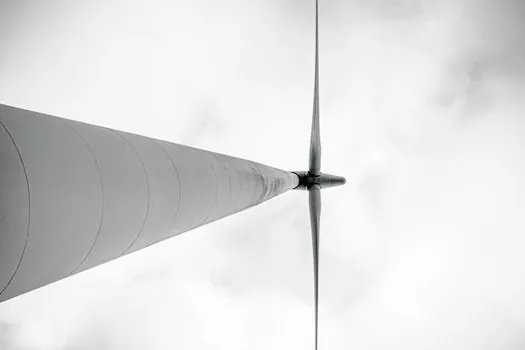
Published defect-detection classification accuracy above 90% is from controlled laboratory conditions, with multimodal sensing architectures adding roughly 20 percentage points over single-sensor systems in the same review [S3]. The same review flags the absence of standardized datasets as a current limitation, which means cross-paper accuracy comparisons should be treated as indicative rather than absolute [S3].
On the operations side, the smart-inspection literature ties the same Industry 4.0 stack to the harsh-environment failure modes that drive real O&M cost: ice accumulation, low-temperature embrittlement, leading-edge erosion, and lightning damage are all framed as defect classes that an AI-trained multimodal rig should be able to flag before they become unplanned downtime events [S1]. Process engineers planning a retro-fit should expect the inspection cell to ingest acoustic emission, thermography, and vibration channels in parallel, not a single camera.
Selection criteria: AM line vs AI inspection cell vs digital twin
Three Industry 4.0 investments dominate 2026 capex discussions, and they do not compete for the same budget line. AM tooling pays back when mold-changeover frequency is high and part size is under the 12 m scalability ceiling; AI inspection pays back when blade count per site is in the thousands, as in the Canadian example of 19,227 blades requiring regular inspection; and digital-twin simulation pays back when process-engineering changes are frequent and expensive to validate on physical coupons [S3][S1].
The same Canadian province-level data is the cleanest sizing input: 12,239 MW of installed capacity spread across 6,409 turbines means roughly 19,227 blades in one country alone, three blades per machine at a 1:1 ratio [S1]. A single AI inspection cell scaled across that fleet, even at partial coverage, is the kind of throughput figure that justifies the capex line, where a single AM cell for a 10 m mold would not.
Materials and end-of-life: where Industry 4.0 meets the recycling problem

Wind turbine service life is 20–25 years, and the cumulative composite waste stream from blades is forecast to grow sharply as first-generation fleets reach retirement in this decade [S7]. AI is being applied to the recycling side as well, with computer-vision sortation and process optimization framed as the binding constraint on closing the composite loop [S5].
Advanced materials dominating new builds are carbon fiber, glass fiber composites, epoxy resins, thermoplastic composites, and bamboo composites, with horizontal-axis blades and the more-than-50 m offshore size class driving the highest material demand [S4]. For an Industry 4.0 retrofit, the practical question is whether the data spine can carry a part's material genealogy from lay-up through service and into the recycling stream, which is the audit trail end-of-life processors actually need.
Who this is for, and who it is not for
Industry 4.0 adoption in 2026 is sized for OEMs and tier-one suppliers running multi-megawatt blade programs with frequent mold changes and an installed base in the thousands of blades, exactly the profile of the major OEMs named in the market reports: Siemens Gamesa, GE Renewable Energy, Vestas Wind Systems, Nordex, MHI Vestas Offshore Wind, Suzlon Energy, Goldwind, and Envision Energy [S2]. Small-scale turbine makers and prototype shops fall outside the payback envelope because the AM tooling and AI inspection cells only amortize at scale.
The 12 m AM scalability ceiling, the lack of standardized inspection datasets, and the absence of full-scale industrial validation are the three constraints that gate adoption today; any deployment that ignores them turns into a pilot that does not scale [S3]. The standard signal to watch is whether 2026/2027 trials publish full-scale factory-floor accuracy numbers that match the 90%+ controlled-lab figures, and whether a shared defect dataset emerges from any of the major-OEM consortia.
Process-control context: where blade plants intersect other factory systems

Smart-inspection and AM cells do not stand alone on a factory floor. The data spine that carries defect images, mold-print telemetry, and digital-twin state has to land somewhere, and on most modern lines that is a PLC layer that handles sequencing, machine interlocking, and quality-gate logic. The same data spine is read by process instrumentation, and the flow meter and pressure transmitter classes on resin and vacuum lines are typical candidates for the IIoT upgrade that lets a plant historian correlate infusion parameters with downstream defect data. [S3]
For a process engineer specifying the controls side of a smart blade plant, the most useful framing is that Industry 4.0 in composites is a quality-and-tooling story first and a networking story second. Plant industrial valve manifolds on resin and vacuum service, turbine flowmeters on the resin hardener dosing line, and pressure sensor arrays on the vacuum manifold are the kind of brownfield upgrades that make the AI layer's data trustworthy, and they are specified the same way regardless of whether the inspection cell is from a major OEM or a research institute.
Trackable next signals through the rest of 2026: full-scale industrial validation of the 90%+ AI defect-detection figures, the first published use of recycled-thermoplastic AM tooling on a commercial blade program, and a standardized composite-defect dataset released by an OEM consortium. The market-projection step from USD 32.68 billion in 2025 toward USD 210.99 billion by 2035 will track how widely those three signals land across the named OEM set [S2][S3].
Background reading: Ball Spline Selection for Automotive Production Lines: 2026 Spec Map.