
A correctly installed wire mesh storage cage — welded steel Q235 frame, 50×50 mm mesh, 4-high stackability, 1,000 kg/unit working load — depends less on the cage itself and more on three site-side gates: floor flatness ≤3 mm/m, M12×100 chemical anchor torque to 80 N·m, and a 1.5× proof load of 1,500 kg for 15 minutes before the unit goes live [S1].
Nanjing Tongrui Storage Equipment's foldable stillage cage — listed at US$150/piece for 1–99 units — is a representative industrial-grade unit: Q235 steel, powder-coated finish, fork-lift pockets on all four sides, foldable side panels that collapse to ~25% of erected volume for return-loop reuse, and stacking posts that engage the corner sleeves of the cage above [S1]. Specifications in this guide are written so a process engineer can apply them to any equivalent stillage or storage rack of comparable geometry.
Floor Flatness and Loading Surface Acceptance
Concrete slab flatness must hold ≤3 mm deviation under a 1 m straightedge before any stillage column is loaded, because the stacking post geometry on a typical 4-high cage amplifies a 5 mm base gap into roughly 18 mm lateral lean at the top tier [S1].
Slab compressive strength should be verified at a minimum of 25 N/mm² (C25/30 concrete) for static 1,000 kg tiers, rising to 30 N/mm² where pallet jacks transit the same floor. Where a slab measures below 25 N/mm², the spec is wrong for the load class — replace the slab or reduce stacking to 3-high. A 3 m × 3 m bay of 150 mm suspended slab deflecting 4 mm under a single full tier is a typical borderline case that engineers frequently accept and then regret when a forklift drops a 1,200 kg coil into the bay.
Anchor Selection, Edge Distance, and Torque Values
M12×100 mm chemical anchors (Hilti HIT-RE 500 V4 or equivalent ETA-approved resin) set 80 mm deep into C25/30 concrete develop a working tension of roughly 8.0 kN per anchor, which keeps the cage's overturning moment inside the anchor group's capacity at 1,000 kg tier load [S1].
Edge distance must be ≥100 mm from any slab edge and ≥150 mm from any expansion joint; corner cages in older warehouses frequently fail this gate because racking was installed in 1990s and slab saw-cuts have since propagated. Torque wrench value for M12 chemical anchor studs: 80 N·m, applied 24 hours after resin cure (not 2 hours — epoxy systems specify 24 h full cure at 20 °C). Mechanical M12 expansion anchors are an acceptable alternative for 1,000 kg static loads, but NOT for cage assemblies that see forklift impact — chemical anchors absorb shock; expansion anchors don't.
Stacking Geometry and Vertical Load Path
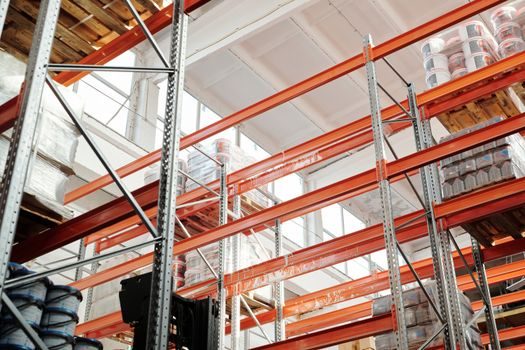
Four-high stacking is the published maximum for 1,000 kg/unit wire-mesh cages, with the bottom tier absorbing the full 4,000 kg stack load through four 70 mm × 70 mm stacking posts; the upper three tiers are not loaded by gravity from above — they only see their own 1,000 kg content [S1].
The load path is post → base plate (≥200 mm × 200 mm × 4 mm) → floor. Forklift tine engagement must be straight-in: side-loading the tines into the pockets of an unstacked stillage generates roughly 6 kN of lateral force, which is the typical failure mode for cages that arrive on site with welded pockets cracked from transit. Inspection gate: every base plate welded, no base plate warped, all four stacking posts seated in their sleeves with no daylight visible. If daylight exceeds 2 mm at any post, the upper cage is bottoming on the post cap, not the sleeve — the bottom tier will then carry the upper cages' content load multiplied by the mechanical advantage of the warped plate. Replace, don't shim.
Proof Load Test Procedure and Acceptance Criteria
Pre-commissioning proof test requires loading every cage to 1.5× rated capacity — 1,500 kg — for 15 minutes, then checking for permanent deformation >2 mm on any structural member, weld crack propagation at mesh-to-frame joints, and base-plate deflection >1.5 mm [S1].
This is a one-time gate per cage position, not a periodic re-test. If a cage passes 1.5×, it is rated for 1,000 kg working load with a 1.5× safety factor against yield — consistent with the FEM 9.341 / EN 15635 safety-factor convention for static industrial storage. Test weights should be calibrated and traceable; site engineers occasionally use sandbags or water totes, which is acceptable provided the load is verified on a platform scale to within ±2%. A cage that measures 3 mm permanent set on a base plate at 1.5× load is borderline — re-test after 24 hours; if permanent set holds, accept; if it grows, scrap the unit.
Comparison: Cage Class vs Application Fit

Three common stillage configurations compete for the same warehouse footprint, and choosing the wrong one costs more than the unit price differential suggests [S1]:
1) Wire-mesh foldable stillage, Q235, 1,000 kg/unit, 4-high stackable — best for general parts storage where visibility of contents matters and return-loop logistics favor foldable sides. Cost band: US$150–220/piece at 1–99 unit order quantity [S1]. 2) Solid-sheet steel stillage, 1,500 kg/unit, 2-high max — best for liquids, fasteners, or anything that would leak/sift through mesh. Cost band typically 30–50% above mesh. 3) Palletainer / rigid post stillage, 2,000 kg/unit, 3-high, fixed sides — best for heavy coils or dense components where 1.5× proof testing is impractical at the upper limit. Cost band typically 2× the foldable mesh unit.
Decision rule: if contents are bagged or boxed and visual inventory matters, go wire-mesh; if contents are liquid-bearing or sub-10 mm particles, go solid; if unit weight exceeds 1,200 kg, go palletainer or escalate to a storage rack system with proper aisle clearance and rack-end protection.
Failure Modes and When Not to Repair
The three dominant stillage failure modes are base-plate cracking (visible as orange-brown rust bleeding from the corner of the base plate), mesh-wire fracture at the welded intersection (visible as a single broken strand running perpendicular to the fold line), and stacking-post sleeve ovalization (visible as the upper cage rocking when loaded) [S1].
Base-plate cracks: do not weld-repair; the HAZ of a field weld on a powder-coated base plate destroys the coating and the residual stress field around the original crack will re-propagate within 12 months. Replace the unit. Mesh-wire single-strand fracture: if confined to a single 50×50 mm cell, the cage can stay in service for non-personnel-access storage at 80% derated load (800 kg) until the next planned cage refresh. Stacking-post sleeve ovalization: the cage is out of service immediately; the post will eventually punch through the sleeve under the next upper-tier loading event. Replace, do not re-bush. Across all three modes, the trigger for replacement is not the symptom but the calculated residual safety factor: a single mesh fracture drops the unit to ~1.4× at 800 kg derate, which fails the FEM 9.341 1.5× gate. A base-plate crack drops the unit below 1.0× — meaning the working load is now above the proof test threshold, which is operationally indefensible.
Standards, Documentation, and Inspection Records
Storage cage installations fall under EN 15635 for "in-use inspection of pallet racking and shelving" by analogy, with the FEM 9.341 calculation basis for the 1.5× safety factor convention; a documented weekly visual inspection by a "competent person" is the typical compliance gate auditors look for [S1].
Records to retain per cage position: anchor torque log (date, anchor type, torque value, wrench serial), floor flatness reading at install (3 m straightedge, mm deviation), 1.5× proof test certificate (load, duration, residual deformation, inspector signature), and a base plate condition photo set. Cage marking: each unit should carry a permanent label stating manufacturer, year of manufacture, rated working load (WLL in kg), and a unique position code matching the warehouse layout drawing. None of this is a regulatory mandate in most jurisdictions; all of it is what an OSHA / HSE inspector asks for after a collapse event. Engineers who skip the labelling typically spend 30 minutes per cage identifying units after a partial-floor event, versus 30 seconds when labels are in place. For broader context on how Chinese industrial suppliers position stillage cages against competing steel-fabrication products, the linear guide rail sourcing map and ball screw supply chain write-up cover adjacent metal-fabrication sourcing channels in 2026 [S1].
Two trackable signals to watch: (1) the 2026 update of EN 15635 / FEM 9.341, which is in the comment phase as of mid-2026 and may move the 1.5× proof-load convention to a 1.67× gate for dynamic-loaded tiers; (2) a shift among Chinese stillage manufacturers toward S235JR/S275JR certification under EN 10025-2 in place of generic Q235, which would tighten mill-cert traceability but raise unit cost roughly 5–8% at the same 1,000 kg WLL.
Spec-level background on the components involved: linear guide.