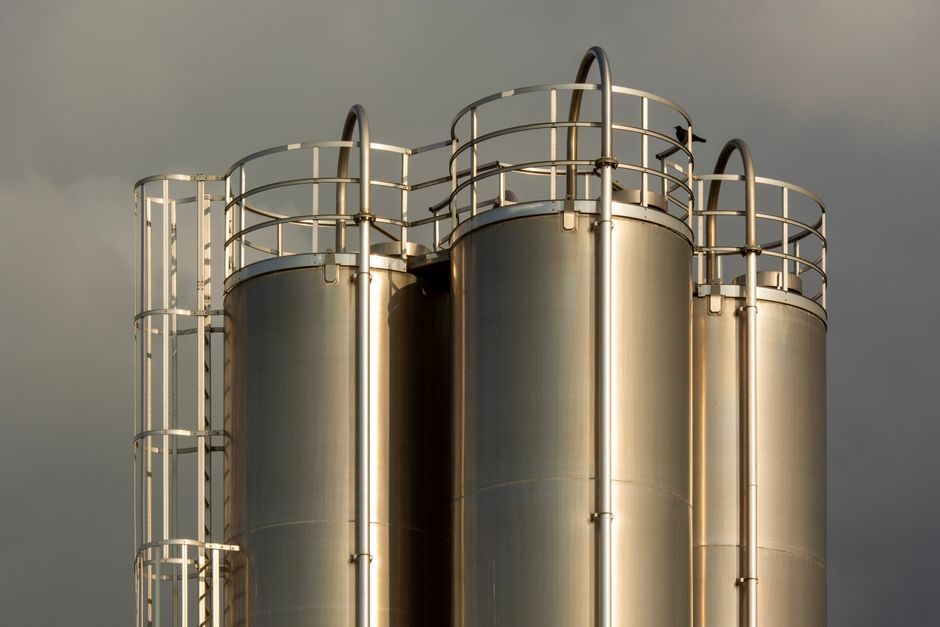
An IBC tank — typically a 1,000 L HDPE bottle caged in a galvanised or painted-steel pallet — is the workhorse intermediate package between drums and road tankers across chemicals, food, pharma, and water-treatment duty.
Engineers choose them because four numbers are favourable at once: 1,000 L nominal capacity, roughly 4:1 stack ratio on standard 1000 L units, ~20-25 kg tare with HDPE bottle, and an FM/UN/DOT 31H1 or 31HH1 rating for liquids up to 1.9 sg — but every one of those figures has a counter-constraint the spec sheet rarely prints on page one.
Capacity, Footprint, and Stack Geometry
Most units are 4-high stackable when full, which sets a per-pallet cube of 4,000 L; cheap warehouses see this drive pallet-rack beam loads of roughly 1,200 kg per loaded position, a number that the rack supplier must verify against the IBC supplier's tested stacking load rather than the 1,040-1,080 kg filled mass alone.
A frequently missed geometry point: the 150 mm DN valve port is on the same face as the fork-tunnel entry, which means bottom-discharge cabinets need 200-250 mm clear depth behind the valve — under-spec this and the operator has to use a hand pump to evacuate the last 10-15 % of heel.
Material Compatibility: HDPE Bottle vs Stainless Alternatives
HDPE bottles are rated by most manufacturers for continuous service between roughly -20 °C and +60 °C, with excursions to 80 °C during short CIP (clean-in-place) wash cycles — the material softens and stress-cracks above this band, so any duty above 60 °C continuous or with aggressive oxidisers (concentrated HNO₃, chlorinated solvents) should switch to a stainless ibc tank variant in 304 or 316L, or to a dedicated fluoropolymer-lined unit [S2].
Inner-bottle wall thickness in standard 1,000 L units sits around 1.5-2.0 mm at the corner moulding; below 1.2 mm stress-crack resistance drops sharply, which is why reclaimed-bottle units in the secondary market have visibly higher failure rates in the 24-36 month window — a fact the UN-DOT re-certification stickers do not always catch because visual inspection of HDPE walls under backlight is the only reliable field check.
Total Cost of Ownership: 5-Year Stack vs Drums and Tankers
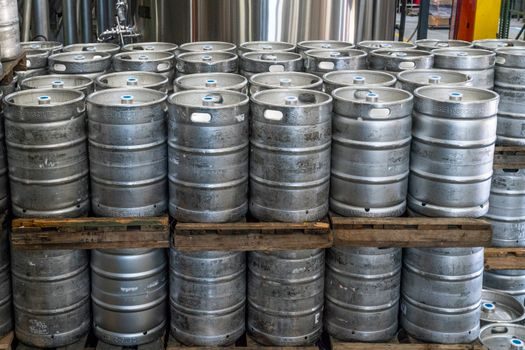
For 5-year TCO modelling, the right structure is: (purchase or lease) + (cleaning 6-12 €/trip) + (return-freight 12-25 €/trip) + (loss/damage reserve ~3 %/trip) + (residual value 15-25 % of purchase for reconditioned resale); a drum fleet needs (purchase) + (disposal 8-15 €/drum after 3-5 trips) + (no residual) layered in, which pushes drum TCO above the IBC line once return distances exceed ~150 km two-way.
Decision threshold worth memorising: below 50 trips per year on a single product and below 200 km average return, drums often win on simplicity; above those, the IBC's cleaning machine compatibility and stack density flip the answer.
Logistics, Handling, and Pallet Interface
Standard IBCs are fork-tunnel and pallet-jack compatible on all four sides and certified for 4-high stack when full and 1-2 high when empty, with empty units nestable only on specific 30 %-volume folded bases — flat-stacking empties without the base is a common safety violation that can buckle the bottom frame at under 1,000 kg static load.
Two spec traps on handling: (1) the steel cage is often painted mild steel and will fail a 200-500 h neutral salt-spray test that a galvanised cage comfortably passes — coastal or food-grade pharma duty should always specify hot-dip galvanised or stainless; (2) the top-load valve cap uses buttress or DIN 50 threads, and cross-vendor interchange is partial at best — locking down a single supplier fleet eliminates a 5-8 % annual loss-to-leakage line item.
For sites already running tank container ISO units on road or rail, IBCs slot in as the de-facto "20-foot ISO in miniature" for batch intermediates, and the same tracking IDs and 31H1 codes apply, which simplifies hazmat documentation across fleet types [S2].
Failure Modes and Inspection Gates
The four recurring failure modes in service are: (1) bottom-corner stress cracks in the HDPE bottle around 24-48 months, accelerated by UV exposure above the supplier's published limit; (2) valve gasket hardening and weeping at the DN50/buttress interface, typically after 8-12 thermal cycles or 18 months; (3) cage weld cracking at the fork-tunnel corners after ~200 fork impacts; (4) cross-threading damage from mismatched cap/valve vendors [S2].
A practical 6-month inspection gate: visual HDPE wall check with backlight, valve seat pressure-decay test at 0.2 bar for 30 seconds, cage weld dye-pen at the four tunnel corners, and tare weight check ±1 % — units failing any one line should be downgraded to non-hazmat secondary duty or scrapped. UN 31H1 re-certification intervals are 30 months for hazardous liquids and 60 months for non-hazardous, but the structural items above should be checked more often.
Selection Criteria: When to Use, When to Walk Away
Specify an IBC when: liquid viscosity under 5,000 cP, density under 1.9 sg, service temperature -20 to +60 °C, batch sizes 500-1,500 L, and return logistics under 300 km on a regular lane — these are the conditions where the 4-high stack, 1,000 L nominal, and reusable 30-trip steel-cage life all pay back together. [S2]
Walk away from a standard composite industrial valve-equipped IBC when: oxidising acids at >30 % concentration, aromatic or chlorinated solvents at elevated temperature, oxygen-sensitive product where full nitrogen blanketing is required, or any pharmaceutical/medical application where cGMP demands a dedicated 316L with documented electropolish — the cost gap between a composite and a stainless IBC (roughly 4-6× at purchase) is almost always lower than the batch-loss line item from one contamination event.
For metering into process, a flow meter on the discharge line plus a pressure transmitter on the headspace is the minimum instrumentation set to capture dispense data and detect valve-closed-but-flowing leaks — both instruments are now routinely ordered as factory-fitted options on new 2026-vintage IBC fleets.
The most useful trackable signal for sourcing teams: EN 14512 / EN 15507 complaint cleaning-station availability within 100 km of the duty point, and the supplier's published 2026 audit trail for HDPE bottle regrind content (typically 30-50 % post-consumer) — both numbers are now appearing on supplier datasheets and a clean answer to either is the difference between a 5-year asset and a 30-month one. For a closer look at intermediate bulk formats in the dry-goods world, the FIBC Bulk Bag Types and Classifications spec map covers the woven-polypropylene sibling category in detail.