Wire rod is a semi-finished hot-rolled coil in the 5.5–22 mm diameter band, produced on high-speed Morgan or no-twist mills and shipped to downstream drawing, stranding or cold-heading lines; embedded parts (also called embedded plates, embedment anchors or cast-in fittings) are fabricated steel assemblies — plates, studs, anchors, channels — welded to rebar cages or loose-set into formwork before a concrete pour, where they transfer load, anchor machinery or carry façade brackets [S1].
The two products sit at opposite ends of the steel value chain: rod is a mill output heading into wire and wire & strands production, while embedded parts are job-shop fabrications consumed at the construction site. Confusion at procurement usually comes from the word "wire" — the rod mill feeds the wire drawer, but the embedded-part shop feeds the rebar placer.
Definition and Scope: Two Products, Two Supply Chains
Wire rod covers hot-rolled coils of low-, medium- and high-carbon steel, copper, aluminium and copper-clad grades. The Elcowire rod product family is described as the European upstream input for wire, strands and conductors [S1]. Dimensional bands are stable: carbon-steel rod typically runs 5.5–22 mm Ø in coil weights of 1.5–2.5 t; copper rod for electrical use runs 8 mm Ø in the well-known ETP and DHP grades, with purity specified at ≥99.90% Cu for electrical applications.
Embedded parts, by contrast, cover plate-and-stud, channel, ferrule and rebar-anchor assemblies cut from hot-rolled plate or bar, then welded to ISO 9001-controlled weld procedures. The catalogue spans embedment plates from 6 mm thick flat bar up to 50 mm thick heavy baseplates, stud diameters M12–M36, and anchor channels in 41/72 mm hot-rolled profiles. Dimensional spread is wider than rod because each assembly is project-specific; the only commonality is that every embedded part must be CE-marked under EN 1090-1 for structural use in the EU and must carry a mill cert back to the plate or bar heat.
Selection Criteria: What Drives the Pick
Rod selection turns on (a) end-use wire/strand/strand-rope specification, (b) carbon content and deoxidation practice, and (c) coil weight, surface scale and decarburisation depth. Embedded-part selection turns on (a) design load — shear, tension, combined — (b) concrete cover, (c) corrosion environment (C1–C5 per ISO 12944) and (d) welding compatibility with adjacent rebar grades. A specifier who picks the wrong starting product pays twice: either the wire drawer rejects the heat for surface defects, or the embedment fails pull-out because the stud-to-plate weld was under-sized. [S1]
For rod, the three practical levers are steel grade (SAE 1006 to 1090 for carbon, C2D/C4D/C8D for cold-heading per EN 10263), surface quality (shot-blasted + limed for severe drawing, as-rolled for mesh), and mechanical-property scatter (tensile and reduction-of-area window per heat). For embedded parts, the three levers are base-material cert (EN 10025 S235/S275/S355 for plate; B500B/B500C for rebar tie-ins), weld-procedure qualification record (WPQR), and corrosion protection (black, hot-dip galvanised to EN ISO 1461, or zinc-rich epoxy).
Wire Rod vs Embedded Part: Criteria-Based Comparison

Across four decision criteria, the two products sit on opposite poles of the steel value chain. [S2]
<strong>Form factor:</strong> rod is coiled round 5.5–22 mm Ø, 1.5–2.5 t per coil, no fabrication; embedded parts are flat/stud/channel assemblies cut and welded from plate 6–50 mm thick, with no standard coil form.
<strong>Tolerance regime:</strong> rod tolerance is EN 10017 (diameter ±0.20 mm at 8 mm, ±0.30 mm at 16 mm, ovality ≤50% of tolerance band); embedded-part tolerance is EN 1090-2 execution class EXC1–EXC4, with plate flatness 0.5% of dimension and stud location ±3 mm typical.
<strong>End user:</strong> rod feeds wire drawers, wire-rod consumers, cold headers and nail/bolt makers; embedded parts feed concrete contractors, façade erectors and equipment-base installers.
<strong>Lead time and MOQ:</strong> rod is mill-stock, 4–8 weeks ex-works Europe, MOQ one coil; embedded parts are project-fabricated, 2–6 weeks off drawing, MOQ typically 50–200 pieces per item.
Material, Standard and Tolerance Map
Wire rod standardisation is dominated by EN 10016 (non-alloy steel wire rod for drawing), EN 10017 (dimensional tolerances), EN 10064 (definitions), EN 10263 (cold-heading grades) and for copper rod EN 1977 (Cu-ETP) and EN 13602 (drawn wire from Cu-ETP). The Elcowire rod range is built on these EN-series foundations [S1]. Tensile-strength windows for plain-carbon rod typically span 360–520 MPa at 5.5 mm rising to 480–720 MPa at 16 mm depending on grade, with reduction-of-area ≥40% for drawing grades.
Embedded-part standardisation is built on EN 1090-1 (CE marking of structural components), EN 1090-2 (technical requirements for steel structures), EN 10025 (hot-rolled plate), EN 1992-1-1 / Eurocode 2 (anchorage in concrete), and EN ISO 1461 (hot-dip galvanising). Corrosion classes follow ISO 12944 C1–C5; anchor-channel systems additionally reference EN 1993-1-1 for the steel-to-steel interface. Stud welds to plate are qualified under EN ISO 14555, and weldable rebar is B500B/B500C per EN 10080.
Process Path: Mill, Draw, Cast-in
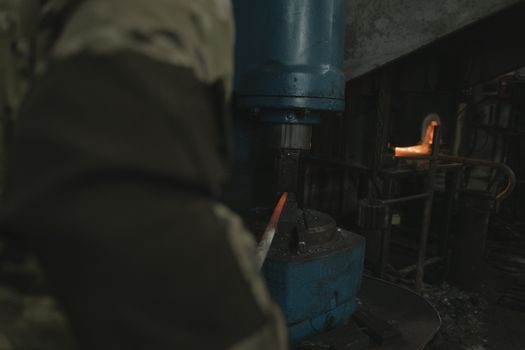
Rod production runs billet through a reheat furnace (1150–1250 °C), a roughing train, an intermediate train, a no-twist or Morgan finishing block (typically 10 stands at 100–120 m/s), a Stelmor or in-line cooling conveyor, and a coil compact/bind station. Copper rod follows a continuous-cast + multi-stand rolling path, with the Elcowire portfolio spanning rod, wire and strands in a single integrated flow [S1].
Embedded-part production runs plate or bar through CNC cutting (plasma/oxy/laser), drill/tap, stud welding (drawn-arc per EN ISO 14555), rebar tie-in, and galvanising or paint. The "embedded" step itself happens on the construction site: the assembly is lifted, levelled, tied to rebar, and concreted in, after which it is no longer accessible for rework — a one-shot operation that justifies the WPQR-and-mill-cert paperwork. This is a fundamentally different process logic from a wire-drawing line, which can be stopped, restarted and re-threaded on every coil change.
Use Cases: Where Each Product Belongs
Wire rod is the right pick when the specifier needs (a) cold-heading feedstock for bolts, screws, nails and fasteners, (b) welding-wire feedstock for CO₂/MIG/TIG consumables, (c) spring-wire feedstock for upholstery and automotive springs, (d) mesh and chain-link feedstock for fencing, (e) ACSR/AAAC core wire for overhead conductors, and (f) PC strand for prestressed concrete — the last two being direct downstream of the Elcowire rod → wire → strands chain [S1].
Embedded parts are the right pick when the specifier needs (a) anchor plates for column base connections, (b) façade-support brackets on high-rise cladding, (c) embedment channels for later bolted attachment of services, (d) starter bars / dovetail slots for wall-to-slab shear transfer, (e) crane-rail base fixings on industrial floors, and (f) machine-base anchor assemblies on pump and compressor skids. The embedded part category in industrial supply catalogues is almost entirely project-engineered rather than off-the-shelf.
Limitations and Failure Modes
Wire rod is rejected at the drawbench for surface defects (seams, scabs, laps), decarburisation beyond grade spec, out-of-round ovality exceeding 50% of the EN 10017 tolerance, and tensile scatter outside the heat-window. Coil handling also matters: oval-coil set (camber) blocks payoff, and rust bloom on unprotected rod forces shot-blast + acid pickling on the draw floor. [S3]
Embedded parts fail in service by (a) pull-out under tension when the embedment depth or stud layout is under-designed against Eurocode 2 anchorage lengths, (b) corrosion of unprotected base metal in C4/C5 environments, (c) weld cracking at stud-to-plate joints when the WPQR does not cover the actual rebar grade, and (d) mislocation where the plate is set off the design coordinate by more than the ±3 mm installation tolerance, forcing costly site rework before the pour. The "one-shot concreting" nature of the product is the dominant constraint — once the form is closed, the part is permanent.
Sourcing and 2026 Market Signals
Wire rod sourcing in 2026 is dominated by integrated European mills (the Elcowire rod + wire + strands chain is one example) running on scrap-EAF and blast-furnace–BOF mixes, with copper rod tied to LME Cu and electrical-grade demand from EV harness, transformer and renewable-cable buyers [S1]. Lead time is 4–8 weeks for stock grades and 10–14 weeks for special cold-heading chemistries. Price moves follow the hot-rolled-coil reference with a conversion cost adder.
Embedded-part sourcing is regional and shop-fabricator driven, with lead times 2–6 weeks off approved drawing, MOQ 50–200 pieces, and pricing sensitive to plate price (S235/S275/S355) plus galvanising tonnage plus WPQR labour. In 2026 the C1–C5 corrosion split is pushing more orders into hot-dip galvanised or zinc-rich-epoxy finishes, and EN 1090-1 CE marking is now a hard procurement filter in EU public works. A specifier who can read the plate cert, the WPQR, the EN 1090-1 declaration of performance and the EN ISO 1461 galvanising thickness on a single datasheet will cut at least one rework cycle out of the project — a measurable saving against typical embedded-part change-order rates of 5–10% of contract value.
For component-level specifications, see wire rod, and draw wire sensor.
For related coverage, see Asphalt Paver vs Cold Milling Machine: 2026 Spec, Process and Selection Frame.