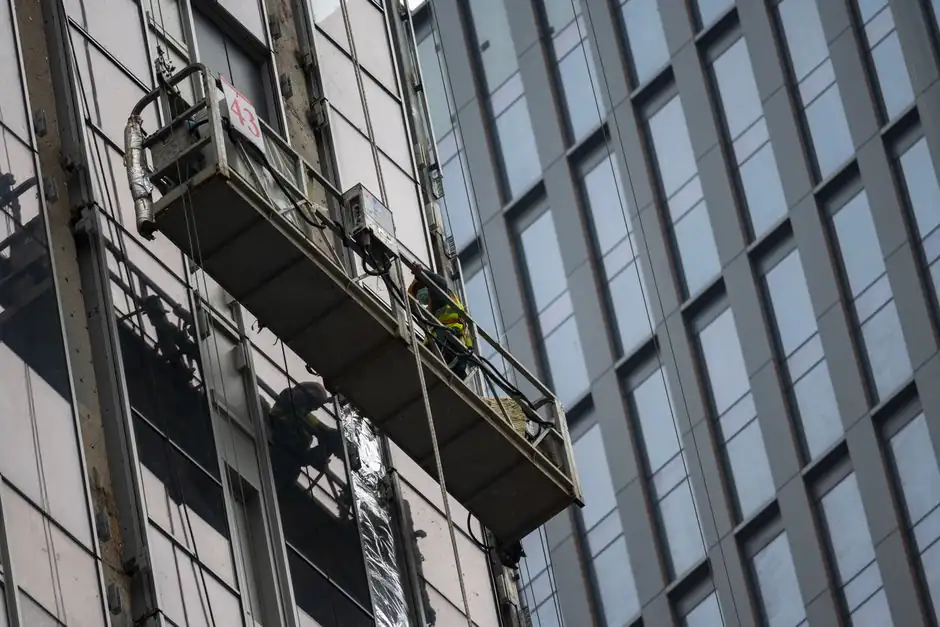
Wire rope suspended platforms and rack and pinion hoists solve different vertical-access problems on a jobsite, and selecting the wrong one drives both safety risk and total installed cost. Wire rope units hang from outrigger beams or parapet davits and depend on steel wire rope as the sole suspension and lifting element, whereas rack and pinion systems ride a motor-driven pinion gear meshing with a rack on a fixed mast.
On new mid- and high-rise builds the two technologies often appear side by side: a rack and pinion construction hoist for crew and material at the core, plus a wire rope platform on the facade. Specifying each against its governing rule set, the height band, and the load profile is the only way to keep weight handling, rack and pinion hoist duty cycle, and rope safety factor in their respective design envelopes.
What each system is, mechanically
A wire rope suspended platform, also called a gondola or hanging scaffold, is a temporary work platform suspended from steel wire ropes that pass over powered traction hoists mounted on a roof carriage or parapet davit [S4]. The working wire rope is the main load-bearing element, directly carrying the platform, personnel, tools, and any staged materials; a separate safety rope and overspeed safety lock arrest a free fall if the working rope loses tension [S3][S4].
A rack and pinion hoist, by contrast, is a mast-climbing system: a vertical steel mast with a fixed rack, a motor-driven pinion gear on the cage, safety devices, door interlocks, overspeed governors, and load monitoring [S2]. The mast is tied to the structure, the cage rides the pinion along the rack, and no suspension rope is required at all, which is why California Title 8 §1604.25 explicitly excepts rack and pinion machines from its hoisting-rope requirements [S1].
Governing rules and the rope safety factor
For wire rope suspended platforms, the binding reference is California Code of Regulations Title 8 §1604.25, which requires hoist cars to be suspended by steel wire ropes attached to the car frame or passing around sheaves specified in §1604.16 [S1]. The rule mandates a Factor of Safety f = (S × N) / W, where S is one rope's manufacturer-rated breaking strength, N is the number of rope runs under load, and W is the maximum static load with the car and rated load at any hoistway position [S1].
Table 5 of §1604.25 sets the minimum factor at 7.60 at 50 fpm, 7.75 at 75 fpm, 7.95 at 100 fpm, 8.10 at 125 fpm, 8.25 at 150 fpm, 8.40 at 175 fpm, and continues to rise at 200 fpm and above [S1]. Every wire rope must carry a metal data tag with diameter, breaking strength, material grade, install month and year, preformed flag, construction class, installer, and manufacturer; a site rope log must record install date, refastening date, and the firm performing the work [S1]. The crosshead data plate must mirror the rope count, diameter, and per-rope breaking strength [S1].
For rack and pinion hoists, no equivalent rope safety factor applies, because there are no suspension ropes. Compliance is driven instead by mast design, rack and pinion engagement, braking, overspeed protection, and door interlocks built into the drive package [S2].
Selection criteria: height, load, and access pattern

On multi-storey developments rack and pinion hoists are commonly used to transport workers, tools, and materials safely between levels and improve site efficiency on tall structures [S2]. For infrastructure work on bridges, rail networks, and power stations, and for industrial maintenance access, the mast-tied configuration is rated for heavy-duty working conditions and large-scale engineering environments [S2].
Wire rope platforms, by contrast, target facade access on vertical surfaces, including building envelopes, bridges, and industrial structures, where the platform travels up and down a face rather than inside a building core [S4]. The defining inspection discipline is visual: workers must always inspect wire ropes for fraying, corrosion, or damage before use, and disengaged ropes, defective brakes, or electrical faults are treated as immediate stop-work conditions [S9][S4].
A useful mental split is the ~40 m mark. Material-only wire rope material hoists such as Beta Max units are typically pitched for working heights of 40 to 400 ft (about 12 to 120 m) and are valued for fast, flexible setups and material delivery [S6]. Above that, on true high-rise cores, rack and pinion construction hoists become the default for personnel plus materials because the mast scales independently of the building face and is tied structurally as the building rises [S2][S8].
Head-to-head on the criteria that matter
Drive system is the foundational difference: rack and pinion uses a geared rack and pinion with no suspension rope, while a rope hoist relies on wire rope reeving [S2]. Installation flexibility favors rack and pinion in tall cores and on tied masts, while rope platforms are excellent where the roof geometry allows simple outrigger or parapet rigging. Maintenance burden sits with rope systems, because the rope itself is a wear item with a finite data-tag life, a required site log, and mandatory renewal documentation under §1604.25, whereas rack and pinion maintenance concentrates on the gear mesh, brakes, and safety devices rather than a structural rope inventory [S1][S2].
Site durability and reliability both rate higher for rack and pinion in the comparison matrix published by Wickham Hoist Ltd, reflecting the mast's resistance to wind and the elimination of long, replaceable suspension rope runs [S2]. High-rise applicability favors rack and pinion; low- to mid-rise facade work and short material lifts are where rope platforms remain cost-effective. For high-rise elevator and core access on commercial builds, the rack and pinion construction hoist is generally the preferred specification [S2][S8].
Use cases and on-site failure modes

Wire rope platforms are the standard tool for facade maintenance, window cleaning, painting, plastering, and cladding installation on buildings where the geometry is straightforward, and the roof can carry outrigger beams [S4][S9]. The dominant failure modes are rope wear, broken strands, corrosion at terminations, and electrical faults in the hoist, all of which §1604.25(b)(2) addresses by forcing a fresh data tag at every rope renewal with a new install month, year, and installer identity [S1][S4].
Rack and pinion hoists are the workhorse for crew and material movement on multi-storey construction, commercial refurbishment, bridge and rail access, and power-station maintenance, and they double as event access for exhibitions, concerts, and sporting venues [S2]. Their failure modes are gear wear, brake fade, overspeed events, and interlocks that fail open, which is why modern packages include emergency braking, overspeed protection, door interlocks, load monitoring, emergency stop controls, and automatic safety devices as standard [S2].
Construction hoist buyer selection guidance published in 2026 explicitly compares passenger/material, material-only, and rack-and-pinion construction hoists, and asks buyers to review load, height, and landing inputs before requesting a quote, which keeps the decision matrix honest [S8].
Limits, constraints, and what not to mix
Do not use a wire rope material hoist for personnel lifting, and do not assume a rack and pinion construction hoist can be rigged from a parapet the way a rope platform can. The two products are governed by different design rules, the §1604.25 exception for rack and pinion machines exists precisely because the rope safety factor logic does not apply to a mast-climbed cage [S1][S2].
Rope platforms also require a separate, independent safety rope and an overspeed safety lock; treating a single working rope as both lifting line and safety line is a spec error that disqualifies the install under standard suspended platform practice [S3][S4]. Maintenance discipline matters: a rope suspended platform with no maintenance regime invites disengaged ropes, defective brakes, or electrical faults that directly endanger workers and inflate unplanned repair cost, which is why the original equipment maintenance schedule is treated as legally binding at purchase [S4].
For procurement, anchor the rope side to Title 8 §1604.25 data-plate, data-tag, and log requirements, and anchor the rack and pinion side to the OEM safety device list, mast tie spacing, and the project's height band, then pick by load, height, and landing inputs as the 2026 buyer guide recommends [S1][S2][S8]. Specifiers working on facade access should also reference the suspended platform and suspended ceiling encyclopedias for the supporting hardware vocabulary, while pallet rack and storage rack documentation is irrelevant here and should not be conflated with vertical access equipment. Trackable signal: any 2026 update to §1604.25 Table 5 factor-of-safety bands or to IEC/EN construction-hoist harmonized standards would shift the rope-side spec floor.
For related coverage, see Tall Wall Forms: When to Combine Internal and External Vibrators.