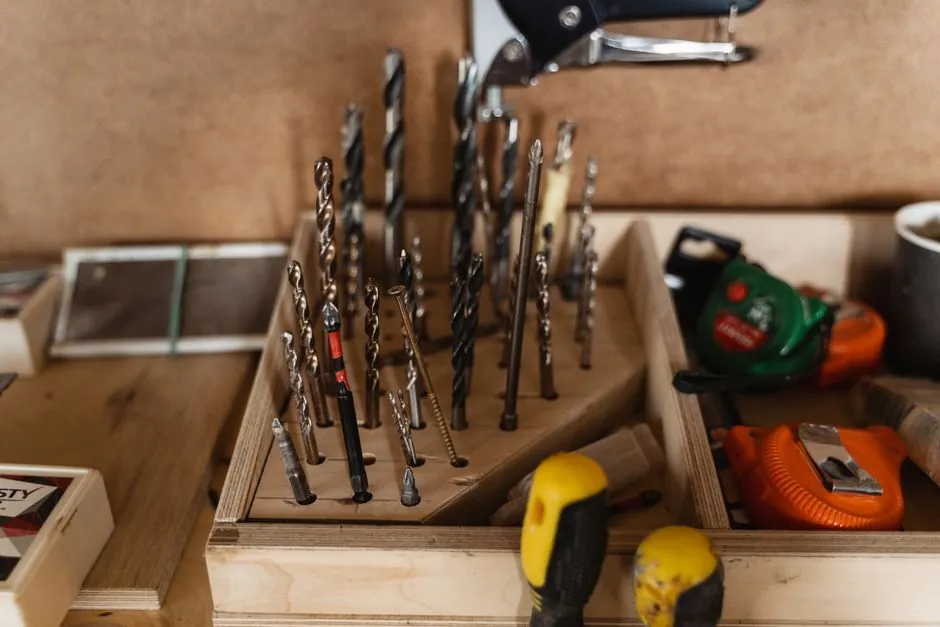
Across 8 published maintenance guides (Feb 2025 to May 2026), the recurring recommendation is a four-tier cadence: daily surface wipe-down, monthly hardware inspection, quarterly deep clean of tracks and holes, and a 6-12 month structural and corrosion audit, with task frequency scaled to load, humidity, and bench material [S1][S3][S4].
Wood, painted steel, and stainless variants share the cadence but diverge on cleaning chemistry: paste wax and mineral spirits for hardwood tops, light machine oil on caster axles, and food-safe neutral detergent on stainless catering benches, as specified in vendor and OEM field guides [S1][S2][S5].
Daily Wipe-Down: Sawdust, Shavings, and Spill Response
Daily brushing of sawdust and metal shavings, followed by a dry or barely damp cloth wipe, is the most-cited single action across the published guides, because loose debris in dog holes and T-tracks is the precursor to sticky slides and inaccurate cuts [S1][S3].
For wood tops, water-based cleaners are contraindicated: swelling and raised grain follow within days, so the operative rule is dry cloth first, mineral spirits second, paste wax quarterly [S1]. For steel and stainless, a mild detergent damp cloth is acceptable, but abrasive scouring pads are explicitly excluded to preserve surface finish [S2][S5].
On a stainless catering bench with integral sink, spills must be wiped within minutes to prevent chlorides from pitting the surface, and the daily routine extends to rinsing the basin, scrubbing with a non-abrasive pad, and pouring boiling water down the drain to keep grease from depositing in the trap [S5].
Monthly Hardware Audit: Fasteners, Vises, Casters, and Tracks
A monthly pass is the second-tier checkpoint, and the workload is mechanical rather than cosmetic: every knob, clamp, leg leveler, and caster bolt is checked for free movement and re-torqued if any wobble or binding appears [S1][S2][S4].
Hardware loosening concentrates at three points, namely caster axles, pegboard mounts, and vise/guide rail brackets, and a soft-bristle brush plus compressed air clears T-tracks and dog holes of compacted dust before re-applying paste wax [S1]. Caster axles take a drop of light machine oil; debris wrapped around the spindle (hair, string, swarf) is removed first, otherwise the oil simply bonds the contamination in place [S2].
For shop benches with built-in power strips, the monthly pass should also include a visual check of cable insulation for nicks or cracking, since sharp tools stored on pegboards are a documented source of impact damage to adjacent wiring [S2].
Seasonal Deep Clean: Wax Cycle, Descaling, and Rust Treatment
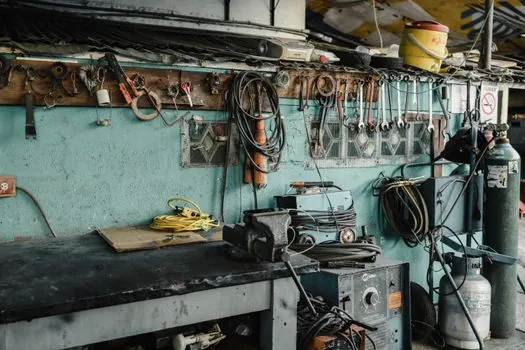
Every 3-4 months, a non-silicone paste wax is applied to hardwood tops under normal use, compressed to monthly cadence for benches exposed to glue, resin, or heavy daily planing [S1]. Silicone-containing polishes are excluded because they migrate into surrounding timber and cause fisheye in subsequent finishes.
For stainless catering benches, the seasonal step shifts to descaling: a 1:1 white vinegar soak on faucet aerators dissolves limescale, and a baking-soda-plus-vinevaar flush clears biofilm from the waste line; the cycle is tightened to quarterly in hard-water areas [S5]. For painted or plated steel frames in humid shops, a wipe-down with light oil or rust inhibitor every 3-6 months is the documented baseline, supplemented by silica gel packs inside drawers to hold relative humidity below the corrosion threshold [S2].
A seasonal flatness check using a straightedge is part of the same visit: lumps and ridges are scraped off before planing, because high spots propagate into every workpiece and accelerate wear on the blade and the bench surface alike [S8].
Material-Specific Failure Modes and Acceptance Criteria
The three dominant materials fail in distinct patterns, and the corrective action differs accordingly. Wood tops crack, cup, and wick moisture; steel frames corrode at weld seams and caster mounts; stainless catering benches pit under chloride exposure and scale at faucet outlets [S2][S3][S5].
For wood, the acceptance criterion after a rehab is a flatness check with a straightedge, no daylight gaps exceeding 0.5 mm across the span, followed by light sanding and refinishing with a hardwax oil, after which a new paste-wax cycle restarts [S1][S8]. For steel, acceptance is no red rust after a 30-day observation post-treatment; if rust returns within that window, the frame needs grinding back to bright metal and a zinc-rich primer rather than another oil pass [S2]. For stainless, pitting deeper than the visual surface layer is the trigger to escalate from polish to section replacement, because chloride-induced crevice corrosion propagates below the visible face [S5].
Comparison: Wood vs Steel vs Stainless Workbench Care
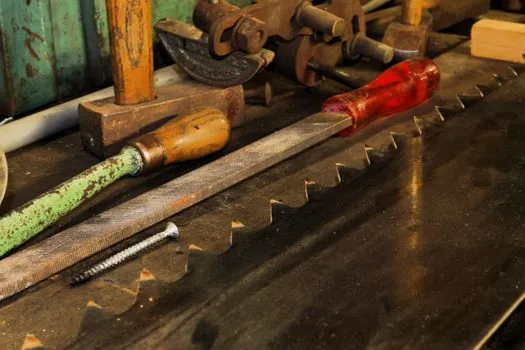
Three material variants line up against four decision criteria as follows. (1) Daily cleaner: wood = dry cloth, steel = mild detergent damp cloth, stainless = food-safe neutral detergent. (2) Lubricant: wood = none on top, tallow on joinery per S6; steel = light machine oil on casters; stainless = food-grade NSF H1 oil on caster threads. (3) Corrosion defence: wood = paste wax with 3-4 month cycle; steel = oil film with 3-6 month cycle; stainless = chloride-free rinse and passivation after any acid spill. (4) Replacement trigger: wood = flatness loss greater than 0.5 mm or structural crack; steel = red rust recurring within 30 days of treatment; stainless = visible pitting beyond the polish layer [S1][S2][S3][S5][S6].
Standards, Sourcing Signals, and When to Escalate
No single ISO or EN standard governs workbench maintenance, so facilities typically reference internal preventive-maintenance procedures benchmarked against OEM service bulletins; for stainless catering units, food-safety frameworks (NSF/ANSI 2 for food equipment, local equivalents) define the cleaning-chemical allow-list, and these constraints override generic polish guidance [S5].
Escalation thresholds converge across sources: structural cracks in the top, persistent misalignment after hardware re-torque, welded-joint fracture on steel frames, and any pitting on stainless that survives polish are all signals to call a professional service agent rather than continue in-house repair [S1][S2][S3][S5]. For heavy industrial benches, spec-mapped workbench selection guidance frames the upstream choice so the maintenance burden is sized to the duty cycle, not retrofitted after failure.
Two trackable signals to watch into late 2026: ESD/dissipative mat proliferation on electronics-assembly benches, where anti-static mats are increasingly layered over the structural top to control charge buildup during sensitive work, and the spread of modular workbench cabinets with integrated power and lighting that shift the maintenance checklist toward electrical inspection rather than purely mechanical [S3]. For procurement teams sourcing complete cells, linear guide and crossed roller guide selection on adjustable-height frames will determine the long-term lubrication interval more than the bench-top material itself.
For the relevant spec sheets and selection criteria, see bench scale.