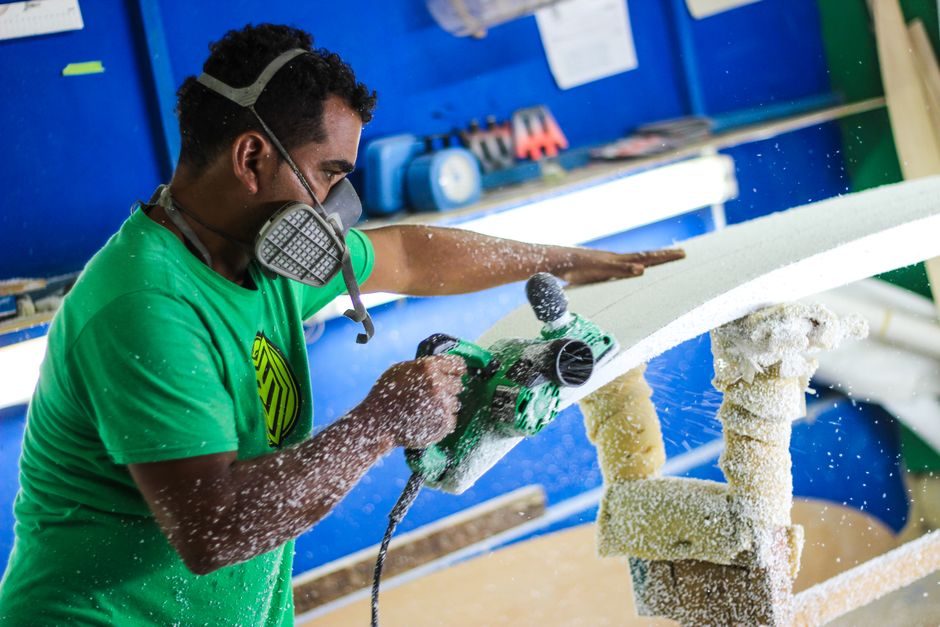
FOB-China spot pricing for extruded polystyrene (XPS) board in 2026 sits in a US$3.30-7.50 window per piece or square metre, with the spread set by compressive-strength grade, foil facing and minimum order quantity [S1][S2].
The same factory typically quotes in two units - per piece (50-piece MOQ) and per square metre (1,000 m² MOQ) - and the lower-bound price is only available at the larger lot, which is the first cost lever any procurement engineer should pull [S2].
Published 2026 Price Bands and What They Sit On
The lowest 2026 offer on record is US$3.30-4.00 per piece at a 50-piece MOQ from Qingdao Zhongchuang Lianhe (Shandong), while the upper band sits at US$6.80-7.50 per square metre at a 1,000 m² MOQ from Feininger (Jiangsu), a Gold Member audited manufacturer [S2]. The unit gap - piece vs m² - is not a hidden surcharge but a direct reflection of board thickness and density: a 50-piece quote usually covers thinner 20-30 mm panels for underfloor heating, while the m² quote is for grooved XPS with aluminium foil facing used in radiant cooling ceilings [S2]. Thermal conductivity for the Okorder-listed grade is specified at 0.029-0.036 W/m·K with minimum 300 kPa compressive strength, putting it inside the same envelope as EN 13164 Type-1 commercial board [S1].
Cost Drivers Behind the Per-m² Spread
Four levers move XPS price more than any other: (1) density / compressive strength, (2) foil or laminate facing, (3) fire-rating additives, and (4) lot size. A raw white XPS panel (≈32 kg/m³, 300 kPa) is the floor; adding a 50-micron aluminium-foil laminate on one or both faces roughly doubles the m² cost because of the lamination pass, the adhesive, and the tighter flatness tolerance required for underfloor heating grooves [S2]. Grooved panels - cut on a separate CNC line for PEX pipe capture - add another 10-20% on top of the foil-faced base, which is why the Feininger m² quote lands at US$6.80-7.50 rather than the Qingdao piece-rate floor [S2]. A 1,000 m² MOQ is the threshold where Chinese mills move from spot to contract pricing and unlock the 30-day net terms visible on most 2026 listings [S2].
How XPS Compares with Other Rigid Foam Boards

Against the two main rigid-foam alternatives - EPS (expanded polystyrene) and PIR/PUR polyisocyanurate - the 2026 cost stack reads roughly: EPS US$1.50-2.50/m² (lowest density, lower λ), XPS US$3.30-7.50/m² (higher density, closed-cell, lower water absorption), PIR/PUR US$8-14/m² (foil-faced, fire-rated, thinnest required thickness). The XPS midpoint of about US$5/m² buys 0.029-0.036 W/m·K thermal conductivity and ≥300 kPa compressive strength, which is the same λ envelope as PIR but at roughly half the price where fire class is not the binding spec [S1][S2]. For a detailed side-by-side on cold-climate wall retrofits where water absorption and λ dominate the design, the XPS vs rock wool spec cut for cold-climate wall retrofits piece pulls the wall-retrofit case apart. The cost comparison of the mineral-wool alternative is laid out in the rock wool 2026 price & cost guide - useful when the spec is driven by fire class A1 rather than λ.
Who XPS Board Is - and Is Not - the Right Buy For
XPS is the right call where closed-cell moisture resistance, ≥300 kPa compressive strength (under slab, plaza deck, inverted roof) and a stable λ around 0.030 W/m·K matter more than fire class. The 2026 spec sheet on Okorder's hot-sale grade explicitly tags the product for roof and floor insulation, foundation perimeter, and underfloor heating - all wet-or-loaded applications where EPS would absorb water and lose R-value [S1]. XPS is the wrong call where a fire rating above Euroclass E is mandatory (façades above 18 m in many EU jurisdictions) or where the assembly needs a Class A surface without an additional gypsum board; in those cases PIR or mineral wool, not higher-density XPS, is the right answer. The base material, and the insulation board encyclopedia entry gives the broader rigid-foam taxonomy to confirm XPS sits in the closed-cell, high-density, low-λ corner of that family.
Standard Production Capacity and What It Means for Lead Time
A typical 2026 Chinese XPS line is rated at 400-500 kg/h output and one supplier offers a complete extrusion line at US$238,000 per set with 5 units/month capacity [S3][S5]. That works out to roughly 2,000-2,500 tonnes per year per line, which is the production envelope that keeps the Qingdao / Jiangsu / Shandong factory tier competitive on the US$3.30-7.50 m² price band [S2][S3][S5]. The foaming agent has shifted in 2026 toward LPG (liquefied petroleum gas) and CO₂ blends on new lines, replacing HCFC-142b that was dominant a decade ago - a change driven by the Montreal Protocol phase-out and mirrored in the XPS board encyclopedia entry on blowing-agent history. For the sister rigid-foam category the EPS board entry covers the pre-expanded bead route that EPS mills run instead.
Failure Modes and Spec Pitfalls Worth Tracking
Three failure modes eat XPS margins on site more than any spec gap: (1) thermal drift at 70 °C and above - XPS softens past ≈75 °C, so it must never sit under a dark-exposed single-ply membrane in hot climates; (2) UV-driven surface dusting that destroys the bond of a torch-applied membrane, so a 50-micron aluminium-foil face or a separate protection board is the field fix; (3) thickness loss under long-term dead load (creep), where specifying ≥300 kPa at 10% deflection (per the S1 datasheet) is the minimum, not the design value. The Okorder 2026 grade declares min. 300 kPa and λ 0.029-0.036 W/m·K, which lines up with EN 13164 Type-1 commercial tolerances [S1]. For tile-backer / wet-room applications the CNBM CMAX board offering is a composite - XPS core with cementitious facing - and the price band on that family sits 30-50% above the bare XPS panel of the same thickness [S4].
Procurement Checklist for a 2026 XPS Buy

Lock the spec to four numbers before requesting quotes: (a) density / compressive strength in kPa at 10% deflection, (b) declared λ in W/m·K, (c) facing type (none, single-side foil, double-side foil, cementitious laminate), (d) MOQ in m² and lead time in weeks. Send the same four-line spec to at least three suppliers inside the Shandong / Jiangsu / Zhejiang cluster, and ask each to quote both per-piece and per-m² pricing at 50 / 500 / 1,000 / 5,000 m² - the slope of those four points is the real cost model [S1][S2]. Verify λ and compressive strength on a third-party test report (EN 13164 or ASTM C578), not the datasheet alone, and confirm the foaming-agent disclosure for any shipment entering EU ports - the LPG/CO₂ blend is now the 2026 default on new Chinese lines, while older HCFC-blown stock is still in circulation [S3][S5].
Track the 2026 H2 spread between the Qingdao piece-rate and the Jiangsu m² quote on a monthly basis: a widening gap signals foil-facestock price moves, while a narrowing gap points to raw styrene cost. Watch for the next round of EU F-Gas-aligned blowing-agent rules on XPS imports - any line quoting HCFC-142b content above the 2026 threshold will price at a discount and is a flag for the due-diligence pass.