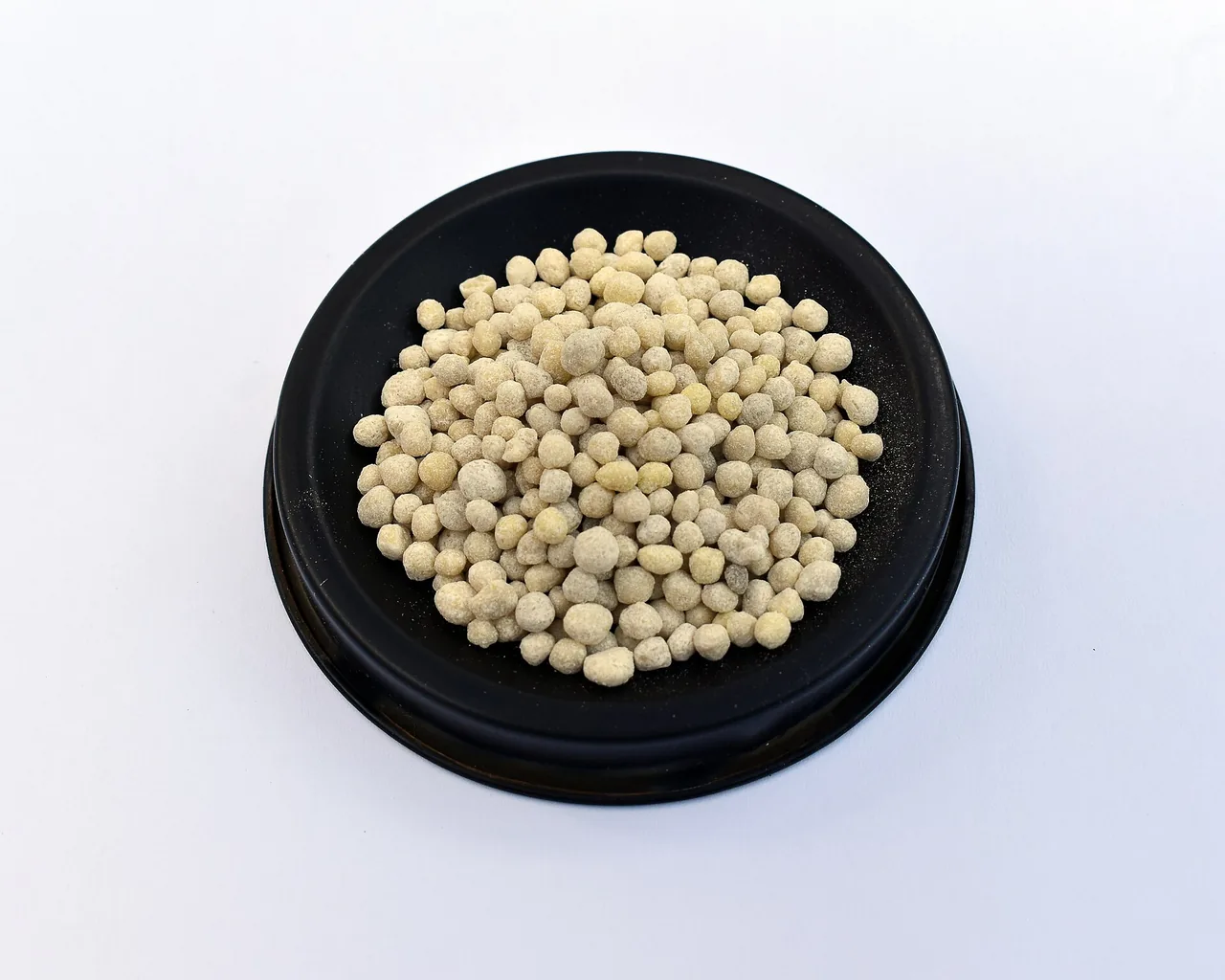
A phosphatic fertilizer is a chemical fertilizer that supplies phosphorus to a crop as phosphate compounds, made by treating phosphate rock with sulfuric, phosphoric or nitric acid or, in the case of finely ground phosphate rock, by milling the rock and spreading it as it is. The family holds single superphosphate, triple superphosphate, monoammonium phosphate, diammonium phosphate, the nitrophosphates and ground rock. Each is sold as a granular or powdered product graded by phosphorus content, nutrient form and physical condition, and each is bought against a guaranteed content that a control laboratory can verify. Straight nitrogen fertilizers such as urea and ammonium sulfate and potassium fertilizers such as potassium chloride enter a phosphatic fertilizer purchase only as blend partners.
Phosphorus in these products is not one substance. Part of it dissolves in water, part dissolves only in an ammonium citrate solution, and the rest stays insoluble, so the same declared percentage can behave differently in soil and in a blender. The acid used to attack the rock decides the impurities that travel with it: calcium sulfate, residual free acid, fluorine compounds and heavy metals such as cadmium. Granule size and strength then decide whether the product arrives as free-flowing granules or as dusty fines and hard lumps. A purchase therefore rests on three papers: the declaration on the bag, the contaminant limits of the market, and a sampling and analysis result for the lot. The rest of the purchase is storage, blending and placement.
Five questions decide a phosphatic fertilizer purchase. First the nutrient form: how much of the declared phosphorus is water-soluble and how much is only citrate-soluble. Second the acid route, which fixes the impurities. Third the physical condition, granule size, crush strength and moisture, which decide dust, caking and flow. Fourth the fit with the rest of the blend and with the soil. Fifth the paperwork: which forms are declared, which tolerance applies, and how the lot was sampled and analyzed. A buyer who answers these five before the first shipment buys nutrient, not trouble.
Chapter 1 / 06
What a Phosphatic Fertilizer Is and How It Works
Every acidulated phosphatic fertilizer starts from phosphate rock, whose phosphorus mineral is fluorapatite. In the wet process the rock is attacked with sulfuric acid, and the net reaction yields phosphoric acid, calcium sulfate and hydrogen fluoride, the calcium sulfate crystallising as gypsum in the dihydrate processes that a 1998 UNIDO fertilizer manual calls the most popular worldwide. The reaction runs in two stages inside one reactor: phosphoric acid first forms monocalcium phosphate with the apatite, and sulfuric acid then converts that salt into phosphoric acid and calcium sulfate. Impurities in the rock, and a higher lime to phosphorus ratio than pure fluorapatite carries, both consume acid, and the hydrogen fluoride reacts with silica and other minerals, so compounds form in the acid that reappear later in the finished fertilizer.
Acidulation turns the phosphorus of the rock into three analytical classes. Water-soluble phosphate dissolves when the sample is leached with water: it is the monocalcium phosphate of the superphosphates and the ammonium phosphates. The residue is then leached with neutral ammonium citrate, and what dissolves is citrate-soluble phosphate; in nitrophosphates it consists mainly of dicalcium phosphate. What still remains is the citrate-insoluble fraction, chiefly unreacted rock, and it does not count as available. The sum of the water-soluble and citrate-soluble fractions is the available phosphate guaranteed on a United States label, and an extension article reviewed in 2018 describes the same two-step laboratory procedure. Neutral and alkaline ammonium citrate solutions were adopted because they dissolve the products of acidulation but were assumed to leave unreacted rock, a 1998 manual notes.
Single superphosphate is made by mixing finely ground rock, about 90% finer than 100 mesh, with sulfuric acid diluted to 68 to 75%, as recorded in a 1998 process description. The overall reaction gives monocalcium phosphate and calcium sulfate, with hydrogen fluoride as a by-product, and it runs in two stages: the first finishes quickly, while the second, in which phosphoric acid attacks fresh rock, continues for days or weeks. The mix sets in a den, is dug out after 0.5 to 4.0 hours at about 100 degrees Celsius (212 degrees Fahrenheit), and then cures in a storage pile for 2 to 6 weeks, during which free acid, moisture and unreacted rock decrease and the available and water-soluble phosphorus increase. Usually 25% or more of the fluorine leaves as gas and must be recovered.
Triple superphosphate is made with phosphoric acid instead of sulfuric acid, so no calcium sulfate is formed and the product concentrates to a usual 44 to 48% phosphorus pentoxide, of which roughly 25 to 30% comes straight from the rock. The reactivity of the rock matters more here than in phosphoric acid production, and unreactive rocks need unusually fine grinding or long reaction times or both. In the 1998 manual the mix sets in 5 to 20 minutes, cures for up to 1 month, and is then dug out and broken in a cage mill to pass a 6-mesh (3.3 mm) screen as run-of-pile material, or it is granulated directly into denser and stronger granules. The den or belt is enclosed and vented to a scrubber, and much of the fluorine stays in the product.
Monoammonium and diammonium phosphate come from phosphoric acid and ammonia. Wet-process acid of average impurity content yields 18-46-0 diammonium phosphate and 11-55-0 monoammonium phosphate. Granular diammonium phosphate is made by a slurry process, 1998 data show: acid reacts with ammonia in a preneutralizer held at an ammonia to phosphate mole ratio of about 1.4, the heat of reaction boils the slurry at about 115 degrees Celsius (239 degrees Fahrenheit) and leaves it with about 16 to 20% water, and more ammonia in the granulator raises the ratio to about 2.0 so that granules form. The granules are then dried, screened and cooled, undersize and crushed oversize return as recycle, and ammonia escaping the equipment is recovered by scrubbing with weak acid.
Nitrophosphates are made with nitric acid, which spares sulfuric acid and adds nitrogen to the product. In a 1998 process description, acidulating the rock raises the liquor to 50 to 60 degrees Celsius (122 to 140 degrees Fahrenheit), and cooling it to 15 to 20 degrees Celsius (59 to 68 degrees Fahrenheit) crystallises about 60% of the calcium nitrate, which is filtered off. Ammoniating the remainder should split the phosphorus evenly between ammonium phosphate, which is water-soluble, and dicalcium phosphate, which is citrate-soluble, but the usual water solubility is only 30 to 40% because most rocks carry more calcium than pure fluorapatite. Cooling to about minus 5 degrees Celsius removes about 85% of the calcium nitrate and lifts water solubility to 80 to 85%; mixed-acid plants add phosphoric acid instead.
Chapter 2 / 06
Phosphatic Fertilizer Types and Material Variants
The two superphosphates are straight phosphates without nitrogen. Ordinary or single superphosphate usually contains 16 to 22% phosphorus pentoxide and keeps its calcium sulfate, while concentrated or triple superphosphate usually contains 44 to 48%, both figures from 1998. An extension article of 2018 lists ordinary superphosphate at 21% total and 20% available phosphorus pentoxide with 85% of the total water-soluble, and concentrated superphosphate at 45% total and 45% available, also 85% water-soluble. Both are sold as powder or as granules. Run-of-pile triple superphosphate is the form a compound fertilizer plant buys as an intermediate, and the granular form is the one spread on fields or blended.
Monoammonium and diammonium phosphate are the concentrated carriers, and both carry nitrogen, so a phosphorus purchase always brings nitrogen with it. The same 2018 table lists monoammonium phosphate at 11% nitrogen, 49% total and 48% available phosphorus pentoxide with 82% of the total water-soluble, and diammonium phosphate at 18% nitrogen, 47% total and 46% available with 90% water-soluble. The pure salts would analyze higher, at 21.19% nitrogen and 53.76% phosphorus pentoxide for diammonium phosphate, but wet-process acid carries impurities that dilute them. A producer safety data sheet for an 18-46-0 product describes the material as 70 to 90% diammonium phosphate with 5.5 to 7.5% ammonium sulfate, sold as gray, tan, brown or black granules with a slight ammonia odor.
Nitrophosphates are nitrogen and phosphorus compounds whose water solubility depends on how much calcium was removed before ammoniation. A 1998 manual gives most plants a 1 to 1 ratio of nitrogen to phosphorus pentoxide, in grades such as 20-20-0, and notes that in a mixed-acid process a product with 40% of its phosphorus pentoxide water-soluble takes 62% of that phosphorus pentoxide from phosphoric acid and 38% straight from rock. The water-insoluble part is soluble in neutral ammonium citrate and consists mainly of dicalcium phosphate. Under EU labeling rules a solid fertilizer may be called complex only if each physical unit contains all the declared nutrients in their declared content, which separates a nitrophosphate granule from a dry blend.
Finely ground phosphate rock is the unacidulated member. It is effective only on acid soils of pH 6 or less, more effective in warm and moist soils and on crops with a long growing season, and the 1998 manual finds little gain from grinding finer than about 90% through 100 mesh (0.147 mm). It is dusty to handle, granulated rock in 1 to 4 mm granules gave poor first-crop results, and very little of it was still in agricultural use in 2018, according to an extension article that lists rock at 34% total but only 3% available phosphorus pentoxide. EU rules grade soft ground rock by its solubility in formic acid.
Physical form is the second axis of the family. EU labels admit four forms: granules, pellets, powder with at least 90% by mass passing a 1 mm sieve, and prills. 1998 data show granular diammonium phosphate for bulk blending at 1.5 to 3.3 mm (0.06 to 0.13 in) or 2.5 to 4.0 mm (0.10 to 0.16 in). Crush strength decides whether those granules survive: in crushing tests on granules between 7 and 8 mesh, diammonium phosphate was the hardest at up to 11.5 lb (5.2 kg), granules below about 3 lb (1.4 kg) are too weak for good handling, and 5 lb (2.3 kg) or above is desirable. Dust comes from unremoved fines, weak granules, conditioner dust that does not adhere, and fine crystals forming on granule surfaces.
The boundary of the family is the nutrient it carries. Urea, ammonium nitrate, ammonium sulfate and ammonium chloride are straight nitrogen fertilizers, and potassium chloride and potassium sulfate are potassium fertilizers; they enter a phosphatic fertilizer purchase only as blend partners, and a product that carries two or three nutrients is a binary or tertiary fertilizer. Upstream sits the acidulation plant, where rock ground in a ball mill meets acid in a den or a preneutralizer and a wet scrubber takes the fluorine-bearing gas. Downstream sit the blender, the bagging line and the spreader, and between them a laboratory whose quinoline and ammonium citrate solutions are bought as chemical reagent grades.
Chapter 3 / 06
Phosphatic Fertilizer Key Specification Parameters and Standards
Grade is the first parameter and it is declared in forms. In the United States the guaranteed figure is available phosphate, the phosphorus pentoxide soluble in neutral ammonium citrate including the water-soluble part. EU labeling rules for an inorganic macronutrient fertiliser allow four statements of phosphorus pentoxide: total, water-soluble, soluble in neutral ammonium citrate and, where soft ground phosphate is present, soluble in formic acid. A straight solid fertiliser declaring phosphorus alone must hold at least 12% by mass of total phosphorus pentoxide, and the phosphorus must be in the phosphatic form with at least one of three solubility levels: 40% of total phosphorus water-soluble, 75% soluble in neutral ammonium citrate, or 55% soluble in formic acid for soft rock. Multiplying phosphorus pentoxide by 0.4364 gives elemental phosphorus.
The second group of parameters covers impurities and contaminants. Regulation (EU) 2019/1009 caps cadmium at 60 mg/kg phosphorus pentoxide in an inorganic macronutrient fertiliser holding 5% phosphorus pentoxide or more, and at 3 mg/kg dry matter below that content. The same list limits hexavalent chromium to 2 mg/kg dry matter, mercury to 1 mg/kg, nickel to 100 mg/kg, lead to 120 mg/kg and arsenic to 40 mg/kg, with copper at 600 mg/kg and zinc at 1,500 mg/kg unless either was added as a micronutrient. A low cadmium claim is allowed at 20 mg/kg phosphorus pentoxide or lower. The regulation has been amended since it was adopted, and its consolidated text keeps these limits. Moisture and free acid complete the list: single superphosphate usually holds 6 to 10% moisture in 1998 data, and its free acid falls during curing.
The third group covers how those numbers are measured. ISO 6598 determines phosphorus by precipitating orthophosphate as quinoline phosphomolybdate in an acid medium with acetone at approximately 75 degrees Celsius (167 degrees Fahrenheit), then filtering, washing, drying and weighing the precipitate. The extraction that separates the forms is older practice: a 1998 manual describes the AOAC neutral ammonium citrate extraction as 1 g of sample in 100 ml of solution for 30 minutes at 65 degrees Celsius (149 degrees Fahrenheit). EU tolerance rules allow a declared form of phosphorus pentoxide to deviate by 20% relative, but by no more than 1.5 percentage points, and granulometry by 10% relative. One producer lists pH 7.0 to 8.0 in a 1% solution for diammonium phosphate, a reading a pH meter reproduces on a received lot.
Parameter
Typical value or requirement
What it decides
Grade, N-P2O5-K2O
DAP 18-46-0; MAP 11-55-0 (1998)
Mass of product per unit of phosphorus
P2O5 in superphosphates
SSP 16 to 22%; TSP 44 to 48% (1998)
Straight or concentrated carrier
Available P2O5, 2018 extension table
OSP 20% of 21%; CSP 45% of 45%
Guaranteed fraction of the mass
Water-soluble share of total P2O5
82 to 90% for MAP, DAP and superphosphates
Release in soil
Minimum, straight solid P fertiliser (EU)
12% by mass of total P2O5
Sale as a straight phosphate
Solubility criterion (EU component material)
40% water-soluble, 75% citrate-soluble or 55% formic acid
Which forms satisfy the declaration
Cadmium (EU)
60 mg/kg P2O5; 3 mg/kg dry matter below 5% P2O5
Market access; low cadmium claim at 20 mg/kg P2O5
Other contaminants (EU)
Cr(VI) 2, Hg 1, Ni 100, Pb 120, As 40 mg/kg dry matter
Impurity load from the rock
Moisture
SSP usually 6 to 10% (1998)
Caking, bag strength, nutrient per tonne
Granule size
DAP 1.5 to 3.3 mm or 2.5 to 4.0 mm (1998)
Spreading and blend segregation
Crush strength (1998)
Below 3 lb (1.4 kg) weak; 5 lb (2.3 kg) desirable
Dust and fines in handling
Loose bulk density (one DAP)
895 to 960 kg/m3 (56 to 61 lb/ft3)
Store volume and bag weight
Decomposition temperature (one DAP)
155 degrees Celsius (310 degrees Fahrenheit)
Drying, heating and fire limits
Tolerance (EU)
P2O5 forms 20% relative, max 1.5 points
How far a lot may deviate from its label
Chapter 4 / 06
Phosphatic Fertilizer Selection and Duty Calculations
Selection runs in a fixed order. Fix the nutrient form for the soil and the placement, convert the nutrient rate into a product mass, check the blend and the storage conditions, then fix how each lot is sampled, analyzed and accepted. Each step has a number attached to it.
Form follows soil and placement. The 1998 manual finds ground rock more effective in warm climates, in moist soils and on crops with a long growing season, and less effective for short-season crops grown in cool soil, particularly in the first year. Within the ammonium phosphates, monoammonium phosphate creates an acidic zone around each granule and diammonium phosphate a basic zone, so a 2018 extension article expects MAP-based material to do better on high-pH and calcareous soils, at least in theory. The same article warns that in drill-row or pop-up placement diammonium phosphate carries approximately 60% more nitrogen, a potential ammonia injury to germinating seeds in dry soils. Where phosphorus is needed without nitrogen, a superphosphate is the straight choice.
The rate calculation converts a nutrient recommendation into a mass of product and a nitrogen credit. A recommendation of 30 lb per acre (34 kg per hectare) of phosphorus pentoxide needs about 65 lb per acre (73 kg per hectare) of 18-46-0, the example worked in that extension article; multiplying the 65 lb by 0.18 shows that about 12 lb per acre (13 kg per hectare) of nitrogen arrives with it. To work in elemental phosphorus, divide by 0.4364 or multiply by 2.2914. Banding raises efficiency: the article states that banded phosphate can be applied at one half of the recommended broadcast rate, and that fertilizer placed on the seed should be kept to a low rate because salts or ammonia near the seed can reduce emergence.
Blend calculations are about matching. Segregation in a dry blend is governed by particle size, and a 1998 manual cites agreement of size distribution curves within plus or minus 10 percentage points as the working criterion. Chemistry sets the second limit. The only completely incompatible pair in its compatibility chart is ammonium nitrate with urea, but urea with single or triple superphosphate carries a limited rating and can turn incompatible when the superphosphate is wet, and triple superphosphate is in any case poorly suited to blending with urea. The critical humidity of a blend of two materials is usually lower than that of either alone. A capped glass bottle of fresh blend held at 30 degrees Celsius (86 degrees Fahrenheit) for 1 day to several months shows wetting, caking or gas.
Storage has its own duty figures. A 1998 manual finds that diammonium phosphate usually needs cooling only to about 71 degrees Celsius (160 degrees Fahrenheit) before storage, while mixtures of urea with unammoniated superphosphate need about 54 degrees Celsius (130 degrees Fahrenheit) to stop urea hydrolysis and the loss of water solubility, and it advises cooling to that lower temperature before bagging to protect the bags. Pressure is the other variable: a stack of 20 bags is moderate, and the bottom bag of such a stack of 50 kg (110 lb) bags carries about 6.4 pounds per square inch (0.45 kilograms per square centimeter), so caking products go in lower stacks or on a pallet rack.
Cost is reckoned per unit of nutrient, never per tonne of product: price divided by the available phosphorus pentoxide fraction, less a credit for nutrient carried alongside, such as the nitrogen of an ammonium phosphate. The 1998 manual notes that a given amount of phosphoric acid yields more fertilizer phosphorus as triple superphosphate than as ammonium phosphate. Verification is the last calculation. ISO 14820-1 specifies representative sampling of packages and containers up to and including 1,000 kg (2,205 lb), of fluid products and of bulk fertilizers in motion, and does not claim complete statistical sampling plans; ISO 14820-2 covers sample preparation, and the reduced sample is analyzed by ISO 6598. The result is judged against the tolerance rules of the market, not against the label alone.
Decision point
What to check
Where it leads
Soil of pH 6 or less
Reactivity and fineness of the rock
Ground rock can supply phosphorus; acidulate other soils
Seed-row or pop-up placement
Nitrogen carried and soil moisture
Keep diammonium phosphate to a low rate in dry soil
Calcareous or high-pH soil
Zone pH around the granule
Favour monoammonium phosphate over diammonium phosphate
Blend containing urea
Free water and free acid of the phosphate
Superphosphates are limited; run a bottle test first
Bulk blending
Size distribution curves of the ingredients
Match within 10 percentage points (1998 criterion)
Cadmium-regulated market
Cadmium per kg P2O5 of rock and product
60 mg/kg P2O5 as the EU limit; 20 mg/kg for a low cadmium claim
Long storage or long voyage
Moisture, crush strength and temperature at bagging
Cooled, strong granules and low stacks
Chapter 5 / 06
Phosphatic Fertilizer Storage, Handling and Typical Failure Modes
A phosphatic fertilizer is a stable solid, yet most complaints begin after it leaves the plant. Moisture, heat, pressure and abrasion turn good granules into lumps and dust, and the acid products attack the building around them. Storage and handling are specification issues.
The storage rule is dry, cool and unloaded. The diammonium phosphate safety data sheet says to use and store the material in dry, well-ventilated areas, in approved containers kept tightly closed, away from incompatible materials and protected against physical damage, because the material may absorb moisture from the air; its listed incompatibility is alkaline material. Triple superphosphate has an acidic character that deteriorates paper or hemp bags, so bags for superphosphates must resist acid, and non-granular triple superphosphate tends to cake in bags unless about 5% of ground limestone is blended in, a 1998 remedy. Bulk piles carry a pressure that grows with height and bulk density, so warm or damp product is never piled high.
Handling equipment is chosen to keep granules whole. A belt conveyor or a screw conveyor moves product with less breakage than a free fall, a bucket elevator lifts it to the screens, and rotary dryers and coolers bring the temperature down before bagging. Cured single superphosphate and run-of-pile triple superphosphate pass through a hammer mill or cage mill and a 6-mesh screen, 1998 data record. A bulk blender weighs each ingredient on a belt scale or a weigh feeder and mixes it in a drum. A bagging line fills each bag on a filling-weighing scale, rejects off-weight units with a checkweigher and closes the bag before it goes onto a pallet.
Corrosion is the second cost of a damp store. The same data sheet lists diammonium phosphate as possibly corrosive to iron and mild steels, aluminum, zinc and copper, so galvanised steel, aluminum and copper fittings are attacked where damp product rests on them, and stainless steel or steel with an industrial coating is the material for hoppers, screens and screws that touch it. Acid services set the rule for concrete: 1998 data credit concrete in a phosphoric acid plant with resisting wet-process acid only when made with acid-resistant aggregate such as siliceous sand and gravel, and advise testing specimens in acidulation slurry before building. Floors and plinths in a fertilizer store deserve the same test: the flooring is chosen against the product it will hold.
Hazard and dust limits are written for the dust, not for the granule. The data sheet classifies its diammonium phosphate as a skin irritant category 2 and eye irritant category 2B with the signal word WARNING, and lists exposure limits for particulates not otherwise regulated: 15 mg/m3 total and 5 mg/m3 respirable as an OSHA permissible exposure limit, and 10 mg/m3 inhalable and 3 mg/m3 respirable for particulates not otherwise specified as an ACGIH threshold limit value, all as time-weighted averages. It advises eye protection, work gloves and ventilation, and a respirator with a type 95 particulate filter where dust exceeds those limits. Heated to decomposition at 155 degrees Celsius (310 degrees Fahrenheit), the material releases oxides of phosphorus, oxides of nitrogen and ammonia.
Housekeeping protects water. The data sheet tells handlers to sweep up spills and package them for disposal and to keep the product out of sewers, storm drains and waterways, because ammonium ions are toxic to fish, un-ionized ammonia above 0.02 mg/l is toxic in fresh water, and phosphates feed algae and deplete oxygen. A site that washes down a blending floor can follow the phosphate in its effluent with a phosphate analyzer before discharge. In transport the product is not regulated, and in the United States it is not listed under CERCLA. A dust detector and a dust particle meter at the transfer points tell when the bag filter is leaking or the hood is blocked.
Symptom or check
Likely cause
Action
Hard lumps in bags or piles
Moisture uptake, warm bagging, stack pressure
Cool to about 54 degrees Celsius (130 degrees Fahrenheit) before bagging, store dry, limit stack height
Product corrosive to mild steel, aluminum, zinc and copper
Use stainless steel or coated steel; keep the product dry
Paper bags weakened
Acidic character of superphosphates
Use acid-resistant bags; bag only cured material
Caked run-of-pile triple superphosphate
Non-granular product bagged
Granulate, or add about 5% ground limestone (1998)
Chapter 6 / 06
Phosphatic Fertilizer Industry Applications and Procurement Checks
The largest use is broadacre agriculture, where a phosphatic fertilizer is broadcast and incorporated before sowing, banded beside or below the seed as a starter, or placed on the seed at a low rate. A 2018 extension article concludes that banding lets a grower cut the recommended broadcast rate in half, that soybean yields more from phosphate broadcast and incorporated than from a band, and that grasses and legumes with shallow roots absorb phosphate broadcast on established stands. Within the family the choice follows soil and crop: a superphosphate where phosphorus is wanted without nitrogen, an ammonium phosphate where both nutrients are welcome, and ground rock only on acid soils.
The industrial customers are compound fertilizer plants, bulk blenders and distributors. A compound plant buys run-of-pile triple superphosphate or nongranular single superphosphate as an intermediate and granulates it with nitrogen and potassium salts, or makes its nitrophosphate on site, with a moisture analyzer at the dryer outlet tracking the endpoint. A bulk blender buys granular diammonium phosphate, monoammonium phosphate or triple superphosphate in matching sizes and mixes them to a formula shortly before spreading, where segregation of unmatched sizes is the main defect. Distributors and cooperatives re-bag imported product under their own label and take the declared grade and the sampling behind it on their own account.
Cost and lead time follow from the raw material and the route. Phosphorus comes from rock whose cadmium and impurity content differ by deposit, and the acid and ammonia come from sulfuric, nitric and ammonia plants, so the price of a tonne moves with mining and with those inputs. Grinding, acidulation, curing and granulation are conversion steps, each with a cost; a 1998 manual rates the direct granulation of triple superphosphate cheaper than granulating cured material. Lead time lengthens with ocean freight in bulk or in bags, with bagging at destination and with laboratory release of a lot. A buyer holds cost down by buying on available phosphorus pentoxide rather than on total.
A purchase order for a phosphatic fertilizer should state the product and the form: single superphosphate, triple superphosphate, monoammonium phosphate, diammonium phosphate, nitrophosphate or ground rock, and granules, pellets, powder or prills. State the grade as nitrogen, phosphorus pentoxide and potassium oxide, and the forms of phosphorus pentoxide declared: total, water-soluble, neutral ammonium citrate soluble, and formic acid soluble for soft ground rock. State contaminant limits, cadmium per kg of phosphorus pentoxide first, then arsenic, lead, nickel, mercury and hexavalent chromium. State moisture, free acid and granulometry as the percentage passing a named sieve. Name the packaging, 50 kg (110 lb) bags on pallets, bulk bags up to 1,000 kg (2,205 lb) or bulk, and the cooling required before bagging. Ask for the safety data sheet, a certificate of analysis for every lot, and the sampling and analysis standards, ISO 14820-1, ISO 14820-2 and ISO 6598. Agree the tolerance rule, keep a sealed retain sample of each lot, and pay on available phosphorus pentoxide.
FAQ
What is a phosphatic fertilizer and what does it do for a crop?
A phosphatic fertilizer is a chemical fertilizer that supplies phosphorus as phosphate compounds made from phosphate rock. The rock is treated with sulfuric acid to give single superphosphate, with phosphoric acid to give triple superphosphate, with phosphoric acid and ammonia to give monoammonium and diammonium phosphate, or with nitric acid to give nitrophosphates; finely ground rock is used without acid. In the soil the water-soluble and citrate-soluble fractions dissolve and supply the orthophosphate that roots take up, while the citrate-insoluble fraction stays where it is. The products are spread broadcast, banded near the seed or applied in a blend.
What is the difference between single and triple superphosphate?
The acid sets them apart. Single superphosphate is made with sulfuric acid and keeps the calcium sulfate, so it usually carries 16 to 22% phosphorus pentoxide. Triple superphosphate is made with phosphoric acid, forms no calcium sulfate and concentrates to 44 to 48%. It sets faster in the den, cures in up to 1 month instead of 2 to 6 weeks and attacks paper and hemp bags, in 1998 figures. A 2018 extension table lists 20% available phosphorus pentoxide for the ordinary grade and 45% for the concentrated grade, 85% of it water-soluble in both.
What do water-soluble, citrate-soluble and citrate-insoluble phosphate mean?
They are three analytical fractions of the same phosphorus. In the laboratory a sample is first leached with water; the phosphate that dissolves is water-soluble and is the monocalcium phosphate of superphosphates or the ammonium phosphate of MAP and DAP. The residue is then leached with neutral ammonium citrate, and what dissolves is citrate-soluble, mostly dicalcium phosphate in a nitrophosphate. What remains is citrate-insoluble, chiefly unreacted rock, and it is not counted. Water-soluble plus citrate-soluble is the available phosphate. In an extension table of 2018, 85% of the phosphorus pentoxide of superphosphates, 82% of MAP and 90% of DAP was water-soluble.
How is phosphorus content declared on a phosphatic fertilizer label?
By grade and by form. The three-number grade, for example 18-46-0, gives nitrogen, phosphorus pentoxide and potassium oxide as percent by mass; multiplying the oxide by 0.4364 converts it to phosphorus. EU rules let a label state total, water-soluble and neutral ammonium citrate soluble phosphorus pentoxide, and formic acid soluble phosphorus pentoxide where soft ground phosphate is present. The label must also give granulometry as the percentage passing a stated sieve and the physical form among granules, pellets, powder and prills. Tolerances allow a declared form of phosphorus pentoxide to deviate by 20% relative, but by no more than 1.5 percentage points.
Which phosphatic fertilizer should a buyer choose: DAP, MAP, TSP, SSP or ground rock?
Start from the soil, the placement and the blend. DAP carries 18% nitrogen against 11% for MAP in a 2018 extension table, and in seed-row or pop-up placement its extra nitrogen can injure germinating seeds in dry soil. MAP, which makes an acidic zone around the granule, is expected to do better on calcareous soils. TSP and SSP supply phosphorus without nitrogen and are the straight choice where a blend already carries enough nitrogen; urea with either has only limited compatibility and turns incompatible when the superphosphate is wet. Ground rock suits only acid soils of pH 6 or less.
How should phosphatic fertilizer be stored and handled to stop caking and dust?
Keep it dry, cool and under low pressure. Diammonium phosphate needs cooling only to about 71 degrees Celsius (160 degrees Fahrenheit) before storage, while material containing urea and unammoniated superphosphate should reach about 54 degrees Celsius (130 degrees Fahrenheit) to avoid losing water solubility, in 1998 figures. A 20-bag stack counts as moderate; higher stacks are only for products of low caking tendency, and a 20-bag stack of 50 kg bags presses about 6.4 pounds per square inch on the bottom bag. Because the product absorbs moisture from the air, keep bags closed in a ventilated store, use acid-resistant bags for superphosphates, and vent transfer points to a dust collector.
What limits apply to cadmium and other contaminants, and how is a lot tested?
Regulation (EU) 2019/1009 caps cadmium at 60 mg/kg phosphorus pentoxide in a phosphate fertiliser, meaning an inorganic macronutrient fertiliser with 5% phosphorus pentoxide or more, and at 3 mg/kg dry matter below that content; hexavalent chromium, mercury, nickel, lead and arsenic are limited to 2, 1, 100, 120 and 40 mg/kg dry matter. A lot is sampled by ISO 14820-1, prepared by ISO 14820-2 and analyzed for phosphorus by ISO 6598, a gravimetric method. For dust, one producer's data sheet for DAP lists 15 mg/m3 total and 5 mg/m3 respirable as an OSHA permissible exposure limit and classifies the product as a skin and eye irritant.