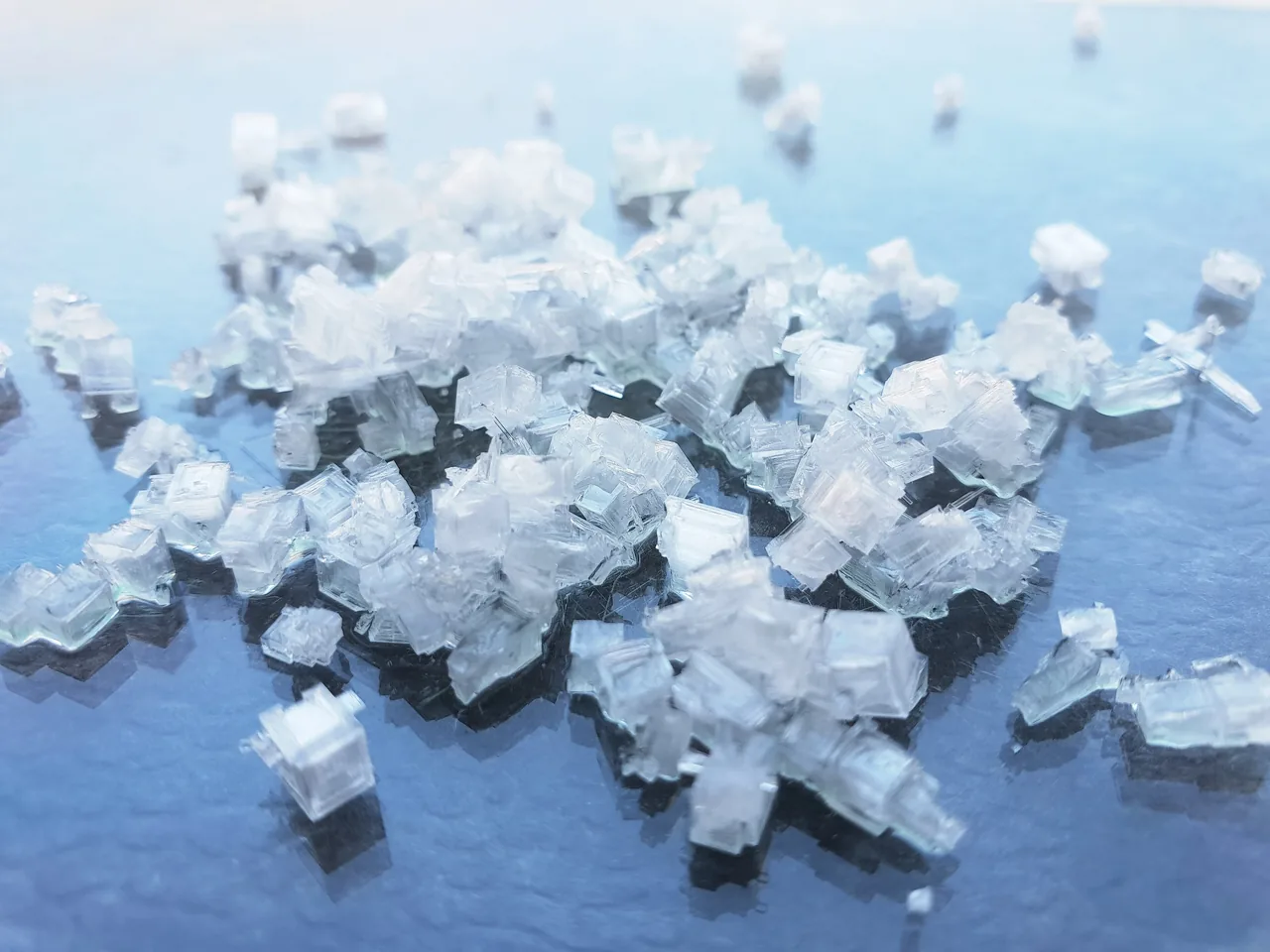
Ammonium chloride is the inorganic salt that forms when ammonia and hydrogen chloride combine, written NH4Cl and known for centuries as sal ammoniac. It is a white, odorless, crystalline solid with a molar mass of 53.49 g per mole, sold as a fine or coarse powder, as cubic crystals, as granules or as lumps. It dissolves freely in water to give a faintly acidic solution, absorbs moisture from damp air and cakes, and when heated it does not melt but splits back into ammonia and hydrogen chloride. Those four behaviors, dissolution, acidity, caking and reversible decomposition, explain nearly everything on its certificate of analysis and most of what goes wrong with it in a plant.
The page is for the engineer or buyer who has to pick a grade, write the purchase specification, and keep a bath or a bagging line out of trouble. The chapters set out its physical and chemical behavior, the production routes and the grade ladder, the certificate parameters and the regulations that attach to food, fertilizer, battery and pharmacopoeia material, the selection and make-up calculations, storage, handling and failure modes, and the applications with their purchasing checks. Property values come from the chemical record kept by the US National Institutes of Health and from the international chemical safety card issued by the ILO and WHO. The exposure limits are the OSHA figures, and the food, pharmacopoeia and galvanizing statements rest on the US regulation, the USP monograph preview and the galvanizers association process page.
Four questions settle an ammonium chloride order. Which grade, because a fertilizer material, a dry-cell electrolyte and a food additive are one salt under different impurity limits. Which regulatory basis, because food and pharmaceutical uses are tied to named texts. Which form and packaging, because a hygroscopic salt that cakes is only as good as its moisture barrier. Which exposure controls, because the dust irritates and heat turns the salt into ammonia and hydrogen chloride. Each answer comes from the use, and the use is the buyer's to state.
Chapter 1 / 06
What Ammonium Chloride Is and How It Behaves
Ammonium chloride is an inorganic salt with the formula NH4Cl and CAS number 12125-02-9, built from one ammonium cation and one chloride anion. Its mineral form, deposited as a sublimate around volcanic vents and on burning coal dumps, is called sal ammoniac, and that name still heads safety cards and catalog entries. The molar mass is 53.49 g per mole, and because each mole carries one atom of nitrogen the pure salt is approximately 26% nitrogen by weight. The salt has no moving parts and no mechanical function. Its job is to deliver ammonium ions and chloride ions into a solution, or ammonia and hydrogen chloride into a hot gas stream, and every industrial use is one of those two deliveries.
In water the crystal lattice comes apart into separate ammonium and chloride ions, and the dissolving is strongly endothermic, with a heat of solution of about 72 cal/g. Solubility rises steeply with temperature: 294 g per liter at 0 degrees Celsius, 383 g per liter at 25 degrees Celsius and 740.8 g per liter at 100 degrees Celsius (212 degrees Fahrenheit). The solution is a weak acid: at 25 degrees Celsius a 1% solution reads pH 5.5, a 3% solution pH 5.1 and a 10% solution pH 5.0, and a 5% solution by mass falls between pH 4.6 and 6.0. With a strong base such as sodium hydroxide it releases ammonia, which is the chemistry that lets it act as a slow acid donor.
Heating reverses the reaction that made it. At atmospheric pressure ammonium chloride does not melt; it sublimes at about 338 degrees Celsius (640 degrees Fahrenheit), leaving as ammonia and hydrogen chloride that recombine on any cool surface as a white smoke of fine crystals. The vapor pressure tells the same story lower down: about 1 Pa at 91 degrees Celsius, 100 Pa at 159 degrees Celsius and 10 kPa at 263 degrees Celsius. Decomposition absorbs 176.1 kJ per mole. Under pressure the salt melts instead, and its triple point is reported near 520 degrees Celsius (968 degrees Fahrenheit). A dryer must therefore stay well below the sublimation range, and any vessel in which the salt gets hot has to be vented so that recondensed salt cannot block ducts or drip back as fume.
The salt is somewhat hygroscopic and has a marked tendency to cake. Moisture absorbed at crystal surfaces dissolves a little salt, forms bridges between crystals, and then dries into solid welds, so that a free-flowing bag arrives as hard lumps that will not discharge from a hopper or dissolve at the intended rate. Temperature cycling drives the same cycle faster. Water is not the only thing that moves: over prolonged storage the solid tends to lose ammonia and become more acidic, which shifts the pH of the solution made from an old lot. Concentrated solutions have their own limit and may crystallize when exposed to low temperatures, so a saturated make-up left in an unheated line will block it.
The solution is a mildly acidic chloride brine, and chlorides are aggressive to many of the metals plants are built from. The international safety card records that ammonium chloride attacks copper and its compounds, and the NIOSH note in the NIH record adds that it corrodes most metals at high temperatures, so a fire is an equipment problem as well as a gas problem. It also reacts with materials often stored nearby: it must be kept apart from ammonium nitrate and potassium chlorate, with which it reacts violently, and it forms a sensitive explosive compound with silver salts. Strong acids, strong bases and strong oxidizing agents are listed as incompatible.
Every application rests on one of three chemical actions. As a flux, the salt or its vapor reacts with the metal oxides on a workpiece and converts them into volatile metal chlorides, leaving a clean surface that molten zinc or solder can wet; hot-dip galvanizing uses it in the form of a zinc ammonium chloride solution. As an electrolyte, it supplies the ionic conduction inside a zinc-carbon dry cell. As a chemical reagent, it is an acid donor, a source of ammonium ions and one half of the ammonia buffer pair: it hardens formaldehyde-based adhesives, works as a mordant in dyeing and printing, and supplies nitrogen to crops. The action decides which impurity matters.
Chapter 2 / 06
Ammonium Chloride Grades and Forms
Three routes make ammonium chloride. The oldest neutralizes the ammoniacal liquid from the destructive distillation of coal with hydrochloric acid and then purifies the crude salt. In direct neutralization, ammonia vapor from a synthetic ammonia process is absorbed in hydrogen chloride or in aqueous hydrochloric acid; the reaction is very exothermic, and when aqueous acid is the feed that heat evaporates much of the water before batch or continuous crystallization recovers the salt. The third route is a double decomposition with sodium chloride, the cheapest chlorine source, which is also the chemistry of the Solvay process for sodium carbonate: ammonium chloride crystallizes from the filtrate, is separated, washed and dried. A plant therefore centers on an acid-resistant neutralizer such as a jacketed reactor, a crystallizer, a filter press or centrifuge, and a dryer such as a fluid bed dryer.
The route leaves its fingerprint on the certificate. The principal impurity of commercial material is sodium chloride, which enters with the salt in every double-decomposition process, and commercial material is commonly described as containing 99.5 to 99.8% NH4Cl. In the ammonium sulfate variant of that process, ammonium sulfate and sodium chloride are dissolved together and kept hot and agitated, sodium sulfate is filtered off, the ammonium chloride liquor is concentrated and cooled in acid-resistant pans, and the crystals are washed with water to remove sulfate and dried. Direct neutralization is chosen where surplus hydrogen chloride is available. Refined, battery and pharmacopoeia grades close the remaining gap by recrystallization from purified solution.
The solid is sold in several physical forms, and the form is a specification item in its own right. The NIH record lists colorless cubic crystals, a white fine or coarse crystalline powder and white granular powder, and it describes technical material as lump or granulated, with rods and granules also available. Powder dissolves fastest and dusts most. Crystals and granules flow better, dust less and pack more densely into a sack. Blocks and rods suit tinning and soldering work, where a piece is touched to a hot iron. A granular fertilizer material is a step further again: it is sized to spread by machine and to resist dust and caking in the sack, and particle size is stated where the use needs it.
The grade ladder runs from technical to pharmacopoeia, and the chemical record itself lists technical material in lump or granulated form, chemically pure material, United States Pharmacopeia material and Food Chemicals Codex material. Technical grade is the workhorse for fluxes, galvanizing, dyeing and adhesives, with sodium chloride as the main remainder. Refined and battery grades tighten iron, heavy metals and moisture, typically to a few parts per million, because iron and copper darken a bath and shorten cell life. Fertilizer grade is guaranteed by its nitrogen content, about 25 to 26%, and by its handling quality rather than by salt purity. Food grade must meet the Codex monograph that US rules incorporate by reference. Pharmacopoeia grade must show 99.5 to 100.5% NH4Cl on the dried basis. Reagent grade adds limits on trace cations.
Ammonium chloride is one chemical substance, and several neighbors are mistaken for it. The chemical reagent leaf describes reagent products in general, their purity names, packaging and test methods; this page describes one salt and the grades it is sold in. An ammonia analyzer is an instrument that measures ammonia in a gas or in water, useful for watching a dissolving station or a flux bath for leaks. Ammonia, the industrial gas that is one of its raw materials, and hydrogen chloride are separate purchases with their own hazards. The double salt zinc ammonium chloride, and the fertilizers ammonium sulfate and ammonium nitrate, are different products. This salt sits between an ammonia source and a hydrogen chloride source upstream, and between a lined sack and a dissolving tank, a flux bath or a cell downstream.
Chapter 3 / 06
Ammonium Chloride Specifications and Standards
A certificate of analysis for ammonium chloride carries a short and consistent list of lines. Assay states the NH4Cl content, on an as-received or dried basis. Moisture, or loss on drying, states how much water the lot holds at packing. Iron is reported in parts per million because it colors the salt and spoils cells and baths. Heavy metals are reported as lead. Sulfate, or residue on ignition, reports the non-volatile matter left by the production route. pH is measured on a solution of stated concentration at a stated temperature. Insoluble matter and sodium chloride complete the list for refined grades, and the form, whether powder, crystal, granule or lump, is stated with a particle size where the use needs one.
Three uses are tied to a named text. In the United States ammonium chloride is affirmed as generally recognized as safe as a direct human food ingredient under 21 CFR 184.1138: it is used as a dough strengthener, a flavor enhancer, a leavening agent and a processing aid, at levels not to exceed current good manufacturing practice, and the same section requires it to meet the Food Chemicals Codex specification. The Joint FAO and WHO expert committee lists it as INS 510 with an acceptable daily intake not limited, inside a group limit shared with hydrochloric acid and its salts. Pharmaceutical material is held to the United States Pharmacopeia monograph for Ammonium Chloride: not less than 99.5% and not more than 100.5% NH4Cl on the dried basis. Battery and fertilizer grades are set instead by a purchaser's specification and by a fertilizer label.
Occupational exposure is governed by the decomposition products more than by the salt itself. OSHA's Table Z-1 does not list ammonium chloride by name, so its dust falls under particulates not otherwise regulated: 15 mg per cubic meter for total dust and 5 mg per cubic meter for the respirable fraction, both as 8-hour time-weighted averages. NIOSH recommends 10 mg per cubic meter as a 10-hour time-weighted average and 20 mg per cubic meter as a 15-minute short-term limit for the fume. Once the salt is hot enough to decompose, the two gases apply in their own right: hydrogen chloride at a ceiling of 5 ppm, not to be exceeded at any time, and ammonia at 50 ppm as an 8-hour time-weighted average. The harmonized hazard classification is harmful if swallowed and causes serious eye irritation.
Parameter
Typical value or limit
What it decides
Formula and molar mass
NH4Cl; 53.49 g per mol
Dose arithmetic; about 26% nitrogen
Density
1.519 g per cubic centimeter
Hopper load; settling in a dissolving tank
Sublimation point
338 degrees Celsius (640 degrees Fahrenheit)
Drying limit; fume from hot baths
Solubility in water
294 g per liter at 0 degrees Celsius; 740.8 g per liter at 100 degrees Celsius
Make-up strength; crystallization on cooling
Heat of solution
Endothermic; 72 cal per g (about 300 kJ per kg)
Heating of a dissolving tank
pH of solution at 25 degrees Celsius
5.5 at 1%; 5.1 at 3%; 5.0 at 10%
Bath control, corrosion, food and drug use
Assay, NH4Cl
99.5 to 99.8% commercial; 99.5 to 100.5% dried basis (USP)
Purity, dose, regulatory acceptance
Nitrogen content
Approximately 26% by weight
Fertilizer guarantee
Moisture, loss on drying
Typically 0.1 to 1.0%
Caking, flow, cell performance
Iron and heavy metals
Typically 2 to 50 ppm Fe; Pb typically 5 ppm or less
Color, cells, food acceptance
Occupational exposure, US
15 mg per cubic meter total dust; 5 mg per cubic meter respirable
Ventilation and dust collection
Chapter 4 / 06
Ammonium Chloride Selection and Duty Calculations
Selecting ammonium chloride means matching a grade to a use, turning the use into a batch or a bath, and choosing packaging that keeps the grade intact until it is opened. The paragraphs below take the cases that recur: use, dissolving, the flux bath, fertilizer and the pack.
Selection starts with the use, because each use rejects a different impurity. Hot-dip galvanizing and tinning consume technical material, usually as the zinc ammonium chloride double salt prepared on site or bought ready made. Zinc-carbon cell production consumes battery grade, where iron, copper and moisture are the limits that matter. Rice and wheat fertilization consumes fertilizer material guaranteed by its nitrogen. Bakers and food processors consume material that meets the food additive regulation and the Codex specification it incorporates. Pharmaceutical and laboratory work consumes material that complies with the pharmacopoeia or reagent monograph. Adhesives, dyeing and metal finishing take technical or refined grade, depending on whether color and iron would show in the product.
Making a solution is the first calculation, and it is a heat balance as much as a mass balance. At 25 degrees Celsius water dissolves about 39.5 g of ammonium chloride per 100 g of water, which gives a saturated solution of about 28.3% by mass, so a 10% make-up is far below saturation at room temperature. Dissolving is strongly endothermic at about 72 cal/g, roughly 300 kJ per kg of salt, so a batch made quickly from cold water cools itself, slows down and leaves salt on the tank floor. Warm make-up water, an agitator and a heated jacket or a plate heat exchanger keep dissolution brisk.
The flux bath is the second calculation. Hot-dip galvanizing prepares steel in three surface steps before the zinc: degreasing, acid pickling in heated dilute sulfuric acid or ambient hydrochloric acid, and fluxing with a zinc ammonium chloride solution that removes the last oxides and lays a protective layer on the steel so that no new oxide forms. The zinc is held at 435 to 455 degrees Celsius. Ammonium chloride is the volatile half of the double salt: on a hot bath some of it sublimes and leaves as fume, and large amounts of fume are typical over a galvanizing line. Bath control therefore rests on analysis: both salts are determined on a schedule, ammonium chloride is added to restore the ratio, and the bath is exhausted through a wet scrubber.
Fertilizer dosing is the third calculation, and it is a nitrogen and chloride balance. Ammonium chloride is approximately 26% nitrogen by weight, so 100 kg of fertilizer-grade material supplies roughly 26 kg of nitrogen, and because each ammonium ion brings a chloride ion the material suits rice and wheat, the crops on which it is mainly used in Asia, better than it suits chloride-sensitive crops such as avocados, beans and grapes. For a nutrient solution the stated range is 50 to 100 mg of nitrogen per liter of water, equal to about 0.2 to 0.4 g of ammonium chloride per liter. Repeated application acidifies the soil, so soil pH is monitored where the material is used season after season.
Packaging is the fifth decision, and it follows from the caking and corrosion behavior rather than from price. The NIH record advises that ammonium chloride, on account of its corrosive nature and its tendency to cake, is best packed in sacks, or for flowable goods in big bags, of paper or polyethylene rather than plastic or metal drums. In practice that means a multiwall paper sack or a woven polypropylene sack with a polyethylene liner, commonly 25 kg (55 lb), or a lined bulk bag of about 1,000 kg (2,200 lb) for a plant that empties it into a hopper. The liner is the moisture barrier, and one stitch punctured in handling undoes it.
Decision
What drives it
Selection rule
Grade
The use and the impurity it rejects
Technical for flux and dyeing; battery or refined for cells; food or pharmacopoeia grade only with its compliance documents
Production route
Raw material availability and impurity profile
Double decomposition carries sodium chloride; direct neutralization suits a site with surplus hydrogen chloride
Form
How the salt is fed
Powder for fast dissolution; crystal or granule for hopper flow; block or rod for soldering
Assay and nitrogen
Dose per batch or per field; about 26% nitrogen, so 100 kg supplies roughly 26 kg
Convert fertilizer guarantees to nitrogen, not to salt
Solute strength
Lowest temperature the line will see
About 28.3% by mass saturates at 25 degrees Celsius; stay below the coldest-case solubility
Packaging
Consumption rate and handling equipment
Lined 25 kg (55 lb) sacks or lined big bags; drums only with a liner
Exposure control
Dust, fume and heat
Local exhaust at emptying points; scrubbing on hot baths; a fixed gas detector where ammonia can gather
Regulatory status
Country and use
Food: 21 CFR 184.1138 and the Codex monograph; pharmacopoeia: the USP monograph; battery and fertilizer: the purchaser's specification
Chapter 5 / 06
Ammonium Chloride Storage, Handling and Failure Modes
The salt itself is stable and noncombustible, so nearly every failure in storage and handling is a failure of the barrier around it or of the equipment it touches. The paragraphs below follow the store, the operator, the spill, the test bench and the list of failures, in that order.
Ammonium chloride is stored dry, and the guidance is explicit: keep the container tightly closed in a dry and well-ventilated place, and keep the material separated from ammonium nitrate and potassium chlorate. In a plant that means sacks on pallets under a roof, away from hot pipes and from walls where condensation forms, a pallet wrapped in stretch film when it will stand for weeks. Heat and temperature cycling do the damage: a hot spot sublimes salt that redeposits as a crust, and a slow loss of ammonia over a long storage leaves the lot more acidic than its certificate says. Tanks and lines for solutions are built to tolerate a chloride brine, commonly thermoplastic or FRP composite tanks and plastic pipe in polypropylene or PVC-U, glass-lined steel, or a nickel alloy where the liquor is hot and concentrated.
Handling controls dust first and fume second. The salt is an irritant to the eyes, the skin and the respiratory tract; it barely evaporates at room temperature, yet a nuisance concentration of airborne particles is reached quickly when powder is poured. The safety card calls for local exhaust or breathing protection, protective gloves, safety spectacles, and no eating, drinking or smoking during work. The NIH record adds the rule that sets plant layout: provide exhaust ventilation wherever dust is formed. So bag slitting and hopper emptying sit under a hood whose air passes through a bag filter, an eye wash station stands within reach of the dissolving station, safety glasses and gloves are worn for every contact, and where ammonia or hydrogen chloride can be released a fixed gas detector watches the air.
A spill or a fire is handled as a dust and gas problem, never as a fuel problem, because the salt is not combustible. Spilled solid is swept into covered containers, with a particulate filter respirator matched to the dust concentration, and the remainder is washed away with plenty of water; that water must not reach a storm drain, because ammonium chloride is designated a hazardous substance under the US Clean Water Act. A pile left in the rain is covered with a plastic sheet so that it does not dissolve into the ground. In a fire the salt gives off toxic and irritating ammonia and hydrogen chloride, may volatilize and redeposit on cool surfaces, and at fire temperature corrodes most metals. Water spray, alcohol-resistant foam, dry chemical and carbon dioxide are the listed extinguishing media for a fire in the surroundings.
Quality control on site rests on a small set of tests that can be run on every lot. One published method finds ammonium nitrogen by distilling the ammonia off and titrating the distillate with 0.02 N sulfuric acid to a lavender endpoint; it applies above 5 mg per liter. The pH of a solution of stated strength is read on a pH meter and set against the certificate. The strength of a make-up solution and the cleanliness of a rinse are followed on a conductivity meter, because the salt conducts well once dissolved. Moisture is found by loss on drying or on a moisture analyzer. Sulfate, sodium and chloride are separated by ion chromatography, the liquid-phase counterpart of the gas chromatograph; iron by colorimetry on a spectrophotometer; and trace heavy metals by inductively coupled plasma on a mass spectrometer.
Check each sack or bulk bag for tears, damp patches and a crushed liner before it is unloaded, and set aside any pack that has taken up water.
Match the lot number on the pack to the delivery papers and the certificate of analysis, and note the production route if the supplier states it.
Take a composite sample with a clean, dry sampling thief from several packs, so that fine and coarse material are both represented.
Run the two tests that catch most storage and handling faults on site: moisture by loss on drying, and the pH of a 5% solution at 25 degrees Celsius.
Stack the lot on pallets in the dry store with the lot number facing out, and release it to production in arrival order.
Failure mode
How it shows
Cause and action
Caking
Hard lumps, bridging in the hopper or a screw conveyor, slow dissolution
Moisture and temperature cycling; store dry and sealed, keep the liner intact, dry the lot before use
Moisture pickup
Damp patches, a crust at the sack seam, weight gain
Torn liner or a damp pallet; reseal the pack, use the lot first, dry the store
Equipment corrosion
Rust staining, pitting, green copper salts, pinholes in pipe
Chloride brine on carbon steel, galvanized steel or copper alloys; convert to plastic, glass-lined steel, suitable stainless steel or a nickel alloy
Ammonia loss in storage
Solution pH lower than the certificate
Long storage in heat; keep cool, use old lots first, re-certify before a pH-critical use
A near-saturated solution cooled below its solubility; dilute, insulate or drain the line
Flux fume and deposits
White smoke over the bath, white crust on cool surfaces, low ammonium chloride in the bath
Sublimation on the hot bath; extract through a scrubber, restore the bath by analysis
Impurity carry-over
Off-color bath or product, sediment, weak cell performance
Sodium chloride, sulfate or iron from the route; tighten the grade or the wash step with the supplier
Reaction with neighbors
Fire or explosion risk in the store
Stored with ammonium nitrate or potassium chlorate; segregate the materials
Chapter 6 / 06
Ammonium Chloride Applications and Procurement Checks
Metal finishing is the oldest industrial outlet and the one with the clearest process chemistry. Hot-dip galvanizing runs through surface preparation, galvanizing and inspection: after degreasing and pickling the steel passes through a zinc ammonium chloride flux, enters the zinc, and is then judged on coating thickness and surface condition, thickness being read with a coating thickness gauge. Ammonium chloride also serves as a flux in zinc and tin plating, as a pickling agent in zinc coating and tinning, in electroplating and the electrolytic refining of zinc, and in etching solutions for printed circuit boards. In soldering it cleans an oxidized iron tip. A US consumption breakdown from 1984 put soldering and refinishing flux at 30% and galvanizing at 15% of the total.
Batteries and fertilizer are the volume uses, and for different reasons. Ammonium chloride is the electrolyte of the zinc-carbon dry cell, the descendant of the Leclanche cell, and in 1984 dry-cell electrolyte took 35% of US consumption. World-wide the dominant use is as a nitrogen fertilizer, taking about 90% of production, mainly on rice and wheat in Asia. The two uses pull the specification in opposite directions. The cell needs the salt free of iron, copper and moisture, and accepts a fine powder that packs into the cell. The field needs the nutrient in a granule that spreads by machine and does not cake in the sack, and it tolerates sodium chloride that a cell cannot.
The remaining uses are chemical. As a hardener for formaldehyde-based adhesives and in the production of urea-formaldehyde resins, the salt releases acid slowly and sets the glue that bonds plywood; the same acid release is sold into formaldehyde-based binder systems for a resin sand line, a use to confirm with the binder supplier. In textiles and leather it works as a mordant in dyeing and printing and in tanning. Oil-well service companies pump a roughly 5% aqueous solution against clay swelling. Food processors use it as a dough strengthener, flavor enhancer, leavening agent, processing aid and yeast nutrient. In the laboratory its solutions with ammonia serve as buffers.
A purchase specification for ammonium chloride should state five things and ask for three more. State the grade and the text that applies: 21 CFR 184.1138 with the Food Chemicals Codex monograph for food, the United States Pharmacopeia monograph for pharmaceutical material, or the purchaser's own limits for battery and fertilizer use. State the form, powder, crystal, granule, lump or rod, and the particle size where it matters. State the packaging, lined 25 kg (55 lb) sacks or lined big bags, with the liner type named. State the lines the certificate must show: assay, moisture, iron, heavy metals as lead, sulfate or residue on ignition, pH of a stated solution, and sodium chloride. State the transport and regulatory status required, with the safety data sheet. Ask which production route the lot comes from, because it sets the impurity profile. Ask for the certificate of analysis for the exact lot, the packing date and the country of origin; the NIH record gives US production in 2023 as 85,000,000 to under 100,000,000 lb, and a handbook it quotes from 1988 says none was then produced for fertilizer in the USA. Ask for retained samples and a lot traceability format.
FAQ
How does ammonium chloride work as a flux?
Ammonium chloride cleans metal by chemical attack on the oxide. Heated on the workpiece or in a flux bath, it sublimes at about 338 degrees Celsius into ammonia and hydrogen chloride, and these gases, or the salt itself, convert iron and zinc oxides into metal chlorides that volatilize at working temperature. The bare metal left behind is wet by molten zinc or solder. In hot-dip galvanizing it is used as a double salt with zinc chloride: the solution removes the last oxides after pickling and lays a protective layer on the steel before it enters the zinc at 435 to 455 degrees Celsius.
What grades of ammonium chloride are available?
The common ladder is technical, refined, battery, fertilizer, food, pharmacopoeia and reagent grade, all one salt with different impurity limits. Technical grade, sold as powder, granule or lump, serves fluxes, galvanizing, dyeing and adhesives, with sodium chloride as the main remainder. Refined and battery grades tighten iron, heavy metals and moisture for dry-cell electrolyte. Fertilizer grade is guaranteed by nitrogen content, about 26% in the pure salt, and by handling quality. Food grade must meet the Food Chemicals Codex specification that US rules incorporate by reference. Pharmacopoeia grade must contain 99.5 to 100.5% NH4Cl on the dried basis.
Which specifications matter most for ammonium chloride?
Assay comes first: commercial material contains about 99.5 to 99.8% NH4Cl, and the pharmacopoeia monograph requires 99.5 to 100.5% on the dried basis. Moisture is next, because the salt is hygroscopic and cakes; 0.1 to 1.0% is a typical loss on drying. Iron and heavy metals as lead decide whether a lot can enter a cell, a food process or a color-sensitive bath. The pH of a solution matters for electrolyte and bath control: about 5.5 for a 1% solution and 5.0 for a 10% solution at 25 degrees Celsius. Those impurity limits are typical; the applicable text gives the binding numbers.
How do I choose the right grade of ammonium chloride?
Start from the use and work back to the impurities it rejects. For galvanizing, tinning, soldering and dyeing, technical grade is normally enough. For a zinc-carbon electrolyte, specify battery grade with tight iron, copper, heavy-metal and moisture limits. For rice and wheat, buy fertilizer material by its nitrogen guarantee and its granule quality, and keep it off chloride-sensitive crops. For food, require material that complies with 21 CFR 184.1138 and the Codex monograph that section incorporates. For pharmaceutical and laboratory work, require the pharmacopoeia or reagent monograph. Then set the form for the feeding method and the packaging for the storage climate: lined sacks or big bags, kept in a dry store.
How should ammonium chloride be stored and handled?
Keep it dry, closed and separated. The safety card asks for a tightly closed container in a dry, well-ventilated place, stored apart from ammonium nitrate and potassium chlorate, with which it reacts violently, and away from silver salts. The salt is somewhat hygroscopic and cakes after moisture pickup, and over a long storage it loses ammonia and turns more acidic. Handle it as an irritant dust: local exhaust or breathing protection at pouring points, protective gloves and safety glasses. It is not combustible, but heating releases ammonia and hydrogen chloride, so hot processes need extraction and scrubbing. Its solution attacks copper, and it corrodes most metals at fire temperature, so equipment is plastic, glass-lined steel or a resistant alloy.
What drives the cost and lead time of ammonium chloride?
The grade, the route and the moisture barrier drive both. Ammonium chloride is made by neutralizing ammonia with hydrogen chloride, or by double decomposition with sodium chloride; a site's access to those raw materials sets its base cost, and the double-decomposition product carries sodium chloride that extra washing and recrystallization remove. Each step up the grade ladder adds washing, recrystallization, drying and testing, and food or pharmacopoeia grade adds compliance documents. The moisture barrier in the sack adds cost that a hygroscopic, caking salt cannot do without. Lead time lengthens when a lot must be imported: US production in 2023 was 85,000,000 to under 100,000,000 lb, and a 1988 handbook says none was then made for fertilizer.
Is ammonium chloride hazardous, and which standards apply?
It is an irritant with low-grade systemic toxicity and with hazardous decomposition products. The harmonized classification is harmful if swallowed and causes serious eye irritation. OSHA does not list the salt by name, so its dust falls under the particulates not otherwise regulated limits of 15 mg per cubic meter total and 5 mg per cubic meter respirable, while NIOSH recommends 10 mg per cubic meter for the fume as a 10-hour average. The decomposition gases carry their own limits: hydrogen chloride at a 5 ppm ceiling and ammonia at 50 ppm. For food use the governing US text is 21 CFR 184.1138; for pharmaceutical material it is the USP monograph.