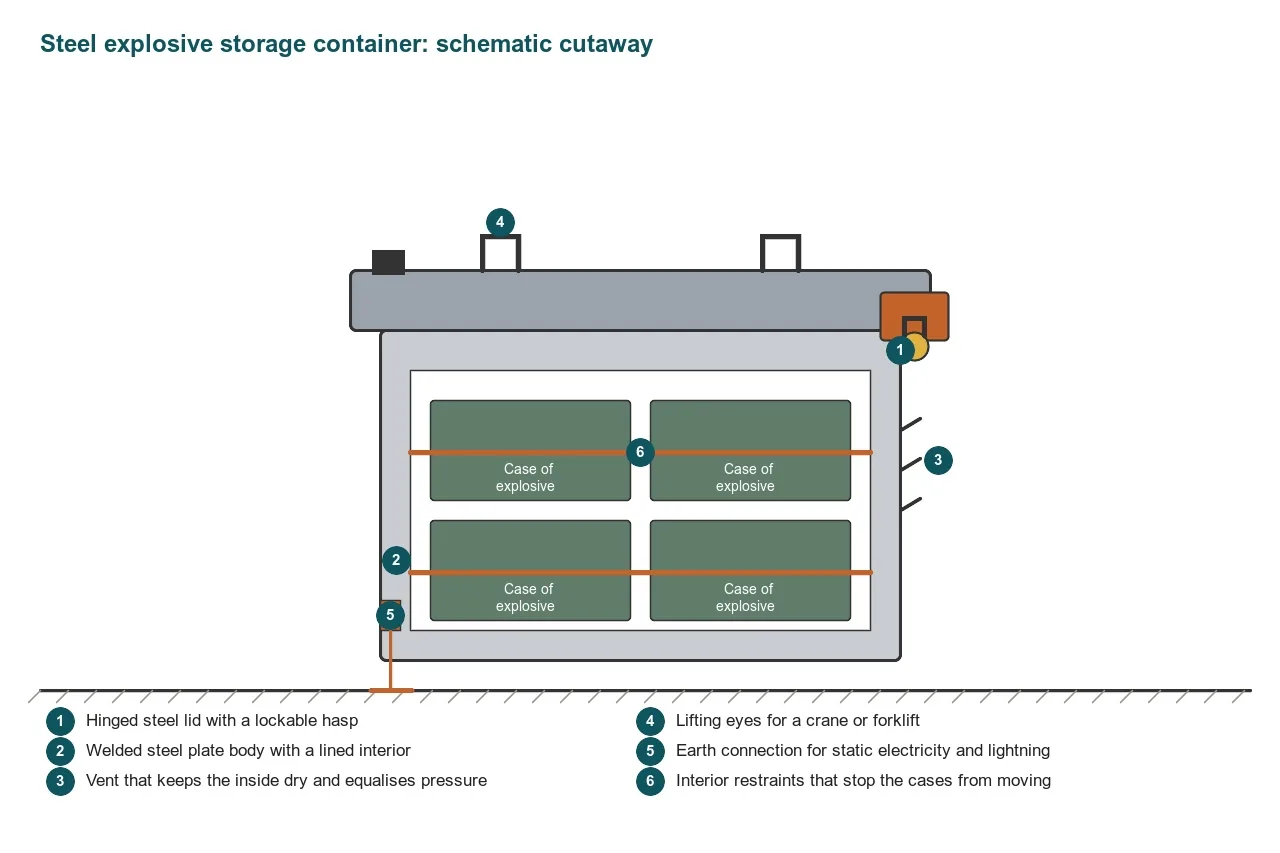
An explosive container is a lockable, ventilated receptacle in which explosives, detonators, fireworks, small arms ammunition and other energetic articles are stored and carried. The family runs from a steel day box one person can carry, through box and trailer magazines, to permanent earth-covered magazines, with ammunition cans and crates inside. United States law calls most of them magazines and sorts them into numbered types by the class of explosive they may hold. The container does not make its contents harmless and is not built to survive the explosion of its own contents: its work is to keep unauthorized people, bullets, sparks, flame and damp away from what is inside, and to keep one initiation from becoming a mass detonation.
Two questions sit in front of every other choice: what class of explosive goes inside, and how much of it. The answers decide which magazine type is allowed, whether it may stand outdoors, and how far it must stand from inhabited buildings, public roads, passenger railways and other magazines. A third question, whether a person attends it at all times, separates a light day box from a heavier box magazine for unattended storage. Climate decides between screened vents alone and heating, insulation or a desiccant system, and the handling route decides between lifting eyes, wheels and a trailer chassis. The container comes with a pad, an alarm and a measured distance on the site plan, and each part constrains the others.
Diagram: SpecForge original drawing of a steel explosive storage container in cutaway, made for this page.
Five things decide an explosive container purchase. First the class and quantity of explosive, which fix the magazine type and the separation distance. Second whether the container is attended, which separates a day box from a magazine for unattended storage. Third the shell and door: plate thickness, non-sparking lining, door overlap, welded hasps and a 5-tumbler padlock. Fourth the climate duty, meaning screened ventilation or active humidity control. Fifth the route it travels, meaning lifting points, handling pockets or wheels, and the placards the law requires on the road. Get these five right and the rest of the order writes itself.
Chapter 1 / 06
What an Explosive Container Is and How It Works
An explosive container has to stop three kinds of harm, and a different feature answers each. Theft and tampering are answered by the lock, the hasp and the door overlap, and by fastening or immobilizing the container. Accidental initiation is answered by keeping bullets, sparks, open flame, static charge and damp away from the contents, and by covering every surface the packages touch with a non-sparking material. Propagation is answered by distance: the container stands off from people, so that an initiation inside it does not reach another store. Under United States rules a permanent magazine and an outdoor box magazine for high explosives must be bullet-resistant, fire-resistant, weather-resistant, theft-resistant and ventilated; day boxes and low-explosive magazines manage without bullet resistance.
The principle is that a small quantity of explosive is far less dangerous when it is the only quantity in its place. Separation comes first. The United States table of distances grows from 70 feet (21.3 m) between a barricaded magazine holding up to 5 lb (2.3 kg) of high explosive and an inhabited building, to 150 feet (45.7 m) for 40 to 50 lb (18 to 23 kg), and a barricade halves the distance, since that quantity needs 300 feet (91.4 m) unbarricaded. Barrier comes second: a steel wall, a hardwood lining, an earth mound or a sand tray keeps a threat out or absorbs part of an event. Controlled access comes third, through locks that cannot be reached with the door shut and an inspection repeated at least every 7 days.
A bullet is answered by the roof and the wall: where a round could pass straight through the roof, the rules accept a metal roof of 0.1875 inch (4.76 mm) plate steel lined with 4 inches (102 mm) of hardwood, or a sand tray holding at least 4 inches (102 mm) of dry sand. A fire outside is answered by the steel shell, the hardwood lining and a coating system that resists abrasion, corrosion and ultraviolet damage. An initiation inside is answered by nothing in the container itself. The Department of Defense puts the limit plainly: its magazines are not designed to resist their own exploding contents and will be heavily damaged or even destroyed by an internal explosion. Their structure is built to resist an explosion outside, which interrupts the propagation chain and so mitigates a sympathetic detonation in the contents or an adjacent magazine.
The working parts are few and each has a job. The shell is welded steel-plate in a portable container, or masonry, metal or wood in a building. The lining covers every interior surface with a non-sparking material, usually plywood, hardboard or hardwood, so that no package rubs on bare steel and no ferrous nail is exposed. The door overlaps the sides by at least 1 inch (25.4 mm), and its hinges and hasp are welded, riveted or bolted with the nuts inside, so that nothing can be undone while the door is shut. The vents are screened against sparks and are offset or shielded against bullets, and the floor and any pallet are non-sparking and strong enough for the maximum quantity stored.
The law sorts the contents before it sorts the containers. United States federal rules recognize three classes: high explosives, which can be made to detonate with a blasting cap when unconfined, such as dynamite; low explosives, which deflagrate when confined, such as black powder and display fireworks; and blasting agents, such as ammonium nitrate and fuel oil. Detonators are kept apart from other explosives in storage. In transport the same materials carry a division from 1.1 to 1.6 and a compatibility group letter; the placard on a vehicle carrying several divisions shows the lowest division aboard, and explosives of different compatibility groups may not travel on one vehicle where the segregation table forbids it.
Because the container does not contain a blast, the rules control where it stands and when it may be opened. United States rules require explosive materials to be kept in locked magazines unless they are being manufactured, physically handled, used or transported, and every outdoor magazine holding high explosives must stand no closer to inhabited buildings, passenger railways, public highways and other magazines than the table of distances allows. A portable day box is lawful only while a person attends it; the contents go back into a Type 1 or Type 2 magazine for unattended storage. A day box is built for short-term transport: it safeguards against theft and against accidental detonation from improper storage and the environment, and it will not contain a blast inside the unit.
Chapter 2 / 06
Explosive Container Types and Structural Variants
United States federal rules define five magazine types, and the type follows the class of explosive and the way the container stands. A Type 1 magazine is permanent: a building, igloo or Army-type structure, tunnel or dugout for high explosives. A Type 2 magazine is mobile or portable, indoor or outdoor, and may be a box, trailer or semitrailer for high explosives. A Type 3 magazine is the day box, a portable outdoor magazine for the temporary storage of high explosives while it is attended. A Type 4 magazine holds low explosives, and may also hold blasting agents and detonators that will not mass detonate. A Type 5 magazine holds blasting agents and may be a bin, box, trailer or building.
Portable steel containers differ in wall thickness and in whether they must stop a bullet. An outdoor Type 2 box has exterior and doors of not less than 0.25 inch (6.35 mm) steel lined with at least 2 inches (50.8 mm) of hardwood, and a lid that carries a gasket or overlaps the sides by at least 1 inch (25.4 mm). An indoor Type 2 box may be of not less than 12-gauge (2.66 mm) sheet with a non-sparking lining. A Type 3 day box is of not less than 12-gauge (2.66 mm) steel lined with at least 0.5 inch (12.7 mm) of plywood or hardboard, and a hand-welded day box of that build weighs 42 lb (19 kg).
Detonators have their own small container. A magazine for 100 or fewer detonators has sides, bottom and doors of not less than 12-gauge (2.66 mm) metal lined with a non-sparking material, hinges and hasps that cannot be removed from outside, and one steel padlock. Larger transport containers are the Type 2 trailer or semitrailer and the mobile Type 4 magazine. An outdoor Type 2 magazine is supported off the ground, on ground that slopes away for drainage, and one smaller than 1 cubic yard is fastened to a fixed object. A vehicular magazine left unattended has its wheels removed or is immobilized by a kingpin lock or another approved method, and Type 5 magazines for blasting agents carry the road transport placards on the magazine itself.
Ammunition arrives inside the magazine in its own packaging. The United Nations ammunition guidelines make an item's hazard classification valid only in its approved package and call for packages to be palletised wherever possible. Loose packages stand on battens that raise them at least 100 mm (3.9 in) off the floor, and they are banded with a strapping-band before they are moved or stacked above ground level. Packaged explosives are stacked to at most 3.7 m (12.1 ft) and packages of detonators to at most 1.5 m (4.9 ft). The can and the crate are the moisture and impact protection for the rounds; the magazine around them supplies the lock, the separation and the weather protection that the law demands.
Permanent magazines add mass and climate control. A Type 1 building has masonry walls at least 6 inches (152 mm) thick; walls of steel or aluminum sheet not lighter than 14-gauge on a metal frame, lined inside with brick, cement block, at least 4 inches (102 mm) of hardwood or a 6 inch sand fill; or wood frame walls covered outside with 26-gauge iron or aluminum sheet around a 6 inch (152 mm) space filled with sand or weak concrete; its doors are of at least 0.25 inch (6.35 mm) plate steel lined with 2 inches (50.8 mm) of hardwood. Shipping containers approved with a reduced net explosive weight fall under separate Department of Defense criteria. Where temperature-sensitive articles are stored, insulation, ventilation or air conditioning holds the interior within its limits.
The boundary around the explosive container is drawn by the contents, not by the shape of the box. A gas-cabinet holds gas cylinders and a tank-container carries bulk liquid or gas; neither is built to the magazine rules. A storage-cage, a flammable-liquid cabinet or a strongroom is theft-resisting storage without a non-sparking lining, a regulated lock or a separation distance, and none of them qualifies as a magazine. The explosive container sits between two site systems. Physical security surrounds it with perimeter-alarm, surveillance-camera and access-control installations inside a safety-fence. Fire protection stands around it rather than inside it: the fire-extinguisher stations, gas fire suppression systems and gas-detector instruments on the site guard people and buildings, while the container itself stays dry, clean and ventilated.
Chapter 3 / 06
Key Specification Parameters and Standards
The first parameters are minimums fixed by rule. For a portable steel magazine the sheet is not lighter than 12-gauge (2.66 mm); for an outdoor high-explosive box the plate is at least 0.25 inch (6.35 mm). A day box is lined with at least 0.5 inch (12.7 mm) of plywood or hardboard. The door overlaps the sides by at least 1 inch (25.4 mm), or a top-opening lid carries a water-resistant seal instead. Seams are welded by hand, and hinges and hasps are welded, riveted or bolted with the nuts inside. Outside, an industrial-coating system of a phenolic alkyd base coat under an acrylic alkyd enamel topcoat protects against abrasion, corrosion and ultraviolet damage.
The lock is specified in detail. Each door of a Type 1, Type 2 or Type 4 magazine carries one of five arrangements: two mortise locks, two padlocks in separate hasps and staples, a mortise lock plus a padlock, a mortise lock that needs two keys, or a three-point lock. A padlock has at least 5 tumblers and a case-hardened shackle of at least 0.375 inch (9.5 mm) diameter, and sits under a steel hood at least 0.25 inch (6.35 mm) thick. A day box and a detonator box need only one such padlock, without a hood. The Department of Defense asks more: its high-security padlock withstands at least 1 minute of attack by battery-powered tools, and an internal locking device behind the door 10 minutes of forced entry.
Vents are screened and sized to prevent dampness and heating; the United Nations ammunition guidelines aim at an interior that rarely falls below 5 degrees Celsius (41 degrees Fahrenheit), rarely rises above 25 degrees Celsius (77 degrees Fahrenheit) and keeps relative humidity no greater than 75 percent. The earthing is a ground ring electrode around the magazine, bonded to the door's metal parts, with a bonding resistance of 1 ohm or less on a sliding door. The governing documents are 27 CFR Part 555, the United States explosives regulation; NFPA 495, the Explosive Materials Code, which covers the manufacture, transportation, storage, sale and use of explosive materials; NFPA 780 for lightning protection; 49 CFR 172.504 and 49 CFR 177.848 for transport; and IATG 06.30 for the storage and handling of ammunition.
Parameter
Requirement or typical value
What it decides
Shell sheet, portable magazine
not less than 12-gauge (2.66 mm)
Theft and fire resistance
Shell plate, outdoor high-explosive box
not less than 0.25 inch (6.35 mm) steel
Bullet resistance outdoors
Lining
0.5 inch (12.7 mm) plywood or hardboard; 2 inches (50.8 mm) hardwood outdoors
Contact between packages and bare steel
Door overlap
at least 1 inch (25.4 mm), or a water-resistant seal
Prying, rain entry and tampering
Padlock
at least 5 tumblers; case-hardened shackle at least 0.375 inch (9.5 mm)
Unauthorized entry
Lock hood
not less than 0.25 inch (6.35 mm) steel where required
Saw and lever attack on lock and hasp
Indoor quantity limit
50 lb (22.7 kg) of high or low explosives per building
Whether the store must move outdoors
Separation, 40 to 50 lb (18 to 23 kg) of high explosive
150 ft (45.7 m) barricaded; 300 ft (91.4 m) unbarricaded
Position on the site plan
Clear zone and no-fire zone
25 ft (7.6 m) clear; no smoking or open flame within 50 ft (15.2 m)
Grounds maintenance and site rules
Storage climate
5 to 25 degrees Celsius (41 to 77 degrees Fahrenheit); humidity up to 75 percent
Ventilation, heating, insulation or desiccant
Stack height
3.7 m (12.1 ft) packaged explosives; 1.5 m (4.9 ft) detonator packages
Shelving and floor loading
Inspection interval
at least every 7 days
Detection of entry or removal
Chapter 4 / 06
Selection and Duty Calculations
Selecting an explosive container is a sequence of narrowing steps, and the order matters, because each step rules out whole container types: contents, attendance, distance, climate and finally handling. The calculations below are the ones a buyer performs before asking for a quotation.
The first step is to state the class and the quantity of everything that will share the container. Each class of explosive leads to a different magazine type, and detonators may not share a magazine with other explosives except in two narrow cases: detonators that will not mass detonate may sit in a Type 4 magazine with electric squibs, shock tube, igniters and igniter cord, and in a Type 1 or Type 2 magazine with delay devices and the same items. Quantities are stated as weight of explosive. Blasting caps up to number 8 strength count as 1.5 lb (0.68 kg) of explosive per 1,000 caps. One magazine holds no more than 300,000 lb (136,000 kg) of explosive or 20 million detonators without special approval.
The second step decides between a day box and a magazine for unattended storage. A day box is lawful only while a person attends it, so it suits blasting crews, demolition teams and training units that carry a working quantity from the store to the point of use and return it the same day. It is built for short-term transport. Anything left overnight goes into a Type 1 or Type 2 magazine, and if that magazine stands indoors it holds no more than 50 lb (22.7 kg) of high explosives per building, with detonators in a separate magazine of up to 5,000 detonators. An indoor magazine need not be bullet-resistant or weather-resistant when the building provides that protection, which makes it lighter and cheaper than an outdoor box.
The third step is the distance calculation, done from the quantity, not the container. A magazine holding 300 to 400 lb (136 to 181 kg) must stand 295 ft (89.9 m) from an inhabited building when barricaded and 590 ft (179.8 m) when unbarricaded, 120 ft (36.6 m) or 240 ft (73.2 m) from a public highway carrying 3,000 or fewer vehicles a day, and 27 ft (8.2 m) or 54 ft (16.5 m) from another high-explosive magazine. For low explosives the table is flatter: 75 ft (22.9 m) from an inhabited building up to 1,000 lb (454 kg), and no barricade reduces these figures.
The fourth step is the climate duty. The ammunition guidelines aim at a store that rarely leaves the band between 5 and 25 degrees Celsius (41 and 77 degrees Fahrenheit) and keeps relative humidity no greater than 75 percent. Nitrate ester propellants must not stay a month or more where the temperature is liable to remain below 5 degrees Celsius (41 degrees Fahrenheit), because they exude nitroglycerine; artificial heating answers that. The Department of Defense criteria warn of the opposite problem: interior surfaces kept cool by thick concrete or an earth berm fall below the dew point of a sudden warm, moist air mass and condense water. Heating the space, insulating the walls or drying the ventilation air with a desiccant system removes the risk.
The fifth step is the handling route, from the works to the site. A container that travels loaded needs lifting points rated for the gross weight, a body strong enough for slinging, and either wheels or pockets for handling equipment; ammunition is lifted only in approved containers with approved slinging methods. Slings of ferrous material, including wire rope and chains, present a spark hazard and are confined to potential explosion sites of electrical category C or D; elsewhere they are removed before any explosive is exposed. A magazine on a trailer is immobilized when unattended. On site the store is usually worked with a forklift, and a mobile-crane sets a heavy box magazine onto its pad with slings that are not ferrous, lifting only as high and as long as needed.
Condition
Container choice
Reason
High explosive, attended, same day
Type 3 day box
Contents return to a Type 1 or Type 2 magazine for unattended storage
High explosive, unattended, outdoors
Type 2 box, trailer or semitrailer
0.25 inch (6.35 mm) steel, bullet-resistant, hardwood lining
High explosive, large quantity at a fixed site
Type 1 building or igloo
Distance table applies; igloo with at least 24 inches (610 mm) of earth
Low explosive or display fireworks
Type 4 magazine
75 ft (22.9 m) from inhabited buildings up to 1,000 lb (454 kg)
Blasting agent
Type 5 magazine
Weather- and theft-resistant; road placards on the magazine
100 or fewer detonators
Detonator box
12-gauge (2.66 mm) metal, one padlock, no hood
Temperature-sensitive articles
Insulated or heated magazine
5 to 25 degrees Celsius (41 to 77 degrees Fahrenheit), humidity up to 75 percent
Transport by road
Placarded box or trailer
EXPLOSIVES 1.1 to 1.3 placards for any quantity
Chapter 5 / 06
Installation, Maintenance, and Typical Failure Modes
An explosive container that passes its construction check can still fail in service. The failures below come from water, corrosion, neglect and mixed storage rather than from thin steel, and a weekly routine that takes minutes catches most of them before they matter.
Installation begins with the ground. An outdoor magazine stands off the soil on ground that slopes away for drainage, inside a zone cleared of rubbish, brush, dry grass and trees for at least 25 ft (7.6 m) in every direction. Volatile materials are kept at least 50 ft (15.2 m) away, and nobody smokes or produces an open flame within the same distance, as a warning-sign at the entrance repeats. In the United States the person who stores explosives tells the local fire authority the type, capacity and location of the site, orally the same day and in writing within 48 hours, then every 12 months, keeping each copy for 5 years. A steel container outdoors receives its ground ring electrode and, unless a justification is accepted, its lightning protection, bonded to the door frame.
Light, power and alarm are installed so that no switch or spark sits inside the magazine. Battery-operated safety lights and lanterns may be used inside; electric lighting must meet the National Electrical Code for the conditions present at any time, and every electrical switch is located outside. Where the atmosphere is classed as a hazardous location, equipment is of spark-proof construction, with an explosion-proof-motor on a fan where required; equipment rated for that location is required there and not otherwise. Security hardware follows the same logic: high-security hasps, steel bars across openings and conduit for an electronic security system. The design aim is a forced entry delay longer than the response force needs, so the alarm circuit and its supply are part of the installation, not an afterthought.
Housekeeping is a storage rule. Packages are never stacked directly against interior walls; a non-sparking lattice keeps them clear so that air can move behind them. Containers are stored with their marks visible and the stock countable at a glance. Metal containers are never opened or repacked inside the magazine or within 50 ft (15.2 m) of it, and they stay closed in storage. The hand-tools used on them are of non-sparking material, and metal tools are not kept in a magazine holding high explosives. Floors are swept with brooms that carry no spark-producing metal parts, and pallets covered with a non-sparking material, such as plastic pallets, count as a non-sparking floor. A pallet-rack is used only if it is stable when full and loaded from the bottom up.
United States rules require every magazine to be inspected at least every 7 days to establish whether there has been unauthorized entry, attempted entry or removal. The same walk round catches the failures that water and time bring. A lid gasket that has flattened or hardened lets rain reach the lining; a screen clogged with dust or a nest stops the vent and the interior sweats; rust on a weld, a door edge or a hinge seizes the door and in time thins the wall, which an ultrasonic-thickness-gauge check confirms; a worn patch of lining bares a steel nail or screw where a case is set down. Before any interior repair the magazine is emptied and cleaned, and before exterior work that could spark, such as striking an arc-welder on the shell, the contents come out as well.
Item
Interval or trigger
Action
Locks, hasps and door
Every 7 days
Look for forced or attempted entry and record it
Stock and marks
Every 7 days
Confirm marks are visible and nothing was removed
Vents and screens
Every 7 days and after storms
Clear dust and debris; replace a torn screen
Door seal and overlap
When a leak or gap appears
Renew the gasket; keep the 1 inch (25.4 mm) overlap
Quarrying, surface mining, road construction and demolition keep high explosives and detonators on site in box magazines and carry the day's charge in day boxes. Fireworks display companies store low explosives in Type 4 magazines under a shorter distance table: up to 1,000 lb (454 kg) net weight of display fireworks calls for 150 ft (45.7 m) between the magazine and an inhabited building, railway or highway, and 100 ft (30.5 m) between magazines. Police and military units carry detonators, breaching charges and training aids in day boxes rated for short-term transport. Laboratories and pyrotechnic workshops keep small quantities indoors under the 50 lb (22.7 kg) limit, and armed forces store ammunition in aboveground and earth-covered magazines.
On the road the container becomes a package in a regulated consignment. United States transport rules place Divisions 1.1, 1.2 and 1.3 among the hazards placarded for any quantity: a vehicle or freight container carrying them displays the EXPLOSIVES 1.1, 1.2 or 1.3 placard, and when more than one division is aboard only the placard for the lowest division number is shown. Divisions 1.4, 1.5 and 1.6 are placarded above 454 kg (1,001 lb) aggregate gross weight. Explosives of different compatibility groups may not travel on the same vehicle where the compatibility table marks them with an X, and a mixed load of one group but several divisions travels as the lower division number. By air or by vessel the compatibility group letter is shown on the placard or label.
Cost follows steel, size and paperwork. A wall of 0.25 inch (6.35 mm) plate is about 2.4 times as thick as 12-gauge (2.66 mm) sheet before any hardwood lining is added, so an outdoor high-explosive box carries far more steel and welding hours than a day box, and a bullet-resistant wall adds a further layer. Options then dominate: a 2 hour fire rating on the walls, a shelved interior, a heating or desiccant plant, an electronic alarm and a ground ring with test wells are each engineered for the site rather than taken from stock. The commonest false economy is buying for the quantity in store today: when the quantity grows past a table band, the distance grows with it.
In the request for quotation state, first, the class and net quantity of explosive, the number of detonators and whether they will be stored together. Second, the magazine type and the setting: Type 3 day box, Type 2 indoor or outdoor box, trailer, detonator box or permanent magazine, attended or unattended, with the separation distances available on the site plan. Third, the construction to be certified: sheet or plate thickness, lining material and thickness, door overlap, how hinges and hasps are attached, and the lock arrangement with its padlock specification. Fourth, the climate duty: screened vent area, a gasket or an overlap on the lid, the heating, insulation or desiccant equipment and the temperature-humidity-recorder needed to hold the storage band. Fifth, the handling: lifting points and their rating, handling pockets, wheels, skid and overall weight. Ask for drawings, a statement of compliance with the applicable regulation and standard, the finish specification, the earthing points and the inspection instructions, and ask the maker to confirm in writing that the container is not represented as blast-containing.
FAQ
How does an explosive container work?
An explosive container works by separating its contents from people and from other explosives and by keeping ignition sources out. The steel shell, a lining that does not spark, a door that overlaps its sides and a padlock under a steel hood keep bullets, sparks, flame and thieves away from the contents. Distance does the rest: a magazine stands off from inhabited buildings, roads and other magazines so that an initiation inside does not spread. The container is not built to contain an explosion and does not make its contents safe to handle; it is one part of a system of distance, lock and inspection.
What are the types of explosive magazine?
United States federal rules define five. Type 1 is a permanent magazine for high explosives: a building, igloo, tunnel or dugout that is bullet-resistant, fire-resistant, weather-resistant, theft-resistant and ventilated. Type 2 is a mobile or portable magazine for high explosives, indoor or outdoor, such as a box, trailer or semitrailer. Type 3 is the day box for temporary attended storage of high explosives. Type 4 holds low explosives and may also hold blasting agents and detonators that will not mass detonate. Type 5 holds blasting agents. Detonators are stored separately from other explosives except in the limited cases the rules allow.
When can a day box be used?
A day box, the Type 3 magazine, is for the temporary storage of high explosives while a person attends it. A crew carries the day's working quantity in it from the store to the point of use. Explosive materials must never be left unattended in a day box; they go back into a Type 1 or Type 2 magazine for unattended storage. The box must be fire-resistant, weather-resistant and theft-resistant, of not less than 12-gauge (2.66 mm) steel with a lining of at least 0.5 inch (12.7 mm) plywood or hardboard, and its door must overlap the sides by at least 1 inch (25.4 mm).
Which specifications matter most in an explosive container?
Four specifications carry most of the safety. The shell: not less than 12-gauge (2.66 mm) steel for a day box or indoor box, or not less than 0.25 inch (6.35 mm) steel with 2 inches (50.8 mm) of hardwood behind it for an outdoor high-explosive box. The lining: non-sparking material throughout. The door: an overlap of at least 1 inch (25.4 mm) on the sides. The lock: a padlock with at least 5 tumblers and a case-hardened shackle of at least 0.375 inch (9.5 mm), under a steel hood where the rules require one. Ventilation, earthing and separation distance complete the list.
How far must an explosive container stand from buildings and roads?
In the United States the distance depends on the quantity of explosive and on barricades. For 40 to 50 lb (18 to 23 kg) of high explosives an outdoor magazine stands at least 150 ft (45.7 m) from an inhabited building when barricaded and 300 ft (91.4 m) when unbarricaded. For 300 to 400 lb (136 to 181 kg) the figures are 295 ft (89.9 m) and 590 ft (179.8 m). Highways with 3,000 or fewer vehicles a day need less distance than passenger railways and busier highways. Low explosives need 75 ft (22.9 m) from an inhabited building up to 1,000 lb (454 kg).
How are humidity and temperature controlled in an explosive container?
The first defense is ventilation: screened openings that let air move behind the stacks and prevent dampness and heating of the contents. Packages are kept off the walls with a non-sparking lattice. The United Nations ammunition guidelines aim at a store that rarely falls below 5 degrees Celsius (41 degrees Fahrenheit), rarely rises above 25 degrees Celsius (77 degrees Fahrenheit) and holds relative humidity no greater than 75 percent. Where that band cannot be met, the choices are heating, insulation, air conditioning or a desiccant system, with a temperature-humidity-recorder or data-logger to show excursions. Nitrate ester propellants need heating if a store stays below the lower limit for a month.
What drives the cost and lead time of an explosive container?
Steel and size come first. A 12-gauge (2.66 mm) day box is a hand-welded sheet-metal product; an outdoor high-explosive box in 0.25 inch (6.35 mm) plate with a 2 inch (50.8 mm) hardwood lining weighs far more and takes more welding hours. Options then dominate the price and the delivery time: a 2 hour fire rating on the walls, bullet-resistant construction, shelving, heating or desiccant equipment, an electronic alarm, a ground ring with test wells and lightning protection. Drawings and certification add lead time. Buying for the quantity in store today is a false economy, since distance requirements grow with quantity.