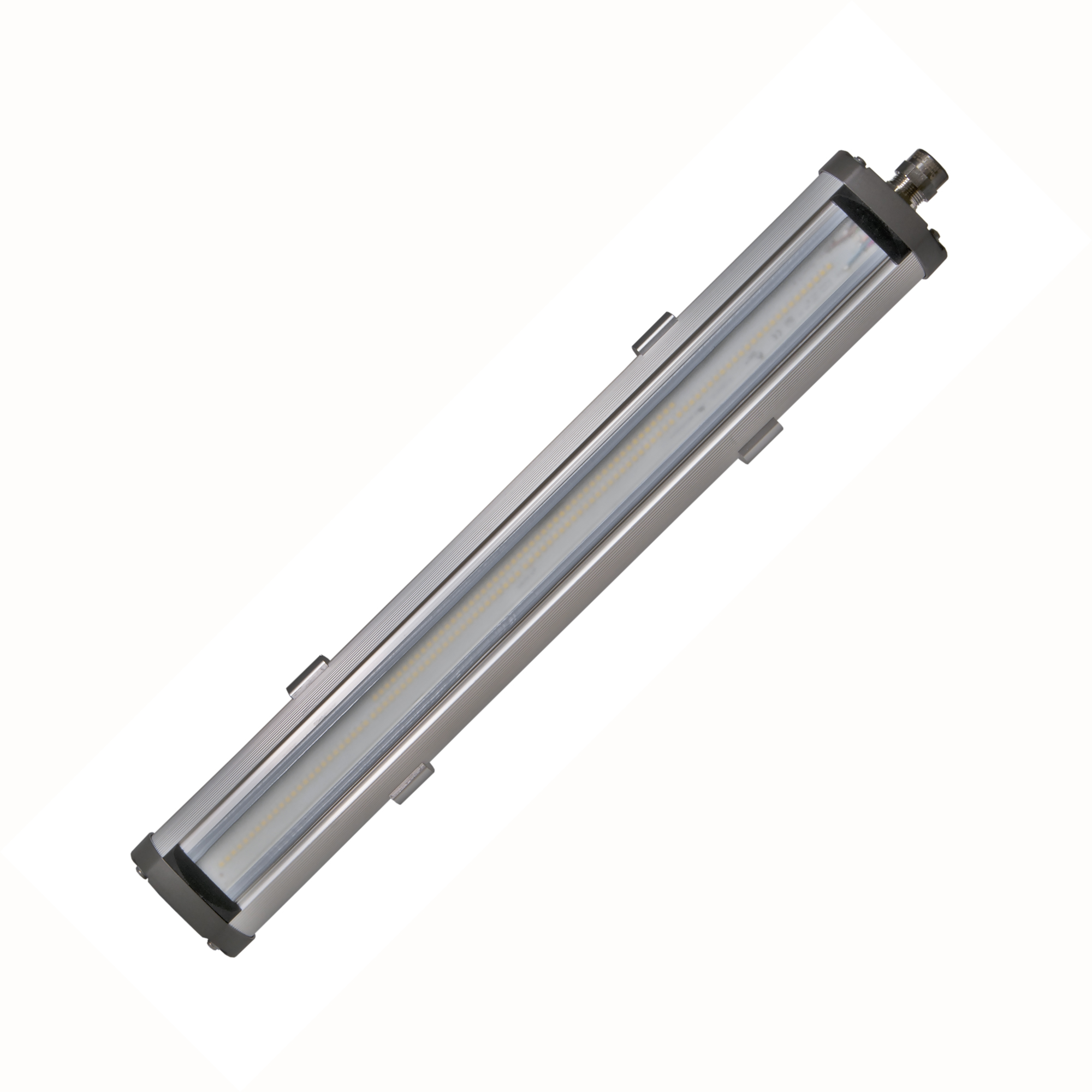
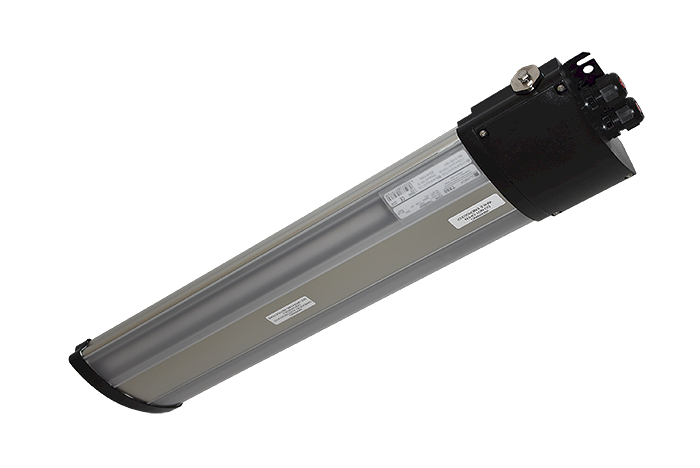
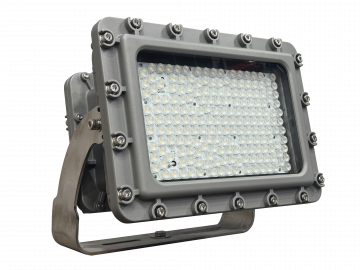
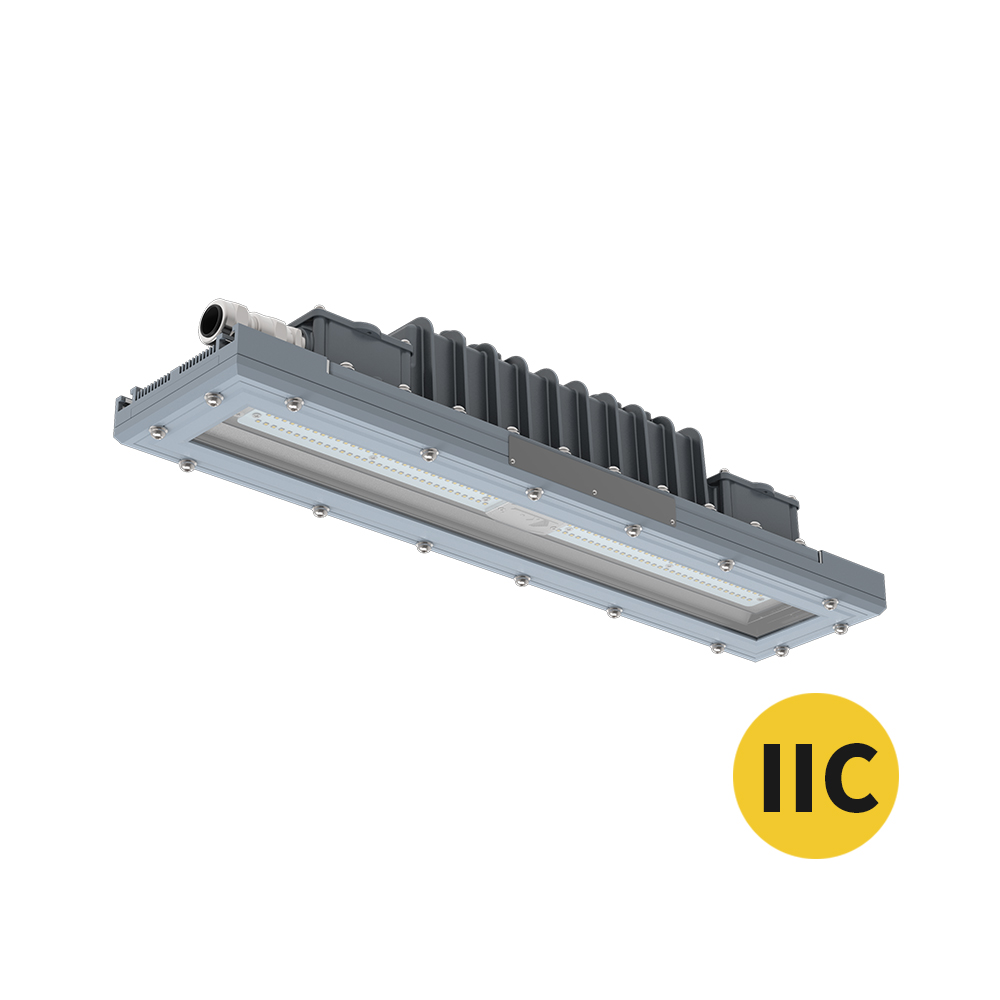
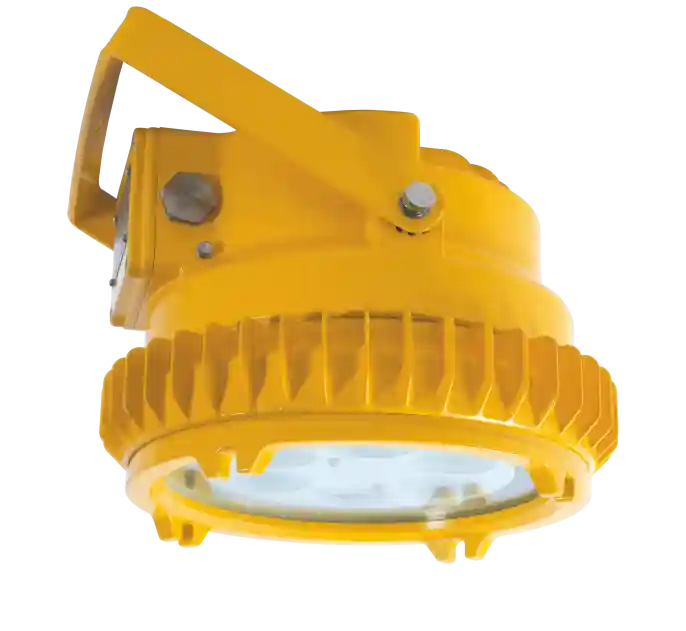
Explosion-proof lighting, more precisely called hazardous-area or Ex luminaires, provides illumination in places where flammable gas, vapour, mist, or combustible dust can form an explosive atmosphere: refineries, offshore platforms, paint shops, grain silos, and chemical plants. The term is a common misnomer. The fixture does not resist an external explosion; it is engineered so that the luminaire itself can never become the ignition source that starts one.
Two design philosophies achieve this. A flameproof enclosure contains and quenches any ignition that occurs inside it, while an increased-safety design removes every arc, spark, and hot surface from normal operation. Selecting the right luminaire means matching the protection concept, gas or dust group, temperature class, and ingress rating to the classified zone where it will hang.
Photo: S.J. de Waard, CC BY 2.5, via Wikimedia Commons
This guide is aimed at industrial purchasing engineers and design engineers. It covers 6 chapters from definitions and hazard classification, protection-type families, optical and thermal technology, materials and ingress sealing, to spec-sheet decoding and selection decisions, with 7 selection FAQs and manufacturer comparisons. All parameters reference the IEC 60079 series (including 60079-0, 60079-1, 60079-7, 60079-31), IEC 60529, ATEX Directive 2014/34/EU, the NEC Article 500 system, and UL 844 public standards.
Chapter 1 / 06
What is Explosion-Proof Lighting
An explosion-proof luminaire is a lighting fixture certified for installation in a hazardous (classified) location, a place where flammable gas, vapour, mist, or combustible dust may be present in quantities capable of ignition. The ignition triangle requires fuel, oxygen, and an ignition source at the same time. Fuel and oxygen are inherent to the process and cannot be removed, so explosion protection works exclusively on the third leg: it guarantees that the luminaire cannot supply the spark, arc, or hot surface that would complete the triangle. This is why the name is a misnomer. A correctly selected Ex luminaire does not survive an explosion so much as prevent one.
Structurally, an Ex luminaire integrates four subsystems that an ordinary fixture treats casually: (1) a certified enclosure whose wall thickness, joint geometry, and fastener torque are part of the type certificate, not a free design choice; (2) a light source and driver whose maximum surface temperature is measured and capped; (3) a sealing and cable-entry system, typically a certified cable gland or an Ex e terminal box, that maintains ingress protection and flame containment at the wiring boundary; and (4) the marking, which is a legally meaningful code declaring exactly which atmospheres the device is fit for.
The historical driver was disaster. Mining catastrophes in the nineteenth century prompted Humphry Davy to invent the wire-gauze safety lamp in 1815, the conceptual ancestor of flame containment. Industrial electrical lighting in coal mines and petroleum plants forced the development of the flameproof enclosure, formalised in Europe through the work that became the EN and IEC 60079 series, and in the United States through the National Electrical Code Article 500 Class and Division framework. The IEC and the European ATEX directives later converged on a single zone-and-EPL vocabulary, while North America retained its parallel Class and Division system, both of which a global luminaire must satisfy.
The light source itself has migrated through several generations. Incandescent and tungsten-halogen fixtures dominated mid-century plants, followed by high-intensity discharge (HID) metal-halide and high-pressure sodium for high-bay duty, and linear and compact fluorescent for general lighting. Since roughly 2010 the LED has displaced all of them in new and retrofit hazardous-area projects because it runs cooler, lasts longer, contains no fragile filament or pressurised arc tube, and makes the all-important T-class easier to certify. The penalty is that LED performance is intensely temperature-dependent, which moves thermal management from an afterthought to a certification-critical discipline.
In application scale, hazardous-area lighting spans the entire industrial map: Zone 0 instrument enclosures inside tanks, Zone 1 process decks on offshore platforms, Zone 2 perimeter and warehouse lighting, and the dust Zones 20 to 22 of flour mills, sugar refineries, coal handling, and pharmaceutical powder rooms. A single refinery may specify a dozen distinct Ex luminaire types, because the correct fixture is never universal; it is the precise intersection of zone, gas or dust group, ambient temperature, and required light level. The luminaire is only one element of a wider hazardous-area system that also includes the explosion-proof motor driving process equipment and the gas detector network that monitors the atmosphere itself.
Chapter 2 / 06
Hazard Classification and Protection Types
Before any luminaire can be chosen, the area must be classified. Two parallel systems exist worldwide. The IEC and ATEX zone system divides gas atmospheres into Zone 0 (explosive atmosphere present continuously or for long periods), Zone 1 (likely in normal operation), and Zone 2 (unlikely, and only briefly if it occurs), with the matching dust Zones 20, 21, and 22. Each zone demands a minimum equipment protection level (EPL): Ga, Gb, or Gc for gas, and Da, Db, or Dc for dust. The North American NEC Article 500 system instead uses Class (I gas, II dust, III fibres) and Division (1 hazard present in normal operation, 2 hazard present only abnormally). The table below maps these schemes so a single luminaire can be specified across regions.
IEC / ATEX zone
Required EPL
ATEX category
Nearest NEC Class/Division
Atmosphere likelihood
Zone 0 (gas)
Ga
1G
Class I, Div 1
Continuous / long periods
Zone 1 (gas)
Gb
2G
Class I, Div 1
Likely in normal use
Zone 2 (gas)
Gc
3G
Class I, Div 2
Unlikely, brief
Zone 20 (dust)
Da
1D
Class II, Div 1
Continuous / long periods
Zone 21 (dust)
Db
2D
Class II, Div 1
Likely in normal use
Zone 22 (dust)
Dc
3D
Class II, Div 2
Unlikely, brief
The EPL encodes fault tolerance. EPL Ga and Da equipment must remain a non-ignition source with two independent faults present, which is why Zone 0 and Zone 20 are the most demanding. EPL Gb and Db must stay safe with one fault, suiting Zone 1 and Zone 21. EPL Gc and Dc need only be safe in normal operation with some enhanced protection, suiting Zone 2 and Zone 22. A higher-EPL luminaire may always serve a lower-risk zone, so a Gb fixture is acceptable in Zone 2, but a Gc fixture must never be hung in Zone 1.
Within each zone, the protection is achieved by a specific type of protection, each with its own IEC 60079 sub-standard and a two-letter or one-letter Ex code. For luminaires the dominant families are flameproof, increased safety, dust protection by enclosure, and increasingly optical radiation and encapsulation methods for the LED and driver. The table below summarises the protection types most relevant to lighting.
Protection type
Ex code
Standard
Principle
Typical luminaire use
Flameproof enclosure
Ex d / Ex db
IEC 60079-1
Contains and cools internal ignition
Zone 1 high bay, floodlight
Increased safety
Ex e / Ex eb
IEC 60079-7
No arc or hot surface in normal use
Zone 1 terminal box, linear LED
Dust by enclosure
Ex t / Ex tb
IEC 60079-31
Dust-tight enclosure, limited surface temp
Zone 21 / 22 dust areas
Encapsulation
Ex m / Ex mb
IEC 60079-18
Components potted in compound
LED driver, control gear
Optical radiation
Ex op is
IEC 60079-28
Inherently safe optical energy
High-power LED emission
Non-sparking
Ex nR / Ex ec
IEC 60079-7 / -15
Restricted breathing, simplified
Zone 2 economy luminaires
Flameproof Ex d is the workhorse for Zone 1 high-power lighting. The enclosure is built heavy enough to withstand an internal explosion of the worst-case gas, and every joint is a machined flame path narrow and long enough to cool escaping gas below its ignition temperature. The cost is weight and fastener discipline: an Ex d luminaire opened for relamping must be reassembled to the certified gap and torque, or its protection is void.
Increased safety Ex e takes the opposite path. By enlarging creepage and clearance distances, using captive high-integrity terminals, and limiting temperature rise, it ensures no ignition source exists in normal operation, so no containment enclosure is needed. Because LEDs and their terminals run cool and sparkless, many modern fixtures combine an Ex d driver compartment with an Ex e light and terminal section, marked Ex de, putting the heavy enclosure only where genuinely required.
Chapter 3 / 06
Light Source and Thermal Technology
The light source determines efficacy, lifetime, and, critically, the surface temperature on which the temperature class depends. Four source technologies have served hazardous areas; LED has displaced the rest in new design. The table below compares their engineering characteristics, with efficacy expressed in lumens per watt.
Source
Typical efficacy
Rated life
Strike / restrike
Status in hazardous areas
Incandescent / halogen
10 to 20 lm/W
1,000 to 4,000 h
Instant
Legacy, largely retired
Fluorescent (T8 / CFL)
60 to 100 lm/W
10,000 to 20,000 h
Instant
Legacy linear, being retrofitted
Metal halide HID
75 to 110 lm/W
10,000 to 20,000 h
5 to 15 min restrike
Legacy high bay, being replaced
LED
110 to 155 lm/W
50,000 to 100,000 h
Instant
Current standard, new and retrofit
LED dominates because it is electrically and mechanically benign for explosion protection. It has no pressurised arc tube to shatter, no filament to fracture under vibration, and it runs cooler than an equivalent HID lamp, which directly eases the temperature class. Certified hazardous-area LED luminaires reach roughly 110 to 155 lumens per watt, so a 150 watt LED delivering around 21,000 lumens replaces a 400 watt metal-halide fixture, and a 200 to 250 watt LED replaces a 1,000 watt unit. The Dialight SafeSite LED high bay, for example, is published at about 110 lumens per watt with up to roughly 23,500 fixture lumens for Class I Division 1 duty. Lumen maintenance, the slow fade rather than sudden failure of an LED, is rated as L70 or L80 at a stated hour count and ambient temperature.
Thermal management is the discipline that links LED efficacy to legal compliance. The T-class certificate is tied to the worst-case enclosure surface temperature, which is the sum of LED junction heat and the maximum rated ambient. A fixture certified T6 (85 degrees Celsius limit) at 40 degrees ambient can exceed that limit if installed where the air reaches 55 degrees, voiding the protection basis. Manufacturers therefore publish ambient-dependent T-class tables, for example T6 to 40 degrees but only T5 to 55 degrees. Finned aluminium heat sinks, sealed driver compartments rated to the same Ex concept, and deliberately derated drive currents are the standard means of holding junction temperature down.
Driver and control gear sit at the boundary between optics and explosion protection. An LED driver generates heat and switching transients, so it is usually placed in a flameproof Ex d compartment or encapsulated as Ex mb. A surge protective device rated at 4 kV to 6 kV is common on outdoor and offshore fixtures, because lightning-induced transients are a leading cause of driver failure. Where dimming or emergency operation is required, the control gear and any internal battery pack must themselves be certified to the luminaire's overall protection level, which is why hazardous-area emergency lighting is a distinct and more expensive product family.
Optical radiation is a subtler hazard. High-power focused LED or laser emission can itself heat a surface or particle to ignition, which is why IEC 60079-28 defines the optical radiation protection type Ex op is for inherently safe optical energy. For ordinary flood and high-bay LED levels this is rarely the limiting factor, but it becomes relevant for very high-intensity or fibre-coupled optical systems used in some process monitoring and lighting applications.
Chapter 4 / 06
Materials, Optics, and Ingress Sealing
Enclosure material decides both the explosion-protection integrity and the corrosion survival of a luminaire that may hang for twenty years in salt spray or acid vapour. Flameproof Ex d enclosures are most often cast or copper-free aluminium alloy, chosen for its strength-to-weight ratio and machinability of the flame paths, or 316 stainless steel for offshore and chemically aggressive duty. Copper-free aluminium matters because friction sparking from high-copper alloys is itself an ignition risk in certain atmospheres. Glass-reinforced polyester (GRP) and engineering polymers serve lighter increased-safety and Zone 2 fixtures where weight and corrosion drive the choice.
The lens and light-transmitting cover is a structural part of the protection, not a cosmetic detail. Borosilicate or tempered optical glass is the traditional choice for its temperature stability and optical clarity, while impact-modified polycarbonate is used where mechanical impact resistance dominates. The cover must hold the ingress and flame-path integrity under thermal cycling, so its gasket and retention are part of the certificate. A cracked lens simultaneously defeats both ingress protection and, in a flameproof design, the flame containment.
Ingress protection follows IEC 60529 and is non-negotiable in hazardous areas. The table below relates IP and IK ratings to typical hazardous-area lighting environments. Note that dust-protection by enclosure (Ex t) under IEC 60079-31 effectively requires full dust-tightness, the 6 in IP6X.
Environment
Recommended IP (IEC 60529)
Recommended IK (IEC 62262)
Notes
Indoor process, sheltered
IP65
IK08
Dust-tight, low-pressure jets
Outdoor / weather-exposed
IP66
IK08 to IK10
Powerful water jets, UV-stable
Washdown / food / pharma
IP66 / IP67
IK10
Smooth surfaces, drainable
Offshore / marine deck
IP66 / IP68
IK10
316 stainless, salt-fog tested
Combustible dust (Zone 21/22)
IP6X minimum
IK08 to IK10
Dust-tight per Ex t requirement
The cable entry is the most common field failure point. Each cable gland must itself be certified to the luminaire's protection type and gas group, and for Ex d entries it must be a flameproof barrier gland or fitted with a sealing chamber when the cable construction demands it. Spare entries must be closed with a certified stopping plug, never a hardware-store blanking nut, because an uncertified plug breaks the entire protection chain. Internal connections land on a certified terminal block either inside the flameproof chamber or in a dedicated Ex e increased-safety terminal box.
Surface and gasket materials complete the picture. Gaskets are typically silicone or fluoroelastomer chosen for the operating temperature and chemical exposure; an aged or hardened gasket silently downgrades the IP rating. External fasteners are stainless steel, and the protective coating, often polyester powder over chromate-passivated aluminium, is specified by salt-spray test hours for marine and coastal sites. For dust areas, smooth external geometry that sheds rather than accumulates dust layers is itself a safety feature, because a thick insulating dust layer can raise the effective surface temperature above the rated T-class.
Chapter 5 / 06
Key Specification Parameters
Reading the Ex marking and photometric data correctly is the core competence for hazardous-area lighting procurement. A complete luminaire datasheet carries both a safety-certification block and a performance block. Eight parameters drive almost every selection decision: the Ex marking, gas or dust group, temperature class, ambient temperature range, ingress and impact rating, light output and efficacy, beam distribution, and certified life. Each is explained below.
The Ex marking is a compact legal statement, for example "Ex db eb IIC T6 Gb" or "Ex tb IIIC T80 degrees C Db". Reading left to right it gives the protection type or types, the gas or dust group, the temperature class, and the EPL. The North American equivalent reads as a Class, Division, and Group string such as "Class I, Div 1, Groups B, C, D". Confirm that the marking covers every zone, group, and class present in the installation, and check the certificate number against the issuing body rather than trusting the catalogue summary.
Gas and dust group describes ignition difficulty. Gas group IIA covers propane-type gases, IIB covers ethylene, and IIC covers hydrogen and acetylene, the easiest to ignite and hardest to contain. A IIC luminaire may be used in IIA and IIB areas, never the reverse. Dust groups are IIIA combustible flyings, IIIB non-conductive dust, and IIIC conductive dust such as metal powder, with IIIC the most demanding. The table below decodes the temperature class, which works alongside the group.
Temperature class
Max surface temperature
Approx. Fahrenheit
Suited to atmospheres igniting above
T1
450 °C
842 °F
450 °C
T2
300 °C
572 °F
300 °C
T3
200 °C
392 °F
200 °C
T4
135 °C
275 °F
135 °C
T5
100 °C
212 °F
100 °C
T6
85 °C
185 °F
85 °C
Temperature class and ambient range must be read together. The T-class caps the surface temperature, and that cap is only valid up to the nameplate maximum ambient temperature. Hazardous-area LED luminaires are commonly rated across a wide window, for instance -40 degrees Celsius to +60 degrees Celsius, but the achievable T-class may step down as ambient rises. Cold-start capability also matters: at -40 degrees the driver and any lens condensation management must still function, which is a real constraint in arctic and refrigerated installations.
Light output and efficacy are reported as fixture lumens, the light actually leaving the luminaire after optical losses, and lumens per watt. Compare delivered lumens, never nominal lamp watts, when replacing legacy fixtures. Beam distribution follows: high bays use roughly 120 degree wide optics for general area coverage, while floodlights offer 40, 60, or 90 degree distributions for aimed lighting onto a vessel, ladder, or perimeter. Colour rendering index (CRI) of 70 or above and a neutral 4,000 K to 5,000 K colour temperature are typical for safe colour discrimination of pipework and labels.
Ingress, impact, and life close the performance block. IP66 is the practical minimum, IK08 to IK10 covers mechanical abuse, and rated life is stated as a lumen-maintenance figure such as L70 at 50,000 to 100,000 hours at a defined ambient. Mounting options (pendant, bracket, pole, stanchion), electrical input (commonly 100 to 277 V or 277 to 480 V AC, 50/60 Hz), surge protection level, and warranty (5 to 10 years from premium makers) round out a complete specification.
Chapter 6 / 06
Selection Decision Factors
To turn the preceding chapters into a defensible model choice, follow the decision sequence below. Most selection errors are not a single wrong number but a decision made before the area has been properly classified. These nine steps double as a fixed RFQ template for hazardous-area lighting.
Area classification first: obtain the site hazardous-area drawing and confirm the zone (0, 1, 2 gas or 20, 21, 22 dust) or the Class, Division, and Group for the exact mounting location. This single input governs every later choice; never reverse-engineer the zone from an available fixture.
Gas or dust group: identify the worst-case substance and its group (IIA, IIB, IIC for gas; IIIA, IIIB, IIIC for dust). Specify a luminaire group equal to or more demanding than the atmosphere.
Temperature class versus ignition temperature: select a T-class whose surface limit sits below the gas auto-ignition temperature or the dust layer ignition temperature, and verify the T-class holds at the actual maximum ambient, not just the catalogue ambient.
Protection type and enclosure: choose flameproof Ex d, increased safety Ex e, dust Ex t, or a hybrid Ex de, then the enclosure material (copper-free aluminium, 316 stainless, or GRP) per the corrosion environment.
Ingress and impact rating: IP66 minimum outdoors, IP67 or IP68 for washdown or submersion, IK08 to IK10 for impact-prone sites, and full dust-tightness for any dust zone.
Photometric requirement: set the target illuminance (lux) and uniformity for the task, then derive fixture lumens, efficacy, beam angle, CRI, and colour temperature, and lay out the photometric plan before fixing quantities.
Electrical and mounting: confirm supply voltage and frequency, surge protection level (4 kV to 6 kV outdoors), certified cable glands and stopping plugs, and the mounting interface (pendant, bracket, pole, or stanchion).
Certification and documentation: require the ATEX EU type-examination, IECEx Certificate of Conformity, and UL or CSA listing as the project demands, plus NEPSI for China, and verify each certificate number with the issuing body.
Total cost of ownership (TCO): purchase price plus installation plus the avoided cost of relamping and the avoided risk of an unplanned outage in a producing zone. An LED retrofit that eliminates HID restrike delays and twenty-year relamp cycles usually repays its premium within a few years.
One frequently overlooked dimension is serviceability and lifecycle support: availability of certified spare lenses, gaskets, and glands; whether the maker holds local certificate copies and photometric files; and how relamping or driver replacement is performed without breaking the protection chain. These details seem irrelevant at purchase but determine repair response after a decade in service. Dialight, Eaton Crouse-Hinds, R. STAHL, BARTEC, and Warom maintain documented spare-part programmes and regional support, which makes them dependable choices for large refinery, offshore, and chemical-plant projects, while regional NEPSI and IECEx suppliers can be cost-effective for non-critical Zone 2 and Zone 22 loads once their certificates are verified.
FAQ
What is the difference between flameproof (Ex d) and increased safety (Ex e) luminaires?
Flameproof Ex d (IEC 60079-1) contains an internal explosion inside a robust enclosure and cools any escaping gas through narrow flame paths below the ignition temperature of the surrounding atmosphere, so it tolerates a potential internal ignition source. Increased safety Ex e (IEC 60079-7) takes the opposite approach: it applies extra construction margins to terminals, creepage, and clearances so that no arc, spark, or excessive surface temperature occurs in normal operation, meaning there is no ignition source to contain. Many modern LED luminaires are hybrid Ex de: a flameproof Ex d driver compartment combined with an increased safety Ex e terminal box, which keeps the heavy enclosure only where it is needed.
How do hazardous-area zones map to equipment protection levels (EPL)?
Under IEC 60079, gas zones map to gas EPLs: Zone 0 needs EPL Ga, Zone 1 needs Gb, and Zone 2 needs Gc. Dust zones map to dust EPLs: Zone 20 needs Da, Zone 21 needs Db, and Zone 22 needs Dc. Ga and Da equipment stays safe with two independent faults, Gb and Db with one fault, and Gc and Dc in normal operation with enhanced protection. ATEX expresses the same idea as categories: Category 1G equals EPL Ga, Category 2G equals Gb, and Category 3G equals Gc, with the matching 1D, 2D, and 3D for dust. A luminaire rated for a higher EPL may always be used in a lower-risk zone, but never the reverse.
What do the gas group and temperature class markings mean on a luminaire?
The gas group describes how easily the surrounding atmosphere ignites: IIA covers propane-type gases, IIB covers ethylene, and IIC covers hydrogen and acetylene, the hardest to contain. Equipment certified for IIC may be used in IIA and IIB areas, but not the reverse. Dust groups are IIIA (combustible flyings), IIIB (non-conductive dust), and IIIC (conductive dust). The temperature class caps the maximum surface temperature: T1 is 450 degrees Celsius, T2 is 300, T3 is 200, T4 is 135, T5 is 100, and T6 is 85 degrees Celsius. The marked surface temperature must stay below the ignition temperature of the gas or the layer ignition temperature of the dust present.
What is the difference between ATEX, IECEx, and the North American Class/Division system?
ATEX is a mandatory EU framework under Directive 2014/34/EU and applies only inside the European Economic Area, adding the CE mark and EU type-examination certificate. IECEx is a voluntary international scheme run by IEC with certificates recognized across 30-plus member countries. Both reference the same IEC 60079 series and use zones, EPLs, gas groups, and T-classes. North America historically uses the NEC Article 500 Class and Division system: Class I gas, Class II dust, Class III fibers, each split into Division 1 and Division 2, with Groups A through D for gas and E through G for dust, evaluated to UL 844. The NEC also recognizes a parallel zone system, so a global project often carries ATEX, IECEx, and UL or CSA marks together.
What IP and IK ratings should an explosion-proof luminaire have?
For hazardous areas, IEC 60529 ingress protection of IP66 is the practical minimum, giving complete dust-tightness and protection against powerful water jets; outdoor, washdown, and temporarily submerged fixtures move to IP67 or IP68. Dust-protection by enclosure Ex t under IEC 60079-31 effectively requires at least IP6X dust-tightness. Mechanical impact resistance is rated to IEC 62262 as IK: impact-prone industrial sites usually specify IK08 to IK10, where IK10 withstands a 20 joule impact. High IP and IK ratings matter because a cracked lens or a failed gasket can both let an explosive atmosphere reach hot internal parts and let moisture degrade the driver.
How do I size LED wattage when replacing legacy HID or fluorescent hazardous-area fixtures?
Compare delivered lumens and efficacy, not nominal watts. Certified hazardous-area LED luminaires reach roughly 110 to 155 lumens per watt, so a 150 watt LED delivering about 21,000 lumens typically replaces a 400 watt metal halide, and a 200 to 250 watt LED replaces a 1,000 watt metal halide. Confirm the new fixture keeps its T-class certification at the actual ambient temperature, since LED surface temperature rises with ambient heat. Then match the beam: high bays use 120 degree wide optics for general coverage, while floodlights offer 40, 60, or 90 degree distributions for aimed lighting. Always re-verify the photometric layout, because LED intensity distribution differs from the old HID reflector.
Why is thermal management so critical for explosion-proof LED lighting?
The temperature class certification is tied to the worst-case surface temperature, which depends on both the LED junction heat and the maximum ambient temperature stated on the nameplate. If a fixture certified T6 (85 degrees Celsius) at 40 degrees ambient is installed where the air reaches 55 degrees, the enclosure surface can exceed the T6 limit and void the protection basis. Manufacturers therefore publish ambient-temperature-dependent T-class tables, for example T6 up to 40 degrees but only T5 up to 55 degrees. Good designs use finned aluminium heat sinks, sealed driver compartments rated to the same Ex concept, and derated LED drive currents to hold junction temperature down and protect the rated lumen-maintenance life of around 50,000 to 100,000 hours.
Explosion-Proof Lighting Manufacturers
Source-backed product routes. Open a company dossier for procurement scope and cited evidence.