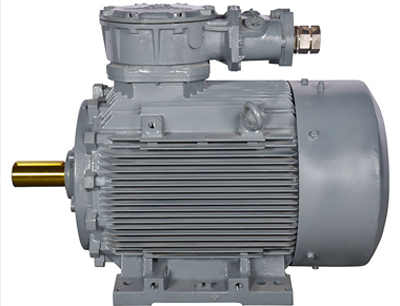
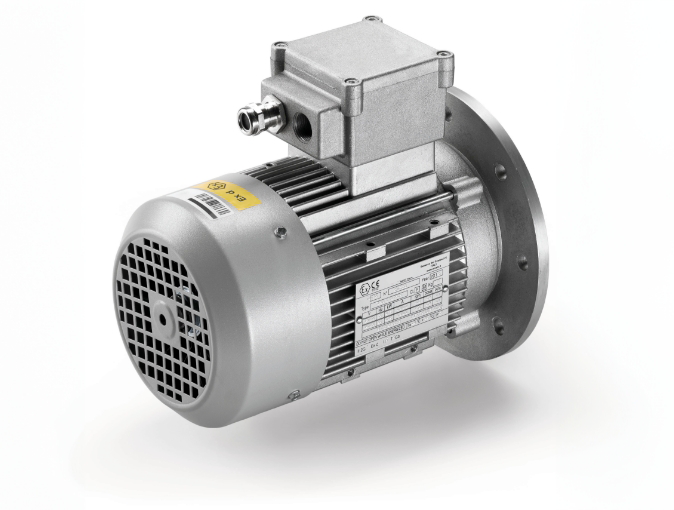
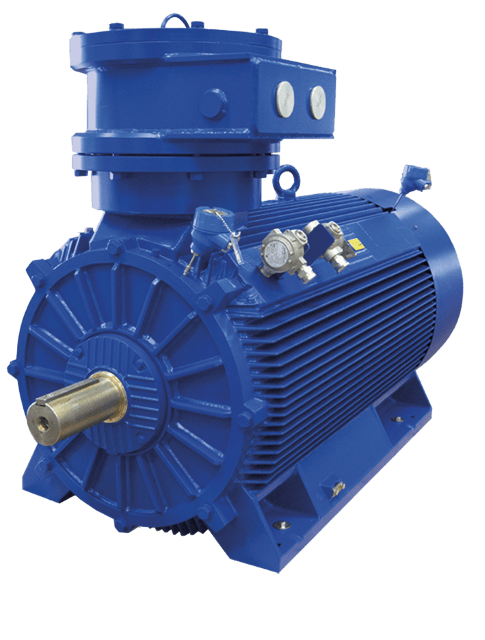
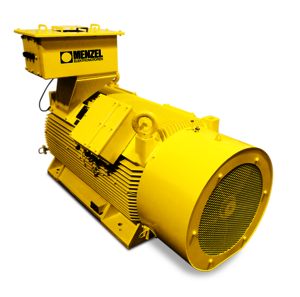
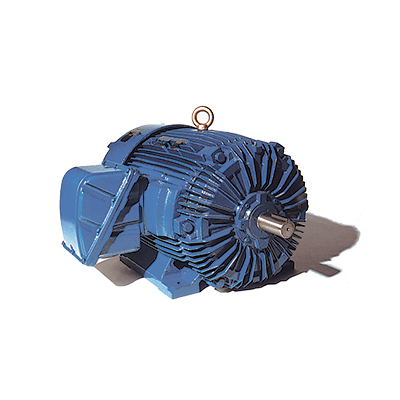
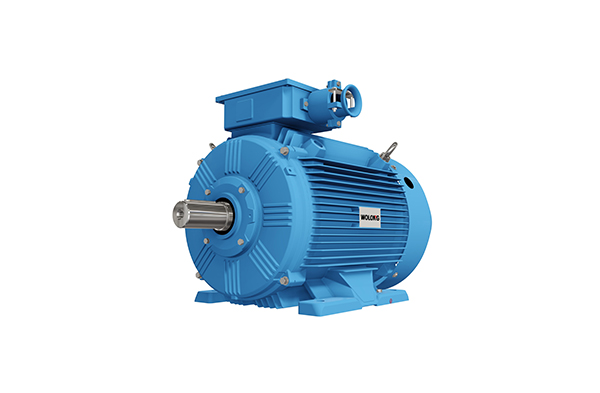
An explosion-proof motor is an electric machine certified to operate in a hazardous area where flammable gas, vapor, or combustible dust may be present, without becoming a source of ignition. The term covers several distinct protection concepts defined in the IEC 60079 series, the most common being flameproof (Ex d) and increased safety (Ex e). In North America the equivalent machines are certified to the Class and Division system and marketed as explosion-proof or NEMA 7.
Despite the everyday name, an explosion-proof motor does not prevent an explosion in the surrounding plant. A flameproof unit is built to contain an explosion that occurs inside its own enclosure and to stop that flame from reaching the outside atmosphere, while an increased-safety unit is designed so no ignition occurs at all. Choosing the right concept, gas group, temperature class, and zone rating is the core of hazardous-area motor selection.
This guide is written for procurement and design engineers specifying motors for oil and gas, chemical, mining, grain handling, and pharmaceutical plants. It covers six chapters, from what an explosion-proof motor is, through protection concepts, zones and gas groups, temperature classes and construction, key spec-sheet parameters, to a selection decision sequence, with seven FAQs and manufacturer comparisons. All parameters reference the public IEC 60079 series (IEC 60079-0, 60079-1, 60079-7, 60079-31), the ATEX directive 2014/34/EU, IEC 60034 for rotating machines, and the North American UL 674 and NEC Article 500 framework.
Chapter 1 / 06
What is an Explosion-Proof Motor
An explosion-proof motor is a rotating electric machine, almost always a three-phase induction AC motor, that has been designed, type-tested, and certified to run safely in an atmosphere that may contain flammable gas, vapor, mist, or combustible dust. Ordinary motors are excluded from such areas because their brushes, windings, terminal connections, and hot surfaces are all credible ignition sources. The explosion-proof family solves this through formally defined protection concepts rather than through any single trick of construction.
The name is a long-standing source of confusion. In the international IEC vocabulary the correct term for the most common concept is flameproof, marked Ex d, and it explicitly does not stop an external explosion. Instead, it accepts that an explosive mixture can seep into the motor through normal clearances and ignite on a hot winding or a spark, then keeps that internal explosion bottled inside a strong enclosure and cools the burnt gases as they escape through long, narrow joints called flame paths, so the gas leaving the joint is too cool to ignite the surrounding atmosphere. The North American term explosion-proof carries the same meaning for Class I locations.
Hazardous-area electrical safety has a long industrial history. The flameproof principle traces to coal mining, where firedamp explosions drove the development of flame-path enclosures in the early twentieth century. The modern framework is the IEC 60079 series, harmonized across most of the world, while the European Union enforces it through the ATEX directive, currently 2014/34/EU, which makes hazardous-area certification a legal condition of sale. North America evolved a parallel Class and Division scheme under the National Electrical Code, with UL 674 governing motors and generators for Division 1 locations.
The application scale is large. Explosion-proof motors drive pumps such as the submersible pump, fans, compressors, agitators, conveyors such as the belt conveyor, and crushers across petrochemical refineries, offshore platforms, gas processing plants, paint and solvent lines, sugar and flour mills, coal handling, and pharmaceutical reactors. Typical low-voltage units span roughly 0.12 kW to several hundred kilowatts, with high-voltage flameproof and pressurized machines reaching into the megawatt range for large compressors. The common thread is that every one of these duties would be illegal and unsafe with a standard motor.
Four engineering attributes define a hazardous-area motor beyond its ordinary ratings: the protection concept (Ex d, Ex e, Ex p, Ex t and combinations), the gas group or dust group it is certified for, the temperature class capping its surface temperature, and the equipment protection level matched to the zone. These four, printed together on the Ex nameplate, decide whether a given motor is legal in a given location. Power, speed, and efficiency are selected on top of that hazardous-area envelope, never the other way around.
Chapter 2 / 06
Protection Concepts and Types
Explosion protection for rotating machines is achieved by one of several recognized concepts, each a separate part of the IEC 60079 series. They differ in philosophy: some contain an ignition, some prevent it, and some keep the explosive gas out entirely. The two dominant concepts for motors are flameproof (Ex d) and increased safety (Ex e), but pressurization (Ex p) and dust ignition protection (Ex t) appear on specific duties. The table below compares the main concepts used on motors.
Concept (marking)
Standard
Principle
Typical zone
Flameproof (Ex d / Ex db)
IEC 60079-1
Contains internal explosion, cools flame through joints
Zone 1 and 2
Increased safety (Ex e / Ex eb)
IEC 60079-7
Prevents arcs, sparks, hot spots by extra margins
Zone 1 and 2
Combined (Ex de)
60079-1 + 60079-7
Ex d frame with Ex e terminal box
Zone 1 and 2
Pressurization (Ex p / Ex px)
IEC 60079-2
Inert overpressure keeps gas out of enclosure
Zone 1 and 2
Non-sparking (Ex ec)
IEC 60079-7
Reduced-risk design for low-likelihood areas
Zone 2 only
Dust protection (Ex t / Ex tb)
IEC 60079-31
Dust-tight enclosure, limited surface temperature
Zone 21 and 22
Flameproof (Ex d) is the workhorse concept for Zone 1 motors. The machine is built into a heavy enclosure, usually cast iron, that can withstand the pressure of an internal gas explosion without deforming or cracking. Where shafts, end shields, and the terminal box meet the frame, the mating surfaces form precision flame paths whose length and gap are fixed by IEC 60079-1 according to the gas group and the internal volume. Hot gases from an internal ignition lose their energy as they travel along these joints, so they emerge too cool to light the external atmosphere. The trade-off is mass and cost: an Ex d motor is substantially heavier and more expensive than a standard machine of the same rating.
Increased safety (Ex e) takes the opposite stance. Rather than containing an explosion, it works to make ignition impossible by removing the sources. The winding is built with enlarged creepage and clearance distances, conservative current density, high-grade insulation, and a strictly limited maximum temperature, and the certificate states a locked-rotor time tE, the time the stalled motor can carry locked-rotor current before any part exceeds the temperature class. An Ex e motor has no arcing or sparking parts under normal operation, so it can be lighter than an equivalent Ex d unit, but it depends absolutely on correct overload protection set to trip within tE.
Combined Ex de is extremely common in practice: the main motor body uses flameproof Ex d construction while the terminal box uses increased-safety Ex e. This pairs the robust containment of Ex d for the winding with the simpler, easier-to-wire Ex e terminal compartment, which avoids the need for certified flameproof cable glands inside a heavy bolted box. Pressurization (Ex p) suits very large or high-voltage machines: a continuous flow of clean air or inert gas holds a slight overpressure inside the enclosure so the explosive atmosphere can never enter, with a purge cycle and pressure monitoring that cuts power on loss of overpressure. Dust protection (Ex t) applies to grain, flour, sugar, and coal plants, where the enclosure is built dust-tight to at least IP6X and the surface temperature is capped to stay below the dust cloud and dust layer ignition temperatures.
Chapter 3 / 06
Zones, Gas Groups, and Classifications
Selecting a hazardous-area motor begins not with the motor but with the area classification, which the plant safety study produces independently. Two parallel systems exist worldwide: the IEC and ATEX zone system used across Europe, Asia, and the Middle East, and the North American Class and Division system used in the United States and Canada. Equipment certified under one system cannot be installed in an area classified under the other without separate certification, so a global project often needs both. The table below maps the two systems for gas atmospheres.
Hazard likelihood
IEC / ATEX zone
EPL / category
North America (gas)
Continuous presence
Zone 0
Ga / 1G
Class I Div 1
Occasional, normal operation
Zone 1
Gb / 2G
Class I Div 1
Rare and brief
Zone 2
Gc / 3G
Class I Div 2
Combustible dust, occasional
Zone 21
Db / 2D
Class II Div 1
Combustible dust, rare
Zone 22
Dc / 3D
Class II Div 2
Rotating machines are not installed in Zone 0, where an explosive atmosphere is present continuously, because no rotating-machine concept is certified for it. Practical motor selection therefore targets Zone 1 or Zone 2. A Zone 1 motor needs ATEX category 2G with equipment protection level Gb, which in IEC terms means a fully type-certified concept such as Ex db or Ex eb. A Zone 2 motor may use the lighter Gc level, including the non-sparking Ex ec concept. The North American equivalent splits the same hazard into two divisions rather than three zones: Division 1 corresponds roughly to Zone 0 plus Zone 1, and Division 2 to Zone 2.
The second axis is the gas group, which ranks gases by how readily an explosion propagates through a joint, characterized by the maximum experimental safe gap measured per IEC 60079-20-1. Group IIA, represented by propane, has the widest safe gap and is the least demanding. Group IIB, represented by ethylene, is intermediate. Group IIC, represented by hydrogen and acetylene, has the smallest safe gap and demands the tightest flameproof joints, because hydrogen has an extremely low minimum ignition energy. A flameproof enclosure certified for IIC is automatically suitable for IIB and IIA, but a IIA-rated enclosure must never be used in a IIB or IIC area.
IEC gas group
Representative gas
North America group
Flame-path demand
IIC
Hydrogen, acetylene
A (acetylene), B (hydrogen)
Tightest joints
IIB
Ethylene
C
Intermediate
IIA
Propane
D
Widest gap allowed
IIIC
Conductive dust
E (metal dust)
Dust-tight IP6X
IIIB
Non-conductive dust
F (coal), G (grain)
Dust-tight IP6X
Note that the North American grouping orders the letters in the opposite direction from the IEC numerals: NEC Group A is acetylene, the most severe, while IEC reserves its toughest group, IIC, for hydrogen and acetylene together. A common selection error is to assume the two lettering systems align, which they do not. When a project spans both jurisdictions, the only safe practice is to certify and mark the motor explicitly in both systems and to verify the gas group of every credible release on site against the safety study, rather than relying on a single nominal process gas.
Chapter 4 / 06
Temperature Classes and Construction
The third axis of hazardous-area selection is the temperature class, which limits the maximum surface temperature the motor may reach so that it always stays below the auto-ignition temperature of the surrounding gas. Auto-ignition is the temperature at which a gas air mixture ignites without any spark, purely from contact with a hot surface. The IEC 60079-0 temperature classes are referenced to a standard ambient of 40 degrees C, and a motor certified to a higher-numbered class satisfies every lower-numbered requirement. The table below lists the limits and where each class typically applies.
Temperature class
Max surface temp
Covers gases auto-igniting above
Typical example media
T1
450 °C
450 °C
Methane, hydrogen, ammonia
T2
300 °C
300 °C
Ethylene, acetylene, butane
T3
200 °C
200 °C
Gasoline, hexane, diesel vapor
T4
135 °C
135 °C
Acetaldehyde, ethyl ether
T5
100 °C
100 °C
Specialized low-AIT vapors
T6
85 °C
85 °C
Carbon disulfide
Most general-purpose hazardous-area motors are certified to T4, because a large share of common solvents and hydrocarbons auto-ignite above 135 degrees C, and T4 leaves a comfortable safety margin while remaining achievable for a motor running at normal winding temperatures. T5 and T6 are demanding for a motor because the surface must stay close to ambient even under full load, often requiring oversizing or forced cooling. The certified class always assumes the 40 degrees C reference ambient; a higher site ambient or high altitude raises surface temperature and may force a lower power rating to hold the class.
Construction follows from the protection concept. A flameproof Ex d frame is cast iron or, in some lighter ranges, cast aluminum alloy, with machined flame-path joints whose gap tolerance is held to a fraction of a millimeter, tightest for group IIC where hydrogen demands the narrowest joints. Bolts are certified high-tensile, the terminal box is either a flameproof Ex d compartment or a bolt-on Ex e box in the Ex de arrangement, and cable entries use certified flameproof or increased-safety cable glands. Shaft seals and bearing housings are designed so that the rotating shaft gap itself forms a valid flame path.
Ingress protection is specified separately from the Ex rating but is closely linked. General gas-area motors are supplied to at least IP55, with IP56 or IP65 for outdoor, marine, and washdown service, and IP66 for offshore and coastal sites where salt-laden mist is constant. For combustible-dust duty certified to Ex t under IEC 60079-31, the enclosure must reach at least IP6X dust-tight construction so that dust cannot accumulate inside and form an ignition path. Anti-condensation heaters, drain plugs, and stainless or epoxy-coated hardware are common additions for humid and corrosive environments, since water ingress and corrosion are leading causes of premature failure on hazardous-area machines.
Thermal protection is part of the certified design, not an option. Many Ex e and Ex de motors embed PTC thermistors in the windings, wired to a certified trip relay that removes power before the temperature class can be exceeded, and Ex e machines depend on an overload device, typically a motor protection relay, set to act within the stated tE time. When such a motor is fed from a variable frequency drive, the certificate must explicitly cover converter operation, because variable speed alters both the heat generated and the cooling delivered by the shaft fan, the same thermal challenge that defines a VFD-duty motor in non-hazardous areas.
Chapter 5 / 06
Key Specification Parameters
A hazardous-area motor data sheet carries everything an ordinary IEC 60034 motor sheet does, plus the explosion-protection block that governs legality. Reading both halves correctly is the core skill. Beyond the headline kilowatt rating, the parameters that actually drive a compliant selection are the protection marking, gas and temperature rating, efficiency class, mounting and frame, ingress protection, duty type, and the thermal and converter provisions. Each is explained below.
Explosion-protection marking is the single most important line and is read left to right. A typical mark such as Ex db IIB T4 Gb means: Ex for explosion protection, db for flameproof to protection level b, IIB the certified gas group, T4 the temperature class, and Gb the equipment protection level for Zone 1 gas. An ATEX nameplate adds the group and category, for example II 2G, and the Ex hexagon with the notified body number. A Class and Division nameplate instead reads, for example, Class I Division 1 Groups C and D T4. Every element must match the area classification; a mismatch on any one of them makes the installation non-compliant.
Rated power, speed, and efficiency follow normal motor practice but interact with the Ex envelope. Power ranges from fractional kilowatt up to several hundred kilowatts for low-voltage machines, with pole numbers of 2, 4, 6, or 8 setting synchronous speeds of 3000, 1500, 1000, and 750 rpm at 50 Hz. Efficiency is graded by the IEC 60034-30-1 IE classes, with IE2 high efficiency and IE3 premium efficiency now standard on most hazardous-area ranges, and IE4 available on selected lines. Higher efficiency lowers winding temperature, which directly helps hold a demanding temperature class.
Frame, mounting, and connection details determine mechanical fit. IEC frame sizes for low-voltage hazardous-area motors run roughly from 71 to 355, with mounting arrangements such as B3 foot, B5 flange, and B35 combined per IEC 60034-7. Terminal connection is via the certified box, and the cable gland must itself carry an Ex certificate matching the concept. Insulation and duty are specified as a thermal class, commonly Class F insulation often used to a Class B temperature rise for extra margin, and a duty type such as S1 continuous per IEC 60034-1.
Ingress protection, cooling, and environment complete the picture. IP55 is a typical minimum, rising to IP65 or IP66 for harsh sites, with the cooling method given as an IC code, commonly IC411 totally enclosed fan cooled. Thermal and converter provisions appear as embedded PTC thermistors, anti-condensation heaters, and, where the motor is drive-fed, a documented converter operating range that is part of the Ex certificate. The list below summarizes the spec-sheet blocks to check on every hazardous-area motor.
Ex marking: concept, gas group, temperature class, EPL or Class/Division, certificate number.
Electrical: rated power kW, voltage, frequency, poles and speed, IE efficiency class.
Mechanical: IEC frame size, mounting (B3/B5/B35), shaft and flange dimensions.
Environmental: IP rating, ambient temperature range, altitude, cooling IC code.
Thermal and protection: insulation class, duty type, PTC thermistors, tE time for Ex e.
Converter: certified VFD operating envelope, forced ventilation if required.
Chapter 6 / 06
Selection Decision Factors
To turn the preceding chapters into a specific model, follow the decision sequence below. Hazardous-area selection mistakes rarely come from one wrong number; they come from deciding power and brand before the safety envelope is fixed. These eight steps work as a fixed RFQ template, and the first three are non-negotiable safety gates that must be settled before any commercial discussion.
Area classification first: obtain the plant zone or Class/Division classification from the safety study, which is informed by where fixed safety equipment such as a gas detector is deployed. Confirm whether the location is gas (Zone 0/1/2, Class I) or dust (Zone 21/22, Class II), and the equipment protection level required.
Gas or dust group: identify every credible release, not just the nominal process medium, and take the most severe group. IIC or NEC Group B covers hydrogen; IIB covers ethylene; IIA covers propane. A IIC-rated motor covers all lower groups.
Temperature class: take the lowest auto-ignition temperature of any present gas and choose the class that stays below it, typically T3 or T4. Verify the rating holds at the actual site ambient and altitude, derating power if needed.
Protection concept: select Ex d, Ex e, Ex de, Ex p, or Ex t to suit the zone, size, and voltage. Ex de is the common default for low-voltage Zone 1; Ex p suits large or high-voltage machines; Ex t covers combustible dust.
Electrical and mechanical rating: set rated power with margin, pole count for speed, voltage and frequency, IE efficiency class, frame size, and mounting (B3/B5/B35). Specify IP55 minimum, higher for outdoor or marine.
Drive and control: if fed from a VFD, require a motor whose Ex certificate explicitly covers the converter envelope, plus PTC thermistors and, where needed, forced ventilation. For fixed-speed duty that only needs a gentle start, a soft starter is the simpler alternative. For Ex e, size the overload to trip within the tE time.
Certification and documentation: require the right marks for the jurisdiction: ATEX (2014/34/EU) and IECEx for international, UL 674 or CSA for North America, NEPSI for China. Collect the certificate numbers as project records, not catalog claims.
Total cost of ownership: weigh purchase price against installation, certified spare parts, periodic Ex inspection per IEC 60079-17, and the downtime cost of a hazardous-area failure. A flameproof motor is a 15 to 20 year asset, so lifecycle cost, not first cost, should decide.
One dimension that is easy to overlook is serviceability and inspection. Hazardous-area motors are subject to periodic Ex inspection under IEC 60079-17, and any repair must preserve the certified flame-path gaps and concept, which means the repair shop itself must hold the appropriate Ex repair competence per IEC 60079-19. Local certified spare-part inventory, documented flame-path dimensions, and a repairer recognized in your jurisdiction all determine how quickly a tripped line can return to service. Established lines such as WEG W22Xd and W22Xdb, Siemens SIMOTICS XP including the 1MB series, ABB hazardous-area motors, and, for North American Class I Division 1 duty, Nidec and Regal Rexnord UL 674 machines, are backed by global certification and spare-part networks, which is why they dominate critical oil, gas, and chemical service even at a price premium.
FAQ
What is the difference between a flameproof (Ex d) and an increased-safety (Ex e) motor?
Flameproof (Ex d, per IEC 60079-1) accepts that an explosive mixture can enter the motor and ignite internally, then contains the explosion inside a heavy enclosure and cools the escaping gases through long, tight flame paths so no flame reaches the outside atmosphere. Increased safety (Ex e, per IEC 60079-7) takes the opposite approach: it prevents ignition in the first place by eliminating sparks, arcs, and hot spots through extra creepage distances, tighter temperature limits, and a guaranteed locked-rotor time tE. Ex d enclosures are heavy cast iron and certified for Zone 1; pure Ex e is lighter and historically limited to Zone 1 or Zone 2 depending on EPL. Many modern motors combine the two as Ex de, with an Ex d main frame and an Ex e terminal box.
What do the zone and gas group designations mean for motor selection?
Under the IEC and ATEX scheme, Zone 0 means an explosive gas atmosphere is present continuously, Zone 1 occasionally during normal operation, and Zone 2 rarely and briefly. Rotating machines are not used in Zone 0; Zone 1 needs equipment of category 2G (EPL Gb), Zone 2 needs at least category 3G (EPL Gc). Gas group splits the hazard by ignition behavior: IIA is represented by propane, IIB by ethylene, and IIC by hydrogen and acetylene, which are the hardest to contain. A IIC-rated flameproof enclosure satisfies IIB and IIA, but not the reverse. In North America the parallel system uses Class I gases with Group A acetylene, B hydrogen, C ethylene, and D propane, plus Division 1 or 2 for likelihood.
How do the temperature classes T1 to T6 work?
The temperature class caps the maximum surface temperature the motor may reach so it stays below the auto-ignition temperature of the surrounding gas. The limits are T1 450 degrees C, T2 300 degrees C, T3 200 degrees C, T4 135 degrees C, T5 100 degrees C, and T6 85 degrees C, all referenced to a standard 40 degrees C ambient. A lower class number is less demanding: a T6 motor satisfies every higher class, but a T3 motor cannot be used where a T4 atmosphere requires it. Most general-purpose hazardous-area motors are certified to T4 because common solvents and hydrocarbons auto-ignite above 135 degrees C. Always confirm the rating holds at your actual ambient and altitude, since derating raises surface temperature.
What is the difference between ATEX, IECEx, and North American UL/CSA certification?
ATEX is the mandatory EU regulatory framework under directive 2014/34/EU; an ATEX motor carries the Ex hexagon, an EU type-examination certificate, and the CE mark, and is legally required to sell into the European Economic Area. IECEx is a voluntary international scheme run by IEC, with Certificates of Conformity mutually recognized in more than 30 countries; it references the same IEC 60079 standards as ATEX. North America runs a separate Class/Division system certified by UL or CSA: UL 674 covers Division 1 motors and CSA C22.2 No. 145 covers the Canadian equivalent, with NEMA 7 the enclosure designation for Class I Division 1. China requires NEPSI. A global project often needs ATEX plus IECEx plus a North American mark, since the systems are not interchangeable.
Can I run an explosion-proof motor on a variable frequency drive?
Only if the motor is certified for inverter duty. Variable speed changes both heating and cooling: at low speed the shaft-mounted fan moves less air while harmonic losses add heat, so surface temperature can exceed the certified T-class. A compliant VFD installation requires a motor whose Ex certificate explicitly lists the converter operating envelope, usually with a documented frequency and load curve, and frequently forced ventilation or PTC thermistors wired to trip the drive. For Ex e and Ex de machines the tE locked-rotor time and the thermal model must be validated for converter supply per IEC 60079-7. Never assume a fixed-speed certified motor is safe on a drive; the Ex certificate, not the nameplate power, governs.
What ingress protection (IP) rating does an explosion-proof motor need?
IP rating and explosion protection are separate but linked. The first digit is solids and dust ingress (0 to 6), the second is water (0 to 9). General hazardous-area gas motors are typically supplied to IP55 as a minimum, with IP56 or IP65 for outdoor, marine, and washdown duty. For combustible-dust areas certified to Ex t under IEC 60079-31, the enclosure must achieve at least IP6X dust-tight construction so dust cannot enter and form an internal ignition path. Offshore and coastal installations commonly specify IP66 plus extra anti-condensation features such as space heaters and drain plugs. A higher IP digit does not replace the Ex certificate; both appear separately on the nameplate.
Why are flameproof motors so much heavier and more expensive than standard motors?
A flameproof Ex d frame must contain an internal explosion without rupturing and without letting flame escape, so the enclosure, end shields, and terminal box are heavy cast iron or thick cast aluminum with machined flame-path joints held to gap tolerances measured in fractions of a millimeter, tightest for group IIC. Fasteners are certified high-tensile, spigot joints are precision ground, and every casting is hydrostatically or type-tested. That construction adds 30 to 60 percent mass over an equivalent standard IE3 motor and a large certification, documentation, and traceability overhead. The premium buys a machine that can sit in a Zone 1 atmosphere for 20 years without becoming an ignition source, which is why total cost of ownership, not purchase price, drives the decision.
Explosion-Proof Motor Manufacturers
Source-backed product routes. Open a company dossier for procurement scope and cited evidence.