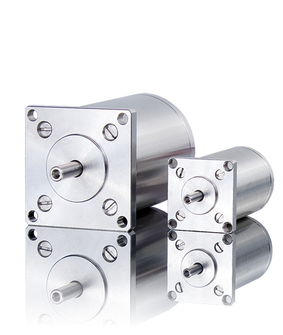
A stepper motor is a brushless DC motor that divides one full rotation into a fixed number of equal steps, moving a precise angle each time the controller sends a pulse. Because position tracks the pulse count without any feedback device, the stepper is the workhorse of low-cost open-loop positioning: 3D printers, CNC routers, semiconductor handlers, valve actuators, and laboratory pumps all rely on it.
The dominant variant in industry is the 2-phase hybrid stepper with a 1.8 degree step angle, giving 200 discrete positions per revolution. This guide explains the motor types, the construction that makes the hybrid superior, how to decode a datasheet, and how to match a motor and driver to a real machine axis.
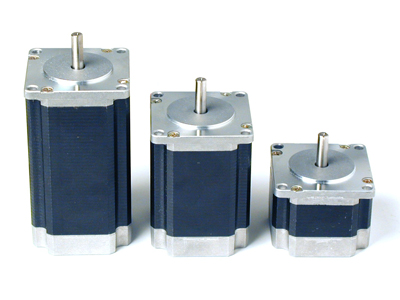
Photo: oomlout, CC BY-SA 2.0, via Wikimedia Commons
This guide is written for procurement and design engineers specifying motion components. It runs six chapters, from working principle and motor types through hybrid construction, key specifications, driver and microstepping technology, to a structured selection sequence, plus seven selection FAQs and manufacturer references. Dimensional and terminology references draw on NEMA ICS 16 frame standards, IEC 60034 rotating-machinery conventions, and published manufacturer engineering handbooks.
Chapter 1 / 06
What is a Stepper Motor
A stepper motor is an electromechanical actuator that converts a train of digital pulses into discrete, equal increments of shaft rotation. Each pulse advances the rotor by one fixed angle, called the step angle, so the total rotation is simply the pulse count multiplied by that angle. This direct, deterministic relationship between pulses and position is what lets a stepper run open-loop: the controller commands a number of steps and trusts that the motor has moved exactly that far, with no encoder confirming the result. For the vast majority of light to medium duty positioning tasks, this assumption holds, which is why steppers remain among the most widely deployed motors in factory automation.
The operating principle is electromagnetic alignment. Stationary stator windings, arranged in phases around the bore, are energized in sequence by the driver. Each energized phase creates a magnetic field that the rotor follows, either because the rotor carries permanent magnets that are attracted to the field, or because soft-iron rotor teeth move to the position of minimum magnetic reluctance, or both. When the driver switches current from one phase to the next, the field rotates by one step and the rotor snaps to the new aligned position. Energizing the windings at standstill locks the rotor in place, producing holding torque, a defining stepper feature that ordinary motors lack.
The most common configuration is the 2-phase motor with a 1.8 degree step angle, which yields 200 full steps per revolution. Higher-resolution motors offer 0.9 degrees (400 steps per revolution), and 5-phase motors reach 0.72 degrees (500 steps per revolution). Manufacturers specify standard 2-phase step accuracy as 1.8 degrees plus or minus 0.05 degrees, equivalent to roughly plus or minus 3 arc minutes, and importantly this error does not accumulate from step to step, so after a full revolution the rotor returns to the same physical angle regardless of the path taken.
Historically, the stepper traces to electromechanical step-by-step mechanisms used in early telephone exchanges and naval gun-laying systems in the 1920s, where a remote dial advanced a selector one position per pulse. The modern variable-reluctance stepper appeared in the 1950s, and the permanent-magnet rotor followed. The hybrid stepper, combining a magnetized rotor with finely toothed pole pieces, was refined through the 1960s and 1970s and became the industrial standard once solid-state chopper drivers made it practical to push high voltage through the windings while regulating current. Microstepping drivers, which interpolate between full steps using sinusoidal phase currents, became mainstream in the 1980s and remain the default today.
The appeal of the stepper rests on four properties that together suit it to bounded-load positioning. First, position is inherently digital and repeatable without feedback. Second, holding torque pins the load at rest without a brake. Third, the open-loop drivetrain is simple and inexpensive, with no tuning loop to commission. Fourth, low-speed torque is high and smooth. The trade-off is that torque falls steeply with speed and the motor can lose synchronism silently if overloaded, so the engineering task is to keep the worst-case load torque comfortably below the torque the motor actually delivers at the required speed.
Chapter 2 / 06
Stepper Motor Types
Steppers divide into three families by rotor construction: permanent magnet (PM), variable reluctance (VR), and hybrid. They differ in step angle, torque, whether they hold position unpowered, and cost. A second, independent axis of classification is the winding configuration, bipolar versus unipolar, which is covered in Chapter 4. The table below compares the three rotor families on the parameters that drive selection.
Type
Typical Step Angle
Holding Torque
Detent (unpowered) Torque
Typical Applications
Permanent magnet (PM)
7.5 to 18 deg
Low to medium
Yes
Office machines, valves, dampers, appliances
Variable reluctance (VR)
5 to 15 deg
Low
None
Mid to high speed indexing, legacy designs
Hybrid
0.9 to 1.8 deg
High
Yes
CNC, 3D printing, automation, instrumentation
Permanent magnet steppers use an axially magnetized rotor with alternating north and south poles, surrounded by claw-pole or can-stack stator windings. Because the field interacts with a fixed magnet, the PM motor produces useful torque and retains detent torque when unpowered, so it holds a damper or valve flap in place with the power off. Step angles are coarse, commonly 7.5 degrees (48 steps per revolution) or 18 degrees, and high-speed performance is limited by losses in the rotor. PM steppers are inexpensive and dominate consumer and light commercial products where fine resolution is not required.
Variable reluctance steppers have a toothed soft-iron rotor and no magnet at all. Torque arises purely from the rotor teeth moving to minimize the reluctance of the magnetic circuit when a stator phase energizes. With no magnet, the VR motor produces zero detent and zero holding torque when unpowered, so it free-wheels with the power off. Its torque is proportional to the square of phase current rather than to current directly, which complicates smooth control, and it tends to be noisier. VR designs offer good high-speed capability and were historically used for fast indexing, but in new equipment they have been largely displaced by the hybrid.
Hybrid steppers combine both effects: a permanent magnet sits between two finely toothed rotor caps, and the stator poles also carry teeth. The magnet biases the circuit while the interleaved teeth multiply the number of equilibrium positions, giving fine step angles of 1.8 degrees or 0.9 degrees with high torque and full detent and holding torque. The hybrid offers the best overall combination of resolution, torque, and efficiency, and is the most popular stepper in the market for industrial and motion-control use. Chapter 3 explains how the toothed-rotor geometry produces the 1.8 degree step.
One practical consequence of these differences: if your application must hold a vertical or spring-loaded load with the power removed, you need detent torque and therefore a PM or hybrid motor, never a VR motor, or you must add a mechanical brake. If you need fine resolution and high torque density in a compact frame, the hybrid is the default and the discussion narrows to frame size, stack length, and winding rather than motor family.
Chapter 3 / 06
Inside the Hybrid Stepper
Because the hybrid dominates industrial use, understanding its geometry clarifies why the 1.8 degree step is standard and why microstepping works. The hybrid rotor is built from two soft-iron end caps, each machined with 50 teeth around its circumference, mounted on a single axially magnetized permanent magnet. One cap becomes a magnetic north face, the other a south face, and the two are mechanically offset by half a tooth pitch. The stator typically has eight salient poles, each carrying several teeth at the same pitch as the rotor, wired into two phases.
With 50 rotor teeth and a 2-phase, 4-step electrical cycle, the geometry yields 50 multiplied by 4, that is 200, stable positions per revolution, so 360 degrees divided by 200 gives the familiar 1.8 degree full step. A high-resolution variant doubles the tooth count effect to reach 0.9 degrees (400 steps per revolution), and 5-phase machines reach 0.72 degrees (500 steps per revolution). The toothed structure is also why the motor has measurable detent torque: even unpowered, the magnet pulls the nearest rotor teeth into alignment with the nearest stator teeth, creating residual cogging the controller must work against during microstepping.
Energizing sequence defines the drive mode. The table below summarizes the common modes, their effect on resolution, and the torque trade-off, using a 1.8 degree base motor as the reference. Note that microstepping multiplies resolution but does not multiply usable torque, and the incremental torque per microstep falls as the microstep size shrinks.
Drive Mode
Phases Energized
Effective Step (from 1.8 deg)
Steps / rev
Relative Torque
Wave (1-phase on)
1
1.8 deg
200
~70%
Full step (2-phase on)
2
1.8 deg
200
100% (reference)
Half step
1 and 2 alternating
0.9 deg
400
~70 to 100%
1/16 microstep
Sinusoidal
0.1125 deg
3,200
smoother, lower per-step
1/256 microstep
Sinusoidal
0.00703 deg
51,200
smoothest, minimal per-step
Full-step, two-phase-on drive energizes both phases at once and produces the rated holding torque, the reference for datasheet figures. Energizing two phases gives roughly 41 percent more torque than a single phase. Wave drive energizes one phase at a time, simplifying the driver but giving about 30 percent less torque and rougher motion, so it is now rare. Half-step alternates between one-phase-on and two-phase-on states to double resolution to 0.9 degrees per step, at the cost of torque ripple between adjacent steps.
Microstepping feeds each phase a sinusoidally weighted current so the rotor settles at intermediate angles between full-step detents. A 1/16 driver commands 3,200 positions per revolution, and high-end drivers reach 1/256, that is 51,200 positions per revolution. The primary benefit is dramatically smoother rotation, lower audible noise, and suppression of mid-range resonance, not improved absolute accuracy. Because the holding torque between adjacent microsteps is small, friction and load can prevent the rotor from reaching the exact commanded microstep, so absolute positioning remains bounded by full-step accuracy.
A characteristic hybrid behavior is mid-range resonance. The rotor and load form a spring-mass oscillator, and at a step rate near the natural frequency, often in the 100 to 300 Hz region for a 2-phase motor, oscillation can build until the rotor loses synchronism and stalls. Microstepping, mechanical damping, added inertia, rapid acceleration through the band, or a driver with anti-resonance compensation all mitigate it.
Chapter 4 / 06
NEMA Frames and Drivers
Two mechanical and electrical decisions sit between the motor family and a real part number: the NEMA frame size, which fixes the mounting interface, and the driver, which determines how current reaches the windings. Both are independent of step angle and must be specified explicitly.
NEMA frame sizes are standardized under NEMA ICS 16, which defines only the square faceplate width, the mounting hole pattern, the pilot diameter, and the shaft, not torque, current, or body length. The designation number is the faceplate width in tenths of an inch, so NEMA 17 is approximately 1.7 inches (42 mm) square and NEMA 23 is approximately 2.3 inches (57 mm) square. Crucially, the frame defines the footprint, not the performance: a short pancake NEMA 17 and a long-body NEMA 17 share the same bolt pattern yet can differ two to three times in holding torque and rotor inertia. The table below lists common frames with representative dimensions and torque bands; treat torque as indicative only and confirm against the chosen series datasheet.
NEMA Frame
Faceplate
Typical Shaft Dia.
Typical Holding Torque
Typical Use
NEMA 11
28 mm (1.1 in)
5 mm
0.05 to 0.10 N·m
Lab, optics, small valves
NEMA 17
42 mm (1.7 in)
5 mm
0.2 to 0.6 N·m
3D printers, desktop CNC, pumps
NEMA 23
57 mm (2.3 in)
6.35 mm
0.5 to 3.0 N·m
CNC axes, conveyors, automation
NEMA 34
86 mm (3.4 in)
12 to 14 mm
3 to 13 N·m
Router gantries, large axes
NEMA 42
110 mm (4.2 in)
19 mm
12 to 30 N·m
Heavy machinery, presses
Winding configuration sets how the driver must wire to the motor. A bipolar motor has two windings and four leads; current reverses through each coil, using all the copper, and delivers roughly 30 to 40 percent more torque than the same motor wired unipolar. A unipolar motor adds a center tap per winding (five, six, or eight leads) so a simpler driver can switch current without an H-bridge, but only half the winding conducts at a time, cutting torque. Eight-lead motors are the most flexible: wire the coils in series for high torque at low speed, or in parallel for higher speed at higher current. Almost all modern industrial drivers are bipolar chopper types.
Chopper drivers are the reason a stepper performs at speed. The driver runs from a bus voltage far higher than the motor rated phase voltage, often 5 to 20 times higher, and rapidly switches the H-bridge on and off to regulate phase current to the set value (constant-current PWM chopping). The high voltage forces current into the inductive winding quickly enough to maintain torque as step frequency rises; without it, winding inductance and back-EMF would starve the current and collapse high-speed torque. Driver features to specify include peak and RMS current rating, microstep resolution, supply voltage range, current decay mode, and anti-resonance or stall-detection (for closed-loop) support.
Open-loop versus closed-loop. A plain stepper has no feedback and can stall silently if overloaded. A closed-loop or hybrid stepper adds an encoder so the drive can detect lost steps, correct position, and modulate current to match load, which eliminates stalling, reduces heat, and suppresses resonance. Closed-loop steppers cost more but approach servo robustness while keeping the stepper torque-at-low-speed advantage, and are common on quality CNC and automation axes.
Chapter 5 / 06
Key Specification Parameters
A stepper datasheet lists a dozen or more figures, but a small set drives selection. Below are the parameters that matter and how to read them, with typical values for a 2-phase hybrid motor. Treat the headline holding torque with caution: what determines whether a motor works is the torque it delivers at the operating speed, read from the torque-speed curve at your actual bus voltage.
Parameter
Typical Value (2-phase hybrid)
Why It Matters
Step angle
1.8 deg (or 0.9 deg)
Sets full-step resolution, 200 or 400 steps/rev
Step accuracy
±5% of step, non-cumulative
Bounds absolute positioning error
Holding torque
0.2 to 13 N·m by frame
Static torque at rated current, both phases on
Detent torque
~5 to 15% of holding
Unpowered hold and low-speed cogging
Rated current / phase
0.5 to 6 A
Must match driver current setting
Winding resistance
0.3 to 10 ohm
Sets I²R heating and voltage drop
Winding inductance
1 to 30 mH
Lower is better for high-speed torque
Rotor inertia
20 to 5,000 g·cm²
Match to load inertia, drives acceleration
Step angle and accuracy. Step angle (1.8 or 0.9 degrees) fixes resolution. Step accuracy is specified as a percentage of the full step, typically plus or minus 5 percent measured at full step under no load, equivalent to roughly plus or minus 5 arc minutes on a standard 1.8 degree motor. The critical property is that this error is non-cumulative: deviations do not add up over many steps, so the motor returns to the same physical angle after each revolution. This is what makes open-loop steppers viable for repeatable positioning.
Holding and detent torque. Holding torque is the maximum static torque at standstill with rated current in both phases, and it is the headline number in N·m, mN·m, or oz·in (1 N·m equals about 141.6 oz·in). Detent torque is the unpowered residual torque from the magnet, typically 5 to 15 percent of holding torque, which holds the load with the power off and contributes to low-speed cogging. Neither figure tells you the running torque, which falls with speed and must be read from the torque-speed curve.
Current, resistance, and inductance. Rated current per phase must be set on the driver; exceeding it overheats the motor, while under-driving it loses torque. Winding resistance sets I²R heating, and stepper motors normally run warm, with case temperatures up to about 80 to 100 degrees Celsius considered acceptable per insulation class. Inductance is the high-speed limiter: at a given step rate the inductance resists current rise, so a low-inductance winding (under about 5 mH) reaches rated current faster and sustains torque to higher speed. Eight-lead motors let you trade between series (high inductance, low-speed torque) and parallel (low inductance, high-speed torque) wiring.
Inertia and torque-speed curve. Rotor inertia should be matched to reflected load inertia (commonly within a 1:1 to 10:1 ratio) so the motor can accelerate the load without losing synchronism. The single most important plot is the torque-speed (pull-out) curve, which shows the maximum torque the motor sustains without stalling at each speed for a given driver and bus voltage. A separate pull-in curve shows where the motor can start, stop, or reverse instantly without acceleration. Always size the load torque to sit well below the pull-out curve, with margin, at your maximum required speed.
Chapter 6 / 06
Selection Decision Factors
To turn the preceding chapters into a part number, work the decision sequence below in order. Most selection failures come not from one wrong figure but from choosing a frame size or motor family before the load and speed are quantified. These steps double as a fixed RFQ template.
Quantify the load and motion profile: compute required torque at the load, including friction, gravity (for vertical axes), and acceleration torque from inertia. Define the maximum speed in rpm and the move profile. This step decides whether a stepper is even appropriate or whether a servo is needed.
Confirm the stepper fits the duty: steppers excel below roughly 1,000 to 1,500 rpm with bounded, predictable loads. If the duty needs high speed, high dynamic load, or guaranteed no-stall behavior, choose a servo or a closed-loop stepper instead of a plain open-loop stepper.
Choose resolution and motor family: for fine resolution and high torque density, select a 2-phase hybrid at 1.8 or 0.9 degrees. If the load must be held unpowered, ensure detent torque exists (PM or hybrid, never VR), or add a brake.
Size the frame and stack length: pick the NEMA frame and body length whose torque-speed curve clears your required running torque at maximum speed with margin (commonly 30 to 50 percent headroom), not just the headline holding torque. Match rotor inertia to load inertia.
Select winding and driver: prefer a bipolar winding (series for low speed, parallel for high speed on 8-lead motors) with a constant-current chopper driver. Set the driver current to the motor rating, choose a bus voltage high enough for your speed, and pick microstep resolution for smoothness.
Address resonance and thermals: verify the operating speed avoids the mid-range resonant band, or rely on microstepping, damping, or anti-resonance drive features. Confirm the motor case temperature stays within its insulation class under continuous duty.
Specify mechanical and environmental fit: shaft diameter and length, single or dual shaft, mounting bolt pattern, ingress protection (IP rating) for washdown or dusty environments, connector or flying leads, and any gearhead or brake option.
Total cost of ownership: weigh motor and driver price against commissioning effort, energy use, and downtime risk. A plain open-loop stepper is cheapest to buy; a closed-loop stepper costs more but removes stall risk and tuning surprises on critical axes, often paying back through avoided downtime.
One last commonly overlooked dimension is manufacturer serviceability and documentation: published torque-speed curves at multiple voltages, encoder and brake options within the same frame, gearhead compatibility, lead-time and local stock, and driver firmware support. Established lines such as Oriental Motor (PKP, AlphaStep AZ/AR), Sanyo Denki SanMotion F2, Lin Engineering, Nanotec, Moons' and Applied Motion, and Schneider Electric Lexium MDrive provide full curves and wide frame coverage, which de-risks specification on production equipment. Cost-sensitive OEM and hobby-grade CNC axes often use suppliers like STEPPERONLINE or JSS at a fraction of the price, which is reasonable for non-critical motion provided the torque-speed curve is verified at the intended bus voltage.
FAQ
What is the difference between a stepper motor and a servo motor?
A stepper motor runs open-loop: it moves a fixed angle per input pulse (commonly 1.8 degrees) and holds position by energizing its windings, with no feedback device required. A servo motor runs closed-loop, using an encoder or resolver to continuously correct position and current, so it never loses count and delivers far higher torque at high speed. Steppers are cheaper, give precise low-speed positioning, and produce full holding torque at standstill, but lose torque rapidly above 1,000 rpm and can stall silently if overloaded. Servos cost more and need tuning, but suit high speed, high inertia, and dynamic loads. Closed-loop or hybrid steppers (with an encoder) bridge the two by adding stall detection to a stepper drivetrain.
What is holding torque and how is it different from detent torque?
Holding torque is the maximum static torque a stepper motor produces at standstill while rated current flows through both phases. It is the headline torque figure on a datasheet, expressed in N·m, mN·m, or oz·in. Detent torque is the residual torque produced by the permanent magnet alone with the windings unpowered, as the magnet aligns the rotor teeth to the nearest stable position. In permanent magnet and hybrid motors, detent torque is typically about 5 to 15 percent of holding torque. Detent torque holds load with the power off and contributes to low-speed cogging, but it also opposes motion and adds to position error during microstepping.
Why does stepper torque drop off at high speed?
Each winding is an inductor. As step frequency rises, winding inductance resists the rapid current change, so phase current cannot reach its rated value within the shrinking time available per step, and torque falls. Rotation also generates back-EMF proportional to speed, which subtracts from the available drive voltage and further limits current. The fix is to drive the motor from a supply voltage much higher than the rated phase voltage, typically 5 to 20 times higher, and let a chopper driver regulate current. Low-inductance windings (under 5 mH) extend the usable speed range. This is why a stepper that holds 2 N·m at standstill may deliver under 0.3 N·m at 2,000 rpm.
Does microstepping increase accuracy?
Microstepping increases resolution and smoothness, but not necessarily absolute accuracy. By feeding sinusoidally weighted current to the two phases, a driver positions the rotor between full-step detents, so a 1.8 degree motor at 1/16 microstepping commands 3,200 positions per revolution. However, the incremental microstep torque is small, so static friction, detent torque, and load torque can prevent the rotor from reaching the exact commanded microstep. Absolute positioning accuracy is still bounded by the motor full-step accuracy, usually plus or minus 5 percent of one full step, and this error does not accumulate. Microstepping mainly reduces resonance, vibration, and audible noise, and only marginally improves repeatable positioning.
What does a NEMA frame size actually specify?
NEMA frame designations such as NEMA 17, 23, and 34 specify only the mechanical mounting interface, namely the square faceplate width, the mounting hole pattern, and pilot diameter, standardized under NEMA ICS 16. The number is the faceplate width in tenths of an inch: NEMA 17 is about 1.7 inches (42 mm) square, NEMA 23 is about 2.3 inches (57 mm), NEMA 34 is about 3.4 inches (86 mm). The frame size does not define torque, current, voltage, body length, or step angle. Two NEMA 23 motors can differ several-fold in holding torque depending on stack length, so always read the full datasheet rather than selecting on frame size alone.
Bipolar or unipolar: which winding configuration should I choose?
Bipolar motors have two windings (four lead wires) and reverse current direction in each coil, using the full copper at all times. They deliver roughly 30 to 40 percent more torque than the same motor wired unipolar, and almost all modern chopper drivers are bipolar. Unipolar motors add a center tap to each winding (five, six, or eight leads) so a simple driver can switch current without an H-bridge, but only half the winding conducts at a time, reducing torque. Eight-lead motors are the most flexible: the coils can be wired series for high torque at low speed, or parallel for higher speed at higher current. For new designs, choose bipolar series or parallel with a chopper driver.
Why does my stepper resonate or stall at a specific speed?
A stepper rotor is a spring-mass system: each step overshoots the target and rings before settling. When step frequency matches the natural mechanical frequency, often in the 100 to 300 Hz region for 2-phase motors (roughly 60 to 180 rpm at full step), oscillation amplifies until the rotor loses synchronism and stalls. This mid-range resonance is the classic cause of a motor that runs fine slow and fast but stalls in between. Remedies include microstepping to spread energy across smaller increments, adding mechanical damping or inertia, shifting the operating speed away from the resonant band, accelerating quickly through it, or selecting a driver with anti-resonance compensation. Closed-loop steppers suppress it electronically.
Stepper Motor Manufacturers
Source-backed product routes. Open a company dossier for procurement scope and cited evidence.