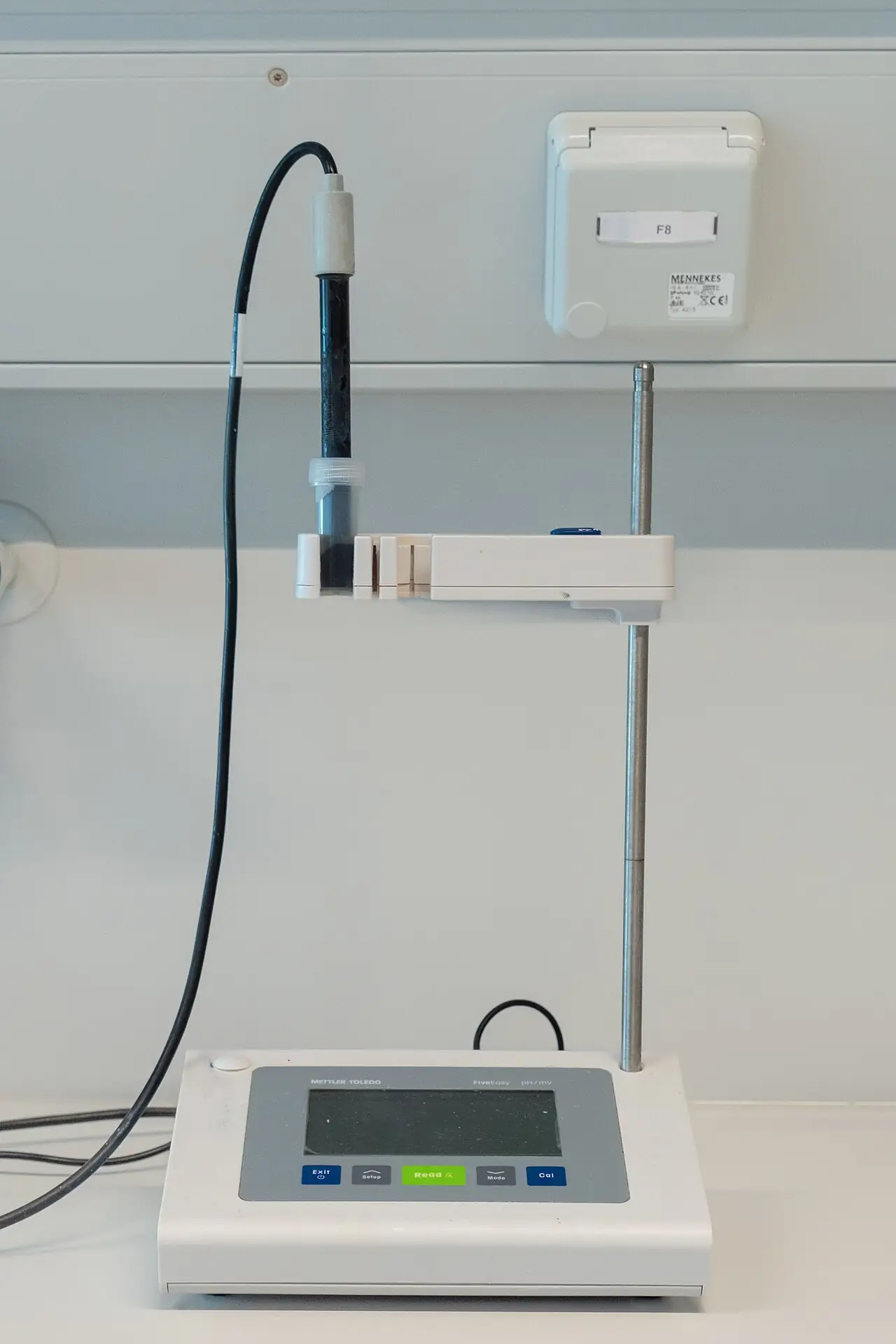
An ORP meter measures the oxidation reduction potential of an aqueous solution, the net electron-accepting tendency of everything dissolved in it, and reports it directly in millivolts. The sensor is a noble metal indicator electrode, platinum in most industrial service and gold where cyanide chemistry poisons platinum, measured against a silver-silver chloride reference through a PTFE junction, with the pair feeding a transmitter that spans minus 2000 to plus 2000 mV. The mV number is a composite: it says how oxidizing or reducing the whole soup is, not how much of any one species is present, and that is exactly why it is the cheapest robust control proxy in water treatment. A chlorine disinfection loop holds plus 650 to 750 mV, a cyanide destruction stage is driven through plus 150 to 250 mV, and a healthy anaerobic digester sits in the minus 200 to 400 mV band.
Procurement engineers meet the ORP meter, often sold as a redox meter at the sensor level and an ORP transmitter at the cabinet level, on municipal and industrial wastewater disinfection, on cyanide destruction and chromium reduction in plating and mining effluent plants, on cooling water and swimming pool biocide trim, and on anaerobic digestion health monitoring. The decision this page settles is which sensor construction survives the chemistry, platinum or gold, gel or polymer electrolyte, which transmitter platform hosts it, analog two-wire or digital with diagnostics, where the sensor lives, in the basin, in an inline tee, or in a conditioned side stream, and which verification regime, Zobell solution offsets validated against laboratory titration, keeps the control setpoint defensible. The answer lands as an RFQ line set: electrode metal, reference system, mounting, outputs, interlocks to the dosing equipment, and the certificates behind the mV.
This page treats the ORP meter as a purchasing object: the Nernst physics behind the millivolt reading, the honest process windows for disinfection, cyanide, chrome, and anaerobic duty, what poisons a platinum band and clogs a junction, how Zobell verification works when no true calibration exists, and how all of it is written into an RFQ. It is written for engineers who issue purchase specifications, not for readers who want a brochure summary.
Chapter 1 / 06
What an ORP Meter Is and What Is Being Decided
An ORP meter is a potentiometric instrument: it draws essentially no current and reports the electrical potential that an inert noble metal surface develops when it equilibrates with the oxidizing and reducing species in the water. The reading is a potential difference between that indicator electrode and a reference electrode of constant potential, silver-silver chloride in industrial practice, the calomel reference surviving only in legacy laboratory contexts. The transmitter amplifies the high impedance signal, displays millivolts, and outputs 4 to 20 mA plus a digital protocol to the control system. Because the metal is inert, the measurement consumes nothing and alters nothing; because it sums every redox couple present, the number is a condition of the water, not an assay of one species, and every serious application uses it that way: as a control and trend variable, validated at intervals by a laboratory method that does measure species.
What is being decided in this purchase is four commitments at once. First, the sensor commitment: platinum band or gold band for the indicator, matched to the poisoning chemistry of the process, and a reference system, gel, polymer, or refillable, matched to the clogging chemistry. Second, the platform commitment: an analog sensor into a panel or two-wire loop transmitter, or a digital sensor that talks Memosens, HART, or PROFIBUS PA to a modern two-wire platform and carries its calibration data in its connector. Third, the installation commitment: immersion in a basin with a holder, an inline sanitary or pipe tee, or a conditioned side stream with controlled velocity past the junction. Fourth, the verification and control commitment: Zobell solution checks on a schedule, laboratory validation of the setpoint, and dosing interlocks wired to a solenoid valve or a metering pump. A quotation that names only the range is an electrode price, not a control measurement.
The instrument lives among analytical siblings, and the RFQ should name the boundaries. The pH meter is the sister measurement: same transmitter platforms, same two-wire architecture, same reference electrode technology, with a glass bulb measuring hydrogen ion activity instead of a noble metal measuring electron exchange, and many plants run both on one dual-sensor platform. A conductivity meter reads ionic strength, cheap and robust, and says nothing about oxidation state. A dissolved oxygen meter reads one species directly and owns aerobic process control where oxygen is the variable; ORP complements it in basins where nitrate, ferric, or sulfide chemistry moves the redox state without oxygen moving. A turbidity meter reads effluent quality, a downstream variable. A spectrophotometer in the laboratory measures specific species by light absorption and is the referee that validates an ORP setpoint, with a delay of minutes to hours that makes it useless for the loop itself.
More companions share the panel and the sample line. A gas analyzer on the digester off-gas, methane and carbon dioxide, plus a flow meter on the gas line, corroborates what the redox trend in the sludge suggests; a moisture analyzer appears nowhere near this duty and belongs to solids water-content work, listed here only because its leaf sits in the same analytical family. A temperature transmitter value documents digester and disinfection contact tank conditions, since reaction rates and electrode behavior both move with temperature. A pressure transmitter on the sample loop confirms it is flowing. Where the effluent is regulated by mass rather than concentration, a densitometer or a flow-based measurement closes the accounting. Each companion has its own leaf in this encyclopedia; this page covers the redox instrument itself.
Compressed to one sentence, the decision is whether defensible, trend-worthy millivolts are bought as a system, electrode matched to chemistry, platform matched to the control room, installation matched to the hydraulics, and verification matched to the permit, or as an electrode part number dropped into the nearest tank. The chapters that follow supply the physics, the hardware families, the datasheet rows, the selection logic, and the failure modes needed to write it the first way.
Chapter 2 / 06
How the Electrode Chain Produces Millivolts
The physics is the Nernst equation, stated in words rather than symbols. A redox couple, an oxidized form and its reduced form, sets an electrode potential that shifts by a fixed amount for every factor-of-ten change in the ratio of oxidized to reduced concentration, and that fixed amount is 59.16 millivolts per decade at 25 deg C for a single-electron couple. Platinum, or gold, is inert: it does not react, it exchanges electrons with whichever couples are present until its potential satisfies all of them simultaneously. In a real process water there are always several couples, hypochlorite and chloride, dissolved oxygen and water, ferric and ferrous, sulfide and sulfate, so the reading is a mixed potential weighted by how fast each couple exchanges electrons on the metal surface. That is not a weakness to apologize for; it is the mechanism by which one bare metal wire summarizes the oxidizing power of the whole water, which is precisely what a disinfection loop or a cyanide oxidation stage needs to control.
The reference half of the chain is where the engineering trouble lives. The silver-silver chloride element sits in a reservoir of potassium chloride electrolyte, gel, polymer, or refillable liquid, which leaks slowly through a junction, an annular PTFE gap or a porous plug, to make electrical contact with the process. The junction must leak, because zero flow means no circuit; it must leak slowly, because exhausting the reservoir means reference drift; and the leak path is exactly where sulfides, oils, biofilm, and suspended solids lodge. Reference drift and junction clogging are the top two field failures of ORP measurement, ahead of anything that happens at the platinum band, and the sensor families differ mainly in how they manage that leak: gels for clean water, polymers for wastewater, refillable liquid KCl for heavy industrial duty where someone services the sensor on a schedule.
Temperature deserves a careful paragraph because ORP is not pH. The pH slope is a single well-defined couple, hydrogen ion, and transmitters compensate it automatically against a Nernst slope table. A process redox mixture has no single slope: each couple has its own temperature dependence, and the composite moves in a way no general table predicts. So the honest practice is to report raw millivolts and control on the number the plant validated at its own temperature band; temperature compensation is applied only where a specific known couple dominates and the method dictates it. What the temperature element in the sensor does do, beyond documentation, is feed cold junction and diagnostics, and on digital platforms a failing temperature input is flagged before it quietly changes what the transmitter believes about the electrode. Input impedance is the other quiet number: the electrode chain is a millivolt source with megohm-class internal resistance, so the transmitter input is gigaohm-class, and damp wiring, moisture in connectors, and ground loops all show up as noisy or offset millivolts long before anything is wrong with the water.
Verification follows from the physics. There is no true calibration of an ORP system against standard solutions in the pH sense, because the electrode is inert and the slope belongs to the chemistry, not the sensor. What is verified is the whole chain, offset and response, against a solution of known redox potential: Zobell solution, a ferri-ferrocyanide buffer, is the industrial standard and reads roughly 231 to 240 mV at 25 deg C against a silver-silver chloride reference per the maker's table, quinhydrone-pH mixtures serve the same purpose in legacy practice. The check is offset only: if the chain reads Zobell within tolerance, it is told the truth about the process water; if not, clean the platinum, service the reference, and check the cable. The setpoint itself is validated the slow way, by laboratory redox titration or species measurement on grab samples across a range of dosing rates, so that the mV number on the panel is anchored to a permit-relevant outcome. ASTM D1498, the standard practice for oxidation-reduction potential of water, and Standard Methods 2580, the ORP procedure for water and wastewater, describe exactly this discipline and are the two citations a specification should carry.
Response time closes the mechanism chapter. The electrode equilibrates in seconds to a minute on a healthy surface with reasonable velocity past it, and loop performance is dominated instead by process transport lag, the time between chlorine injection at one end of a contact tank and sensor response at the other, plus sampling lag where the sensor sits in a conditioned side stream delivered by a sample conditioning system rather than the main flow. A control engineer sizing the loop budgets instrument response, transport lag, and mixing together, and locates the sensor downstream of the injection point by the residence time the chemistry needs, not by the convenience of the handrail. The types chapter shows which hardware families make that discipline easy.
Chapter 3 / 06
Sensor and Platform Types, Construction, and Duty Boundaries
Four configurations cover the industrial market. The classic analog sensor is a combination electrode, platinum band plus Ag/AgCl reference with a PTFE junction and gel electrolyte, delivering a high impedance mV signal to a panel or two-wire loop transmitter; the Rosemount 5081 class of two-wire instruments is the reference architecture, loop-powered, hazardous-area capable, and simple enough to specify from one datasheet. The digital sensor family embeds the transmitter electronics in the sensor head or its connector: the Endress+Hauser Orbisint CPS12D is the reference construction, a digital ORP sensor with a platinum band, PTFE annular junction, gel or polymer electrolyte choice, and Memosens inductive coupling, talking to a Liquiline CM42 class two-wire platform over HART or PROFIBUS PA; the calibration and operating history travel with the sensor, so a swapped electrode arrives pre-identified to the transmitter. The third configuration is the dual platform: one CM42-class transmitter hosting pH and ORP sensors together, which is how water treatment trains are actually built, acid-base dosing and oxidant dosing on one cabinet with shared alarms. The fourth is the portable handheld redox meter, a battery instrument with a platinum electrode, which belongs to basin surveys and commissioning checks, never to the control loop.
Construction choices within the analog and digital families carry more warranty weight than the family name. The shaft and holder materials run 316 stainless standard, PVDF or PPA bodies where galvanic and chemical environments demand it; the junction is PTFE annular for wastewater and fiber-free ceramics for clean water by maker; the electrolyte is gel for clean service, polymer for long-life wastewater service, refillable liquid potassium chloride for heavy duty with scheduled maintenance. The indicator metal is the chemistry decision: platinum is the default and covers disinfection, digestion, and chrome work; gold is specified where cyanide chemistry is present, because cyanide solutions poison platinum surfaces, and because the gold couple behaves better in that specific electrolyte. Seals and O-rings follow the fluid, EPDM and FKM covering most water and wastewater duty, and the cable head is specified IP68 on established families so connector moisture, the historic analog failure, is engineered out rather than diagnosed quarterly.
The comparison table compresses the configurations into the form a specification meeting argues from.
Configuration
Construction, reference examples
Duty it wins
Watch item
Analog sensor plus two-wire transmitter
Platinum band combination electrode, PTFE junction, gel electrolyte, Rosemount 5081 class loop transmitter
Retrofit into existing panels, long cable runs, simple acceptance
Connector moisture and cable noise; calibration trips are manual
Digital sensor plus two-wire platform
Orbisint CPS12D class with Memosens or HART or PROFIBUS PA into a Liquiline CM42 class platform
New plants, predictive maintenance, hazardous areas, dual measurements
Protocol must match the control system; platform licensing
Dual pH plus ORP on one platform
Two digital sensors, one transmitter cabinet, shared display and alarms
Water treatment trains dosing acid, base, and oxidant together
Shared reference architecture must be stated in the RFQ
Portable handheld redox meter
Battery meter, platinum electrode, temperature probe
No continuous signal; electrode hygiene decides honesty
Duty boundaries keep the configurations honest against each other. The analog two-wire loop is not obsolete: it is the cheapest intrinsically safe route to one measurement in one tank, and where a plant already owns the panel architecture, matching it beats modernizing for its own sake. The digital family wins wherever maintenance labor is the scarce resource, because sensor identity, calibration history, and diagnostics travel with the electrode and the transmitter tells the technician what to do. The dual platform wins on cabinet count and alarm integration, not on measurement physics. And the handheld wins only the verification duty; a surprising number of small plants try to run disinfection on a weekly handheld number, which is not control, it is a diary.
Electrode-level boundaries close the chapter. A gel reference in a sulfide-laden anaerobic stream will drift within weeks; that duty takes polymer or refillable electrolyte and a polishing schedule. A platinum band in a cyanide-bearing stream will read fiction; that duty takes gold. A fixed cable analog sensor in a washdown room with hose discipline will die of connector moisture; that duty takes the inductively coupled digital head. None of these are premium-versus-economy choices; they are chemistry-versus-construction matches, and every one of them is a datasheet row in chapter 4.
Chapter 4 / 06
Key Specification Parameters
The datasheet rows below decide whether a quoted instrument matches the service; values are stated as the common industrial spans of the established families and must be confirmed against the model datasheet before order.
Attribute
Typical range or options
What it decides
Measuring range
Minus 2000 to plus 2000 mV full scale
Headroom over the worst process excursion and polarity
Transmitter accuracy
Plus or minus 1 mV class on digital platforms
Offset tolerance accepted in the Zobell check
Indicator electrode
Platinum band standard; gold band for cyanide service
Poisoning behavior in the actual chemistry
Reference system
Ag/AgCl with gel, polymer, or refillable KCl electrolyte; PTFE annular or ceramic junction
Service life, drift rate, and clogging behavior
Process temperature
0 to 135 deg C class on sterilizable variants, lower on gels
Electrolyte and seal limits, sterilization acceptance
Process pressure
6 to 12 bar class at ambient, derated at temperature, vendor typical
Holder and inline tee rating on the actual line
Outputs and protocol
4 to 20 mA plus HART or PROFIBUS PA; relay or bus-driven interlocks
Integration path to PLC, DCS, and dosing equipment
Area classification
ATEX or IECEx executions; intrinsic safety via a safety barrier
Wiring concept in classified areas
Response time
Seconds to one minute at a healthy electrode
Loop tuning against transport and sampling lag
Diagnostics on digital families
Sensor identity, calibration history, junction and temperature health bits
Whether faults arrive as alarms or as slow drift
The reference system row deserves expansion because it is the row that sets the maintenance budget. Gel electrolyte is sealed, factory-filled, and honest in clean water for one to three years of service; when it exhausts, the electrode is replaced whole. Polymer electrolyte trades some early-precision for resistance to poisoning and back-diffusion in wastewater, stretching service in exactly the streams that kill gels. Refillable liquid KCl asks for scheduled attention, topping and reservoir cleaning, and repays it with stable reference potential in hot and fouling duty. The junction material pairs with the electrolyte choice, PTFE annular where fibers and grease are present, ceramic where the water is clean, and the combination, not either alone, is what the RFQ should name.
The mV accuracy row carries an honesty clause the specification should inherit. The transmitter resolves and linearizes millivolts to plus or minus 1 mV class without difficulty; the electrode chain, junction potentials included, is the reason a Zobell check is written with a tolerance band rather than a point value, and the plant's control tolerance is usually tens of millivolts wide, set by the chemistry's slope, not the electronics. Specifying an instrument to single-millivolt field accuracy confuses the transmitter with the measurement; specifying a verification regime with stated band, interval, and corrective action, polish, service, replace, is what actually holds the number. The installation and verification table below states the practical spans with the reasoning that connects them.
Installation or verification parameter
Practical span
Logic
Velocity past the sensor
5 to 30 cm per second in side streams and tees
Faster erodes the junction and abrades the band; slower grows biofilm
Immersion mounting
316 or PVDF holder, 1 inch class, immersion depth 150 mm and beyond
Survives rakes, foam, and hose impact in basins and channels
Location relative to dosing
Downstream of injection by the chemistry's residence need
Loop stability depends on transport lag, not electrode speed
Verification solution
Zobell solution, roughly 231 to 240 mV at 25 deg C per maker table
Whole-chain offset check; no slope calibration exists to perform
Inspection cadence
Weekly in wastewater and digesters; monthly in clean water
Poisoning and biofilm move readings tens of mV between checks
Electrode polish
Fine abrasive on the platinum or gold band, on demand
Restores response time without replacing the electrode
Finally, the datasheet must state the companionship rows when the purchase is a system rather than an electrode: whether the platform hosts a pH meter beside the ORP sensor, whether a temperature transmitter shares the same panel for contact tank and digester documentation, which digital protocol the plant standard dictates, whether the dosing interlock drives a solenoid valve or a metering pump from the transmitter relay or from the PLC over the bus, and what wiring concept, intrinsic safety with a safety barrier or flameproof enclosures, applies in classified areas. An ORP purchase that answers none of these arrives as one electrode and four site arguments.
Chapter 5 / 06
Selection Decision Factors and RFQ Language
The selection sequence runs as a checklist, and each line eliminates a class of quotations before price comparison begins.
State the control objective as a process outcome, permit-compliant disinfection, cyanide destruction endpoint, chromium reduction endpoint, digester health, and the mV window the plant or the regulating method assigns to it.
Characterize the water: poisoning species, sulfides, oils, surfactants, cyanide; fouling load, solids and grease; temperature and pressure at the sensor point.
Choose the indicator metal, platinum default, gold for cyanide chemistry, and the reference system, gel, polymer, or refillable, against that chemistry.
Choose the platform: analog two-wire for simple singles, digital with diagnostics for anything a technician walks to less than weekly.
Fix the installation: basin immersion holder, inline tee, or conditioned side stream with 5 to 30 cm per second past the junction, located by residence time after the dosing point.
Fix the verification regime: Zobell offset check with tolerance and interval, laboratory validation of the setpoint, and the polish-and-service actions that follow a failed check.
Fix the control integration: 4 to 20 mA or bus to the PLC, dosing interlock to the solenoid valve or metering pump, and alarms on diagnostic bits.
Add the compliance lines: ATEX or IECEx with the wiring concept, a safety barrier where intrinsic safety is chosen, and the ASTM D1498 and Standard Methods 2580 citations behind the procedure.
Against the neighboring analytical instruments the ORP meter holds specific ground, and the comparison belongs here in the selection chapter rather than in a page title. The pH meter is the sister measurement on the same platform and neither substitutes for the other: acid-base state and oxidation state are independent axes, and chlorine disinfection chemistry moves both, which is why the dual platform exists. A conductivity meter tells ionic strength and nothing about oxidation state; it belongs on the same panel for different alarms. A dissolved oxygen meter measures one species and owns the aeration loop where oxygen is the manipulated variable; ORP covers the wider chemistry, anoxic and anaerobic zones, nitrate and sulfide, where oxygen readings alone mislead. A turbidity meter reports effluent quality after the fact, not control state before it. In the laboratory, a spectrophotometer measures the specific species, free chlorine, cyanide, hexavalent chromium, that the mV number merely integrates; the lab result validates the setpoint and calibrates the policy, then the electrode holds the loop between laboratory visits. A densitometer serves mass-balance accounting on sludge and brine streams, a moisture analyzer serves solids water content, and a gas analyzer on digester gas plus a flow meter on the gas line corroborate digester health that the redox trend flagged first. The honest selection rule: buy the ORP meter when the control question is "how oxidizing is the water, right now", buy the laboratory method when the question is "how much of what, exactly", and wire the two together in the verification procedure.
The application map below compresses the practice into the form a project file carries, with the process windows stated as the bands actually controlled in municipal and plating practice.
Application
Control window and dosing actuator
Check before order
Effluent chlorine disinfection
Plus 650 to 750 mV setpoint; metering pump or solenoid valve on hypochlorite
Transport lag between injection and sensor; lab validation of the setpoint
Cyanide destruction, alkaline chlorination
Plus 150 to 250 mV oxidation stage at high pH; second stage to completion
Gold band where platinum poisons; pH interlock ahead of the redox stage
Chromium VI reduction
Setpoint held in the low positive band with bisulfite at acid pH
Stage sequencing, chrome speciation confirmed by lab method
Anaerobic digestion health
Minus 200 to 400 mV monitoring with alarms, not control
Sulfide poisoning rate; weekly inspection cadence; gas analyzer cross-check
Cooling water and pool biocide trim
Plus 650 to 750 mV trim on oxidant dose
Surfactant and oil films; holder accessibility for weekly polish
Aeration and SBR process control
Redox slope used with a dissolved oxygen meter to trim DO setpoints
Biofilm on the junction; basin mounting against rakes
The RFQ block should be written once and reused: quantity and configuration; indicator metal and reference system with junction type; measuring range and transmitter accuracy class; process temperature, pressure, and chemistry at the sensor point including the poisoning species named; mounting, immersion holder, inline tee, or side stream, with velocity and location stated; platform and protocol, and whether a pH meter shares the cabinet; outputs, relay or bus interlock to the solenoid valve or metering pump, and alarm list; area classification with wiring concept and the safety barrier where intrinsic safety applies; the verification procedure with Zobell tolerance band and interval; and the acceptance test, Zobell check plus a live comparison against the laboratory method on actual process water at two dosing states. A quotation returned without the reference system named or the verification procedure answered is incomplete at any price.
Chapter 6 / 06
Installation, Standards, Failure Modes, and Maintenance
Installation carries the measurement because an ORP electrode is a surfaces-and-flow instrument. In basins and channels, mount on a 316 or PVDF holder with enough immersion, 150 mm and beyond, positioned where mixed liquor actually moves past the band, shielded from rakes and hose impact, and reachable from the walkway because this is an electrode someone polishes weekly. In pipes, an inline tee or flow-through cell with 5 to 30 cm per second past the junction keeps the surface swept; too fast erodes the junction and slowly sands the band, too slow lets biofilm and grease define the surface the water sees. The sensor goes downstream of the dosing point by the residence the chemistry needs, and where the main line is too large or too hostile, a sample conditioning system delivers a tempered side stream to a panel of sensors, ORP beside a pH meter, with isolation valves and a return, and the sample line is kept short and at process temperature so the mV at the panel means the mV in the process. A pressure transmitter or simple flow indication on that loop confirms it is alive, because a stagnant side stream reads a confident number about yesterday's water.
Electrical installation decides the noise floor. The electrode chain is a megohm-source millivolt signal, so cable runs are continuous or inductively coupled on digital families, junction boxes are IP68 and drained, and above all the tank and piping bonding is checked: ground loops through improperly bonded plastic-to-metal transitions and stray currents from nearby DC equipment show up as offset or wobbly millivolts that no calibration removes. Where the tank sits on an insulating flange, verify the bonding strategy deliberately. In classified areas the intrinsic safety concept pairs the loop with a certified safety barrier, and the barrier, not habit, sets the transmitter model that can be used. Commissioning records the Zobell offset, the as-found response time in process water, and the first laboratory comparison, which becomes the baseline the maintenance schedule refers back to.
The standards frame is short and honest. ASTM D1498 is the standard practice for oxidation-reduction potential measurement of water and defines the electrode chain and procedure discipline. Standard Methods 2580 is the ORP procedure for water and wastewater analysis that municipal and permit language references. IEC 60746 governs the galvanic cells, the pH and redox electrode vocabulary and the expression of performance that datasheets lean on. Hazardous area execution carries ATEX or IECEx with the installation concept. There is no ISO certificate that makes a redox reading true; the Zobell check and the laboratory validation do that, and citing the two method standards in the RFQ tells the supplier the buyer knows it.
Failure modes follow a short and predictable list. Poisoned platinum or gold surface: sulfides, oils, and biofilm shift readings tens of millivolts and slow the response; the fix is polish with a fine abrasive on schedule and replacement when polishing stops holding. Reference junction blockage: the classic slow-response, drifting-offset symptom, remedied by cleaning or replacement, and prevented by the velocity window and the right junction material. Reference drift from electrolyte exhaustion: gels age out in one to three years by duty, polymer longer, refillable asks for topping; the Zobell check catches it as an offset that polish does not fix. Cable and connector moisture on analog fixed cables: the historic failure, engineered out by inductively coupled digital heads and IP68 fittings. Ground loops and stray currents: diagnosed by disconnecting and floating checks, fixed by bonding and isolation review. Temperature element failure: skews any compensation the platform applies and flags on digital diagnostics; verify against the platform's own reference or a calibrated thermometer during service.
Maintenance is deliberately boring and budgeted in electrodes, not man-days. Weekly in wastewater: inspect, rinse, polish on demand, and log the reading against the laboratory check where one exists. Monthly in clean water: the same, lighter. Zobell offset check monthly to quarterly by duty, with the tolerance band and the action written in the procedure. Electrode replacement every one to three years by chemistry, planned as a consumable line from day one, which is also why the digital head that carries calibration identity to the new sensor earns its premium on maintenance labor alone. The throughline of this page is that an ORP meter is the cheapest honest control instrument in the water plant exactly when it is treated as a system: electrode matched to the chemistry, mounted where the water moves, verified against Zobell, and validated against the laboratory method on a schedule. Skipped on any of the four, it still produces millivolts, and they still look exactly as authoritative as good ones.
FAQ
What ORP setpoint should chlorine disinfection control at?
Municipal and industrial practice controls effluent disinfection in the plus 650 to 750 mV window against a silver-silver chloride reference, with the exact setpoint validated by laboratory coliform or chlorine speciation on grab samples across dosing rates. The mV number integrates every oxidant present, so the setpoint is plant-specific and permit-anchored, not a universal constant. Locate the sensor downstream of injection by the residence time the chemistry needs, or the loop chases its own transport lag.
How do I verify an ORP meter when no true calibration exists?
Verify the whole chain with an offset check against a solution of known potential, industrially Zobell solution, which reads roughly 231 to 240 mV at 25 deg C against a silver-silver chloride reference per the maker's table. If the reading falls inside your stated tolerance band, the chain is telling the truth; if not, polish the metal band, service or replace the reference, and check the cable before suspecting the water. The electrode is inert, so there is no slope calibration to perform, only offset and response to confirm.
When should the electrode be platinum and when gold?
Platinum is the industrial default and covers disinfection, digestion, chromium, and general redox duty. Gold is specified for cyanide-bearing streams, because cyanide chemistry poisons a platinum surface and the gold couple behaves more predictably in that electrolyte. Poisoning shows as drifting readings and slow response that polishing temporarily fixes; if a plant polishes weekly and still drifts, the metal choice, not the maintenance schedule, is the problem.
Why is my ORP reading drifting slowly?
Three usual causes in order of likelihood. Reference junction clogging or electrolyte exhaustion produces a slow offset shift that the Zobell check confirms and polish does not fix. A coated or poisoned metal band, biofilm, oil, or sulfide, shifts readings tens of millivolts and slows response until polished. On analog loops, connector moisture and ground loops add noise and offset; inductively coupled digital heads and verified bonding remove both. Diagnose in that order before replacing anything.
Does temperature compensation apply to ORP?
Mostly no, and this is not a defect. A process redox reading is a mixed potential of several couples, each with its own temperature dependence, so no general compensation table exists the way it does for pH. Honest practice reports raw millivolts and controls on a setpoint the plant validated at its own operating temperature. The sensor's temperature element feeds diagnostics and documentation; slope compensation is applied only where a single known couple dominates and the method calls for it.
Can one transmitter host both pH and ORP?
Yes, and water treatment trains are usually built that way: two digital sensors on one two-wire platform cabinet of the CM42 class, sharing display, alarms, and the verification calendar. The two measurements are independent axes, acid-base and oxidation state, but the dosing chemistry couples them, and one cabinet integrating both simplifies interlocks to the metering pump or solenoid valve stages. State the shared-platform requirement in the RFQ so protocol and licensing match.
Where should the ORP sensor be mounted?
Where the water moves and the chemistry has acted: in basins on a 316 or PVDF holder with 150 mm and beyond of immersion, shielded from rakes; in pipes or side streams at 5 to 30 cm per second past the junction, faster erodes the junction, slower grows biofilm; and downstream of the dosing point by the residence time the reaction needs. Avoid dead legs entirely, keep sample lines short and at process temperature, and confirm the loop is flowing with a pressure transmitter or flow indication.