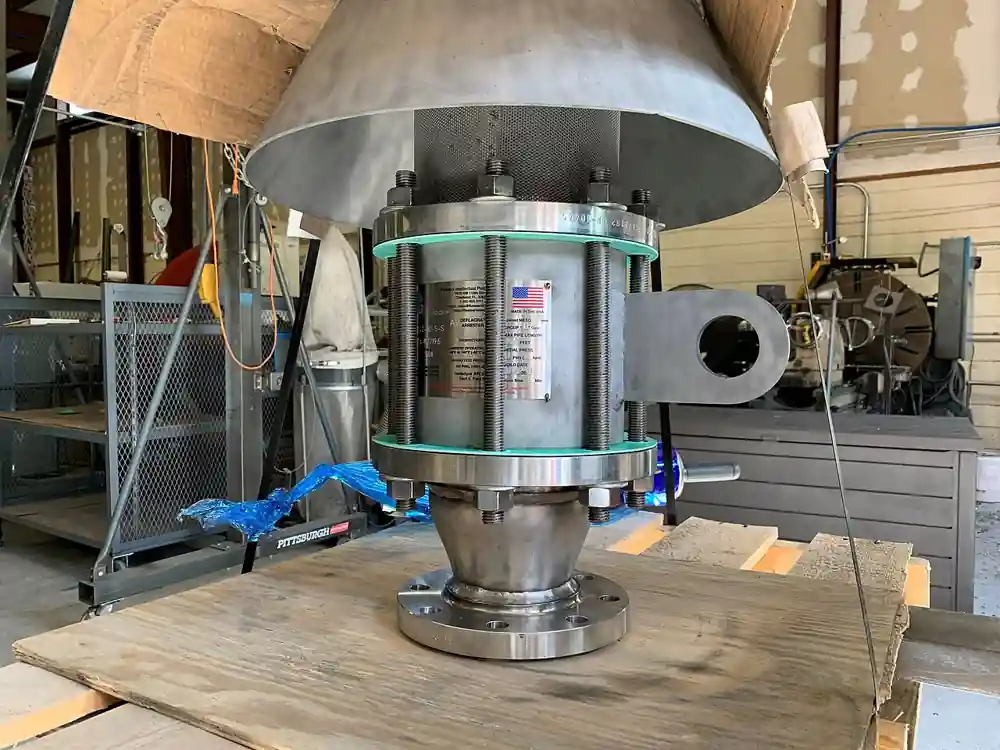
A pressure vacuum relief valve is a self contained, two pallet device fitted to the roof nozzle of an atmospheric or low pressure storage tank. One pallet holds the pressure seat closed under dead weights or a spring and lifts when vapor space pressure reaches its set point, discharging to atmosphere or to a vapor line. A second pallet holds the vacuum seat and admits air when internal pressure falls to the vacuum set point. The trade also calls the device a conservation vent or a breather valve, and both aliases describe the same hardware: a vent that stays sealed at rest and thereby conserves vapor that an open gooseneck would lose, but that breathes in both directions the moment the tank needs it. Set points sit within tens of millibars of atmospheric, from about minus 0.5 mbar vacuum to 35 mbar pressure on standard catalog builds, and the sizing basis is not the catalog but the venting calculation in API 2000.
Procurement engineers meet these valves on tank farms storing diesel, gasoline, ethanol, produced water, and liquid chemicals, on blanketed process tanks, and on terminal loading racks. The decision this page settles is a protection scheme rather than a fitting: which venting cases set the nozzle, thermal and liquid movement breathing plus the fire case, whether the construction is weight loaded or pilot operated, whether the discharge is end of line or piped to a recovery header, and how the set points stack against the tank design pressure and any nitrogen blanketing regulator. The answer lands as an RFQ line set, capacity, set pressures, construction, materials, and accessories, and every chapter below feeds that line set so the tank is protected by arithmetic rather than by habit.
This page treats the pressure vacuum relief valve as a purchasing object: how API 2000 builds the inbreathing, outbreathing, and emergency venting demand, how weight loaded and pilot operated pallets meet it, how set points stack against tank design pressure and nitrogen blanketing, and how the whole package is written into a defensible RFQ. It is written for engineers who issue purchase specifications for storage tanks, not for readers who want a brochure summary.
Chapter 1 / 06
What a Pressure Vacuum Relief Valve Is and What Is Being Decided
The mechanism is deliberately primitive, and that is its virtue. A machined pallet sits on a seat ring; dead weights stacked on the pallet spindle, or a spring, supply the closing force; and the set pressure in millibar is simply that force divided by the seat annulus area. When tank pressure overcomes the load the pallet lifts, flow passes around the seat through the body and out of the weather hood, and gravity or spring force reseats the pallet when the excess is gone. The vacuum side is the same arrangement acting upward. There is no pilot, no externally supplied energy, and no dependence on anything outside the tank, which is why the weight loaded conservation vent has protected tank farms for a century and why any sophistication added on top of it must justify itself against that baseline.
What is actually being decided in this purchase is a protection scheme, not a component. The buyer must establish the required venting capacity in cubic meters per hour of free air for three separate cases: inbreathing from pump out and thermal effects, outbreathing from filling and vapor generation, and emergency venting under fire exposure, all per API 2000, 7th edition. The buyer must then select the construction that meets the governing case: weight loaded pallets or a pilot operated valve, end of line discharge or pipe away to a vapor recovery header, bare vent or a certified combination with a flame arrester underneath. Set points must be stacked against the tank design pressure and against any nitrogen blanketing regulator. The RFQ therefore settles five linked lines, capacity, set pressures, construction, materials, and accessories, and a quotation that answers only one of them has not answered the tank.
Against its neighbors the device occupies the millibar territory deliberately. The familiar safety relief valve protects ASME pressure vessels: it is built to code pressure vessel practice, sets at pressures of several bar and upward, and depends on a spring load that would render it crude and leak prone if asked to hold a 20 mbar seat. The rupture disk is a one shot membrane with no reclosing behavior at all, wrong for a tank that breathes daily. Neither instrument is interchangeable with this valve, and chapter 5 works through the boundary cases where specifiers reach for the wrong hardware. At the other neighbor, the open vent and the gauge hatch, there is no set point and no conservation; they are the fallback that the closed pallet improves upon whenever vapor loss, odor, or emission rules matter.
Four documents organize the datasheet. API Standard 2000, Venting Atmospheric and Low Pressure Storage Tanks, 7th edition, defines the venting demand calculation, the inbreathing and outbreathing terms, the fire case, and the tables every manufacturer certifies capacity against. API 650 builds the atmospheric tanks this valve protects and requires normal and emergency venting in accordance with API 2000. API 620 governs low pressure tanks up to 15 psig, where the higher set bands and pilot constructions begin. NFPA 30 aligns the fire exposure and environmental factor practice for flammable liquids. A datasheet that names none of these four is a price tag, not a protection specification, because nobody can check capacity without stating the calculation basis.
The station matters as much as the valve. The device bolts directly to a tank roof nozzle whose flange drilling and facing must match, ASME B16.5 Class 150 flat face is the norm, with a gasket chosen for the stored fluid rather than whatever is nearest in the store. There must be no isolation valve between tank and vent, because a closed ball valve or gate valve under a pallet vent is the classic prelude to a collapsed roof; where site practice insists on one for maintenance, it is car sealed or locked open and appears in the administrative controls. Where a nitrogen blanketing system exists, its supply line usually enters through its own regulator and check valve, and the vent set points must stack around the blanketing set points. Vapor space monitoring, a pressure transmitter on the control system or a standalone pressure sensor with local indication, plus an independent pressure switch for high and low alarm, belongs in the same RFQ package so the tank is watched as well as protected.
Chapter 2 / 06
How API 2000 Builds the Venting Demand
Inbreathing demand has two components, and engineers who size only for their pumps routinely miss the larger one. Liquid movement: every cubic meter of liquid pumped out frees a cubic meter of vapor space that must be replaced by air, and API 2000 expresses this as 0.94 cubic meter of free air per cubic meter of maximum pump out rate, summed over every pump that can empty the tank simultaneously. Thermal: the vapor space cools after sunset, contracting the gas and condensing vapor, and the standard supplies tabulated thermal inbreathing rates against tank vapor space volume for exactly this effect. On many storage tanks the thermal term, not the pump out term, sets the vacuum side requirement. The vacuum pallet must pass the summed flow, expressed in cubic meters per hour of air, at the overpressure its certified capacity table allows, and the breather valve that cannot is a nozzle ornament.
Outbreathing runs the same logic in reverse with a fluid dependent factor. Filling displaces vapor at essentially the filling rate for products with a flash point at or above 37.8 deg C, and at roughly double that for light stocks whose flash point sits below 37.8 deg C, because evaporation adds to displacement; API 2000 carries the factors and combines liquid movement with thermal outbreathing from daytime heat up in its tables. The pressure pallet must relieve that total at the accumulation the tank can tolerate, which on an atmospheric tank is a handful of millibar. Specifiers should note that the fire case is calculated separately and is almost never covered by pallets sized for normal breathing, which is why many tanks carry a larger emergency vent or gauge hatch alongside the normal vent, and why the RFQ must state which device owns which case.
The fire case is the largest demand the roof will ever see. API 2000 bases it on the wetted area of the shell within 9.1 meters above grade, on the reasoning that a pool fire heats liquid covered steel, and it reduces the required capacity by an environmental factor where drainage, water spray, or insulation earns credit, down to roughly 0.3 in well protected installations and 1.0 for a bare tank with no drainage. The result is again cubic meters per hour of air, on a large tank one to two orders of magnitude larger than normal breathing. The standard permits one device to serve both duties if its certified capacity covers the emergency case at emergency accumulation, but economy of a single large pallet usually loses to the practical split: a light pallet for daily breathing, which then seats tightly and conserves vapor, plus a dedicated emergency vent sized only for the fire.
Pallet mechanics explain both the strengths and the limits of the weight loaded construction. Set pressure is force over area, so the available seating force equals the weight that sets the pallet; at 90 percent of set pressure the sealing load is already near its minimum and the vent approaches simmer, the faint continuous leak that wastes vapor and generates odor complaints. Blowdown is small because gravity reseats promptly, typically within a few millibar of set, which is exactly what a fragile tank roof wants. Pallet diameter is the designer's balancing variable: a large pallet lifts the same vapor rate at a lower set pressure but needs more travel to pass it, and a small pallet concentrates wear on a narrower seat land. Everything that shifts weight, friction, or geometry, ice on the seat, paint on the guides, corrosion product on the ring, moves the set point, which is why chapter 6 treats inspection as part of the specification rather than a courtesy.
A pilot operated vent decouples seating force from set pressure and buys back everything the dead weight gives up. A small pilot senses tank pressure and, below set, applies full tank pressure to the top of a main valve diaphragm, so the seat closes with a force far greater than any dead weight could supply at the same set point. At set the pilot vents the diaphragm chamber and the main valve opens fully, then reseats crisply. The practical consequences are measurable: near zero simmer, which cuts standing evaporation losses and emissions; set points held within a few percent of the tank design pressure, which lowers working losses; and higher unit capacity per nozzle. The price is a second set of moving parts, diaphragms and seats in FKM or PTFE that demand scheduled inspection, and vulnerability to fouling service where polymerizing or crystallizing vapors are stored, which is why the pilot is specified deliberately rather than by default.
Chapter 3 / 06
Types, Construction, and Duty Boundaries
Catalogs resolve into four constructions. The end of line weight loaded vent, the default on water, diesel, and heavy product tanks, discharges through a weather hood and carries its pallets on dead weights. The pipe away model swaps the hood for flanged outlets, so outbreathing can be collected into a vapor recovery line while vacuum is admitted through a separate port. The pilot operated vent serves blanketed and emission controlled tanks where seat tightness pays for itself in recovered product. The combination unit marries the vent to a deflagration flame arrester in a single certified body, standard on Class I product service where external ignition sources such as lightning are credible. Between them these four cover the tank farm, and the selection question is which construction the stored fluid and the local authority force onto the nozzle.
Materials follow the stored fluid and the climate. Housings are cast aluminum on routine atmospheric duty because the metal survives weather without painting and is light enough for one technician to lift onto a nozzle; coated carbon steel where hot service, heavier set bands, or mechanical abuse demand it; and CF8M or 316L stainless steel for corrosive service such as sour produced water, methanol, and coastal salt air. Pallets and seat rings are 316 stainless steel as the default, with PTFE facings on the seat where tightness at very low set pressure matters. Diaphragms and soft parts in the pilot are FKM or PTFE. The flange is ASME B16.5 Class 150, flat face in aluminum and raised face in steel, and the gasket is chosen to match: compressed fiber for utility products, spiral wound 316 windings with graphite filler for hydrocarbon and fire sensitive service. A stainless steel standpipe under the vent keeps roof corrosion products away from the seat, a small line item that saves a maintenance shift.
The boundaries deserve plain statements. This valve protects tanks designed near atmospheric, from full vacuum to roughly 1 barg; above that band the device family changes to code safety hardware. It must never be isolated by a closed valve, and it must never be painted after installation, because paint glues a pallet to its seat more reliably than any adhesive. Where the stored liquid flash point is below the handling temperature, a bare vent is not acceptable in most jurisdictions and the certified flame arrester combination is the default. Where nitrogen blanketing is fitted, the vent does not substitute for the blanketing regulator, it backs it up, and the set ladder in chapter 5 is what keeps the two devices out of each other's way. And where the fire case governs the nozzle, the normal vent is sized for breathing and the emergency duty is assigned to a dedicated device, unless the single unit's capacity has been checked against the emergency calculation explicitly and in writing.
The duty map below compresses those boundaries into a table a specifier can carry into a review meeting; it pairs common storage services with the construction that survives them and the shortcut that eventually calls the engineering desk.
Service
Suitable construction
Construction to avoid
Diesel and fuel oil, flash point above 37.8 deg C
End of line, cast aluminum or coated carbon steel body, bird screen
Pipe away cost spent with no vapor recovery header to receive it
Gasoline and ethanol service
Certified combination with flame arrester, stainless internals
Bare aluminum vent where the arrester credit is required by rule
Sour produced water
316L stainless steel body and pallets, sealed hood
Carbon steel housing, corrosion products jam the pallet within a year
Nitrogen blanketed chemical tank
Pilot operated, pipe away, stacked set ladder
Weight pallet set so close to the blanket regulator that it simmers continuously
Cold climate, high humidity icing
Heat traced or steam jacketed body, insulated hood
Bare winter vent with no de icing provision
Heated heavy product, asphalt or molten sulfur
Coated carbon steel body, high temperature seals, jacketed
Soft seat facings rated below the stored product temperature
Small tank in a fire dominated dike
Normal vent plus dedicated emergency vent sized on wetted area
Single small pallet trusted to cover a fire case it was never rated for
Chapter 4 / 06
Key Specification Parameters
The table below decodes the datasheet lines that decide whether a quoted vent matches the tank. Each row is purchase defining; the paragraphs after the table explain what to demand and what a weak answer looks like.
Attribute
Typical range or options
What it decides
Nominal size
DN 50, 80, 100, 150, 200, 300; DN 80 and DN 100 most common on tank farms
Nozzle drilling, roof loading, and the certified capacity envelope
Set pressure, pressure side
2 to 35 mbar standard weight loaded, to 3.5 kPa; higher with spring or pilot builds
Distance from tank design pressure and from the blanketing set point
Set vacuum
minus 0.5 to minus 10 mbar typical, from minus 0.05 kPa
Protection against roof pull in during pump out and steam out
Certified capacity basis
m3/h free air at stated set and overpressure, per API 2000
Whether the quotation can be checked against the venting calculation at all
Body material
Cast aluminum, coated carbon steel, CF8M or 316L stainless steel
Weathering, product corrosion, and roof nozzle compatibility
Pallet and seat
316 stainless steel pallets, PTFE faced seats as an option
Seat tightness and reseat behavior between inspections
Flange and facing
ASME B16.5 Class 150, flat face aluminum, raised face steel
Gasket selection and installation practice at the nozzle
Accessories
Weather hood, bird screen, pipe away outlets, steam or electric jacket, drip ring
Which venting, icing, and emission duties the single unit can legally carry
Two rows deserve paragraphs of their own. Capacity: demand the certified flow table in cubic meters per hour of free air at your actual set pressure and its stated overpressure, never the catalog maximum at a set point you will not use, because weight pallet capacity moves strongly with set pressure as the same orifice works against a heavier load. Set tolerance: a bench set weight pallet repeats to a few tenths of a millibar, but installed tolerance after gasket compression, roof nozzle distortion, and wind adds up to worse, so keep real margin between the blanketing regulator, the vent set, and the tank design pressure. Specifiers who stack three set points within 5 mbar of each other are buying simmer and calling it protection.
When the combination unit is chosen, the derate is not optional arithmetic. A deflagration flame arrester in series with the pallet adds resistance, so the certified capacity of the pair at your set pressure is lower than the vent alone, and only the manufacturer's combined table, tested as an assembly, can be used in the API 2000 check. Specifying a vent from one supplier and an arrester from another, then multiplying catalog numbers, is the error auditors find after the tank has already been protected by luck. The construction comparison below is the type decision in one view.
Construction
Set band and seat tightness
Where it earns its cost
Watch items
End of line weight loaded
minus 0.5 to 35 mbar; simmer begins near set
Water, diesel, and heavy product breathing duty
Standing evaporative losses; screen blockage by nests
Pipe away weight loaded
Same pallet mechanics; outlet to a header
Vapor recovery and odor control on product tanks
Header backpressure shifts the true set pressure upward
Pilot operated
Set within a few percent of design; near zero simmer
Nitrogen blanketed, emission limited, high value vapor
Pilot maintenance; fouling in polymerizing service
Certified flame arrester combination
Same vent families with a series arrester element
Flash point below handling temperature, lightning exposure
Added pressure drop derates capacity; element cleaning
Chapter 5 / 06
Selection Decision Factors and RFQ Language
The decision sequence is short enough to run as a checklist in a specification meeting, and each step eliminates a class of quotations before price comparisons begin.
Run the API 2000 calculation first: inbreathing, outbreathing, and the fire case in cubic meters per hour at stated conditions; the vent is bought against numbers, not nozzle habit.
Fix the set ladder: blanketing regulator, pressure pallet, vacuum pallet, tank design pressure, each separated by a margin you can defend, typically 20 percent of band or more.
Choose construction: weight loaded end of line for routine duty, pilot operated where tightness pays, pipe away where vapor is collected and credited.
Decide the flame arrester question from flash point and ignition sources, then specify a certified combination unit if the answer is yes.
Match materials to product and climate: aluminum, coated carbon steel, or 316L stainless steel housing; 316 pallets; PTFE seats where tightness is critical.
Size the nozzle and flange with the tank designer, not after the roof is built: ASME B16.5 Class 150 drilling, correct facing, and the gasket specified by class of service.
Add monitoring to the package: a pressure transmitter or pressure sensor on the vapor space and an independent pressure switch alarm at values operations will act on.
Fix the evidence: capacity certification against API 2000, material certificates to EN 10204 3.1, and the inspection schedule the site will actually keep.
Against neighboring devices, the boundary runs as follows, and it belongs here in the selection chapter rather than in the page title. A safety relief valve is the right instrument for a code pressure vessel and the wrong one for an atmospheric tank: its spring loaded seat is designed for bar and multiples of bar, its blowdown of 7 to 10 percent has no meaning at 20 mbar, and its certification basis does not transfer to millibar protection. A rupture disk fits fouling, viscous, or slurry service on vessels where reclosing is not wanted, but it is a single event device, and a tank that breathes daily would consume disks like gaskets. Between them and this valve sit the gauge hatch and dedicated emergency vent for the fire case, and the nitrogen blanketing regulator below the vent in the set ladder. Choosing among them is not a search for the best valve; it is a question of which pressure band the vessel actually lives in, and a millibar tank answers it every time.
The application map below turns the checklist into a table the project file can carry.
Application
Construction to specify
Check before order
External diesel storage, temperate climate
End of line, cast aluminum, DN 80 or DN 100, bird screen
Certified capacity against pump out plus thermal inbreathing
Gasoline storage with vapor recovery unit
Pipe away weight loaded or pilot, stainless internals
Combined header backpressure applied to the true set pressure
Blanketed methanol or chemical tank
Pilot operated, pipe away, stacked set ladder
Regulator, vent, and design pressures separated by margin
Sour water tank
316L stainless steel body and pallets, sealed hood
Corrosion plan and inspection frequency stated in the RFQ
Winter icing site
Heat traced or jacketed vent, insulated hood
Power or steam supply reliability at minus 20 deg C and below
Fire case governed small tank
Normal vent plus dedicated emergency vent
Wetted area within 9.1 m of grade used in the calculation
The RFQ block should be written once and reused. A complete block reads: tank size and design pressures, internal and external; stored product with flash point and storage temperature; the three API 2000 calculated demands in cubic meters per hour with the calculation basis stated; nozzle size, flange class and facing, and gasket specification; set pressures for the pressure and vacuum pallets with tolerance, plus the blanketing regulator set point; construction, weight loaded, pilot operated, pipe away, or certified combination with flame arrester; materials of housing, pallets, seats, and soft parts; accessories, hood, bird screen, jacket, drip ring; monitoring devices, a pressure transmitter or pressure sensor and an independent pressure switch alarm; certification, capacity test data against API 2000 and material certificates EN 10204 3.1; and the inspection and retest interval the site commits to. A quotation returned without a capacity table at your set pressure is incomplete at any price.
Chapter 6 / 06
Installation, Standards, Failure Modes, and Maintenance
Installation quality decides whether the pallets stay free. The nozzle must be plumb, because a tilted vent biases its pallet weights; the roof flange must be level and its gasket compressed evenly to the maker's bolt pattern, since a squeezed gasket can lift one side of the seat land and set the vent to a different pressure than the bench tag says. The hood and bird screen go on as delivered, and paint does not: a painted guide or pallet is a seized vent under a neat finish. There is no isolation valve under the vent in normal practice; where a ball valve or a gate valve exists it is locked open with a car seal and appears in the site's administrative controls. Keep roof access clearance for the person who will inspect the unit annually, and keep the vent clear of hot exhaust stacks and crane paths, both classic interference sources on crowded tank roofs.
Commissioning verifies three numbers. First the set points: a portable pop test kit or a bench rig confirms the pressure and vacuum pallets within the tolerance the RFQ stated, and the values are recorded with serial numbers into the tank file. Second the ladder: with the nitrogen blanketing regulator forced to its set point, confirm by record that the pressure pallet sits above it and the vacuum pallet below it, with the margins the calculation demanded, and verify the nitrogen supply line check valve holds when the tank breathes vacuum. Third the monitoring: prove the pressure transmitter against a calibrated gauge and trip the high and low pressure switch alarms at the values operations will live with. Steam out and first fill are the two events that find every vent error; walk the tank through both before handover.
The standards frame the verification. API 2000, 7th edition, remains the sizing basis, harmonized with ISO 28300. API 650 requires normal and emergency venting for atmospheric tanks in accordance with API 2000 and fixes the nozzle practice around it. API 620 governs the low pressure tanks whose higher set bands push toward pilot operation. NFPA 30 aligns the fire exposure and environmental factor practice for flammable liquids. Where vapor emission is regulated, the local air quality rule, not the manufacturer, decides whether a bare end of line vent is still permitted, and the RFQ should state the rule by name so the supplier quotes against it rather than assuming grandfathered rights.
Failure modes follow a short and predictable list. Sticky pallets: paint, polymerized vapor, or corrosion products glue a pallet to its seat, the tank then holds pressure it should have relieved or pulls vacuum on pump out; found by the annual manual lift check. Seat corrosion: sour or coastal service pits the seat ring until the vent simmers continuously; found by vapor space pressure trend and frequently by the nose, since standing losses smell before they show. Icing: water vapor and freezing rain freeze the pallet or its guides in winter, the classic February roof collapse; prevented by jackets and tracing. Pilot fouling: crystallizing or polymerizing service plugs the pilot sense line and disables the tightness the pilot was bought for; prevented by scheduled inspection. Screen blockage: bird nests and windblown film choke the hood and add backpressure the set calculation never included; found visually. Every one of these is a maintenance finding, not a manufacturing defect, which is why the inspection interval belongs in the purchase specification.
Maintenance intervals scale with service severity. A visual check, screen clear, pallet free, no paint, no corrosion product, is a quarterly walk by on severe service and annual on benign product tanks. Set point verification belongs on a 12 to 36 month cycle depending on service corrosivity and local regulation, using a portable test kit in place or a bench rig, with results trended by serial number. Soft parts and the nozzle gasket are replaced at any lift test that shows drift. Spare pallet sets and a spare gasket for each nozzle size live in the store before the first winter. Every inspection produces a number the next RFQ can use: drift rates and corrosion findings tell the next buyer which construction actually survived the service, which is how a tank file gets smarter instead of just older.
FAQ
How do I choose set pressures for the pressure and vacuum pallets?
Set the pressure pallet at or just below the tank internal design pressure and the vacuum pallet at the external design pressure, then check the ladder. Where nitrogen blanketing is fitted, the regulator must sit a few mbar above atmospheric and comfortably below the pressure pallet, with at least 20 percent of the band kept as margin between each set point. Standard catalog pallets cover vacuum settings from about minus 0.5 mbar and pressure settings up to 35 mbar (3.5 kPa).
How does API 2000 build the inbreathing requirement?
Inbreathing has two parts. Liquid movement out requires 0.94 cubic meter of air per cubic meter of liquid pumped out at the maximum simultaneous rate. Thermal inbreathing, from vapor space contraction as the tank cools, comes from the standard's tables against vapor space volume, and on many tanks it exceeds the pump out term. The vacuum pallet must pass the sum, in cubic meters per hour of free air, at its certified overpressure.
When is a flame arrester required under the vent?
Wherever the stored liquid can form a flammable vapor space and an external ignition source such as lightning is credible, which in practice means Class I products such as gasoline and ethanol and any stock stored above its flash point. The arrester must be certified as a combination unit with the vent, because the element adds pressure drop that derates the pallet's capacity, and the combined flow table is the only number usable in the sizing check.
How do set points coordinate with a nitrogen blanketing regulator?
The regulator senses tank pressure and supplies nitrogen slightly above atmospheric, typically a few mbar positive. The pressure pallet must sit above the blanketing set point far enough that normal breathing does not lift it, and the vacuum pallet below the point where the regulator can no longer respond to a sudden pump out. Written as a ladder: regulator set, then margin, then pallet, then tank design pressure. Vents that simmer daily are almost always stacked too tightly.
Can the vent outlet be piped to a vapor recovery header?
Yes, pipe away models are built for it, with flanged outlets for outbreathing and a separate vacuum port for air admission. The engineering point is backpressure: the header pressure acts on the pallet outlet, so the true set pressure is the bench set plus whatever the header carries at that moment, and capacity drops accordingly. Specify the maximum header backpressure in the RFQ and require the capacity table referenced to it.
Why do storage tanks collapse inward, and how does the valve prevent it?
A roof collapses when vapor is removed faster than air enters: a pump out with a blocked vacuum pallet, or a steam out followed by condensation or cold rain on a hot shell. Each event can demand thousands of cubic meters per hour of air through the vacuum seat. The vacuum pallet admits it at a few mbar of depression, well inside the shell's external design limit, provided the pallet is free and the nozzle is unobstructed.
How often should a pressure vacuum relief valve be inspected and tested?
Industry practice is a visual inspection at least annually, more often in corrosive, icing, or fouling service, and a set point verification every 12 to 36 months by portable pop test or bench rig. Sticky pallets, seat corrosion, icing damage, and screen blockage are the findings that actually occur, and each is caught by lifting the pallet by hand and looking at the seat. Record every result by serial number so drift can be trended.