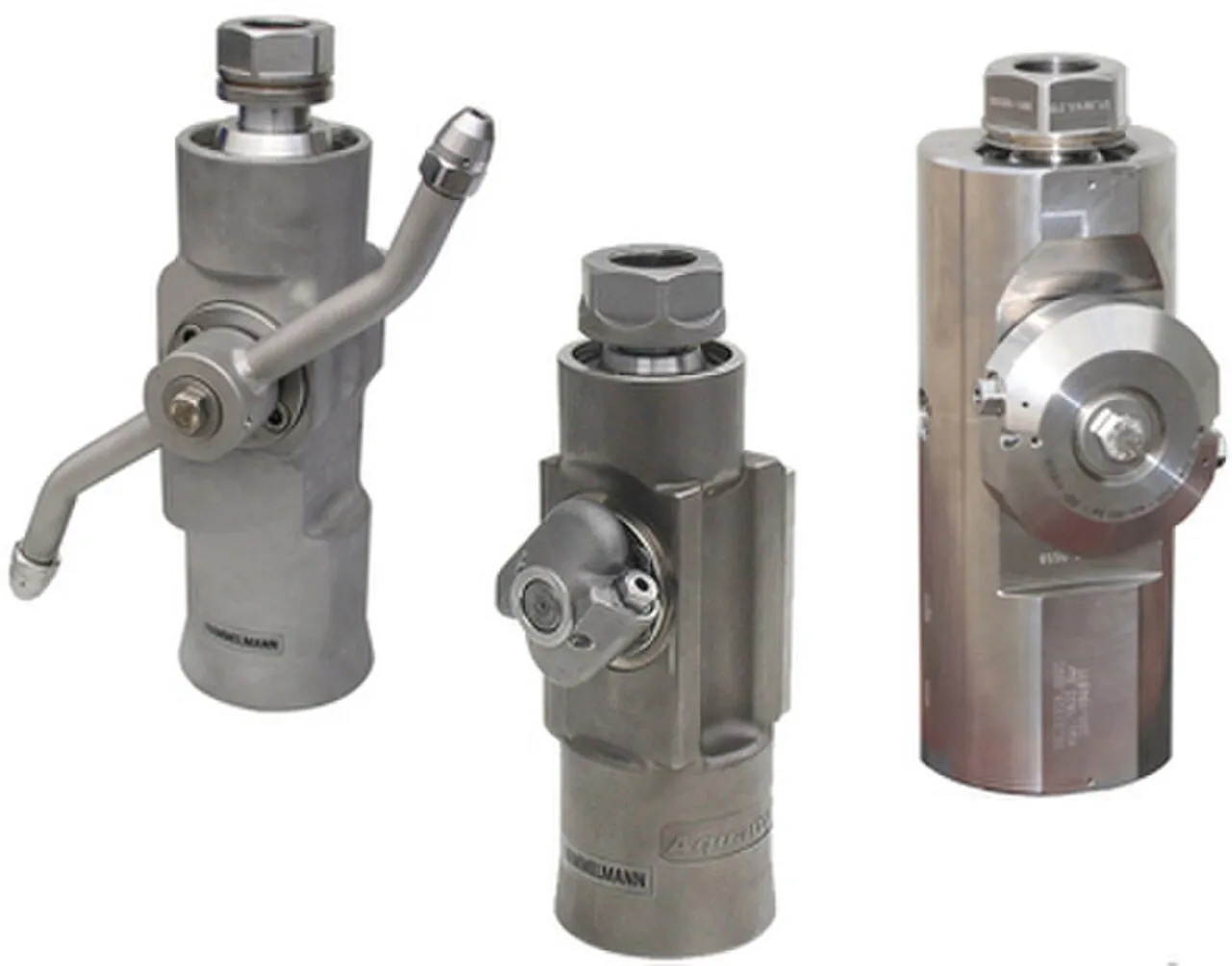
A tank cleaning machine is a device installed inside a tank, vessel, reactor, drum, or intermediate bulk container that distributes water or cleaning solution across the internal surface to remove residue. The family spans three classes: static spray balls that flood the wall with high flow and low impact, rotary spray heads that add rotation to pressurized fan sprays for medium impact, and rotary jet heads that concentrate flow into a few high-velocity jets indexed through a precise 360 degree pattern for the highest impact per unit area.
Tank cleaning is the mechanical-action term in clean-in-place (CIP) and clean-out-of-place (COP) practice. Choosing the wrong class wastes water, chemicals, and cycle time, or leaves residue that fails a riboflavin coverage check. This guide decodes the device classes, the impact physics, wetted materials, spec sheets, and the hygienic standards that govern food, dairy, beverage, and pharmaceutical service.
This guide is aimed at industrial purchasing engineers and process engineers. It covers 6 chapters from device classification, impingement physics, wetted materials, spec-sheet decoding, to selection decisions, with 7 selection FAQs and manufacturer comparisons, helping you build a complete tank cleaning knowledge framework in 30 minutes. All parameters reference 3-A Sanitary Standard 78-04, EHEDG hygienic design guidelines, ASME BPE, and published manufacturer data.
Chapter 1 / 06
What is a Tank Cleaning Machine
A tank cleaning machine is a fluid-driven device placed inside a closed or open vessel that distributes a cleaning medium, water, caustic, acid, or sanitizer, across the entire internal surface to remove product residue, films, scale, and biofilm. It is the working element of clean-in-place (CIP) and clean-out-of-place (COP) systems, which clean process equipment without dismantling it. Unlike a hand-held lance or a fire hose, a fixed or insertable tank cleaning device is engineered to deliver repeatable, documented coverage of every square unit of internal area, including the top dish, walls, agitator shaft, baffles, and outlet.
Functionally, a tank cleaning machine sits at the intersection of two engineering disciplines: spray technology, which governs how flow and pressure convert into impact, throw distance, and wetting pattern, and hygienic design, which governs how the device itself stays clean, self-draining, and free of harbour points where bacteria or product can lodge. A device that cleans the tank perfectly but cannot clean itself is a contamination source, which is why hygienic-service units are governed by dedicated standards rather than general spray nozzle specifications.
Three device classes dominate the field, in ascending order of mechanical energy delivered to the wall. Static spray balls are perforated spheres that release the cleaning medium through dozens of small holes and rely on the sheer volume of falling liquid and the cascading film it forms. Rotary spray heads turn while supplying pressurized fans of solution, combining rotation and spray pressure to raise effectiveness over a fixed array. Rotary jet heads, also called rotary impingement or orbital jet cleaners, use the flowing medium to drive an internal gear train that rotates two to four concentrated jets through a precise two-axis orbital pattern, delivering the highest impact force of any tank cleaning device.
The economic logic behind tank cleaning is captured by the Sinner's circle, also called the TACT circle, formalized by chemist Herbert Sinner around 1959 to 1960. It states that every cleaning result is the combined contribution of four factors: Temperature, Action (mechanical impact), Chemistry (detergent), and Time. The four trade off against one another, so increasing mechanical impact lets a plant cut chemical concentration, lower wash temperature, or shorten cycle time while holding the same cleanliness target. A tank cleaning machine is the lever that supplies the mechanical-action term, which is precisely why a high-impact rotary jet head can pay for itself through reduced water, chemical, energy, and downtime cost over a static spray ball.
Application scale runs from 200 litre drums and intermediate bulk containers up to storage tanks beyond 500,000 litres, and from gentle rinsing of low-residue food product to the removal of cured resin, polymerized fats, and baked-on chemical deposits. No single device covers this whole range. The essence of selection is mapping the soil type, tank geometry, and hygienic requirement to a specific device class, size, material, and operating point.
Chapter 2 / 06
Device Types and Classification
Tank cleaning devices are classified by how they convert flow and pressure into surface coverage. The three mainstream classes are static spray devices, rotary spray heads, and rotary jet heads. A fourth field-service category, the portable jet lance fed by a high-pressure pump and hose reel, is used for cargo tanks, rail cars, and road tankers where a permanent fitting is impractical. The table below compares the core engineering characteristics of the three fixed-and-insertable classes.
Class
Mechanism
Typical Pressure
Relative Impact
Best For
Static spray ball
Fixed perforated sphere, cascading flow
1.5 to 3 bar
Baseline (1x)
Light, soluble residues, rinsing
Rotary spray head
Rotating fan sprays, slow-turn
1 to 4 bar
Medium
Medium soils, 3 to 20 ft tanks
Rotary jet head
Gear-driven jets, 2-axis indexing
3 to 69 bar
10 to 50x
Dried, baked-on, large vessels
Static spray balls are the simplest and lowest-cost class. The body is a hollow sphere or disc with numerous drilled holes that function as crude nozzles, releasing the cleaning medium in fixed streams that fan out and cascade down the wall as a falling film. Because there are no moving parts, they are robust and easy to validate, and they remain the default for hygienic service that conforms to 3-A practice. The trade-off is high flow demand and low impact: a static ball wets the wall but does not scrub it, so it suits easy-to-clean, soluble residues and final rinsing rather than tenacious soils. A common design rule supplies roughly 3 US gallons per minute per foot of tank circumference.
Rotary spray heads add a rotating element so that pressurized fans of solution sweep across the wall rather than hitting fixed points. They typically handle tanks from about 0.9 to 6 m (3 to 20 ft) in diameter and operate around 1 to 4 bar (15 to 60 psi). By combining rotation with spray pressure, a rotary spray head reaches more of the surface with usable energy than a static ball and is commonly cited as delivering around a 30 percent reduction in time, water, and chemical consumption versus a static spray ball. They are a sensible middle option where soils are moderate and full jet impact is not required.
Rotary jet heads, also marketed as rotary impingement or orbital cleaners, are the high-impact class. The flowing medium passes through an internal turbine or gear train that drives a washing head carrying one to four nozzles, rotating it about two orthogonal axes at the same time. The result is a small number of concentrated, high-velocity jets that trace a dense, repeatable global pattern across the entire interior. Roughly 95 percent of the cleaning and rinsing fluid passes directly to the nozzles, so almost all the pumped energy becomes jet impingement rather than spray drift, and the impact per unit area is documented at 10 to 50 times that of a static spray ball. This is the only class that reliably removes dried, polymerized, or baked-on soils, and its lower flow demand for a given impact often cuts total water and chemical use despite the higher pressure.
Within the rotary jet head class, manufacturers offer size families. Compact units fit through small openings for drums and intermediate bulk containers: the Alfa Laval GJ 9, for example, passes through openings as narrow as 76 mm (3 inches). Mid-size units serve process tanks, while large units such as the Gamajet GJ 4 are rated for tanks over 4.6 m (15 ft) in diameter with effective throw to roughly 30 m (100 ft). The portable jet lance and hose-reel category extends the same impingement principle to cargo and transport tanks that have no permanent CIP fitting.
Chapter 3 / 06
Impact Physics and Cleaning Mechanism
The difference between device classes comes down to where the pumped energy goes. A static spray ball spreads its flow across dozens of small holes, so each stream carries little momentum and quickly breaks into a low-velocity film. A rotary jet head channels almost the entire flow through two to four nozzles, so each jet retains high velocity and momentum, and momentum delivered to a soil layer is what fractures and lifts it. The published figure that a rotary jet head delivers 10 to 50 times the impact per unit area of a static spray ball is a direct consequence of concentrating the same flow into fewer, faster streams.
Two coverage radii must not be confused during selection. The wetting radius is the maximum horizontal distance the medium can reach as a falling film, with little impact force. The cleaning radius is the shorter distance over which the jet still carries enough impact to remove the target soil. A device may wet a wall it cannot clean. Catalogs that quote a single large radius are usually quoting wetting; for tenacious soils the cleaning radius governs, and it is always smaller.
The table below summarizes representative published specifications for industrial and hygienic rotary jet heads so the orders of magnitude are concrete. Always confirm against the current manufacturer datasheet for the exact model, since ranges shift by nozzle set and configuration.
Model
Pressure
Flow
Cleaning / Throw Range
Notes
Gamajet GJ 4
3 to 20 bar (40 to 300 psi)
115 to 1210 lpm (30 to 320 gpm)
to 30 m (100 ft)
Large tanks over 15 ft dia.
Gamajet GJ 5
3 to 70 bar (40 to 1000 psi)
38 to 130 lpm (10 to 35 gpm)
to 2.5 m (7.5 ft)
Compact process tanks
Gamajet GobyJET
10 to 21 bar (140 to 310 psi)
75 to 570 lpm (20 to 150 gpm)
to 30 m (100 ft)
Compact body, long throw
Gamajet FLEX
7 to 69 bar (100 to 1000 psi)
11 to 30 lpm (3 to 8 gpm)
0.76 m (2.5 ft) radius
Small high-pressure unit
The cleaning action of a rotary jet head is built up cycle by cycle, not in a single pass. In the first cycle the nozzles lay out a coarse pattern of jet tracks across the wall; each successive cycle indexes the pattern slightly so that fresh tracks fall between the previous ones. Manufacturer documentation commonly describes full interior coverage being achieved after about eight cycles for a large vessel, which is why the cleaning program specifies a number of revolutions or a run time rather than an instantaneous spray. This global indexing pattern is what makes coverage repeatable and verifiable.
Coverage is proven in the field with the riboflavin coverage test. Riboflavin (vitamin B2) is chosen because it fluoresces strongly under ultraviolet light. The internal surface is coated with a dilute riboflavin solution and allowed to dry, the cleaning cycle is run, and the operator then inspects the interior under UV light. Any residual fluorescence marks a spot the device failed to reach with adequate impact and flow, exposing shadow zones behind agitator blades, baffles, and dip tubes. The riboflavin test converts the abstract claim of full coverage into a documented, repeatable acceptance check, and is the standard validation method in food, dairy, beverage, and pharmaceutical CIP.
Finally, the four cleaning factors interact through the Sinner's circle. Mechanical impact, the variable a tank cleaning machine controls, can be traded against temperature, chemistry, and time. Raising impact with a jet head lets a plant lower caustic concentration, reduce wash temperature, or shorten the cycle while holding cleanliness constant. Because water heating and chemical dosing are major recurring costs, and because shorter cycles raise asset utilization, the impact term is usually where the best return on a tank cleaning investment is found.
Chapter 4 / 06
Wetted Materials and Hygienic Standards
The wetted material of a tank cleaning machine must resist the cleaning chemistry, not just the product, because CIP solutions are often more aggressive than the process media. The default is austenitic stainless steel 316 or 316L, which handles the majority of water, steam, food, dairy, and pharmaceutical CIP chemicals. Published rotary jet head data places the working temperature window at roughly -30 to +120 degrees Celsius, with short-term peaks near +140 degrees Celsius. Internal bearings and bushings are typically PTFE or PEEK so the device runs without lubricant that could contaminate the product.
When the chemistry is harsh, 316L is not enough. Caustic (sodium hydroxide) above about 10 percent concentration, hydrochloric acid, and chlorine-based sanitizers attack 316L over time, especially at elevated temperature, so wetted parts should be upgraded to nickel-based Hastelloy C-276 and the seals specified as PTFE, FFKM, or EPDM matched to the exact chemical and temperature. Seal selection is as important as the metal: EPDM resists caustic and hot water but swells in oils, while FFKM tolerates aggressive chemistry and high temperature at a much higher cost. The wrong elastomer fails silently and contaminates batches.
Hygienic design is governed by dedicated standards because the device must clean itself as well as the tank. The controlling US standard is 3-A Sanitary Standard 78-04, Spray Cleaning Devices Intended to Remain in Place. It requires that all surfaces be self-draining and self-flushing, that internal corners be formed with a radius rather than a sharp angle, that interior surfaces be polished, and that no machine threads contact product or solution. In Europe, EHEDG hygienic design guidelines serve the same purpose, and for bioprocessing equipment ASME BPE governs surface finish, drainability, and the avoidance of dead legs. A device that meets these standards leaves no crevice for biofilm and fully drains between cycles.
The table below maps common cleaning chemistries and service conditions to recommended wetted materials. It is for initial selection only; before specifying, obtain the manufacturer corrosion chart and confirm the exact concentration, temperature, and contact time.
A tank cleaning machine datasheet may list a dozen parameters, but only a handful drive the selection decision: device class, operating pressure, flow rate, cleaning radius versus wetting radius, cleaning diameter or tank size rating, inlet connection and opening size, materials and surface finish, and certification. Each is explained below.
Operating pressure sets the jet velocity and therefore the impact and throw. Static spray balls run low, about 1.5 to 3 bar (20 to 45 psi). Rotary spray heads run around 1 to 4 bar (15 to 60 psi). Rotary jet heads run higher to build impact, from about 3 to 20 bar (40 to 300 psi) for large industrial units up to 7 to 69 bar (100 to 1000 psi) for small high-pressure devices. Crucially, more pressure is not always better: each device has an optimal pressure window where impact and rotation speed are balanced, and over-pressurizing a unit can spin it too fast, thin the jets, and reduce cleaning effectiveness.
Flow rate is the volume of medium the device passes per unit time, and it pairs with pressure to define pump and piping requirements. For static and rotary spray devices, flow is sized from tank circumference: roughly 3 US gallons per minute per foot of circumference for static balls, and about 1.5 gallons per minute per foot at 60 psi or higher for rotary heads. Rotary jet heads break this linear rule because they reuse concentrated energy, so size them from the manufacturer coverage chart against tank diameter rather than circumference; published industrial flows range from tens to over a thousand litres per minute depending on model.
Cleaning radius versus wetting radius is the parameter most often misread. The wetting radius is how far the medium can reach as a film; the cleaning radius is the shorter distance over which the jet still removes the target soil. Size the device so the cleaning radius covers the farthest wall, not just the wetting radius, or shadow zones will fail a riboflavin test. Inlet connection and opening size matter physically: the device must fit through the manway or fitting, which is why compact jet heads that pass through 76 mm (3 inch) openings exist for drums and intermediate bulk containers.
Materials, surface finish, and certification close the spec. The key items to confirm on the datasheet are:
Wetted material: 316 / 316L for standard service; Hastelloy C-276 for aggressive caustic, acid, or chlorine chemistry.
Bearing material: PTFE or PEEK bushings for unlubricated, contamination-free rotation.
Surface finish: roughness average (Ra) target, commonly Ra 0.8 um or finer for food and 0.5 um or finer for pharma.
Hygienic certification: 3-A 78-04, EHEDG, or ASME BPE conformance for product-contact service.
Self-draining: confirmation that the device fully drains and self-flushes between cycles, with no internal liquid hold-up.
Temperature rating bounds the service window: roughly -30 to +120 degrees Celsius continuous for 316L rotary jet heads, with short peaks near +140 degrees Celsius. Hot caustic CIP often runs at 70 to 85 degrees Celsius, comfortably inside this band, but live steam sterilization (SIP) and very hot acid cycles must be checked against the seal and bearing limits, which are usually lower than the metal limit.
Chapter 6 / 06
Selection Decision Factors
To turn the preceding five chapters into a specific model, follow the decision sequence below. Most selection mistakes are not a single wrong number but a premature decision at the wrong level: picking a device class before characterizing the soil, or sizing on wetting radius instead of cleaning radius. These eight steps double as a fixed RFQ template.
Characterize the soil: Is the residue soluble and easy to rinse, a moderate film, or a dried, polymerized, or baked-on deposit? Easy soils may justify a static spray ball; tenacious soils require the impact of a rotary jet head. This is the single most decision-critical input.
Define the hygienic requirement: General industrial, or food, dairy, beverage, and pharmaceutical service requiring 3-A 78-04, EHEDG, or ASME BPE conformance plus self-draining design and a defined surface finish (Ra).
Measure the tank: Diameter, height, and internal obstructions (agitator, baffles, coils, dip tubes) that cast spray shadows. The cleaning radius must cover the farthest wall, and shadowed zones may need a second device or relocated inlet.
Select the device class: Static spray ball (low impact, high flow), rotary spray head (medium impact, about 30 percent less water and chemical than static), or rotary jet head (10 to 50x impact, lowest medium use per unit of impact).
Size pressure and flow: Match the device operating window to available pump pressure and flow. For spray balls and rotary heads use the circumference rules (3 gpm/ft static, 1.5 gpm/ft rotary at 60 psi or higher); for jet heads use the manufacturer coverage chart versus diameter.
Check the opening and mounting: The device must pass through the manway or CIP fitting. Confirm the through-opening dimension (for example 76 mm / 3 inch for IBC and drum units) and whether the unit is permanently mounted or insertable.
Specify materials and seals: 316L for standard chemistry; Hastelloy C-276 plus PTFE, FFKM, or EPDM seals for aggressive caustic, acid, or chlorine. Match the elastomer to both chemical and temperature, not chemical alone.
Validate and total the cost: Plan a riboflavin coverage test for acceptance, then total the cost of ownership: device price plus the recurring water, chemical, energy, and downtime that the Sinner's circle trade-off lets a higher-impact device reduce over its service life.
One commonly overlooked dimension is serviceability: rotary jet heads contain gears, bearings, and seals that wear, so local spare-part availability, rebuild-kit pricing, and the ability to swap a unit during a short maintenance window matter as much as the initial datasheet. Manufacturers such as Alfa Laval (GJ, Toftejorg, Gamajet, SaniJet, SaniMagnum series), Spraying Systems Co. (TankJet), BETE, and Scanjet maintain device families across the drum-to-storage-tank range with documented spare parts and validation support, which is what keeps a CIP line running years after the purchase decision. Confirm that the chosen series has a rebuild kit and a local stocking partner before standardizing on it across a plant.
FAQ
What is the difference between a spray ball and a rotary jet head?
A static spray ball is a fixed perforated sphere that floods the tank wall through dozens of small holes, relying on cascading flow rather than impact, so its impact per unit area is low. A rotary jet head is a gear-driven device that concentrates the same flow into two to four high-velocity jets and indexes them through a repeatable 360 degree two-axis pattern. Manufacturer data places rotary jet head impact at roughly 10 to 50 times that of a static spray ball, which is why jet heads clean dried or baked-on soils that spray balls only wet. Between the two sits the rotary spray head, which adds rotation to fan sprays for medium-impact duty.
How do I size flow rate for a tank cleaning device?
For static spray balls, a common rule of thumb is to supply roughly 3 US gallons per minute per foot of tank circumference; rotary spray heads and rotary impingement devices need about 1.5 US gallons per minute per foot of circumference at 60 psi (about 4 bar) or higher. Circumference equals pi times tank diameter, so a 3 m (10 ft) diameter tank has about 9.4 m (31 ft) of circumference, requiring roughly 93 gpm for a static ball or 47 gpm for a rotary device. Jet heads break this linear rule because they reuse concentrated energy, so size them from the manufacturer coverage chart against tank diameter, not circumference.
What pressure does a tank cleaning machine need?
Pressure depends on device class. Static spray balls work at low pressure, typically 1.5 to 3 bar (about 20 to 45 psi). Rotary spray heads operate around 1 to 4 bar (15 to 60 psi). Rotary jet heads use higher pressure to build jet impact: industrial units such as the Gamajet GJ 4 run 3 to 20 bar (40 to 300 psi), the GJ 5 runs 3 to 70 bar (40 to 1000 psi), and small high-pressure units such as the FLEX reach 7 to 69 bar (100 to 1000 psi). Higher pressure raises jet impact and effective throw distance but also raises pump and energy cost.
What standards apply to hygienic tank cleaning machines?
For food, dairy, beverage, and pharmaceutical service, the controlling US standard is 3-A Sanitary Standard 78-04, Spray Cleaning Devices Intended to Remain in Place. It requires that all surfaces be self-draining and self-flushing, internal corners be radiused, contact surfaces be polished, and no machine threads contact product or solution. In Europe, EHEDG hygienic design guidelines apply, and ASME BPE governs bioprocessing surface finish and drainability. Coverage is verified in the field with a riboflavin coverage test: the vessel is coated with fluorescent riboflavin, cleaned, then inspected under ultraviolet light for residual fluorescence.
What materials are tank cleaning machines made from?
The standard wetted material is austenitic stainless steel 316 or 316L, which handles most water, steam, and food or pharmaceutical CIP chemicals across roughly -30 to +120 degrees Celsius, with short-term peaks near +140 degrees Celsius. Bearings and bushings are typically PTFE or PEEK for low friction without lubrication that could contaminate product. For aggressive chemistry, such as caustic above 10 percent, hydrochloric acid, or chlorine-based sanitizers, upgrade wetted parts to Hastelloy C-276 and specify PTFE, FFKM, or EPDM seals matched to the chemical and temperature.
How is tank cleaning coverage verified?
The standard visual method is the riboflavin coverage test. Riboflavin (vitamin B2) is selected because it fluoresces under ultraviolet light. The internal surface is coated with a dilute riboflavin solution, dried, then run through the cleaning cycle. After cleaning, the operator inspects the tank under UV light; any residual fluorescence marks a spot the device failed to reach with sufficient impact and flow. For rotary jet heads the cycle is documented as a global indexing pattern that builds full coverage over several passes, commonly cited as eight cycles for complete interior coverage on large vessels.
Can one machine clean both small drums and large storage tanks?
No. Effective jet throw and coverage scale with tank diameter, so a device sized for a 1.5 m (5 ft) drum is wrong for a 7.6 m (25 ft) storage tank, and the reverse over-pressurizes a small vessel and wastes water. Manufacturers offer families by size: compact rotary jet heads that pass through openings as narrow as 76 mm (3 inches) for drums and intermediate bulk containers, mid-size units for process tanks, and large units rated for tanks over 4.6 m (15 ft) in diameter with throw to 30 m (100 ft). Match the device coverage chart to tank diameter and inlet location.