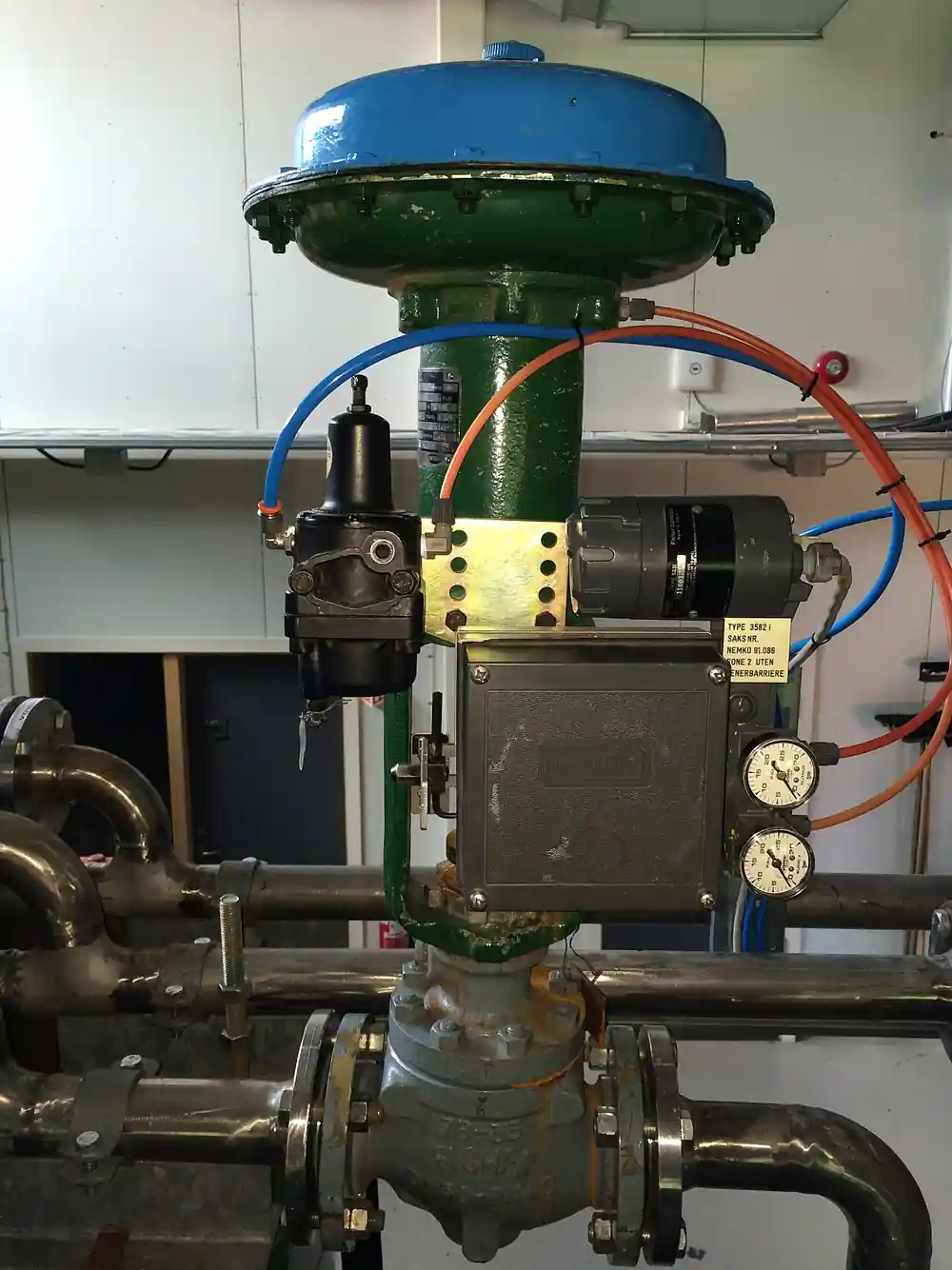
A smart valve positioner is a microprocessor-based instrument mounted on a control valve actuator that holds the valve plug or disc at the position commanded by the control system. It reads a 4-20 mA setpoint, measures actual valve travel through a feedback sensor, computes the error digitally, and modulates instrument air to the actuator until measured position matches command. Unlike a conventional pneumatic positioner, which balances forces mechanically, a smart positioner adds HART or fieldbus communication, automatic commissioning, custom flow characterization, and onboard diagnostics such as partial stroke testing.
Smart positioners are the accessory that turns a control valve from an approximate device into a precise final control element. Packing friction, seat load, and process pressure all push the stem away from where the actuator pressure alone would set it; the positioner closes a fast inner loop that cancels these disturbances. This guide is written for purchasing and design engineers comparing positioner models before a control valve project.
This guide is aimed at industrial purchasing engineers and design engineers. It covers 6 chapters from what a positioner is, through positioner types, sensing and pneumatic technology, mounting and communication standards, and spec-sheet decoding, to selection decisions, with 7 selection FAQs and manufacturer comparisons. All parameters reference public standards and manufacturer datasheets, including IEC 60534-6-1 (NAMUR linear mounting), VDI/VDE 3845 (rotary mounting), IEC 61508 / IEC 61511 (functional safety), and IEC 60079 (hazardous-area protection).
Chapter 1 / 06
What is a Smart Valve Positioner
A valve positioner is a device that guarantees a control valve reaches and holds the opening commanded by the controller. The actuator alone cannot do this reliably: forces such as friction from packing and seals, seat load, and process differential pressure all conspire to re-position the valve stem, so stem travel does not precisely correlate to actuator pressure. The positioner solves this by closing a local feedback loop. It continuously compares the commanded position against the measured position and adjusts the air pressure to the actuator until the two agree, typically many times per second.
A smart, or digital, positioner performs this comparison in a microprocessor rather than through a mechanical beam-and-cam linkage. It receives the controller signal, most commonly a two-wire 4-20 mA current loop, reads valve travel from a position sensor, computes the error with a stored control algorithm, and converts the result into a drive current for an electropneumatic stage, which in turn drives a pneumatic output to the actuator. Because the loop is computed, the same hardware can be commissioned automatically, configured remotely over HART, and instructed to apply a custom relationship between input signal and valve travel.
The accessory has three generations in field service today. The original pneumatic positioner is a purely mechanical force-balance device with a flapper and nozzle, accepting only a 3-15 psi pneumatic command. The analog electropneumatic positioner adds a current-to-pressure (I/P) converter so it can accept 4-20 mA, but the control comparison is still mechanical. The smart positioner replaces the mechanical comparison with digital electronics, which is what unlocks two-way communication, automatic setup, and diagnostics. All three still perform the same core job of holding valve position; they differ in intelligence and signal chain.
Why install a positioner at all? Five reasons recur across process plants: to overcome stem friction and dead band so the valve responds to small signal changes; to speed up the stroke of large actuators by supplying high-capacity air; to reshape the inherent valve characteristic into linear or equal-percentage flow; to enable split-range operation where one signal drives two valves over different portions of travel; and, on safety valves, to run partial stroke tests that prove a shutdown valve is not stuck. A smart positioner adds a sixth: continuous health monitoring that flags packing friction, air-supply problems, and drift before they cause a trip.
Pneumatic position control of valves dates to the mid-twentieth century, when force-balance positioners using a flapper-nozzle and pilot relay became standard on diaphragm actuators. The I/P converter brought electrical command in the 1970s and 1980s. The HART protocol, introduced in the late 1980s, overlaid digital configuration on the 4-20 mA loop and made the modern smart positioner possible. Since 2000, non-contact magnetic feedback, piezo pilot valves, and onboard diagnostics have become standard on premium units, and functional-safety certification to IEC 61508 has made the positioner a recognized component of safety instrumented systems.
Chapter 2 / 06
Positioner Types and Action
Positioners are classified along two independent axes. The first axis is intelligence: pneumatic, analog electropneumatic, or digital (smart). The second axis is pneumatic action: single-acting or double-acting, which must match the actuator. Confusing these two axes is the most common specification error, because a positioner can be smart and still be single-acting, or analog and double-acting. The table below separates the three intelligence classes.
Class
Command Signal
Control Method
Communication and Diagnostics
Pneumatic
3-15 psi air
Mechanical force balance, flapper-nozzle
None
Analog electropneumatic
4-20 mA
I/P converter plus mechanical balance
None or basic
Digital (smart)
4-20 mA, HART, fieldbus
Microprocessor closed loop
HART/fieldbus, autostart, PST, signatures
Pneumatic positioners remain in service on legacy plants and on simple, robust applications where no electrical signal is available. They are immune to power loss and need no electronics, but they cannot be configured remotely, cannot reshape the valve characteristic without a physical cam change, and provide no diagnostics. Analog electropneumatic positioners bridged the era when controllers became electronic but field intelligence had not arrived; they accept 4-20 mA through an I/P converter yet still balance forces mechanically. Digital smart positioners dominate new installations because the cost premium over analog is small and the operational benefits, automatic commissioning and continuous diagnostics, are large.
The action axis is set by the actuator. A single-acting positioner sends air to one chamber of the actuator and relies on a spring for the return force. This suits the classic spring-and-diaphragm sliding-stem control valve, where the spring also defines the fail-safe position: fail-closed or fail-open on loss of air. A double-acting positioner pressurizes both chambers of a springless piston actuator and balances the two pressures to set position. Double-acting is standard on large rotary, scotch-yoke, and rack-and-pinion actuators that develop high torque and have no return spring. Achieving a defined fail position on a double-acting actuator requires an additional component such as a volume tank, trip valve, or lock-up relay.
Many modern smart positioners support both actions from one electronics platform by fitting a different pneumatic relay. The Fisher FIELDVUE DVC6200, for example, installs on sliding-stem or rotary, single- or double-acting actuators by selecting the appropriate relay during ordering. This flexibility reduces spare-part variety on a plant but makes it essential to confirm the relay type on each order, because a single-acting relay cannot stroke a double-acting actuator and vice versa.
A further distinction is mounting geometry. Linear positioners track the straight-line travel of a sliding-stem valve through a lever or rail. Rotary positioners track the angular travel of a part-turn valve such as a ball, butterfly, or plug valve. As covered in Chapter 4, most digital units cover both geometries with the same electronics and a geometry-specific mounting kit, but the feedback linkage and the mounting standard differ.
Chapter 3 / 06
Sensing and Pneumatic Technology
Inside a smart positioner, two subsystems determine performance: the position feedback sensor that measures where the valve actually is, and the electropneumatic stage that converts the computed drive signal into air pressure. The table below compares the dominant technologies on each side, followed by a closer look at how they work.
Subsystem
Technology
Characteristics
Typical Use
Position feedback
Lever and potentiometer / Hall arm
Contacting, simple, wear point at linkage
Economy and legacy units
Position feedback
Non-contact magnetic / Hall-effect
No mechanical coupling, vibration tolerant
Premium digital units
Electropneumatic stage
I/P plus flapper-nozzle and pilot relay
Continuous air bleed, higher consumption
Fisher DVC, many HART units
Electropneumatic stage
Piezo pilot valve
Very low bleed, fast, low air consumption
Siemens SIPART PS2 and similar
Position feedback by contacting linkage uses a lever connected to the valve stem that rotates a shaft into a potentiometer or rotary Hall sensor. It is simple and proven, but the linkage is a wear point, and high vibration or many million cycles eventually loosen the coupling and introduce dead band. Non-contact magnetic feedback mounts a magnet on the moving stem or shaft and a Hall-effect or magnetoresistive sensor in the positioner housing, with no mechanical connection between them. Non-contacting Hall-effect sensors withstand large vibration forces common in valve service, eliminate the linkage wear point, and maximize cycle life. The Fisher DVC6200 uses exactly this linkage-less, non-contact travel feedback to remove wearing parts from the feedback path.
The flapper-nozzle electropneumatic stage is the classic design. The microprocessor outputs a drive current to an I/P converter whose coil deflects a flapper toward or away from a nozzle, changing the nozzle back-pressure. A pilot relay, a pneumatic amplifier, multiplies this small back-pressure into the high-flow output air that strokes the actuator. The design is robust and high-capacity, but the nozzle bleeds air continuously, so steady-state air consumption is non-trivial: a standard-relay Fisher DVC6200 draws less than 0.38 normal m3/h at 1.4 bar (14 scfh at 20 psig) and under 1.3 normal m3/h at 5.5 bar (49 scfh at 80 psig).
The piezo pilot stage replaces the bleeding flapper-nozzle with piezoelectric valves that open and close only when air must move. Because there is almost no continuous bleed, air consumption collapses: the Siemens SIPART PS2 consumes less than roughly 0.036 normal m3/h in the controlled, holding state, an order of magnitude below a comparable bleed-type unit. Across a plant with hundreds of valves, the compressed-air saving is significant and is a leading reason to specify piezo positioners on new projects, alongside their fast response and low heat generation.
The choice between high-capacity flapper-nozzle and low-bleed piezo is a genuine engineering trade-off. Large actuators with big air volumes benefit from the high flow of a pilot relay so the valve strokes quickly; small and mid-size valves benefit from the low air consumption and fast settling of a piezo stage. Some manufacturers offer both relay options under one model family so the engineer can match the pneumatic stage to actuator volume without changing the electronics or the diagnostics package.
Chapter 4 / 06
Mounting, Communication, and Standards
A positioner only works if it can be physically attached to the actuator and electrically integrated into the control system. Two international standards govern mechanical mounting so units from different vendors interchange, and a small set of protocols govern communication. Getting both right at the specification stage avoids the most expensive site surprises: a positioner that will not bolt onto the actuator, or that the DCS cannot configure.
Linear mounting follows the NAMUR interface standardized in IEC 60534-6-1. This defines a NAMUR rail and pickup geometry on sliding-stem actuators so any compliant positioner mounts with a standard bracket and feedback arm. Rotary mounting follows VDI/VDE 3845, the NAMUR rotary standard, which fixes the bracket height and shaft dimensions on part-turn actuators. Because nearly all serious positioner and actuator makers honor these two standards, a Fisher, Siemens, or SAMSON positioner can be fitted to a third-party actuator with the correct kit. Always confirm the actuator carries the matching NAMUR or VDI/VDE 3845 interface before ordering.
Communication ranges from the universal to the project-specific. The default is 4-20 mA with HART: the analog current still carries the fast, deterministic position command while HART superimposes digital configuration, status, and diagnostic data on the same two wires. This drops into existing analog infrastructure and is why most retrofit and replacement work uses it. PROFIBUS PA and FOUNDATION Fieldbus are pure digital buses that let many devices share one cable pair, cutting wiring on large greenfield plants at the cost of segment design effort. Newer units add Ethernet-APL or PROFINET for high-bandwidth diagnostics. The table below maps protocols to typical use.
Protocol
Signal Basis
Wiring
Best Fit
4-20 mA + HART
Analog loop plus digital overlay
One pair per device
Retrofit, replacement, most loops
PROFIBUS PA
Pure digital bus
Shared pair, multi-device
Large PROFIBUS plants
FOUNDATION Fieldbus
Pure digital bus
Shared pair, multi-device
Large FF-standardized plants
Ethernet-APL / PROFINET
Two-wire Ethernet
High bandwidth
New digital-native plants
Functional safety is governed by IEC 61508 and its process-sector application IEC 61511. A positioner used in a safety instrumented function carries a SIL rating and a safety manual stating its failure rates and proof-test requirements. Positioners are commonly certified for safety functions up to SIL 2 as a single device, and shutdown loops reach SIL 3 in redundant or de-energize-to-trip architectures. The partial stroke test (PST) function, which moves a shutdown valve a small fraction of travel to prove it is not stuck, raises proof-test coverage and is a standard feature of safety-rated smart positioners.
Hazardous-area protection follows the IEC 60079 series, implemented regionally as ATEX in Europe, IECEx internationally, FM and CSA in North America, and NEPSI in China. Positioners are offered as intrinsically safe (Ex ia), flameproof (Ex d), or Type n, and an outdoor or washdown installation also needs an ingress rating, commonly IP66 or NEMA Type 4X. A device may carry several of these certifications at once; cross-region projects often require ATEX, IECEx, and NEPSI together on the same unit.
Chapter 5 / 06
Key Specification Parameters
A positioner datasheet lists many fields, but eight drive selection: input signal, action and actuator compatibility, supply air pressure, air consumption, travel and rotation range, ambient temperature, ingress and explosion protection, and accuracy or linearity. The table below contrasts three established smart positioners on these parameters, using published manufacturer figures, and the text decodes each parameter.
Parameter
Fisher DVC6200
Siemens SIPART PS2
SAMSON 3730-3
Input signal
4-20 mA, HART 5/7
4-20 mA, HART/PA/FF
4-20 mA, HART
Supply pressure
up to 10.0 bar (145 psig)
approx 1.4-7 bar
approx 1.4-7 bar
Steady air consumption
<0.38 m3/h at 1.4 bar
<0.036 m3/h holding
approx 110 ln/h
Linear travel
6.35-606 mm
3-130 mm
3.6-300 mm
Rotary travel
45-180 deg
30-100 deg
24-100 deg
Ambient temperature
-40 to 85 C
-30 to 80 C
-45 to 80 C
Ingress / safety
IP66, Type 4X
IP66, SIL 2
IP66, SIL per manual
Input signal and action together fix integration. The signal must match the controller output (4-20 mA, HART, or a fieldbus), and the action (single- or double-acting) must match the actuator as covered in Chapter 2. Supply air pressure is the instrument-air range the positioner accepts. The Fisher DVC6200 accepts up to 10.0 bar (145 psig) and asks that supply be set at least 0.3 bar (5 psig) above the maximum actuator requirement. Most positioners operate in the 1.4 to 7 bar range; set supply pressure to the actuator demand plus a small margin, not arbitrarily high, because excess pressure wastes air and can overstroke the actuator.
Air consumption has two parts. Steady-state consumption is what the unit bleeds while holding position, a recurring operating cost across a plant: under 0.38 normal m3/h at 1.4 bar for a bleed-type DVC6200, against under 0.036 normal m3/h for the piezo SIPART PS2, and around 110 ln/h for the SAMSON 3730-3. Peak air capacity, a separate figure, governs how fast a large actuator strokes. Low steady consumption matters most on plants with many small valves; high peak capacity matters most on a few large ones.
Travel and rotation range defines the span of valves a positioner can serve. The SAMSON 3730-3 spans 3.6 to 300 mm of linear travel or 24 to 100 degrees rotation; the SIPART PS2 spans 3 to 130 mm or 30 to 100 degrees; the DVC6200 spans 6.35 to 606 mm or 45 to 180 degrees of rotation. The valve travel must fall inside the positioner range, and the autostart routine learns the actual end stops during commissioning so the unit calibrates to the real span rather than the nominal.
Ambient temperature is the housing operating window, distinct from process temperature, which the actuator and valve see. Standard ranges run roughly -40 to 85 C, with extreme-temperature options pushing the low end further: the DVC6200 offers a -52 to 85 C (-62 to 185 F) extreme-temperature variant. Ingress and explosion protection, commonly IP66 or NEMA Type 4X plus an Ex marking, must match the area classification. Accuracy and linearity are usually given as independent linearity in percent of span; the DVC6200, for example, specifies roughly plus-or-minus 0.50 percent of output span. Confirm the figures against the manufacturer datasheet, because test conditions and definitions vary between vendors.
Chapter 6 / 06
Selection Decision Factors
To turn the preceding five chapters into a specific model, follow the decision sequence below. Most selection mistakes come not from a single wrong field but from deciding in the wrong order, for example fixing a brand before confirming the action matches the actuator. These eight steps can serve as a fixed RFQ template for control valve accessories.
Actuator type and action: First confirm sliding-stem or rotary, and spring-return (single-acting) or springless piston (double-acting). This decision constrains every later choice, because the positioner relay and mounting kit must match the actuator before anything else.
Mounting interface: Verify the actuator carries the NAMUR linear interface per IEC 60534-6-1 or the VDI/VDE 3845 rotary interface. Order the corresponding mounting kit and feedback arm or magnet; a non-contact magnetic kit avoids the main wear point on high-cycle valves.
Command signal and protocol: Match the controller output. 4-20 mA plus HART is the default for retrofit and most loops; choose PROFIBUS PA, FOUNDATION Fieldbus, or Ethernet-APL only where the plant is already standardized on that bus.
Functional safety requirement: If the valve performs a safety function, specify the SIL level (commonly up to SIL 2 single-device, SIL 3 in redundant or de-energize-to-trip loops), require the IEC 61508 safety manual, and confirm partial stroke test support for emergency shutdown duty.
Hazardous area and ingress: Specify the Ex protection (intrinsically safe Ex ia, flameproof Ex d, or Type n) per IEC 60079, with the regional certificate the site needs (ATEX, IECEx, FM, CSA, NEPSI), plus the ingress rating, typically IP66 or NEMA Type 4X for outdoor or washdown.
Air supply and consumption: Confirm the available instrument-air pressure falls in the positioner range (commonly 1.4 to 7 bar) and choose a low-bleed piezo stage where compressed-air cost matters, or a high-capacity pilot relay where a large actuator must stroke quickly.
Travel range and characterization: Confirm the valve travel or rotation falls inside the positioner span, and decide whether you need custom characterization (linear, equal-percentage, or user-defined) or split-range operation across two valves.
Diagnostics and total cost of ownership: Weigh onboard diagnostics (valve signature, friction trend, travel histogram, PST) against purchase price. A positioner that flags rising packing friction before a trip can save far more than its price premium in avoided downtime over a 10-year service life.
One last commonly overlooked dimension is manufacturer serviceability: local spare-parts inventory, field calibration capability, registration of the HART DD or fieldbus DTM with the relevant interoperability body, and firmware upgradability. These seem irrelevant at the purchasing stage but determine repair response time after years of production. Emerson (Fisher FIELDVUE), Siemens (SIPART), SAMSON, Baker Hughes (Masoneilan), Flowserve (Logix), ABB, and Metso/Neles (ND9000) all maintain service and calibration support in major markets, making them defensible choices for large projects, while NEPSI-certified domestic units suit non-critical loops at lower cost.
FAQ
What is the difference between a smart positioner and a conventional pneumatic positioner?
A conventional pneumatic positioner is a purely mechanical force-balance device: a cam, beam, and flapper-nozzle compare actuator pressure against a spring and modulate output air, with no electronics. An electropneumatic (analog) positioner adds an I/P converter so it can accept a 4-20 mA signal, but the control loop is still mechanical. A smart, or digital, positioner replaces the mechanical comparison with a microprocessor: it reads the 4-20 mA setpoint, reads valve travel from a non-contact sensor, computes the error digitally, and drives a piezo or I/P stage. The microprocessor adds HART communication, automatic commissioning, custom characterization, and onboard diagnostics such as partial stroke testing. Same job of holding valve position, very different signal chain and intelligence.
Do I need a single-acting or double-acting positioner?
It depends on the actuator. A single-acting positioner sends air to one side of the actuator and relies on a spring to provide the return force, which is the classic spring-and-diaphragm arrangement used by most sliding-stem control valves. A double-acting positioner pressurizes both chambers of a springless piston actuator and balances the two pressures to set position, which is standard on large rotary and scotch-yoke actuators. Many digital positioners such as the Fisher DVC6200 ship the same electronics with either a single-acting or double-acting pneumatic relay, so you select the relay to match the actuator. Specifying the wrong relay means the positioner cannot stroke the valve or cannot achieve a defined fail position.
How is a smart positioner mounted to the valve and actuator?
Mounting follows two international interface standards so positioners and actuators from different vendors are interchangeable. For linear, sliding-stem actuators the attachment uses the NAMUR interface defined in IEC 60534-6-1, typically a NAMUR rail or a pickup arm coupled to the stem. For rotary, part-turn actuators the attachment uses VDI/VDE 3845, the NAMUR rotary standard that defines bracket height and shaft dimensions. A smart positioner reads travel through this linkage with either a lever-and-shaft arm or, on modern units, a non-contact magnetic or Hall-effect sensor that needs no mechanical coupling to the stem, which removes the main wear point and improves cycle life.
What is a partial stroke test and why does it matter for SIL?
A partial stroke test (PST) moves an emergency shutdown valve a small amount, typically 10 to 20 percent of travel, and returns it without disturbing the process, to prove the valve is not stuck. Spring-return shutdown valves can sit unmoved for years, so without testing their failure on demand is unknown. A smart positioner with PST exercises the valve on a schedule, records the signature, and raises an alarm if the valve sticks, which raises the proof-test coverage and lets the loop reach a higher safety integrity level. Positioners certified to IEC 61508 are commonly rated for safety functions up to SIL 2 as a single device, or SIL 3 in redundant or de-energize-to-trip architectures. Always confirm the SIL figure against the manufacturer safety manual and the loop architecture.
How much instrument air does a smart positioner consume?
Two figures matter: steady-state consumption when the valve is holding position, and peak flow capacity when stroking. Steady-state consumption depends on the relay design and supply pressure. A pilot-relay positioner such as the Fisher DVC6200 consumes less than about 0.38 normal m3/h at 1.4 bar (14 scfh at 20 psig) and under about 1.3 normal m3/h at 5.5 bar (49 scfh at 80 psig). Piezo-pilot designs such as the Siemens SIPART PS2 are far lower, under roughly 0.036 normal m3/h in the controlled state. Over a large plant the steady leakage of bleed-type positioners adds up, so low-bleed or piezo designs cut compressed-air cost. Supply pressure typically runs 1.4 to 7 bar, set 0.3 to 1 bar above the maximum actuator requirement.
Which communication protocol should I choose: HART, PROFIBUS PA, or FOUNDATION Fieldbus?
HART overlaid on 4-20 mA is the default for the vast majority of installations: it keeps the analog control signal for fast, deterministic positioning while adding digital configuration and diagnostics on the same two wires, so it drops into existing DCS infrastructure. PROFIBUS PA and FOUNDATION Fieldbus are pure digital buses that let many devices share one cable pair, which cuts wiring on large greenfield projects but adds segment design and host complexity. Newer units may offer Ethernet-APL or PROFINET for high-bandwidth diagnostics. For most retrofit and replacement work, 4-20 mA plus HART is the safe, interoperable choice; reserve fieldbus for new plants already standardized on it.
Which manufacturers and series are common for smart valve positioners?
The established platforms are Emerson Fisher FIELDVUE DVC6200 (HART 5 or 7, single- or double-acting, non-contact feedback), Siemens SIPART PS2 (piezo pilot, very low air consumption, HART or PROFIBUS PA or FOUNDATION Fieldbus, SIL 2), SAMSON 3730 and 3731 series (HART, FOUNDATION Fieldbus, EXPERTplus diagnostics), Baker Hughes Masoneilan SVI II AP and the newer SVI3 (32-bit, advanced diagnostics), Flowserve Logix, ABB TZIDC and Metso/Neles ND9000. For lower-budget or non-critical loops, Chinese suppliers and licensed builds offer NEPSI-certified units at a fraction of imported price. Match the series to the hazardous-area approval, SIL requirement, communication protocol, and local spare-parts and calibration support rather than to brand alone.