A diaphragm pump is a positive displacement pump that moves fluid by flexing one or more elastomeric or PTFE membranes back and forth inside a chamber, with two check valves forcing the flow in one direction. Because the diaphragm fully isolates the pumped media from the drive mechanism, there is no rotating shaft seal to leak, which makes the diaphragm pump the workhorse for corrosive, abrasive, shear-sensitive, and hazardous fluids across chemical, paint, mining, food, and water-treatment plants.
Two families dominate industrial use: the air-operated double diaphragm (AODD) pump for bulk transfer, and the controlled-volume metering (dosing) diaphragm pump for precise chemical injection. This guide separates the two, decodes the spec sheet, and frames the selection decision the way a procurement engineer must.
Photo: Aleksander Ma, CC BY-SA 4.0, via Wikimedia Commons
This guide is aimed at industrial purchasing engineers and design engineers. It covers 6 chapters from working principle, pump types, drive technologies, diaphragm and body materials, spec-sheet decoding, to selection decisions, with 7 selection FAQs and manufacturer comparisons, helping you build a complete diaphragm pump knowledge framework in 30 minutes. Performance and accuracy references draw on API 675 for controlled-volume pumps, the EU ATEX directive 2014/34/EU and IEC 60079 for hazardous areas, and FDA 21 CFR 177 / EU 1935/2004 for food-contact elastomers.
Chapter 1 / 06
What is a Diaphragm Pump
A diaphragm pump is a reciprocating positive displacement pump in which a flexible membrane, the diaphragm, replaces the piston of a conventional reciprocating pump. As the diaphragm pulls back, the pumping chamber volume increases and fluid is drawn in through an inlet check valve; as the diaphragm pushes forward, the volume decreases and fluid is forced out through a discharge check valve. The diaphragm seals the chamber completely from the drive side, so the working fluid never touches a rotating seal, bearing, or lubricant. This single structural fact explains why diaphragm pumps lead in leak-free, corrosive, and hazardous service.
Functionally a diaphragm pump has four elements: (1) the diaphragm itself, made of elastomer (Santoprene, Viton, EPDM, Neoprene, Nitrile) or fluoropolymer (PTFE), which is the consumable wear part; (2) two check valves, usually ball-and-seat or flap, that rectify the reciprocating motion into one-way flow; (3) the pump body or fluid chamber, made of cast or machined metal (aluminum, ductile iron, 316 stainless) or molded plastic (polypropylene, PVDF, conductive acetal); and (4) the drive, which may be compressed air, an electric motor with a crank, a hydraulic actuator, or a solenoid. When two diaphragms are linked on a common shaft and driven by air, the machine becomes the familiar air-operated double diaphragm, or AODD, pump.
The principle is old. Hand-operated diaphragm pumps for dewatering and bilge service date to the nineteenth century, and rubber-diaphragm well pumps were common by the early 1900s. The modern AODD pump was commercialized in the mid-1950s by Wilden Pump in California, which patented the air-driven double-diaphragm design that remains the industry template. Controlled-volume metering pumps grew in parallel through the chemical-dosing demands of water treatment and refining, and the American Petroleum Institute codified their performance in API 675, first issued in 1980. Air distribution efficiency became the competitive frontier after 2000, with energy-saving air valves cutting the air bill that historically made AODD pumps the least efficient pump type.
Diaphragm pumps span a wide duty envelope. AODD transfer pumps deliver from a fraction of a litre per minute up to roughly 1,060 L/min (280 US gpm) in a single 76 mm (3 in) or larger body, at discharge pressures up to about 8.6 bar (125 psi) on a standard 1:1 air section. Metering diaphragm pumps work at the opposite extreme of the map: low flow, often millilitres per stroke, but high accuracy and discharge pressures that can exceed 200 bar in hydraulic API 675 designs. No single diaphragm pump covers both ends; selection is the art of mapping the duty point onto the right family and size.
Four engineering metrics drive diaphragm pump quality and total cost of ownership: diaphragm flex life (cycles to failure), chemical and abrasion compatibility of the wetted parts, air or energy efficiency, and serviceability of the consumable diaphragms and valves. A pump bought purely on low purchase price but fitted with the wrong diaphragm material can rupture within weeks, contaminating the process and forcing an unplanned shutdown that dwarfs the original price difference.
Chapter 2 / 06
Diaphragm Pump Types
Diaphragm pumps split first by drive method and second by the number of diaphragms. The drive method determines energy source, efficiency, and hazardous-area suitability; the diaphragm count determines flow smoothness. The five mainstream configurations below cover almost all industrial purchase orders. Choosing the wrong family, for example using a transfer AODD pump where a metering pump is required, is the most common and most expensive selection error.
Type
Drive
Typical Flow
Typical Pressure
Best For
AODD (air-operated double)
Compressed air
Up to 1,060 L/min
Up to 8.6 bar
Bulk transfer, hazardous areas
Electric (motor-driven)
Electric motor + crank
Up to ~400 L/min
Up to ~12 bar
Continuous transfer, no air supply
Hydraulic metering
Hydraulic actuator
mL/min to ~10,000 L/h
Up to 200+ bar
API 675 high-pressure dosing
Mechanical metering
Motor cam, spring return
Low, mL per stroke
Up to ~12 bar
Agriculture, water treatment dosing
Solenoid metering
Pulsed solenoid
mL/h to a few L/h
Up to ~16 bar
Low-cost chemical dosing
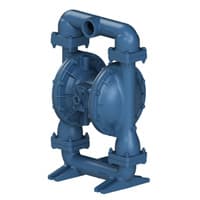
Air-operated double diaphragm (AODD) pumps are the most widely deployed. Two diaphragms are joined by a central shaft, and an air distribution valve alternately pressurizes one air chamber while venting the other. When one diaphragm is on its discharge stroke, the other is on its suction stroke, so flow overlaps and pulsation is moderate. AODD pumps self-prime, run dry without damage, stall safely against a closed valve, and contain no electricity in the wetted path, which makes them the default for solvents, acids, paints, slurries, and any duty in a classified hazardous area.
Electric diaphragm pumps replace the air valve with a motor that drives an eccentric or crank, flexing one or two diaphragms. They are far more energy efficient than AODD pumps because no air is compressed and exhausted, and they suit sites without a compressed-air supply or with continuous high duty cycles. The trade-off is that they need explosion-proof motors for hazardous areas and overpressure protection, since unlike an AODD pump they do not simply stall when deadheaded.
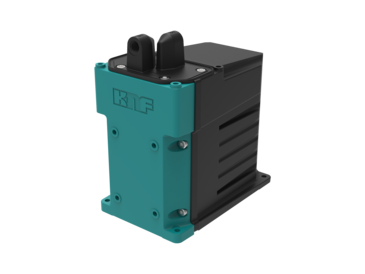
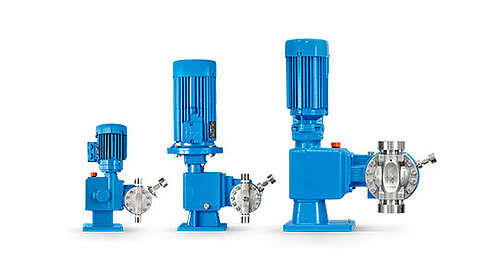
Metering (controlled-volume) diaphragm pumps are a separate world. Here the goal is not throughput but dose accuracy. A motor or solenoid moves the diaphragm a precisely adjustable stroke length and frequency, delivering a known volume per stroke. Hydraulically actuated metering pumps use an oil cushion behind the diaphragm so that high discharge pressures, often above 200 bar, do not over-stress the membrane, and these are the pumps specified to API 675 for refinery and petrochemical chemical injection. Mechanically actuated and solenoid metering pumps are simpler and cheaper for lower-pressure water-treatment dosing.
A secondary distinction is single versus double diaphragm. A single-diaphragm pump has one chamber and produces strongly pulsating flow, which is acceptable for metering where a pulsation damper smooths the output, or for low-cost hand and OEM pumps. A double-diaphragm pump halves the pulsation and doubles the effective displacement per cycle, which is why nearly all industrial transfer pumps are double-diaphragm.
Chapter 3 / 06
Drive Principles and Air Distribution
The drive determines how the diaphragm is flexed, and for the dominant AODD type it is the air distribution system (ADS) that governs efficiency, reliability, and cost of operation. Understanding the air valve is the single most useful piece of AODD knowledge for a buyer, because the air bill over a pump's life usually exceeds its purchase price many times over. The table compares the four drive principles on the metrics that matter at selection.
Drive
Energy Efficiency
Dry-Run / Deadhead
Hazardous Area
Dose Accuracy
Air (AODD)
Low (~10 to 20%)
Safe, stalls
Inherently safe
Transfer only
Electric motor
High
Needs protection
Needs Ex motor
Moderate
Hydraulic metering
High
Relief-valve protected
Per motor rating
±1% (API 675)
Solenoid metering
Moderate
Safe
Limited
±2 to 3%
AODD operating cycle. Compressed air enters air chamber A and pushes diaphragm A outward on its discharge stroke. Because both diaphragms share a central shaft, diaphragm B is simultaneously pulled inward on its suction stroke, drawing fluid past the inlet check ball into chamber B while fluid is expelled from chamber A past its discharge check ball. At the end of the stroke a pilot signal flips the main air spool, which vents chamber A and pressurizes chamber B, reversing the action. The inlet and outlet check valves rectify this back-and-forth into continuous one-directional flow.
The 1:1 ratio and stall safety. In a standard AODD pump the air-side and liquid-side diaphragm areas are equal, so the achievable liquid pressure equals the supplied air pressure. About 7 bar of air gives about 7 bar of liquid, and standard pumps top out near 8.6 bar (125 psi). When discharge pressure rises to meet the air pressure, the pump simply stops cycling and stalls with no damage, which is the source of the AODD pump's famous dead-head tolerance. For higher pressure, amplifying air sections with a larger air piston driving a smaller fluid section multiply pressure (for example 2:1), at the expense of flow.
Efficiency is the weak point. An AODD pump compresses air at the compressor, then exhausts it to atmosphere on every stroke, so a large share of input energy is lost as heat and noise. Overall wire-to-fluid efficiency is often only 10 to 20 percent, the lowest of common pump types. The dominant loss is overfilling the air chamber late in the stroke, when the diaphragm has already reached the end of travel but air keeps flowing. This is exactly what modern energy-saving air valves target.
Energy-saving air distribution systems. The Wilden Pro-Flo SHIFT incorporates an air control spool that automatically restricts air entering the chamber during the latter part of each stroke, eliminating overfill. Wilden reports up to 60 percent air savings and up to 34 percent greater flow versus older designs, using an unbalanced spool to prevent stalling and a pilot spool to trigger which chamber fills. Electronically actuated systems push efficiency further by timing the air valve with sensors, at higher cost. For a buyer, the takeaway is that air-valve generation, not body material, often drives the lifetime operating cost.
Metering drives. In a hydraulic metering pump a plunger displaces hydraulic oil behind the diaphragm; the oil cushion transmits force evenly so the membrane survives high discharge pressure, and a built-in hydraulic relief valve protects against overpressure, set per API 675 at least 10 percent or 175 kPa (25 psi) above rated discharge. Mechanical metering pumps drive the diaphragm directly by a cam with spring return, simpler but limited in pressure. Solenoid metering pumps pulse the diaphragm with an electromagnet, cheap and compact for low-flow dosing.
Chapter 4 / 06
Diaphragm and Body Materials
Material selection in a diaphragm pump happens on two fronts: the diaphragm and check balls that flex and wear, and the pump body that contains the fluid. Both must be chemically compatible with the media, but the diaphragm carries the extra burden of flex fatigue, which makes it the consumable that defines maintenance interval. A material that resists the chemistry but cracks from flex fatigue, or one with long flex life but poor compatibility, will both fail prematurely.
Diaphragm materials. Santoprene, a thermoplastic elastomer (TPE), is the all-round default: it combines rubber flexibility with plastic durability, survives more than 20 million cycles in water service, resists dilute acids and caustics, and is cost-effective. PTFE (Teflon) offers the broadest chemical compatibility, handling aggressive acids, hot caustics, and halogenated solvents, but it is stiff and flexes only 5 to 10 million cycles, so it is normally fitted with an elastomer backing diaphragm and reduces suction lift. Viton (FKM) is the choice for hot aromatic and chlorinated hydrocarbons, fuels, and high temperatures. EPDM serves food, pharmaceutical, ketone, and dilute-acid duty but fails on oils. Neoprene and Nitrile (NBR) are low-cost diaphragms for non-aggressive water, seawater, and petroleum-based fluids.
Diaphragm Material
Flex Life
Compatible Media
Avoid
Santoprene (TPE)
20M+ cycles
Water, dilute acid/caustic, food
Strong oxidizers, hot solvents
PTFE (Teflon)
5 to 10M cycles
Almost all chemistries, acids, solvents
N/A (universal)
Viton (FKM)
Lower
Hot aromatic/chlorinated HC, fuels
Ketones, hot caustics, steam
EPDM
Good
Food, pharma, ketones, dilute acid
Oils, fuels, hydrocarbons
Neoprene / Nitrile
High
Water, seawater, petroleum fluids
Strong acids, polar solvents
Body materials. Metal bodies (aluminum, ductile iron, 316 stainless steel, Hastelloy) handle high pressure, solvents, and food-grease applications, and they can be grounded for hazardous areas. Aluminum is light and economical for general transfer; 316 stainless suits sanitary, solvent, and moderately corrosive duty; Hastelloy handles aggressive acids. Plastic bodies (polypropylene, PVDF, conductive acetal) resist corrosion at lower cost. Polypropylene (PP) is the economical choice for many acids and caustics; PVDF (Kynar) is more chemically resistant than PP, handling most acids and caustics even at higher concentration, and resists abrasion better, at higher cost.
Hazardous-area grounding. Standard PTFE is an insulator, around 10^14 ohms, so a plain PTFE pump can accumulate static charge. For ATEX-classified areas, metal or conductive PVDF housings provide grounding lugs, conductive PTFE diaphragms and conductive check balls are specified, and all metallic parts are bonded to ground with a resistance to ground below 10 ohms. The static grounding connection is a mandatory condition of keeping the explosion-protection certification valid; an ungrounded plastic AODD pump in a solvent transfer is a recognized ignition risk.
The same selection discipline applies to check balls and seats, which see both chemical attack and abrasive wear from solids. PTFE, stainless steel, and ceramic balls are common, matched to the diaphragm chemistry. For abrasive slurries, harder ball and seat materials extend life, while for solids handling the valve geometry (ball versus flap) sets the maximum passable particle size.
Chapter 5 / 06
Key Specification Parameters
Reading a diaphragm pump data sheet is a core procurement skill. A single AODD or metering pump may list dozens of parameters, but a manageable set truly drives the selection. The Key Specifications table below summarizes the headline parameters and their typical industrial ranges; the paragraphs that follow decode each one. Always read these in combination, because a flow figure quoted at zero discharge head is meaningless without the corresponding pressure.
Parameter
Typical Range
Unit
Notes
Port size
6 to 203
mm (1/4 to 8 in)
Sets max flow class
Max flow (AODD)
Up to 1,060
L/min
At low discharge head
Max discharge (1:1)
Up to 8.6
bar (125 psi)
Equals air pressure
Air inlet pressure
2 to 7 (max ~8.6)
bar
1:1 air-to-liquid
Displacement / stroke
~2.27 (2 in body)
L (0.60 gal)
Size-dependent
Suction lift, dry
4 to 5
m
Self-priming
Suction lift, wet
Up to 8 to 9.8
m
Primed
Max solids size
2 to 19
mm
Ball-check, by size
Max fluid temperature
Up to ~104 (177 metal)
°C
Diaphragm-limited
Metering accuracy
±1 (API 675)
% steady-state
Dosing pumps
Port size and flow. Port size, from 6 mm (1/4 in) to 203 mm (8 in), sets the flow class of an AODD pump. Larger ports and larger diaphragms move more fluid per stroke, scaling flow from a few litres per minute on a quarter-inch pump up to about 1,060 L/min (280 US gpm) on a large body. Crucially, AODD flow is infinitely turndownable: a single pump runs from zero to maximum simply by adjusting air pressure and air flow, so one model covers a wide operating window.
Discharge pressure and air supply. On a standard 1:1 pump the discharge pressure cannot exceed the supplied air pressure, which is why air inlet is typically specified between 2 and 7 bar and maximum discharge near 8.6 bar (125 psi). The flow-versus-pressure curve falls as discharge head rises; data sheets give a family of curves at different air pressures, and the duty point must sit on a real curve, not at the unloaded maximum.
Suction lift and self-priming. AODD pumps self-prime and pull a dry suction lift of roughly 4 to 5 m and a wet (primed) lift up to about 8 to 9.8 m, depending on size and diaphragm stiffness. Stiff PTFE diaphragms reduce lift versus flexible elastomers, and viscous fluids derate it further. This self-priming ability lets a diaphragm pump sit above the liquid and evacuate the suction line on start-up, unlike a centrifugal pump.
Solids and temperature. Ball-check AODD pumps pass solids from about 2 mm on small bodies up to roughly 19 mm (3/4 in) on large ones, and the low-shear action protects fragile particles and emulsions. Maximum fluid temperature is set by the diaphragm and body: elastomer-diaphragm pumps commonly run to about 104 degrees Celsius (220 degrees Fahrenheit), and PTFE-diaphragm metal pumps reach far higher, with some Wilden metal pumps rated to about 177 degrees Celsius (350 degrees Fahrenheit). Above the rated limit, consult the manufacturer.
Metering accuracy. For controlled-volume diaphragm pumps the headline figures are steady-state accuracy, linearity, and repeatability. API 675 compliant pumps deliver steady-state accuracy of plus-or-minus 1 percent, linearity of plus-or-minus 3 percent or better, repeatability of plus-or-minus 3 percent or better, and reproducibility better than plus-or-minus 1 percent across the 10 to 100 percent stroke range. Turndown ratio, the ratio of maximum to minimum reliable dose, is another key metering spec.
Chapter 6 / 06
Selection Decision Factors
To turn the preceding chapters into a specific model, follow the ordered decision sequence below. Most selection mistakes come not from a single wrong value but from deciding low-level details before the high-level family is fixed. These eight steps double as a fixed RFQ template for a diaphragm pump enquiry.
Duty family first: Decide transfer versus metering. Transfer points to AODD or electric diaphragm; precise dosing points to a controlled-volume metering pump, and high-pressure critical dosing points to a hydraulic API 675 design.
Flow and pressure point: Fix the required flow at the actual discharge head, then size the port and body so the duty sits on a real performance curve, not at the unloaded maximum. Allow margin for system fouling and viscosity.
Fluid characterisation: Document chemistry, concentration, temperature, viscosity, abrasiveness, solids size, and shear sensitivity. This drives diaphragm, ball, seat, and body material per Chapter 4.
Material set: Choose diaphragm (Santoprene, PTFE, Viton, EPDM, Neoprene/Nitrile) for flex life plus compatibility, and body (aluminum, 316 stainless, PP, PVDF) for containment, balancing cost against service life.
Suction and installation: Confirm dry and wet suction lift against the actual layout, NPSH and viscosity derate, and whether the pump is flooded, lifting, or submersible.
Certifications: Hazardous area ATEX / IECEx with conductive parts and grounding, sanitary 3-A / EHEDG and FDA / EU 1935/2004 food-contact elastomers, API 675 for refinery dosing, and Pressure Equipment Directive PED 2014/68/EU where applicable.
Air or energy efficiency: For AODD, specify an energy-saving air distribution system and right-size to avoid throttling; compare lifetime air cost, not just purchase price. For continuous high duty, evaluate an electric diaphragm pump instead.
Total cost of ownership (TCO): Purchase price plus diaphragm and valve consumables, air or electrical energy, downtime for diaphragm changes, and spare-part lead time. The lowest-priced pump with the wrong diaphragm or a thirsty air valve is rarely the cheapest to own.
One frequently overlooked dimension is serviceability. Diaphragms and check valves are consumables, so the ease and cost of replacing them, the availability of genuine spare kits, and local technical support determine real uptime more than the original spec sheet. The established AODD brands, Wilden (Pro-Flo SHIFT and Original, a PSG Dover brand), Graco (Husky, SaniForce), Ingersoll Rand ARO (PRO, EXP), Yamada, Versamatic, SandPIPER, Almatec, Tapflo, and Verderair, all maintain spare-part distribution and bolt-together repairability. For metering duty, ProMinent (Hydro API 675), Milton Roy, Grundfos, and LEWA carry the dosing accuracy and certification depth required by process projects. Confirm spare availability in your region before committing to a brand.
FAQ
What is the difference between an AODD pump and an electric diaphragm pump?
An AODD (air-operated double diaphragm) pump uses compressed air as its only power source: an internal air valve alternately pressurizes and vents two air chambers, driving two diaphragms linked by a shared shaft. It has no motor, no rotating seal, and no electrical parts in the wetted path, so it is inherently safe in explosive atmospheres and cannot burn out when run dry or deadheaded. An electric diaphragm pump replaces the air valve with an electric motor and an eccentric or crank mechanism that flexes the diaphragm. Electric units are far more energy efficient (an AODD pump wastes energy compressing then exhausting air, with wire-to-fluid efficiency often only 10 to 20 percent), but they require explosion-proof motors for hazardous duty and overpressure or dry-run protection to avoid damage.
How does the 1:1 air-to-liquid pressure ratio of an AODD pump work?
A standard AODD pump is a 1:1 ratio machine: the diaphragm area exposed to air equals the area exposed to liquid, so the discharge pressure cannot exceed the supplied air pressure. Roughly 7 bar (100 psi) of air yields about 7 bar of liquid pressure, and standard pumps top out near 8.6 bar (125 psi) because that is the practical air-supply limit. When the discharge pressure equals the air pressure the pump simply stalls without damage, which is why AODD pumps are dead-head safe. For higher pressure, two-to-one or higher amplifying air sections are available, where a larger air piston drives a smaller liquid section to multiply pressure at the cost of flow.
Which diaphragm material should I choose for my chemical?
Match flex life against chemical compatibility. Santoprene (TPE) is the all-round default: excellent flex life of 20 million-plus cycles, good resistance to water, dilute acids and caustics, and low cost. PTFE handles almost any chemistry including aggressive acids, hot caustics, and halogenated solvents, but it flexes only 5 to 10 million cycles and is stiffer, so it is usually backed by a Santoprene or Neoprene support diaphragm. Viton (FKM) suits hot aromatic and chlorinated hydrocarbons and fuels. EPDM serves food, pharma, ketones, and dilute acids but not oils. Neoprene and Nitrile are low-cost choices for non-aggressive water, seawater, and petroleum fluids. Always confirm concentration, temperature, and abrasion against the manufacturer corrosion chart before ordering.
What suction lift and solids size can a diaphragm pump handle?
AODD pumps self-prime and can pull a dry suction lift of roughly 4 to 5 m (13 to 16 ft) and a wet (primed) lift up to about 8 to 9.8 m (26 to 32 ft) depending on size and diaphragm stiffness; stiff PTFE diaphragms reduce lift versus elastomers. Ball-check pumps pass solids typically from 2 mm on small units up to about 19 mm (3/4 in) on large bodies, and flap-valve designs pass larger soft solids. Because the flow is gentle and low-shear, diaphragm pumps suit shear-sensitive and abrasive media that would damage centrifugal or gear pumps. Always derate suction lift for viscous fluids and high altitude.
Why is AODD pump efficiency low and how do I reduce air consumption?
An AODD pump must compress air at the compressor, then exhaust it to atmosphere every stroke, so a large fraction of the input energy is lost as heat and noise; overall wire-to-fluid efficiency is often only 10 to 20 percent, the lowest of common pump types. The biggest waste is overfilling the air chamber late in each stroke. Energy-efficient air distribution systems, such as the Wilden Pro-Flo SHIFT with its air control spool, restrict air late in the stroke to cut consumption by up to 60 percent and raise flow up to 34 percent versus older designs. Practical measures: right-size the pump, run the lowest air pressure that meets the duty, fit a flow-control or stroke-counting electronic actuator, and minimize discharge restriction.
What is API 675 and when does a metering diaphragm pump need it?
API 675 is the American Petroleum Institute standard for controlled-volume (metering) positive displacement pumps with variable capacity, covering plunger and diaphragm types. Compliant pumps deliver steady-state accuracy of plus-or-minus 1 percent, linearity of plus-or-minus 3 percent or better, and repeatability of plus-or-minus 3 percent or better, with reproducibility better than plus-or-minus 1 percent across the 10 to 100 percent stroke range. API 675 hydraulically actuated diaphragm pumps include an internal hydraulic relief valve set at least 10 percent or 175 kPa (25 psi) over rated discharge, whichever is greater. Specify API 675 for refinery, petrochemical, and critical chemical-injection dosing where dose accuracy and containment are contractual; general water treatment dosing can use lower-cost solenoid or mechanically actuated metering pumps.
Which manufacturers and series are common for industrial diaphragm pumps?
For AODD transfer duty, the established brands are Wilden (Pro-Flo SHIFT and Original series, a PSG Dover brand), Graco (Husky and SaniForce), Ingersoll Rand ARO (PRO and EXP series), Yamada, Versamatic, SandPIPER, Almatec, Tapflo, and Verderair, in ports from 6 mm (1/4 in) to 203 mm (8 in). Wilden bolted metal pumps reach pressures up to 221 bar (3,200 psig) with amplified air sections and temperatures to about 177 degrees Celsius (350 degrees Fahrenheit). For metering and dosing, ProMinent (Hydro API 675 series), Milton Roy, Grundfos, LEWA, and SEEPEX cover hydraulically and mechanically actuated diaphragm metering. Match port size, body and diaphragm material, certification, and local spare-part support to the project before selecting a brand.
Diaphragm Pump Manufacturers
Source-backed product routes. Open a company dossier for procurement scope and cited evidence.