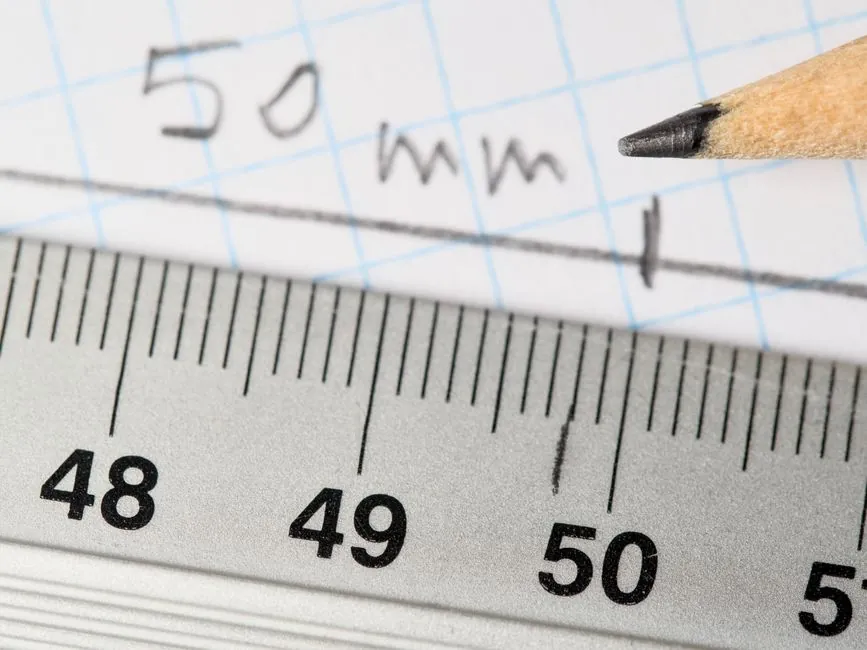
0.250" x 0.250" square key stock is a standard imperial keystock size, cold drawn from medium-carbon steel to ANSI B17.1 Class 2 tolerance, with parallel sides held to roughly +/-0.001" on the nominal cross-section [S2].
The 1/4" square profile is one of the most commonly stocked keystock sections, supplied in lengths from 12" up to 36", and in carbon steel (ASTM A29), 303/316 stainless, and zinc-plated finishes across U.S. industrial distributors [S1][S5][S9].
Cross-Section Geometry and Nominal Tolerance Bands
The 0.250" x 0.250" section is a true square, with width and height equal, and sharp, perpendicular corners that are required for full keyway contact in parallel-key applications per ANSI B17.1 [S2]. Fix Industrial Supply lists this exact size as 0.250" W x 0.250" H x 28.000" L, undersized variant, ASTM A29 medium-carbon steel, classified as "Standard" sub-type [S1]. Undersized stock is held to a tighter low-side tolerance band so the cut key drops cleanly into a standard keyway (Class 1 clearance fit) without hand-filing, while oversize stock is held to a high-side band for Class 3 interference fits where the key is pressed or thermally expanded into the seat [S2].
Square keystock and rectangular keystock share the same tolerance regime, but square stock is the default selection for square keyways where the key is loaded on its sides rather than top and bottom, and where the hub bore depth and shaft keyseat depth are cut to the same dimension. Suppliers offer the 1/4" square in three tolerance classes on the cross-section: nominal, oversize, and undersize, with the dimensional band typically +/-0.001" to +/-0.002" depending on supplier and class [S5][S8].
ANSI B17.1 Fit Classes and What They Mean for 0.250" Stock
ANSI B17.1 defines three key-fit classes that govern whether the same 0.250" x 0.250" bar will sit loosely, snugly, or require press-fit installation [S2]. Class 1 is a clearance fit where the key is smaller than the keyway width, allowing the shaft and mating part to slide axially relative to one another for timing or assembly reasons. Class 2 is a transition fit and is the canonical "keystock" tolerance, with the key width a small amount over or under the keyway, giving a snug joint that can still be disassembled without tooling. Class 3 is an interference fit where the key is larger than the keyway and must be installed with press force or a temperature differential to expand the key or contract the hub.
Only Class 2 material is technically "keystock" in the strict sense, though the term is applied broadly in catalog listings to any cold-drawn precision bar stock suitable for cutting machine keys [S2]. For shop-floor work, this means an undersized 0.250" bar is the safe default: it will fit any standard 1/4" wide keyway, and the small amount of side clearance can be taken up with a light file if a tighter fit is needed.
Material Options: Carbon Steel, Stainless, and Plated Finishes

The default material for 0.250" x 0.250" square keystock is bright-drawn medium-carbon steel, conforming to ASTM A29, which balances machinability (hack-sawable, fileable) with the shear and compressive strength needed to transmit torque through a key joint [S1][S2]. Huyett notes that carbon steel is "fairly strong and hard" but "soft enough to be cut with a hacksaw and filed to the desired dimensions," which is why it remains the default shop-floor choice for general-purpose machine keys [S2].
Stainless options are widely available for corrosive service: McMaster-Carr catalogs stainless steel keystock bars including square and rectangular profiles, with 303 and 316 grades typically offered [S10]. Stainless is roughly three times the price of carbon in the 1/4" size and is justified only when the operating environment would corrode carbon steel, since the lower shear strength of austenitic stainless reduces the allowable torque per key. Zinc-plated keystock, sold as "Standard Key Stock" in 1/8" to 1" cross-sections, is the third common option and gives a mild corrosion barrier at near-carbon cost [S5].
Length Options and Stocking Practice for 0.250" Square
0.250" square keystock is stocked by U.S. industrial distributors in lengths from 6" up to 36", with 12" and 36" being the most common [S1][S2][S9]. Huyett's technical writeup defines keystock as "metal stock longer than 12 inches from which machine keys are cut," and notes that imperial and metric cross-sections extend up to roughly 2" square across the full product range [S2]. Fix Industrial Supply ships the 1/4" square in a 28" length, a stocking length that fits a standard 24" machinist's vise with overhang for measurement [S1].
For maintenance and field work, the practical selection rule is to buy a 12" or 36" bar and cut keys to length rather than ordering cut-to-size keys, because cut-to-size requires a drawing, a part number, and minimum order quantities that the 1/4" square does not justify unless volume is in the hundreds. Buyers Products and other distributors stock the same 1/4" square in bulk for OEM production runs where the per-piece cost difference becomes significant [S7].
Comparison: Square vs Rectangular Keystock, and Undersized vs Oversize Variants

For a 0.250" square keyseat on a 1/4" shaft or larger, the comparison comes down to four decision criteria. Cost: nominal 1/4" square carbon is the cheapest option, with oversize/undersize variants adding roughly 10-20% to unit price. Installation fit: undersized is the safe default for unknown or worn keyways, nominal for new keyways cut to spec, oversize for permanent or high-torque joints. Availability: nominal 1/4" square is in stock at every U.S. industrial distributor (Fix Industrial Supply, Huyett, McMaster-Carr, Buyers Products, Denali Industrial), while rectangular 0.250" x 0.375" or 0.250" x 0.187" variants are stocked but less common [S1][S2][S7][S9][S10]. Material: carbon steel is the baseline, stainless is the upgrade for corrosion, and zinc-plated is a middle-ground finish choice [S5][S10].
The 1/4" square is the right call when the shaft keyseat and hub keyway are cut to the same depth, which is the common case for general-purpose couplings, small sprockets, and gear hubs. Switch to rectangular 0.250" x 0.187" when the hub keyway is shallower than the shaft keyseat, which keeps the key fully engaged in the shaft while not bottoming out in a shallow hub. A related reference on 0.250 x 0.250 x 1.37 in square key length tolerance walks through cut-key length selection for that specific dimension.
Failure Modes and Spec Pitfalls on 0.250" Square
The most common 1/4" square key failure is shear of the key body at the shaft-hub interface, typically from underspecifying the key material (using stainless where carbon would do) or from keyway fillet radii that leave the key bearing on a sharp corner rather than flat [S2]. A secondary failure is hub-bore elongation or "keyway chewing," which happens when the Class 2 transition fit has too much side clearance and the key rocks under reversing load. The mitigation is to specify the undersized tolerance class for new assemblies and verify that both shaft keyseat and hub keyway were cut to the same nominal width with parallel sides.
Length is the silent spec trap on small square keys. A key that is too short relative to the hub length will not develop the full shear area, and the key will rotate in the keyway under torque rather than the hub rotating on the shaft. The general rule is a minimum key length of roughly 1.5x the shaft diameter for a single key, but for a 0.250" key on small shafts, the key length is usually driven by the hub face width rather than a torque calculation. For shaft and keyway cross-reference geometry, the shaft-key encyclopedia entry has the relevant base dimensions.
Sourcing and Standards Reference

Three standards govern the 0.250" x 0.250" square key as purchased off the shelf. ANSI B17.1 covers keys, keyways, and the three fit classes (1, 2, 3) and is the controlling document for what is technically "keystock" versus plain precision bar [S2]. ASTM A29 governs the medium-carbon steel feedstock used for cold drawing the bar to keystock tolerance [S1]. Material options draw on ASTM A276 for stainless keystock grades and on common zinc-plating practice (ASTM B633) for plated variants [S10]. Distributor stocking data (Fix Industrial Supply, Huyett, McMaster-Carr, Buyers Products, Denali Industrial, MDS of Michigan) confirms 0.250" square in 12" to 36" lengths is a maintained stock SKU in carbon and stainless across U.S. industrial supply as of 2026 [S1][S2][S5][S7][S9][S10].
For related spec work on small power-transmission components, the steel-section reference covers the upstream bar stock that keystock is drawn from, and the 0.250 x 0.250 x 1.37 in square key length tolerance article extends the cross-section spec into a finished-cut key dimension.
Spec-level background on the components involved: pressure transmitter.