
A marine-spec universal joint is a flexible mechanical coupling that transmits rotary motion between two misaligned shafts, with selection dominated by maximum operating angle, continuous torque, RPM, angular velocity, and corrosion exposure rather than by catalog convenience [S1][S2].
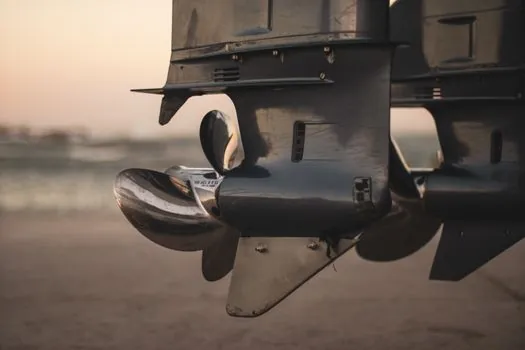
Inboard-outboard stern drives, steering linkages, and PTO shafts on auxiliaries commonly use double-center universal joints because the driveline must accommodate simultaneous pivot for steering and change in propeller trim angle, with the Mercury Marine double-center coupler case documenting a 3.5 in. ring, 4 in. overall length, and approximately 2 lb. finished weight at 250,000 units/year [S4].
Operating angle is the primary spec gate
BFG Marine specifies its marine universal joints for a maximum operating angle of 30° and manufactures them to meet MIL-20625A, a military specification that controls yoke, bearing, and cross dimensions for marine and industrial service [S3].
Operating angle directly drives journal bearing life: as angle increases, the cross and bearing kit sees higher cyclic loads and shorter fatigue life, so angle-limited spec lines are not interchangeable with general industrial joints. For stern-drive applications where steering and trim combine, the practical working angle is often held below the 30° maximum to preserve service interval. A separate military standard, MIL-J-6193, governs heavy-duty MS 271 series universal joints and is referenced when the application exceeds MIL-20625A's envelope [S8].
Torque, RPM, and series identification
Torque capacity scales with journal diameter, and the SKF catalog uses series numbering keyed to bearing diameter (BD) and bolt circle (BC) as the interchange handles between suppliers [S5].
Selection should first establish the series from a known competitor part number, a dimensional check, or a size-comparison template, then verify the cross and bearing kit, lube fitting type, and lock-up style (solid body vs. greaseable) match the application [S5]. For marine auxiliaries running continuously, continuous torque is the rating that matters, not the catalog peak, because peak is a short-duration figure. SKF's catalog structure (Standard Series, Metric Series, PTO, End Yokes, Flange Yokes, Slip Yokes) reflects the dominant duty class and is a useful cross-check when reading vendor data sheets [S5].
Solid-body vs. greaseable: maintenance drives the choice

There are two body types: solid-body (non-greaseable, often "lubed for life") and greaseable with a zerk fitting, and the choice on marine equipment is driven by service interval and access rather than price [S7].
Solid-body joints are commonly used where the joint is buried in a driveline run with no easy access, because they ship from the factory with a sealed bearing pack and require no scheduled re-lubrication. Greaseable joints are still the default for stern-drive and surface-piercing applications where periodic re-lubrication flushes saltwater intrusion, a failure mode that a sealed joint cannot recover from. For long-shaft run on a small craft, the choice often comes down to whether a grease gun can physically reach the zerk at the dock. Related driveline hardware such as V-Belt Selection for Steel Mill Drives follows a similar access-versus-service-interval logic in adjacent rotating-equipment spec work.
Material selection: ductile iron vs. forging vs. stainless
The Mercury Marine universal joint coupler was originally produced as a steel forging requiring 10 machining steps, then converted to a ductile iron sand casting, which reduced component cost by approximately 50% while meeting fatigue and dimensional requirements at 250,000 units/year [S4].
That case study shows the material trade-off: ductile iron casting offers near-net shape, shorter lead times, and domestic sourcing, but only when fatigue life and dimensional tolerance can be met without forging's grain flow. For smaller-volume marine auxiliaries or any application with sustained saltwater exposure, 17-4 PH or 316 stainless crosses and yokes are commonly specified, accepting higher cost for corrosion resistance. The same corrosion-vs.-cost balance appears in the spec work behind Choosing Quartz Material: A Spec Engineer's Selection Workflow, where material grade drives lifetime cost more than initial unit price.
Alignment, misalignment type, and the constant-velocity question
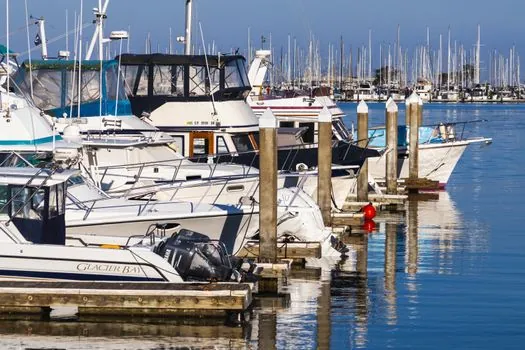
Universal joints accommodate angular misalignment between two shafts, but standard single joints introduce velocity fluctuation that grows with operating angle, which is why stern drives use a double-center (two-joint) arrangement to cancel the secondary couple [S1][S4].
Where smooth rotation under constant load is required (instrumentation drives, some hydraulic pump drives), a constant-velocity (C.V.) joint is specified instead of a standard universal joint, and the two are not interchangeable. A double u-joint with the two yokes phased correctly can approach C.V. behaviour at a fixed angle, but it does not replace a true C.V. joint in applications requiring a wide range of angles or precise motion control [S1]. Misalignment type (angular only, parallel offset, or combined) is the question that decides whether a standard joint, double u-joint, or C.V. joint is on the print.
Failure modes and what kills a marine u-joint first
Common failure modes in marine service are needle-bearing spalling from water ingress, cross-shaft fatigue cracking at the trunnion fillet, and yoke-ear wear from cyclic angular load, with salt-water corrosion accelerating every one of them [S7][S8].
Inspection intervals should be tied to operating angle and RPM, because the same joint will last several times longer at 10° than at 30°. Visible red flags on a teardown are rust on the needle bearings, brinelling on the cup races, and any free play at the trunnion. Once a joint shows trunnion wear, replacement of the complete cross and bearing kit, not the yokes, is the standard repair, and SKF documents the quick-disconnect repair kit line as the field-service option for that case [S5].
What to confirm before placing the order
Final marine selection should be checked against five fields: maximum and continuous torque, maximum operating angle, RPM, shaft-to-shaft length and yoke style, and material/corrosion spec, with each field cross-referenced to a known series number from the SKF catalog or a documented MIL spec [S5][S8].
If torque and angle place the application outside MIL-20625A, step up to MIL-J-6193 MS 271 series and re-check bore and keyway dimensions before quoting lead time [S8]. For driveshafts on related rotating equipment, the same fit-and-tolerance discipline is documented in Locking Assembly Selection for Pulp and Paper, where the same shaft-hub interface questions are answered on a different duty class. Two trackable signals to watch are any 2026 revision to MIL-20625A testing tables and any new corrosion-protective coating (zinc-rich epoxy over ductile iron) being offered as a stocked catalog option rather than a special order.
Detailed specification references: universal joint, expansion joint, and marine hvac.