
A 16-inch cut-off saw is the stronger choice for large steel sections because its larger abrasive wheel provides greater cutting depth and reaches heavier stock, while a 14-inch saw is more economical for typical bar, tube, and pipe preparation [S1][S2].
The comparison must be made by stock shape, wall thickness, cutting angle, clamping range, wheel approval, and machine geometry, not by wheel diameter alone; published capacities are machine-specific rather than universal [S1].
14-Inch vs 16-Inch Capacity by Workpiece
A 14-inch abrasive wheel is normally the better fit for routine fabrication involving angle iron, flat bar, some tubing, pipe, and reinforcing bar when the machine and wheel are approved for each material [S1]. The 16-inch option becomes preferable when the workpiece approaches the 14-inch machine's limit, especially large solid sections, thick pipe, or substantial rectangular tube, because the larger wheel provides more usable cutting depth.
For a 14-inch diamond blade, the rule-of-thumb cutting-depth estimate is 6 inches, while maximum real-world depth is typically about one-third to just under one-half of blade diameter, subject to saw-guard limitations, arbor size and mounting, cutting angle and stability, and blade exposure [S2]. This range must not be transferred directly to an abrasive metal cut-off saw because the wheel, arbor, motor, guard, and workpiece geometry define the usable envelope [S1].
A useful comparison is therefore based on four criteria: maximum workpiece dimension, handling burden, operating cost, and cut quality. A 14-inch saw wins on portability, replacement-wheel cost, and lower material removal. A 16-inch saw wins on section capacity and cutting depth. The best machine is the one that holds the actual workpiece securely and cuts it within its approved capacity without forcing the head [S1].
When a 14-Inch Saw Is the Better Buy
A 14-inch saw is suitable when most work is short lengths of ordinary steel stock and the largest routine workpiece remains comfortably inside the machine's section-specific capacity chart [S1]. It is also the sensible choice where operator mobility, transport weight, lower wheel cost, and easier handling of small pieces matter more than maximum section size.
Published user evidence gives a useful economic signal: a good 14-inch blade was described as costing about $70 less than a 16-inch blade, although this is a dated market observation rather than a universal price rule [S5]. The 14-inch format also has established machine support. Ridgid built its 14-inch Abrasive Cut Off Machine around a 15-amp motor [S3].
Portable 14-inch machines can still impose meaningful limits. The Milwaukee 14-inch abrasive cut-off machine is described as lightweight and durable, with a large spindle-lock button for blade changes [S6]. Neither portability nor a quick-release vise compensates for inadequate jaw capacity or inability to secure the workpiece, so verify those dimensions before purchasing [S1].
When a 16-Inch Saw Justifies the Extra Capacity

A 16-inch saw is justified when routine jobs include very large bar, thick-walled pipe, heavy rectangular tube, or other sections that a 14-inch machine can only approach at its limit [S1]. It also reduces the temptation to force a cut or make repeated passes merely because the stock exceeds the smaller saw's approved envelope.
The trade-off is physical and financial. In a comparison of abrasive saw practice, 16-inch blades were described as thicker and as removing more material than 14-inch blades, while a good 14-inch blade could cost approximately $70 less [S5]. Larger diameter therefore does not automatically mean lower cost per cut. The larger abrasive wheel may cut deeper, but it also consumes more stock, creates a wider kerf, and can demand a more substantial machine.
Blade thickness changes the operating balance. In a 16-inch saw discussion, 3/32-inch wheels were described as producing a narrower kerf and cutting faster than 1/8-inch wheels in 15 A portable chop saws. A 1/8-inch wheel was stiffer than 3/32 inch, while 5/32 inch added stiffness at the cost of more material removal and heat [S4]. These observations apply only within their stated machine context; blade grade, workpiece, motor power, and wheel approval remain controlling.
Blade Diameter Is Not the Capacity Rating
Wheel diameter identifies the cutting tool, not the maximum workpiece that the saw can cut [S1]. Capacity differs for round pipe, square tube, rectangular stock, and solid bar, and changing the fence position or cutting angle changes the practical limit. A straight-cut figure therefore cannot be assumed for a 45-degree cut [S1].
Three separate checks are required. First, compare the largest routine workpiece, including wall thickness or solid section, against the section-specific chart [S1]. Second, verify the minimum workpiece dimensions that the vise can grip securely [S1]. Third, confirm that a 14-inch or 16-inch wheel is approved for the exact machine, including diameter, arbor size, wheel type, thickness range, flange requirements, and maximum operating speed [S1].
Do not substitute a larger wheel or improvise adapters to overcome a capacity limit. Guard clearance, wheel speed, balance, and guarding must remain within the machine instructions [S1]. For related saw-depth reasoning, the distinction between a 90-degree cut and a 45-degree bevel is explained in Circular Saw Depth: 90-Degree vs 45-Degree Bevel.
Steel Cutting Capacity, Finish, and Cost
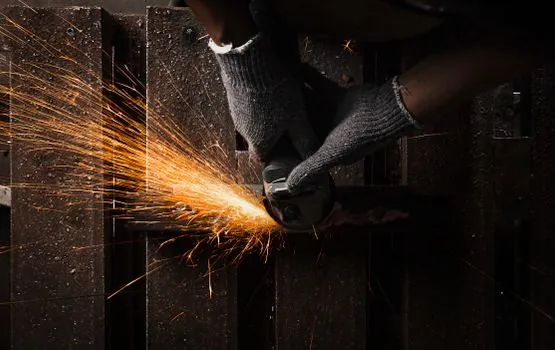
Both sizes can handle approved metal stock, but abrasive cutting creates a narrow groove by wearing away metal, generates sparks and heat, leaves an abrasive kerf, and may leave a burr requiring removal [S1]. A 14-inch machine is normally preferable when the cut can be followed by drilling, grinding, or filing. A 16-inch machine earns its extra size when the required workpiece capacity outweighs greater wheel consumption and handling burden [S5].
Abrasive wheels lose diameter during use, so a section that is comfortable with a fresh wheel may cease to fit as the wheel wears [S1]. Capacity should therefore be evaluated with a representative worn wheel, not only a new-wheel demonstration. For work that regularly approaches the limit, wheel consumption and replacement intervals belong in the purchase calculation alongside machine price [S1].
Thicker wheels resist bending, which is valuable for square cuts and angle cuts, but they generate more heat because they remove more material [S4]. Excessive heat can glaze a wheel and reduce cutting action; forum guidance recommends dressing the wheel when it stops cutting effectively, using an appropriate dressing tool and considering a more friable wheel for thick-walled material [S4]. Treat this as operating guidance, not a substitute for wheel-label instructions.
Selection Checklist by Application
Choose a 14-inch saw for frequent cuts in ordinary angle iron, flat bar, tube, pipe, or reinforcing bar; for jobs requiring frequent transport; and for workflows where a smaller workpiece can be clamped reliably [S1]. Confirm the actual capacity for each shape rather than applying the wheel diameter as a universal limit [S1].
Choose a 16-inch saw for repeated heavy-section work, larger structural stock, or production where deeper cuts reduce pass count [S2]. Compare motor power, wheel speed, base and vise stiffness, blade approval, and expected wheel consumption before accepting the larger format. A 7.5 hp 16-inch example illustrates the class, while the 15 A Ridgid R4142 illustrates a portable 14-inch class with a 3,900 RPM wheel speed [S3][S4].
Use both types of cut-off saw only with the approved abrasive wheel, intact guard, secure vise, and correct mounting components [S1]. The decisive specification is the largest real workpiece at the planned angle, not the number stamped on the wheel. For a procurement file, record model, blade diameter, arbor, wheel speed, motor rating, capacity chart, and expected replacement-wheel consumption, then test the largest routine stock sample.