
For fixed production, mount the cut-off machine on a rigid bench; for site work, use a portable stand only when its height, footprint, and wheel fit match the tool.
Decision criteria include cut capacity, material type, wheel speed, repeatability, operator movement, setup time, and transport requirements. The research materials provide no universal bench or stand load rating, so verify those values against the machine and accessory manufacturers before use.
Define the Decision by Workload and Cut Type
A bench-mounted cut-off machine is the stronger choice when the work stays in one workshop and repeatability matters more than portability. The bench must resist cutting load without flexing, while the machine is fixed in position and its work area remains supported. That arrangement is better suited to production cuts, batch preparation, and operations where a stop or repeatable setup is used. [S4]
A portable stand is the stronger choice when the cut-off machine must move between a garage, driveway, basement, or construction site. A portable woodworking bench described as a complete cutting station must provide a flat, stable surface, a way to hold a guide square, and physical stops for reproducing dimensions without repeated measuring [S1]. Those same requirements apply to a cut-off machine: mobility is useful only if the machine does not rock, vibrate, or shift under load.
The bench should also provide a defined working height. A portable woodworking bench must accommodate uneven or constrained environments such as garage floors, cracked and gravel-covered driveways, basements with low ceilings and support posts, and undulating job-site subfloors [S1]. Those dimensions illustrate the trade-off between support area and transport footprint, not universal requirements for every cut-off machine.
Compare the Two Configurations Criterion by Criterion
On mobility, the portable stand wins because the workstation can be transported and deployed at different locations. A modular workstation can be built around named-brand miter or table saws, with universal mounting kits and individual adjustable legs; one published platform adjusts from 32 to 38 inches and accepts saws with deck heights of 4.25 inches or less [S2]. These figures belong to that specific workstation design, not to all portable stands.
On stability and repeatability, a properly braced bench-mounted configuration wins when the shop floor is sound and the machine is bolted down. A portable stand is not automatically less accurate, but its performance depends on level adjustment, base rigidity, and the quality of the mounting interface. A complete portable cutting station must remain stable under cutting loads and support the workpiece through the cut [S1].
On setup speed, the bench wins after installation because the saw, guide, stops, and material flow can be arranged once. A portable stand wins only when transport and redeployment occur often enough to offset setup time. For metal cutting, a chop saw has a clear operating advantage for fast, abrasive cuts, while a portable band saw allows the operator to leave the cut running and later use the machine as a stationary cutting station; abrasive saw consumables were also identified as a cost disadvantage in a 2017 comparison [S4].
On floor space and access, a portable stand can be deployed where the work is occurring, but it still needs room for the operator, stock, offcuts, cord, and outfeed support. A bench-mounted machine concentrates those functions into a fixed workstation, which can reduce handling and improve material flow.
Bench-Mounted Configuration: Fixed Accuracy and Production Flow
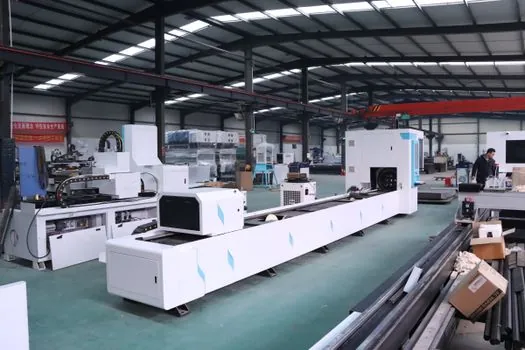
A bench-mounted cut-off machine is appropriate for a fixed workshop, metal fabrication shop, maintenance bench, or production cell where cuts are repeated throughout the week. The mounting arrangement should minimize movement, preserve the machine’s intended operating position, and allow the workpiece to be supported on both sides of the cut where practical. [S2]
Bench mounting does not automatically provide precision. The critical specification is the combined stiffness of the machine, bench top, mounting hardware, guides, and workpiece support. A bench that flexes during a cut can change the relationship between the wheel and the work even when the machine itself is accurate. The research describes a useful cutting station as a flat and stable surface that does not flex under cutting loads [S1].
A fixed bench also supports a better repeatability system. For abrasive cut-off wheels, a stop can set the cut-off position for repeated pieces, reducing the need to measure each workpiece. This is particularly valuable when producing identical brackets, tubing, or bar stock. The final dimension still depends on the wheel condition, machine geometry, stop placement, and operator technique.
The practical limitation is inflexibility. A dedicated bench occupies floor area and requires material to be brought to the machine. For low-volume work at scattered locations, this travel and handling can cost more than the accuracy gained.
Portable Stand Configuration: Site Access with Measured Limits
A portable stand is appropriate for installation crews, remodelers, maintenance teams, and users who need a cut-off machine at several locations. The stand must provide enough footprint for the machine, enough height for the operator, and enough rigidity to prevent movement under cutting load. Selecting a portable cutting-station setup for a garage, basement, or driveway requires accounting for the environment’s floor, ceiling, and support-post constraints [S1].
Uneven terrain requires more than placing a saw on folding legs. Independent adjustable legs can compensate for small height differences, but they cannot correct a soft surface that sinks under load. On gravel or soft ground, flat boards beneath the feet can distribute the load [S1]. The practical acceptance test is simple: tighten the machine, apply representative cutting load, and verify that the base and workpiece do not shift.
The stand must also match the cut-off machine. An adjustable workstation advertised for major miter and table saws accepts machines with deck heights of 4.25 inches or less and offers 32–38-inch height adjustment [S2]. A cut-off machine with a different base, guard geometry, wheel position, or height requirement needs its own mounting plate and stability check. Do not infer compatibility from the generic term “portable stand.”
Portable stands also face transport and wheel-consumable constraints. A rough framing band saw on a portable off-road table can support field cutting, while an abrasive chop saw provides fast cuts but consumes more wheels or other abrasive consumables [S4]. If the abrasive wheel must match a specific arbor, diameter, thickness, and rated speed, verify those details separately through the cut-off wheel arbor compatibility guide.
Material and Wheel Selection Still Control the Result
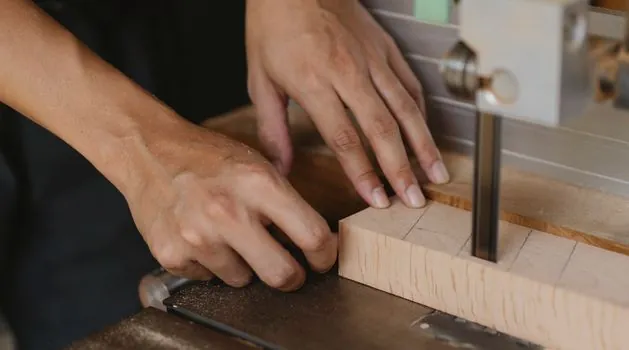
The mounting decision cannot compensate for the wrong cut-off wheel. For stainless steel, wheel bond and abrasive specification affect heat, loading, and finishing performance; the stainless-steel wheel bond comparison provides a separate technical basis for that selection. [S2]
Abrasive cut-off wheels are suited to fast, straight cuts in compatible ferrous metal, while a portable band saw can handle profiles and cuts that are difficult to reach with a fixed abrasive saw [S4]. The machine and stand choice should therefore follow the workpiece: cut length, section size, shape, tolerance, edge condition, and whether a cutting wheel is suitable for the alloy.
Wheel speed and machine speed must remain compatible. The stand should not alter the saw arbor, guard, guard adjustment, wheel clearance, or operating controls. If the portable platform changes the working height, it should preserve the operator’s control of the cut and provide full workpiece support. A stand that blocks guards or encourages unsupported cutting is unsuitable regardless of its portability.
Application Recommendations and Sourcing Checklist
Choose the bench-mounted configuration for repeat shop cuts, batch work, and operations where an operator can stage stock at one location. Choose the portable stand for scattered installation work, constrained access, and crews that need to carry the machine between sites. For mixed use, a mobile workstation is justified only when transport frequency is high enough to offset its larger setup burden and when the base can be leveled and braced at each location. [S2]
Request the machine manufacturer’s approved mounting interface, required support dimensions, allowable accessories, and operating conditions. Obtain the stand manufacturer’s deck or mounting dimensions, height range, load rating, leg adjustment range, and transport weight. For abrasive wheels, confirm diameter, bore or arbor, thickness, maximum operating speed, and material application from the wheel and machine documentation [S2].
The most defensible specification is therefore not “bench” or “stand” by itself. Specify the intended material, cut geometry, production volume, transport frequency, site surface, working height, required support area, and wheel compatibility. If the seller cannot document those values, treat the configuration as unverified rather than assuming that a generic workstation is interchangeable with a dedicated production bench.