A cut-off wheel fits only when its diameter, arbor hole, thickness, speed rating, and mounting arrangement satisfy the saw or grinder manufacturer [S1].
The practical comparison is machine arbor versus wheel hole, with brand, adapter availability, flange type, wheel profile, and approved operating speed determining whether substitution is safe.
Why arbor size is only one part of the fit
Wheel selection must begin with the exact machine model, followed by checks for approved diameter, arbor size, wheel type, thickness range, flange requirements, and operating speed [S1]. Arbor diameter identifies the nominal bore, but a wheel cannot be mounted solely because its stated hole appears close to the spindle diameter. The mounting flange, centering step, nut, washer, or adapter must also support the wheel as specified.
Diameter must also match the machine class. A product listing that gives only diameter, thickness, and a maximum speed of 5,400 RPM still requires the buyer to verify all of those dimensions against the equipment [S5].
Machine arbor versus wheel bore
There are two useful ways to express the fit: the machine's spindle or mounting diameter and the wheel's nominal arbor hole. The comparison should also include the physical stack of flanges and adapters because a nominal match can still fail to center or clamp correctly. Field discussion from 2006 documents 4.5-inch grinder wheels offered with 7/8-inch bores while some users preferred 5/8-inch holes, with backing plates and bushings used to bridge differences [S4]. That case illustrates why adapter availability, not the brand name, determines interchangeability.
The historical discussion is useful for understanding the mechanism, but its age limits its role as product evidence [S4]. Machine designs, wheel profiles, flange arrangements, and speed classes are not interchangeable across eras. For procurement, the controlling evidence is the machine manual and the wheel marking or manufacturer documentation for the exact wheel [S1].
Cutting tools should also be distinguished by operating system. A bonded abrasive metal saw, a dry-cut metal saw using a purpose-built toothed blade, and a woodworking miter saw may have similar dimensions without accepting the same consumables [S1]. A branded wheel comparison is therefore meaningful only after the machine category has been fixed.
Brand is a weaker criterion than geometry
No single brand determines compatibility because the decisive variables are physical and documented: machine model, approved wheel diameter, arbor bore, thickness, maximum speed, wheel profile, and flange arrangement [S1]. Bosch, DeWalt, Makita, Norton, and other brands may offer wheels with different hole sizes, including 4-inch, 4.5-inch, and larger formats, but the machine acceptance check remains the same [S4].
A forum poster preferred a 5/8-inch arbor hole and found 4.5-inch wheels with 7/8-inch arbor holes [S4]. A 4-inch Type 1A wheel, a 4.5-inch wheel with a 7/8-inch bore, and a larger wheel with a 5/8-inch bore are three different specification families. They should be compared in a table before purchase rather than treated as interchangeable stock.
The related decision between 5/8-inch and 7/8-inch mounting hardware is covered in the 5/8-inch arbor versus diamond knockout blade fit guide, but a knockout-style blade and an abrasive cut-off wheel still require separate approval for the tool and application.
Flanges, adapters, and thin wheels
Arbor adapters are only acceptable when the machine manufacturer permits them and the adapter correctly positions the wheel. One 2006 discussion describes 4-inch and 4.5-inch accessories being fitted by changing or omitting washers, while another user notes that a typical 7/8-inch adapter can be too thick for a 0.045-inch wheel [S4]. These observations identify a practical failure mode: a nominally usable adapter can place an incorrect clamping load on a thin wheel.
The wheel profile changes the required flange. Cut-off wheels require a cutting guard with half-moon-shaped, 180-degree coverage rather than the grinding guard typically supplied with right-angle grinders [S2]. A flange or guard that happens to fit one profile is not automatically suitable for the other.
Decision criteria for comparing wheel options
The main options can be lined up against four criteria: machine approval, geometry, installation hardware, and application rating. For a replacement purchase, all four must pass. A larger-diameter wheel may fit physically while exceeding the spindle speed; a smaller wheel may run below maximum speed but fail to reach the machine's approved diameter. An adapter may bridge the bore while violating the required flange arrangement or wheel thickness. [S1]
Wheel application also has to match the material. A cut-off wheel for rough steel preparation should not be substituted with a wheel intended for masonry merely because both have the same diameter and arbor. A concrete wheel example carries a 5,400 RPM maximum speed and requires verification of diameter, thickness, arbor, and speed against the equipment [S5]. Application markings such as stainless steel or masonry identify intended use, while general-purpose labeling does not authorize every material.
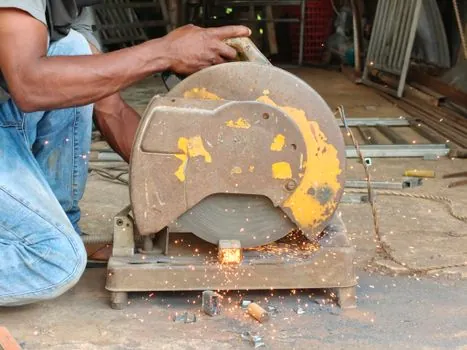
This comparison also separates machines from end users. A bench saw with a vise and fixed fence suits repeated cuts to length, while a handheld cutter is useful where the work cannot be brought to a station [S1]. The selection is for fabricators and contractors who can verify the machine specification and control the workpiece, not for users who intend to fit a wheel by diameter alone.
Safety limits that override a size match
Diameter and arbor agreement does not authorize use if the wheel exceeds the machine's speed rating or lacks the required guard. A wheel with cracks or other visible damage must be replaced, and the tool should be jogged briefly to confirm that it runs true [S2]. Visual inspection should cover both the wheel and the tool because impact damage may occur while the wheel remains mounted.
The workpiece must be tightly secured in a vise or clamp so that it cannot move, bend, or roll during the cut [S2]. Operators should not flex the wheel, push it through the cut, or use a cut-off wheel for grinding. Cutting and grinding require a wheel marked for both operations, and the tool's own weight should provide the cutting force rather than additional pressure [S2].
Personal protective equipment for this work includes safety glasses, a face shield, ear protection, gloves, flame-resistant clothing, a leather apron, and safety shoes; hard hats or welding caps can add head protection from sparks [S2]. These controls are part of the machine-wheel system, not optional additions to an otherwise successful arbor match.
Procurement and verification sequence
Start with the machine model and manufacturer, then record the approved wheel diameter, nominal arbor size, maximum operating speed, permitted wheel thickness, profile, and flange arrangement [S1]. Next, compare those values with the wheel's printed specification, including a stated maximum speed of 5,400 RPM where applicable [S5]. Brand and application marking come after the dimensional checks, not before them.
For cross-brand purchasing, maintain a wheel matrix with columns for machine model, diameter in inches or millimeters, arbor hole in inches or millimeters, wheel thickness, profile, speed rating, required flange, and approval status. The existing cross-reference on choosing the cut-off wheel bond for stainless steel can be applied after fit has been established, because the correct bond cannot compensate for an incompatible arbor or unsafe speed.
Trackable signs of a sound inventory system are low adapter dependence and zero wheel-match exceptions. Any substitution that requires an unapproved washer, omitted flange, altered nut stack, or wheel outside the published machine envelope should remain on hold until the machine manufacturer confirms it.