A 1D laser barcode scanner reads only linear codes (UPC, Code 128, Code 39) by sweeping a 650-670 nm laser beam across the bar pattern, while a 2D area imager captures a full CMOS image of the symbol and decodes both 1D and 2D codes (QR, Data Matrix, PDF417) in any orientation [S1][S2].
Entry-level 1D wired handheld units list at $25 to $75 per unit, a price point established by the 2026 POS buying guides for small retail and basic inventory use [S8]. 2D area imagers typically cost 2-5x more than comparable 1D laser models, with industrial-grade ruggedized 2D imagers (IP65, drop-rated 1.8 m to concrete) priced accordingly higher due to added optics, decoder ASIC, and omnidirectional firmware [S2][S3]. The total cost gap narrows once lifecycle and read-rate failure costs are factored in, because 2D imagers resolve damaged, low-contrast, and on-screen codes that force re-scans on a 1D laser [S4][S5].
Engine Architecture: Laser, Linear Imager, 2D Area Imager
A laser scan engine uses a 650-670 nm visible laser diode reflected off an oscillating mirror to sweep one horizontal line across a 1D barcode; the photodiode measures reflected light and the decoder converts the pulse train to ASCII [S4]. Reading range is typically 1 inch to 3.5 feet for standard UPC-A labels on retail 1D laser units [S4]. Laser engines exclusively read 1D codes, and performance degrades on damaged or soiled labels because the sweeping beam cannot reconstruct missing bars the way an image-based sensor can [S1][S6].
A linear imager replaces the laser with a 1D CCD/CMOS line sensor plus LED illumination, capturing a single row of pixels and decoding it as a 1D code; this image-based approach recovers some damaged or low-contrast 1D labels that a laser misses, but it is still 1D-only [S1][S2]. A 2D area imager adds a 2D CMOS sensor (typically 640x480 to 1280x800 pixels) and global-shutter or rolling-shutter readout, captures a full frame, then runs symbology decode in firmware; it reads 1D and 2D codes from any orientation and from backlit LCD/OLED phone screens [S1][S4][S5]. A useful adjacent reference is the industrial barcode scanner technology overview, which covers the same engine classes at greater depth.
Price Tiers and What Drives the Gap
1D laser handheld units cluster into three bands: $25-$75 entry-level wired (USB-HID keyboard wedge, plastic housing, no IP rating); $80-$180 mid-range (better optics, longer depth of field, occasional IP54); and $200-$500+ industrial laser (IP65, 2 m drop, extended temperature -30 to 50 degrees C) [S8]. The 2D area imager tier typically starts at $90-$150 for basic 2D imagers with USB interface and rises to $300-$900+ for DPM-capable, IP67-sealed, Bluetooth or Wi-Fi industrial imagers [S2][S5]. A 2D imager "scan engine" inside a mobile computer or PDA costs more than a laser scan engine of equivalent housing grade because the CMOS sensor, lens assembly, and decode firmware are more complex than a single laser diode plus oscillating mirror [S4].
The price gap is widest in the entry tier and narrows as you move into rugged industrial housings, where sealing, drop spec, and battery (for cordless) dominate the BOM regardless of engine type. For buyers comparing barcode scanner price 1D laser vs 2D imager, the practical rule is: a 1D laser will read 1D-only at the lowest unit cost, while a 2D imager buys 1D+2D capability, omnidirectional read, and screen-read at roughly 2x the entry price and 1.3-1.5x the industrial price [S2][S3][S8]. Cost-conscious deployments that will only ever scan clean 1D labels (grocery, library, basic retail) should stay on 1D laser; anything reading shipping labels, GS1 DataMatrix, mobile coupons, or DPM on metal parts should spec 2D imager from day one [S3][S4][S5].
Read Performance on Damaged, Low-Contrast, and Screen Codes
2D area imagers outperform 1D lasers on damaged or poorly printed 1D codes because the CMOS frame can reconstruct missing bars from surrounding pixels and the decoder can apply error-correction heuristics (Reed-Solomon for Data Matrix, QR's built-in EC) that a 1D laser, which depends on a clean sweep across a single line, cannot [S1][S4][S5]. Industrial logistics labels printed on rough kraft, scuffed cartons, or thermal-printed with low contrast are a known pain point where 1D laser first-pass read rates drop, increasing operator re-scans and dock-door dwell time [S3].
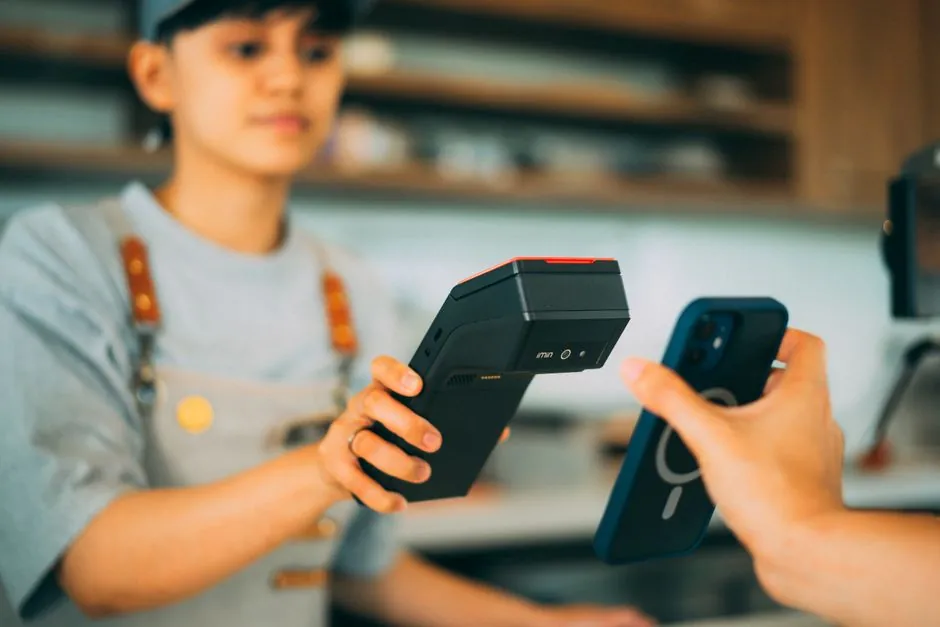
For mobile-coupon, ticket, and payment workflows, 2D area imager is mandatory: a 1D laser cannot read a QR code or a 2D Data Matrix from a phone LCD/OLED screen because those codes encode data in two axes and the laser sweep is one-dimensional [S1][S2][S5]. Direct Part Marking (DPM) on metal or plastic (laser-etched, dot-peened, ink-jetted) is another 2D-only workload, with dedicated DPM 2D imagers using diffuse or polarized illumination to handle specular and low-contrast marks on reflective substrates [S4]. For a deeper look at code-quality tolerance and decoder tuning, see the related piece on industrial barcode scanners for damaged and low-contrast codes.
Use-Case Decision Matrix: 1D Laser, Linear Imager, 2D Imager
The right engine maps to a 2-axis decision: (1) symbology set (1D only vs 1D+2D) and (2) code quality + read surface. 1D laser is the lowest-cost fit for clean 1D-only labels at close range (1 inch to 3.5 feet) in controlled lighting [S4]. Linear imager (1D CCD) is a small step up in price and a real step up in tolerance for damaged 1D labels, still 1D-only [S1][S2]. 2D area imager is the default for any workflow that includes 2D codes, screen-presented codes, omnidirectional read, or DPM [S3][S4][S5].
Per use case: grocery POS and library check-out should stay on 1D laser (UPC/EAN only, controlled lighting, low price) [S2][S4]; warehouse receiving and shipping with mixed-quality labels should spec linear imager (1D, damaged-label tolerance) or 2D imager if GS1-128 plus occasional Data Matrix is in scope [S3][S5]; pharmaceutical and healthcare unit-dose scanning should spec 2D imager (Data Matrix on vials, mobile-coupon or e-ticket on patient phones) [S3][S5]; automotive and aerospace parts traceability with DPM must spec DPM-rated 2D imager with polarized illumination [S4]; mobile-coupon, loyalty, and ticketing retail (airline, stadium, transit) must spec 2D imager for screen read and omnidirectional capture [S1][S5]. The single most common spec error in 2026 industrial RFPs is buying 1D laser units for a line that will soon receive GS1 DataMatrix or QR-coded shipping labels; the per-unit savings are erased by retrofit cost within 12-24 months [S3][S4].
Interface, Form Factor, and Integration Constraints
USB-HID keyboard wedge is the dominant interface across all three engine classes and is the lowest-friction integration path because the host software sees scanned data as typed characters [S5]. RS-232 serial is still specified for legacy PLC, WMS, and conveyor-sorter integrations where USB host ports are not available, and Bluetooth or Wi-Fi cordless imagers connect to a base/cradle that then presents USB-HID or serial to the host [S5]. Form factors range from pistol-grip handheld (most common in warehousing) to in-counter, presentation, and fixed-mount (for conveyor and kiosk), with the engine choice independent of the housing [S4][S5].
Industrial buyers should also weigh IP rating (IP54 for warehouse, IP65/IP67 for dock-door and freezer), drop spec (1.5 m minimum, 1.8-2.0 m for industrial), and operating temperature (standard 0 to 40 degrees C, extended -30 to 50 degrees C for cold-chain and outdoor), because a $50 1D laser will not survive a freezer aisle no matter how well it reads [S3][S5]. For adjacent process-control context where barcode capture feeds a PLC, the sensing-distance dynamics discussed in inductive sensor sensing distance: how target metal changes the real range offer a useful parallel on how the same nominal spec can shift dramatically with the target.
Standards, Symbology Specs, and Sourcing
1D symbologies covered by most engines include UPC-A/UPC-E, EAN-8/EAN-13, Code 39, Code 128, GS1-128, Interleaved 2 of 5, and Codabar; 2D symbologies include QR Code (ISO/IEC 18004), Data Matrix (ISO/IEC 16022), PDF417 (ISO/IEC 15438), and Aztec [S5]. For industrial DPM, AIM DPM-1-2006 is the de facto guideline for mark quality, while ISO/IEC 15416 and ISO/IEC 15415 define the print-quality grading that scanner decoders can use to tune aggressiveness [S5]. Buyers should request a vendor's published decode-zone (depth of field) chart and a first-pass read rate spec on representative damaged labels, not just the brochure read range, because marketing read-range figures assume a high-contrast 13 mil UPC label in lab lighting [S4][S5]. A foundational reference is the industrial barcode scanner technology overview, which catalogues the engine classes and their typical application fit.
Trackable signals for the next 6-12 months: GS1's ongoing push to migrate shipping labels from UPC/Code 128 to GS1 Digital Link QR (a 2D code) on more retail and logistics lines, and the growing requirement from major 3PLs for DPM-readable 2D imagers on part-receiving stations [S3][S4]. The price gap between entry 1D laser and entry 2D imager is expected to keep compressing below $50 delta for basic USB models, narrowing the only remaining reason to choose 1D laser in 2026. Buyers specifying new lines should default to 2D area imager unless 1D-only is a hard constraint, and should keep one 1D laser handheld as a bench reference for legacy label debugging. See also the industrial barcode scanner technology overview for cross-vocabulary alignment.
The underlying component specifications are covered under thermal imager, and laser level.