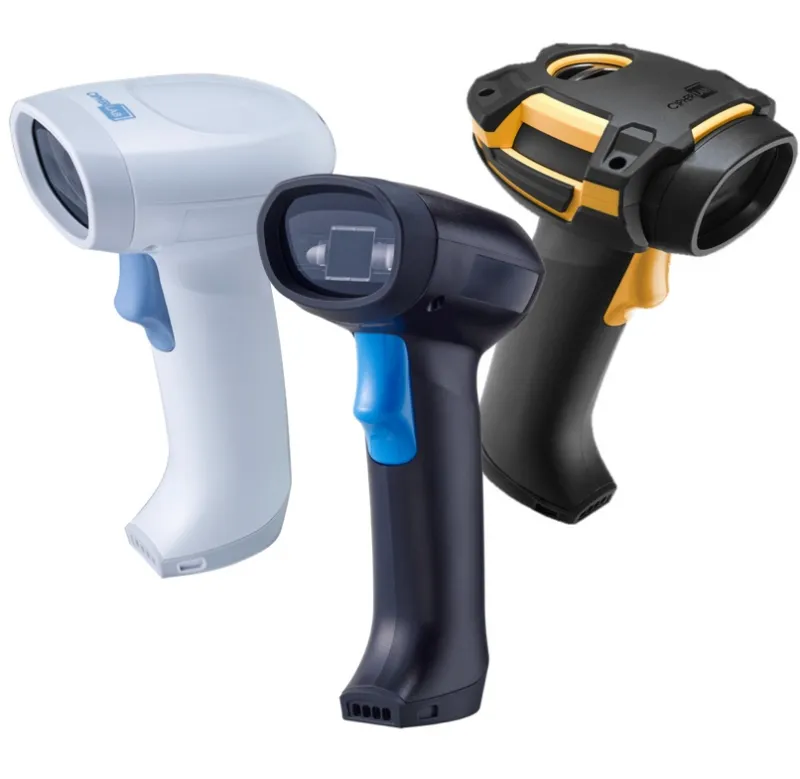
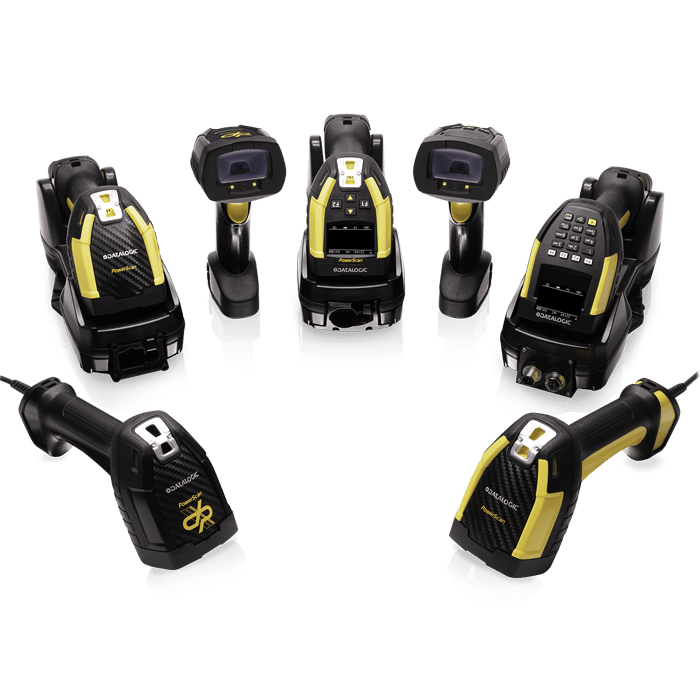
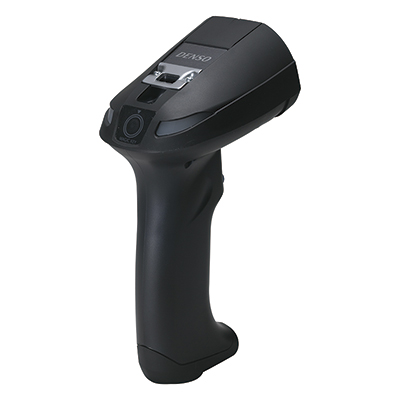
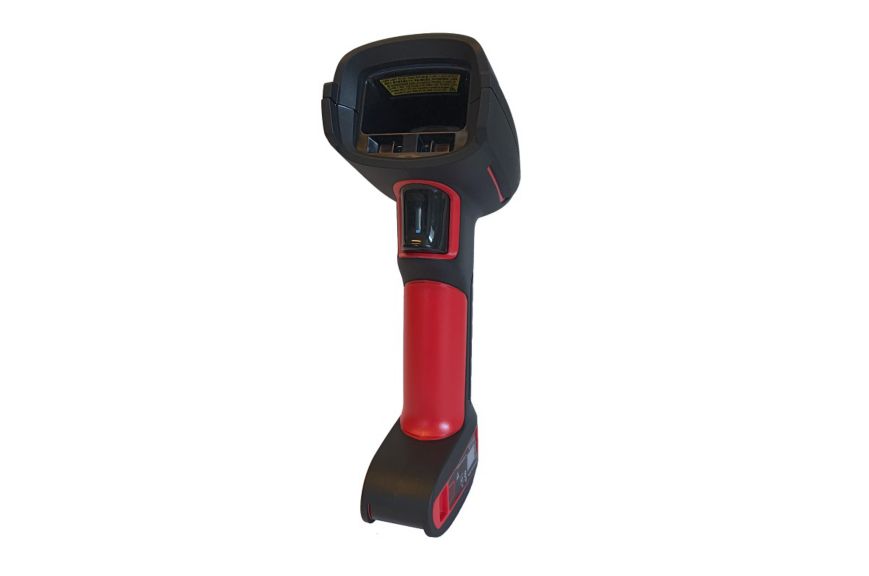
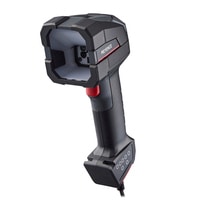
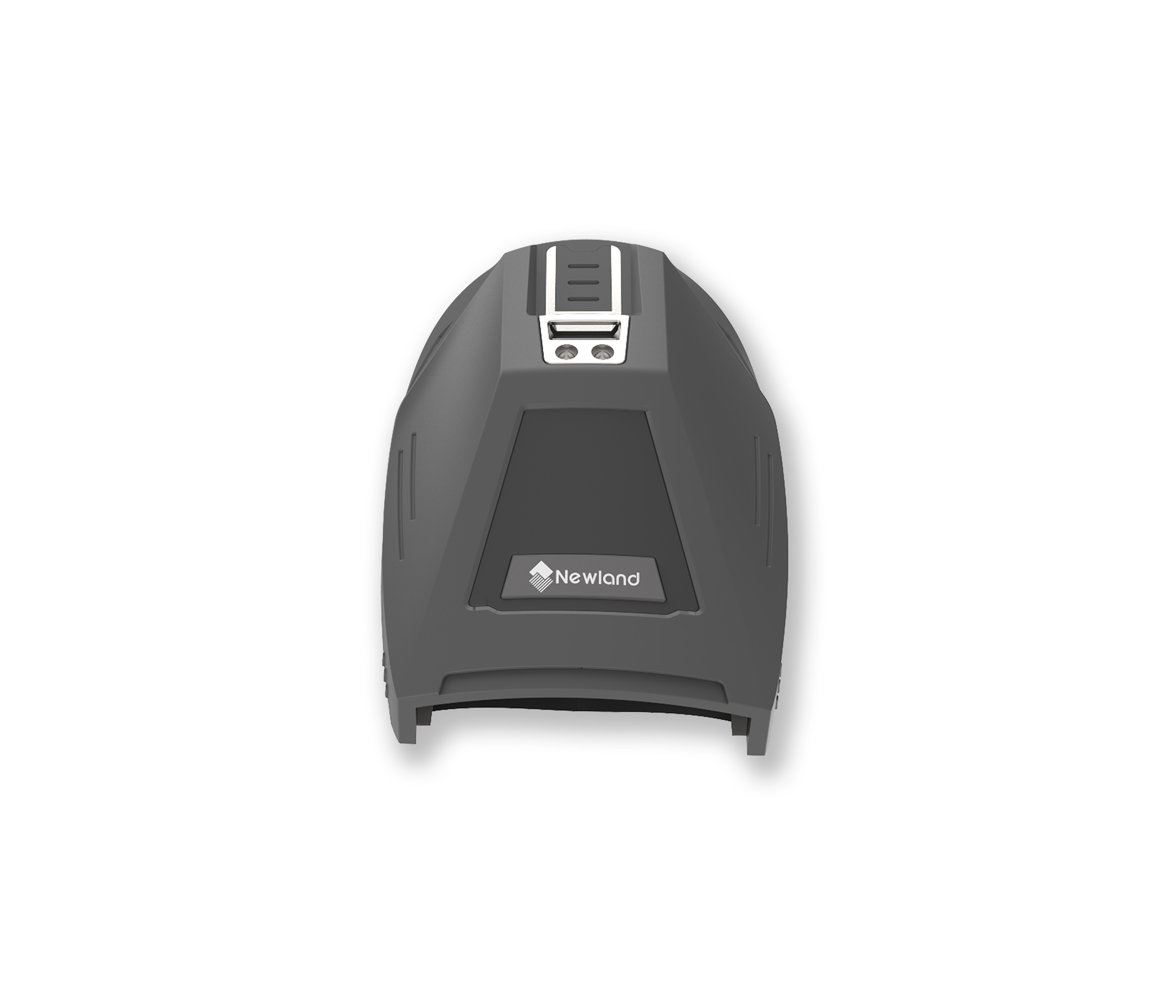
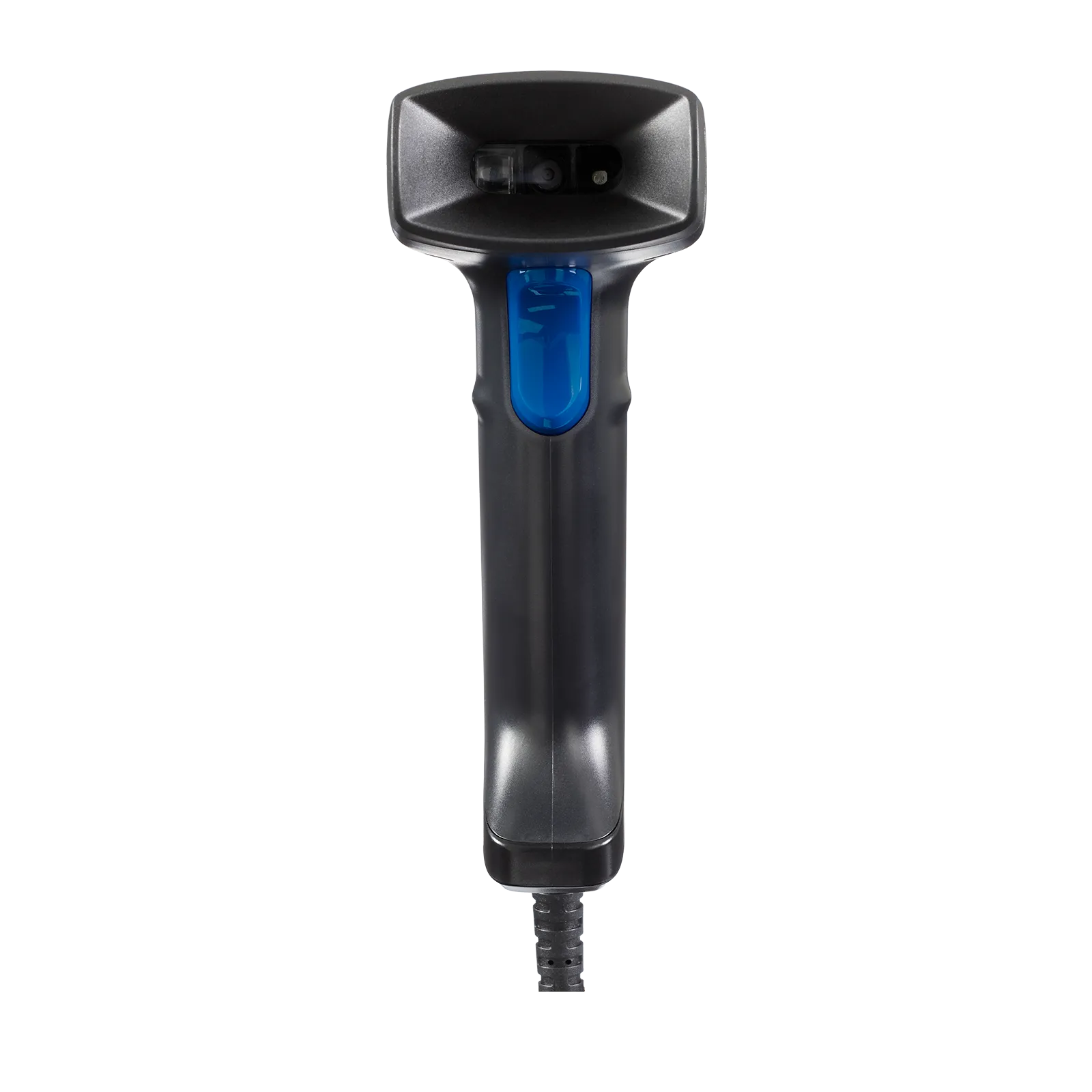
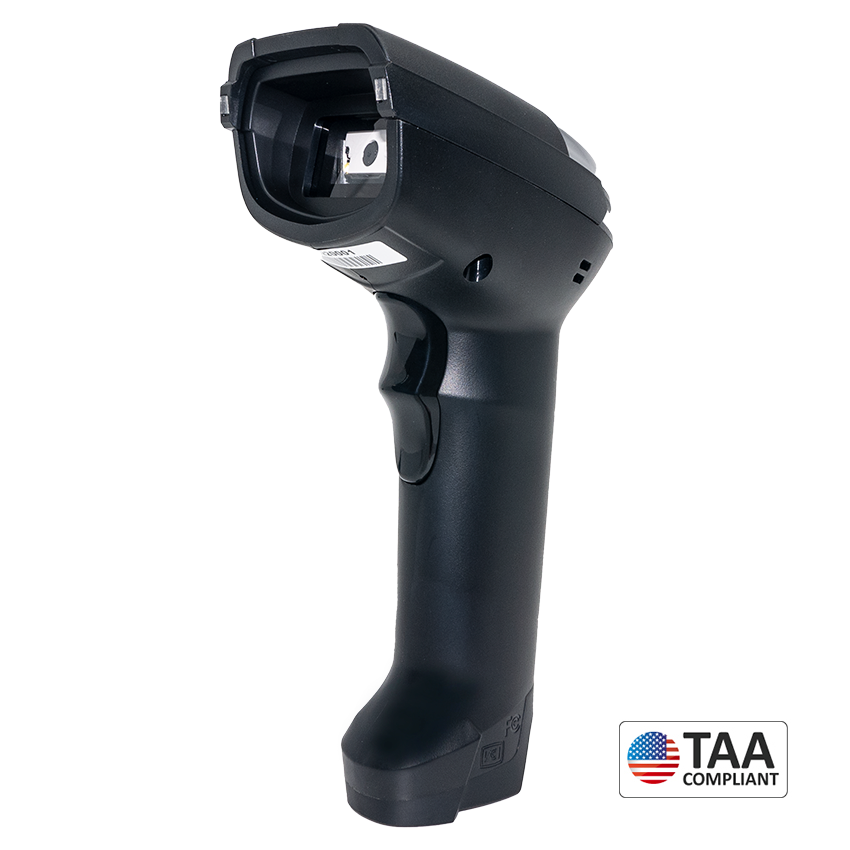
An industrial barcode scanner is a fixed-mount or handheld device that reads machine-readable codes, both linear (1D) barcodes and two-dimensional (2D) matrix codes, and converts them into data for a control system. Unlike consumer point-of-sale scanners, industrial readers are engineered for continuous duty on conveyors and machines: sealed enclosures, solid-state optics, fieldbus connectivity, and decode algorithms that recover damaged, low-contrast, or directly marked codes. They are a cornerstone of traceability, sortation, and error-proofing in modern manufacturing and logistics.
Two device families dominate the plant floor: laser scanners that sweep a beam across linear codes, and image-based readers (2D imagers) that photograph the code and decode it in software. The market has shifted decisively toward imaging because a single image-based reader handles every symbology, reads omnidirectionally, and grades code quality, while laser scanners survive only in long-range linear duties.
Photo: Raimond Spekking, CC BY-SA 4.0, via Wikimedia Commons
This guide is written for procurement engineers and design engineers specifying automatic identification (auto-ID) equipment. It covers 6 chapters from device types and imaging principles to symbologies, code-quality standards, spec-sheet decoding, and selection decisions, with 7 selection FAQs and manufacturer comparisons. Parameters reference the public standards ISO/IEC 15416 (1D print quality), ISO/IEC 15415 (2D print quality), ISO/IEC 29158 (DPM), the ISO/IEC symbology specifications, and IEC 60529 (ingress protection).
Chapter 1 / 06
What is an Industrial Barcode Scanner
An industrial barcode scanner, also called an auto-ID reader or code reader, is an optoelectronic device that detects the high-contrast pattern of a barcode or matrix code, decodes it against a known symbology, and outputs the encoded data string to a PLC, industrial PC, or warehouse system. The underlying physics is simple: the reader illuminates the code, dark elements absorb light while light elements reflect it, and a photosensor or image sensor converts that reflectance contrast into a digital pattern. The decoding software then maps that pattern to characters using the rules of the specific symbology, validates the check character, and emits the result.
Structurally, an industrial reader comprises four subsystems: (1) an illumination unit, typically LEDs in red, white, blue, or infrared, sometimes with multiple controllable angles; (2) an optical and sensing element, either a swept laser with a single photodiode or a fixed lens focusing onto a CMOS or CCD image sensor; (3) a decode processor running the symbology algorithms and error correction; and (4) an interface and housing providing fieldbus communication and ingress protection. When these are integrated into a sealed unit that mounts over a conveyor and triggers on a signal from a photoelectric sensor as product arrives, the industry calls it a fixed-mount reader, the configuration most common on automated lines.
The technology has a layered history. The first patent for a linear barcode was granted to Norman Joseph Woodland and Bernard Silver in 1952, but it was the adoption of the Universal Product Code (UPC) at a Marsh supermarket in 1974 that made barcoding commercial. Laser scanning matured through the 1980s for retail and logistics. The Data Matrix 2D symbology, introduced in 1987 and later standardized as ISO/IEC 16022, enabled small high-density codes on parts, and QR Code followed in 1994 (ISO/IEC 18004). Image-based industrial readers arrived in the 2000s as CMOS sensors and embedded processing became cheap enough to photograph and decode in real time, and the most recent generation adds liquid-lens autofocus and on-device machine-learning models to recover marginal codes.
In application scale, industrial reading spans from millimetre-scale Data Matrix codes laser-etched, often by a dedicated laser marker, onto semiconductor wafers and surgical instruments, through carton and pallet labels in distribution centres, to long-range tyre and tote reads several metres away. Each duty maps to a different combination of resolution, field of view, working distance, and lighting. There is no universal reader: the essence of selection is matching the code's size, contrast, surface, and presentation speed to a reader's optics and decode capability.
Three engineering outcomes determine the value of an industrial reader: read rate (the fraction of presented codes decoded on the first attempt, where world-class lines target 99.5 percent or better), false-read rate (decoding the wrong data, which must approach zero because the check character is the last defence), and uptime. A reader that costs little but misreads or no-reads even one percent of codes generates rework, mis-shipments, and line stoppages whose cost dwarfs the hardware saving within a single quarter of operation.
Chapter 2 / 06
Scanner Types and Form Factors
Industrial scanners divide along two axes: the sensing principle (laser, linear CCD, or 2D imager) and the form factor (fixed-mount, handheld, or presentation). Choosing the wrong combination is the most common specification error: a long-range laser cannot read a 2D Data Matrix, and a high-resolution close-focus imager cannot cover a wide pallet. The table below compares the four principal device classes on the metrics that drive selection.
Device Class
Codes Read
Typical Range
Moving Parts
Best For
Laser scanner
1D linear only
50 to 1,000 mm
Yes (mirror)
Long-range linear, high-speed retail
Linear CCD / LED
1D linear only
0 to 250 mm
No
Close, shiny or dirty 1D labels
2D imager (fixed)
1D and 2D
50 to 1,000 mm
No
Conveyor traceability, DPM, mixed codes
2D imager (handheld)
1D and 2D
contact to 10+ m
No
Receiving, manual inspection, rugged duty
Laser scanners use a laser diode and an oscillating mirror or rotating polygon to sweep a focused beam across a linear code. A single photodiode times the reflected light and reconstructs the bar pattern. Laser scanning is fast, works at long working distance, and reads narrow high-density linear codes well. Its limitations are decisive for modern lines: it reads only 1D codes, it has wearing moving parts that fail under shock and vibration, and the beam must cross the bars roughly perpendicular, so the code must be oriented. Laser readers persist where the duty is purely linear and the range is long, for example reading tote labels several metres overhead.
Linear CCD and LED readers replace the swept beam with a fixed array of photosensors that capture the whole linear code at once under flood LED illumination. With no moving parts they resist shock and read shiny or partially obscured labels more reliably than a laser at short range, but the fixed array limits working distance to a few hundred millimetres and they too read only 1D codes. They occupy a narrowing niche between laser and full 2D imaging.
Two-dimensional imagers are cameras. A lens focuses the field of view onto a CMOS or CCD area sensor, and the processor decodes any 1D or 2D symbology found in the image, in any orientation, with error correction that recovers torn, smeared, or low-contrast codes. Fixed-mount imagers mount over conveyors and machines and integrate lighting, optics, and fieldbus in a sealed IP65 or IP67 housing; the Cognex DataMan and Keyence SR-X families are representative. Handheld imagers add ruggedized ergonomics for receiving, kitting, and field service. Because one imager covers every code type and grades quality, image-based reading is the default choice for new industrial installations, and the same imaging hardware often shares a platform with a broader machine vision system used for inspection.
Form factor follows the workflow. Fixed-mount readers automate hands-free, triggered reading on moving product and integrate directly with PLC logic. Handheld readers serve manual, variable-position tasks and tolerate drops and washdown. Presentation readers sit on a bench for operators to pass items in front of, common in assembly verification and pharmacy dispensing. A single traceability project frequently mixes all three across its stations.
Chapter 3 / 06
Imaging Technologies and Decode
Within image-based reading, performance is governed by the sensor, the optics, the illumination, and the decode algorithm working together. The same nominal megapixel count can read very differently depending on lens, lighting, and processing. The table below compares the imaging building blocks an engineer must reconcile during selection.
Building Block
Typical Options
What It Determines
Image sensor
CMOS or CCD, 1.2 to 5 MP
Field of view vs. resolvable detail
Resolution
0.4 to 5 MP (e.g. 1.4 / 2.3 MP)
Smallest readable module (mil)
Lens / focus
Fixed, manual, or liquid-lens autofocus
Working distance and depth of field
Illumination
Red / white / blue / IR, multi-angle
Contrast on the target surface
Decode engine
Multi-core / FPGA / ML-assisted
Read rate on damaged or DPM codes
The image sensor is most often a CMOS area array because of its low cost, high frame rate, and global-shutter options that freeze motion on a conveyor. Industrial readers commonly use 1.2 to 5 megapixel sensors. As a verified reference point, the Keyence SR-X series offers a 1.4 megapixel (1360 by 1024) model and a 2.3 megapixel (1920 by 1200) model. More pixels widen the field of view for a given resolvable module size, but they also raise data volume and can slow the decode, so the right sensor is the smallest one that resolves the target code across the required field of view.
Resolution in practice is the pixels-per-element ratio: reliable decoding generally needs several sensor pixels across the narrowest bar or 2D module. This is why specifications quote a minimum element size in mil, the width in thousandths of an inch of the smallest feature the reader resolves at a stated distance. High-resolution readers resolve down to roughly 3 mil for linear codes and 5 mil for 2D codes, while typical labels carry a 10 to 20 mil X-dimension. Pushing resolution higher than the code requires only shrinks the usable field of view and depth of field.
Optics and focus set the working distance and the depth of field, the band of distances over which the code stays in focus. Fixed-focus lenses are cheapest and most stable for a single presentation distance. Liquid-lens autofocus, now common on premium readers, electronically refocuses between reads, which is essential for mixed-height parcels and multi-position presentation. The verified reading range of the Keyence SR-X series, for example, spans roughly 50 to 1,000 mm depending on model and code size.
Illumination is decisive on difficult surfaces. Flat printed labels read well under broad red or white light, but reflective metal, curved parts, and directly marked codes need controlled geometry. Dome lighting diffuses light to suppress glare on shiny or curved surfaces; low-angle dark-field lighting grazes the surface to throw etched or peened marks into relief; on-axis bright-field lighting suits flat specular parts. Integrated multi-angle, multi-colour lighting, switchable per read, is what separates a true DPM reader from a label reader. Decode algorithms close the loop: multi-core and FPGA processing, increasingly assisted by on-device machine-learning models, recover blurred, distorted, low-contrast, and partially occluded codes that defeat simple thresholding, and they exploit the Reed-Solomon error correction built into 2D symbologies to rebuild missing data.
Chapter 4 / 06
Symbologies and Code Quality Standards
A reader is only as useful as the symbologies it decodes and the quality standard it can hold codes to. Symbology is the encoding scheme (the grammar of bars and modules); each mainstream symbology is defined by an ISO/IEC specification that fixes its structure, encoding, and decode algorithm. The table below lists the symbologies an industrial reader should support and their governing standards.
Symbology
Type
ISO/IEC Standard
Typical Use
Code 128 / GS1-128
1D linear
15417
Logistics, GS1 supply chain
Code 39
1D linear
16388
Defence, automotive legacy
Interleaved 2 of 5
1D linear
16390
Numeric carton codes
EAN / UPC
1D linear
15420
Retail item identification
Data Matrix
2D matrix
16022
DPM, small-part traceability
QR Code
2D matrix
18004
Mobile, mixed data, marketing
PDF417
2D stacked
15438
ID documents, high data volume
Linear symbologies remain ubiquitous. Code 128, defined by ISO/IEC 15417, is the workhorse for logistics because it encodes the full ASCII set densely; its GS1-128 variant carries GS1 Application Identifiers that structure data for the global supply chain. Code 39 (ISO/IEC 16388) is older and lower density but persists in defence and automotive legacy systems. Interleaved 2 of 5 (ISO/IEC 16390) is a compact numeric-only code for carton marking, and the EAN/UPC family (ISO/IEC 15420) identifies retail items at point of sale.
Two-dimensional symbologies carry far more data in less area and tolerate damage. Data Matrix (ISO/IEC 16022) is the industrial standard for direct part marking and small-item traceability: its Reed-Solomon error correction can recover a symbol even when a substantial fraction of it, up to roughly 30 percent depending on configuration, is damaged. QR Code (ISO/IEC 18004) offers similar robustness with higher data capacity and is common where mobile devices also read the code. PDF417 (ISO/IEC 15438) is a stacked linear symbology used on identity documents and where large data payloads must fit a rectangular space.
Code quality standards are distinct from symbology standards and are what separate a guess from a guarantee. A symbol that decodes on a forgiving reader may still be a poor mark that fails elsewhere in the supply chain. Three quality standards govern grading, each assigning attribute scores that roll up to a letter grade from A (4.0) down to F (0). ISO/IEC 15416 grades linear (1D) print quality by taking ten independent scan profiles across the symbol height and grading parameters such as edge determination, minimum reflectance, symbol contrast, modulation, defects, decode, and decodability. ISO/IEC 15415 grades 2D matrix print quality across parameters including symbol contrast, modulation, axial nonuniformity, grid nonuniformity, fixed pattern damage, and unused error correction. ISO/IEC 29158, the former AIM DPM guideline, adapts ISO/IEC 15415 specifically for low-contrast direct part marks by standardizing the lighting geometry and recalculating contrast against the image histogram. A minimum grade of C (2.0) is the common acceptance floor for global scannability, and verification itself uses calibrated equipment per ISO/IEC 15426.
The practical takeaway for procurement: confirm not only that the reader decodes your symbologies, but that it understands the GS1 Application Identifier structure if you trade through GS1, and that you separately budget for an ISO/IEC 15426 traceable verifier on the marking line if your customers impose a minimum print-quality grade. A reader and a verifier answer different questions and are not interchangeable.
Chapter 5 / 06
Key Specification Parameters
Reading an industrial reader datasheet is a core procurement skill. A single model may list twenty or more parameters, but only a handful truly drive whether it reads your codes on your line. The eight parameters below decide selection; each is explained so the numbers on a spec sheet become decisions.
Minimum element size (resolution) is the width of the narrowest bar or 2D module the reader resolves at a stated distance, quoted in mil (1 mil equals 0.0254 mm). It must be at or below your printed code's X-dimension with margin. A reader rated to 5 mil reads denser codes than one rated to 10 mil, but at the cost of a smaller field of view. Always compare resolution at the actual working distance, not a best-case close focus.
Field of view (FOV) is the area the sensor covers at a given distance, usually given as width by height in millimetres at a reference distance. The FOV must contain the entire code plus positional variation of the product. FOV and resolution trade against each other for a fixed sensor: widening the FOV reduces the pixels across each module and raises the readable mil floor.
Working distance and depth of field together define where the reader can sit. Working distance is the nominal window-to-code range; depth of field is the band over which the same code still decodes. Larger X-dimension codes and smaller apertures widen DOF; higher resolution narrows it. On a conveyor the usable DOF shrinks because the code is in the focused zone only briefly, so autofocus or liquid-lens optics are valuable for variable product heights.
Decode and motion performance covers read rate (first-pass decode fraction, with good lines at 99.5 percent or better), decode time or trigger-to-result latency (often well under 150 ms on premium readers), and motion tolerance, the maximum code speed or line speed at which reads hold. Image-based readers state motion tolerance in metres per second; it falls as resolution and exposure demands rise, so verify it at your line speed.
Illumination and optics options determine whether the reader can be tuned to your surface: available LED colours (red, white, blue, infrared), controllable angles (dome, low-angle, on-axis), and external lighting support. For DPM and reflective parts this is the difference between a 99 percent and a 70 percent read rate.
Communication interfaces are the integration surface. Industrial readers commonly offer Ethernet (TCP/IP) plus industrial protocols, and the verified Keyence SR-X interface list, for example, includes EtherNet/IP, PROFINET, and OPC UA over 100BASE-TX, with optional EtherCAT, alongside RS-232C and USB. The reader must speak the same protocol as your PLC or line controller, so confirm fieldbus fit before anything else.
Ingress protection and ruggedness follow IEC 60529: IP65 resists dust and water jets for general indoor duty, while IP67 adds temporary immersion for washdown, food, and outdoor lines. Solid-state fixed-mount readers add shock and vibration immunity; rugged handhelds add multi-metre drop ratings and wide temperature windows. Match these to the physical bay, not to a generic catalogue figure.
Operating temperature and supply close out the envelope. Fixed-mount readers typically run on 24 VDC and specify an operating range; the verified Keyence SR-X range is 0 to +45 degrees Celsius, whereas rugged handhelds such as the Honeywell Granit family extend to roughly -30 to +50 degrees Celsius. Outdoor and cold-store duties demand a reader rated for the actual ambient, not a benign laboratory figure.
Chapter 6 / 06
Selection Decision Factors
To convert the preceding five chapters into a specific model, follow the decision sequence below. Most selection failures come not from a single wrong parameter but from deciding in the wrong order, for example fixing on a brand before characterizing the code. These steps double as a reusable RFQ template.
Characterize the code first: symbology (Code 128, Data Matrix, QR, PDF417), X-dimension in mil, contrast, and surface (printed label, etched metal, ink-jet DPM). This single step eliminates whole device classes; a 5 mil Data Matrix on metal rules out laser scanners immediately.
Define the presentation: static or moving, line speed in metres per second, product height variation, code orientation, and the number of codes per item. Moving product narrows usable depth of field and may require autofocus and global-shutter imaging.
Fix the geometry: required working distance and field of view, then derive the resolution (mil) and sensor size that resolve the code across that FOV. Choose the smallest sensor that meets the resolution, not the largest available.
Specify lighting for the surface: flat labels accept standard red or white flood; reflective, curved, or directly marked codes need controllable dome, low-angle dark-field, or on-axis lighting. For DPM, require a reader with multi-angle integrated illumination and ISO/IEC 29158 grading awareness.
Pick the form factor and ingress class: fixed-mount for hands-free triggered reading, handheld for variable manual tasks, presentation for bench verification. Set IP65 for general indoor duty or IP67 for washdown and outdoor, per IEC 60529, plus any drop and temperature requirement.
Match the interface: confirm the reader speaks your control network (EtherNet/IP, PROFINET, EtherCAT, Modbus TCP, or serial) and integrates with your PLC or line system, including digital I/O for trigger and result signalling.
Decide reading versus verification: if a customer or standard imposes a minimum print-quality grade, budget separately for an ISO/IEC 15426 traceable verifier graded to ISO/IEC 15416, 15415, or 29158. A reader cannot substitute for a verifier.
Evaluate total cost of ownership: hardware plus integration, lighting accessories, spares, and the cost of misreads and no-reads. A reader that saves a few hundred dollars but holds a one percent no-read rate generates rework and mis-shipments that exceed the saving within a quarter.
One dimension teams routinely overlook is application-engineering support and serviceability: availability of local pre-sale read trials on your actual parts, lighting and lens accessory ecosystems, firmware updatability, and spare-part lead time. These matter little at purchase but determine read-rate stability and repair response over a line's 5 to 10 year service life. Established industrial brands, including Cognex (DataMan 280, 370, 8700), Keyence (SR-X), Zebra Technologies, Honeywell (Granit, Xenon), Datalogic (Matrix), SICK (Lector), and Omron Microscan (MicroHAWK), maintain field-application engineering and spares networks that make them defensible choices for production-critical reading.
FAQ
What is the difference between a laser barcode scanner and a 2D imager?
A laser scanner sweeps a single focused beam across a linear (1D) barcode using an oscillating mirror or prism, reading one scan line at a time. It is fast and works at long range, but it has moving parts that wear, it cannot read 2D matrix codes, and it must be roughly aligned with the bars. A 2D imager is a camera: a CMOS or CCD sensor captures a full two-dimensional image of the code and decodes it in software. Imagers have no moving parts, read 1D and 2D symbologies omnidirectionally, and reconstruct damaged or low-contrast codes through error correction. For new industrial installs, image-based readers have largely displaced laser scanners except in long-range linear-only duties.
What does scanner resolution in mil mean and how do I pick it?
Resolution is stated as the minimum element size, the width of the narrowest bar or 2D module the reader can resolve, expressed in mil (one thousandth of an inch, so 1 mil equals 0.0254 mm). Smaller, denser codes require a lower mil rating. Common labels use an X-dimension of 10 to 20 mil; high-resolution readers resolve down to about 3 mil for linear codes and 5 mil for 2D codes. To pick a value, take the printed code's X-dimension, then choose a reader whose minimum element size is at or below it with margin. Reading a 5 mil code with a 10 mil-rated engine fails; over-specifying resolution shrinks the field of view and depth of field.
What is DPM and why does it need a special reader?
DPM (Direct Part Marking) is a code applied permanently into the part surface by laser etching, dot peening, electrochemical etching, or ink-jet, used for lifetime traceability in aerospace, automotive, electronics, and medical devices. DPM codes are typically low contrast because the mark is formed by indentation or surface texture rather than printed black on white, so a standard reader optimized for paper labels often cannot decode them. DPM readers use controlled, multi-angle lighting (dome, low-angle dark-field, on-axis bright-field) and adaptive image processing to lift the code out of the reflective metal background. Quality is graded under ISO/IEC 29158 (the former AIM DPM guideline) rather than ISO/IEC 15415.
What is the difference between a barcode reader and a barcode verifier?
A reader answers one question: can this code be decoded right now on my line. A verifier measures whether the printed or marked code meets an objective quality standard, grading attributes such as symbol contrast, modulation, decode, axial nonuniformity, and unused error correction, then assigning a letter grade from A (4.0) down to F (0). Verification uses a calibrated, fixed-geometry aperture and lighting per ISO/IEC 15426, following ISO/IEC 15416 for 1D, ISO/IEC 15415 for 2D, and ISO/IEC 29158 for DPM. A code can read on a forgiving scanner yet fail verification, which predicts read failures downstream in the supply chain. Use readers for sortation and verifiers for print-quality control.
How do depth of field and working distance affect conveyor scanning?
Working distance is the nominal range from the reader window to the code; depth of field (DOF) is the band of distances over which the same code still decodes. DOF widens with larger X-dimension and a smaller aperture and narrows with higher resolution and faster lens speed. On a moving conveyor the usable DOF shrinks further because the code spends less time inside the focused zone, so you size the optics around the actual product height variation plus a margin and confirm the reader's motion tolerance, stated in metres per second or as a maximum line speed. Autofocus or liquid-lens readers extend the practical DOF by refocusing between presentations, which suits mixed parcel heights.
Which symbologies should an industrial reader support?
At minimum, support the linear codes Code 128 (ISO/IEC 15417), Code 39 (ISO/IEC 16388), Interleaved 2 of 5 (ISO/IEC 16390), and the GS1 retail family EAN/UPC, plus GS1-128 and GS1 DataBar. For 2D, the priorities are Data Matrix (ISO/IEC 16022), QR Code (ISO/IEC 18004), and PDF417 (ISO/IEC 15438), with GS1 Data Matrix for healthcare UDI and food traceability. Data Matrix dominates industrial DPM because its Reed-Solomon error correction recovers codes even with up to about 30 percent of the symbol damaged. Confirm the reader decodes GS1 Application Identifier structures, not just the raw symbology, if you exchange data through the GS1 supply chain.
What IP rating and ruggedness do plant-floor readers need?
Enclosure protection follows IEC 60529. IP65 resists dust ingress and low-pressure water jets and suits most indoor fixed-mount duties; IP67 adds temporary immersion to 1 m and is the norm for washdown, food, and outdoor lines. Fixed-mount industrial readers such as the Cognex DataMan and Keyence SR-X families are rated IP65 or IP67 with solid-state, no-moving-parts construction for shock and vibration immunity. Rugged handhelds such as the Honeywell Granit series add multi-metre drop ratings (about 3 m to concrete), tumble cycles, and wide operating ranges (around -30 to +50 degrees Celsius). Match the IP code, drop spec, and temperature window to the bay, not to a generic catalogue number.
Industrial Barcode Scanner Manufacturers
Source-backed product routes. Open a company dossier for procurement scope and cited evidence.