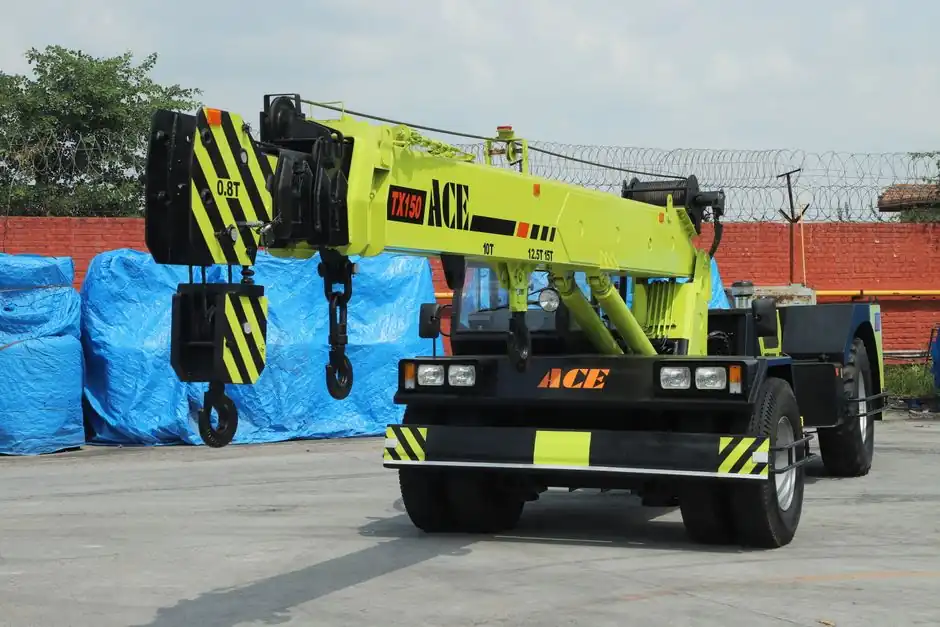
A 20 tm lorry loader crane typically mounts on an 18-26 t chassis, delivers 10-18 m of reach, and still lifts roughly 1.2-1.5 t at 12 m outreach, per truck loader crane class data [S1].
Step up to 30 tm and the envelope widens by roughly 50% on the load chart and ~5 m on the boom, with a typical horizontal reach of ~20 m, on a heavier 32 t four-axle carrier, the same 20-25 mt mid-range that Fassi targeted with its F330/F360XP.28 in the 30 tm segment [S2][S1].
Where the two classes sit in the lifting-moment ladder
Loader crane classes are quoted in metre-tonnes (mt), the product of load and outreach: a 15 mt crane can theoretically lift 15 t at 1 m or 1.5 t at 10 m, though the binding figures are those in the manufacturer's load chart [S1][S4]. The 20 tm unit sits at the top of the standard 10-25 mt band (18-26 t carriers, 10-18 m reach), while the 30 tm unit already lives in the 25-60 mt heavy band (32 t four-axle chassis, 18-26 m reach, often with a jib and winch) [S1].
That step from 20 to 30 tm is not a 50% jump in payload at any given radius; it is a 50% jump in the moment envelope, which means a 30 tm crane can either lift more at the same radius, or reach further at the same payload. The Fassi F330/F360XP.28 illustrates the second interpretation: 835 kg at ~20 m horizontal outreach with the slow "extra power" mode, and 2 t to a 24 m hook height [S2].
Real load-chart numbers for 20 tm-class machines
For a typical 20 mt loader on a 26-tonner, expect several tonnes close to the column and 1.2-1.5 t at 12 m outreach; the binding rating, however, comes from the load chart that the manufacturer is legally obliged to fit [S1][S4]. The 12 m, 1.2-1.5 t envelope already covers most building-materials trade, carpentry, roofing, and small precast elements that define the 10-25 mt segment [S1].
Older long-boom 20-25 mt designs showed how far the same class could be pushed: Amco Veba's 24 tm 924/8s lifts about 1.5 t to 26 m maximum height and only 500 kg at 20.5 m maximum outreach, and the lighter Palfinger PK 24502 lifts 510 kg at 21.3 m [S2]. The takeaway: even within a 20-30 mt class, boom length and the slow "extra power" mode trade directly against tip load.
Real load-chart numbers for 30 tm-class machines
At 30 tm, the headline tip-load figures shift up sharply. Fassi's 30 tm F330/F360XP.28 is rated at 835 kg at ~20 m horizontal outreach in "extra power" mode, and 2 t at 24 m hook height; the heavier 35 tm F380/F420XP.28 sibling lifts 200 kg more at the same maximum reach but matches it on height [S2]. Palfinger's 25 tm PK 26502 sits in the band below, lifting 570 kg at 21.3 m, and the PK 27002 lifts 640 kg at the same 21.3 m [S2].
For mid-30s machines, F.lli Ferrari's 35 tm model 735 lifts 1,355 kg at 16.4 m maximum outreach (1.3 t at 16.3 m for the 735 A6) and reaches 20 m hook height; the larger 41 tm 741 A8 lifts 970 kg at 21 m horizontal and up to 24.5 m with a hydraulically-powered fly jib [S2]. The pattern is consistent: every additional metre of boom costs kilogrammes of tip load.
Chassis, outrigger, and payload-cost trade-off
The chassis dictates where each class can operate. A 20 tm loader typically rides an 18-26 t two- or three-axle truck, leaving useful payload on the bed; a 30 tm unit is usually on a 32 t four-axle or articulated combination, with four- or six-point outrigger support whose spread electronically limits the side-load chart [S1]. Knuckle-boom and telescopic-boom layouts both exist, but knuckle-boom is standard for the 20-30 tm range because it folds low behind the cab and gives better upward and rear reach [S1].
Heavy-class 30 tm-plus work also blurs the line with mobile cranes. Medium-duty and heavy loader cranes in and above the 20 tm band are routinely specified with eight or nine hydraulically-extended boom sections to reach past 20 m, and the editorial framing from 2004 already had them competing with telehandlers, rough-terrain cranes, and even self-erecting tower cranes on general site lifting work [S2]. Choosing 30 tm over 20 tm, in practice, is often a question of whether the truck needs to act as a small mobile crane on site.
Use-case fit: 20 tm vs 30 tm
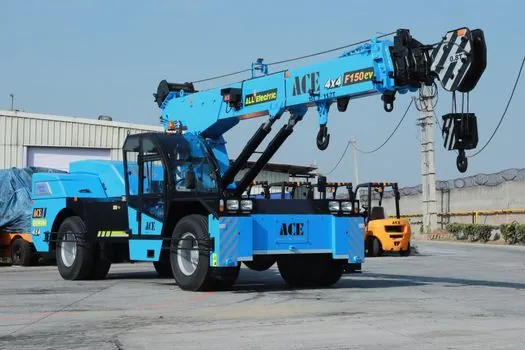
A 20 tm class is the right call for building-materials yards, scaffolding, carpentry, roofing, small precast, and general delivery work where the lift stays within ~12 m and 1.5 t. A 30 tm class earns its keep on construction sites placing loads into upper storeys, on steel and timber yards where a fly jib and 20+ m horizontal reach replace a separate mobile crane visit, and on articulated carriers working infrastructure jobs [S1][S2].
For heavier end of the 30 tm band, the HMF 6120K-RCS shows the upper envelope: 30-45 tm nominal, up to 52.8 tm lifting moment, 21.3 m base reach extending to 31.4 m with extensions, and a 16 t self-weight figure, which is the size where chassis selection, not just boom spec, starts driving the build [S3]. Tadano's PM 30.5 SP also targets this medium-tonnage class with a balance of low weight and high lifting power, illustrating where the 30 tm segment is positioned between the standard 20 tm workhorse and the 60 mt+ heavy haulers [S5].
Safety, load-moment limiting, and standards
Every loader crane in this class, 20 tm or 30 tm, must carry a load chart and a working lifting-moment limiting device; the device tracks unusual movement that could cause overloading, and the moment value itself guides the operator on the correct action when the limit is approached [S4]. Load-chart components that drive both classes include capacity deductions (environment, hardware, crane load), lifting capacity, boom angle, boom length, lift range, and operational notes [S4].
EN 13000-series and EN 12999 cover crane safety in this segment, with EN 12999 specifically addressing loader cranes; the load-moment limiter and the load chart are mandatory documentation that must remain on the machine throughout its service life, and operators reading the chart need to apply the right deductions for the configured boom and attachment combination, otherwise the 20 vs 30 tm rating means nothing on site [S4].
Selection checklist before you size the crane

Three numbers decide 20 tm vs 30 tm: the maximum load in tonnes at the worst-case working radius, the maximum horizontal outreach required, and the carrier's permissible front-axle load once the crane, body, and a typical 1-2 t payload are on it [S1]. If the worst-case combination sits inside 1.2-1.5 t at 12 m on a 26 t chassis, stay at 20 tm; if the job needs 1 t at 18-20 m, jib duty, or 2 t at 24 m hook height, the 30 tm class is the minimum that meets it without an "extra power" workaround [S1][S2].
Chassis choice feeds back into the decision as well, and the 6x4 vs 8x4 loader crane chassis trade-off covers how axle count, route restrictions, and payload rules push 30 tm buyers toward heavier carriers. For yard and fleet operators comparing the 20 vs 30 tm step against the wheel loader and backhoe loader classes used on the same sites, the decision is rarely about raw lifting capacity and almost always about whether the truck needs to act as its own crane. Watch the load chart revisions for any 20 tm or 30 tm model you shortlist, and treat the moment limiter's event log as a maintenance input, not a black box [S4].
The underlying component specifications are covered under lifting vehicle.