
More than 32,500 new financed mini excavators were sold in the U.S. between June 1, 2025 and May 31, 2026, a 7.7% year-over-year decline, while the global heavy construction equipment market sits at USD 160.11 billion for 2026 and is projected to reach USD 226.91 billion by 2033 at a 5.1% CAGR [S1][S4].
The figures put a two-speed market on the page: compact units in North America are softening as buyers migrate to used inventory, while OEM revenue forecasts still call for steady mid-single-digit growth led by crawler excavators, wheel loaders, and rigid dump trucks in Asia Pacific. Mini excavators remain the second-highest selling financed product category in the U.S. at 21.5% of new financed sales, behind compact track loaders [S1].
Mini Excavator Rankings: Cat Edges Kubota, Bobcat Stays Third
Caterpillar took the top spot in new financed U.S. mini excavator sales for the period with 7,588 units, or 23.3% share, narrowly ahead of Kubota at 7,270 units (22.4%) and Bobcat at 5,572 units (17.1%) [S1].
John Deere followed at 4,966 units (15.3%) and Takeuchi at 1,054 units (3.2%), with the top five manufacturers covering more than 81% of new financed mini excavator volume [S1]. The best-selling model was the Kubota KX040-5 at 2,120 units, powered by a 40.3 gross hp engine and an operating weight range of 9,182–10,417 lb, followed by the Cat 305 CR (1,992 units, 12,688 lb, 45 net hp) and the Deere 35 P-Tier (1,855 units, 8,135 lb, 23.3 net hp) [S1]. Mid-frame demand is visible across the rest of the top 10, where operating weights stretch from 7,892 lb (Bobcat E35i) to 18,493 lb (Cat 308 CR, 69.5 net hp) and average financed-unit horsepower clusters in the 33–55 net hp range [S1].
Used vs. New: Buyers Pivot to Depreciated Stock
Used mini excavator financing volumes grew during the same window that new sales fell, signalling a demand rotation rather than a demand collapse, as contractors with tighter bid margins chase depreciated machines or short-term rental over new purchase [S1].
Used equipment pricing has stabilized in 2026 after the post-pandemic spike, but values remain firm for low-hour machines under 2,000 operating hours, which dealers still price at a premium to high-hour stock [S3]. The global pre-owned construction equipment market is projected to grow from USD 78.27 billion in 2025 to USD 148.99 billion by 2035 at a 6.65% CAGR, a faster clip than the new-equipment market tracked by the same forecasters [S6]. For fleet planners, the read-through is straightforward: the lowest TCO per operating hour is increasingly found in 2- to 4-year-old late-Tier 4 Final stock, not in the 2026 model year. Pricing detail on the construction machinery and equipment category pages tracks the same shift toward attachment versatility and telematics as resale drivers.
CNH Industrial: 3% Q1 2026 Construction Segment Decline
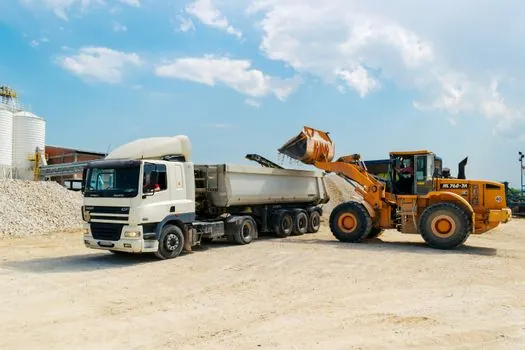
CNH Industrial posted USD 574 million in global net sales for its construction equipment segment in Q1 2026, a 3% year-over-year decrease, with an adjusted operating loss of USD 28 million for the quarter [S2].
The drop was driven by lower equipment volumes in North and South America, compounded by rising tariff costs, rising labor costs, and increased marketing spend; higher machine selling prices only partially offset the revenue gap [S2]. CEO Gerrit Marx confirmed in the same quarter that CNH remains in active partnership talks for the CASE and New Holland Construction business, with management expecting clearer direction in the second half of 2026 or early 2027 [S2]. In a market already dominated by Caterpillar, Komatsu, Volvo, and Deere, any CASE or New Holland restructuring would reshape mid-tier dealer footprints across North America. For comparison, tower crane vs construction hoist site trade-offs show the same pattern of OEMs holding list prices while buyer commitment cycles extend, a dynamic that shows up across the equipment spectrum.
Global Market Sizing: USD 160.11 Billion in 2026, Asia Pacific Leads
The global heavy construction equipment market is valued at USD 160.11 billion in 2026, up from USD 154.62 billion in 2025, and is forecast to reach USD 226.91 billion by 2033 at a 5.1% CAGR [S4].
Asia Pacific accounted for 40–45% of the 2025 market and remains the dominant region, with crawler excavators, mini excavators, wheel loaders, backhoe loaders, and rigid dump trucks leading global unit sales [S4]. By equipment category, earthmoving is the fastest-growing segment through 2033, while rigid dump trucks are projected at the highest equipment-type CAGR of 6–8% [S4]. The 201–400 HP power band is forecast to grow at 4.7% CAGR, and sub-5 L engine capacity at 4.4% CAGR, both matching the broader mix shift toward mid-frame excavators and mid-size wheel loaders rather than the largest mining-class machines [S4]. Buyers weighing telematics and Tier 4 Final aftertreatment options can cross-reference the lamps and light fittings and machine-mounted work-light pages, since machine lighting and beacon spec is now a routine bid-line item on infrastructure RFPs.
Compact Segment Outlook: Mini Excavators are expected to lead the product type segment with 38.0% share in 2026, reflecting trenching demand across utility and housing projects [S5].
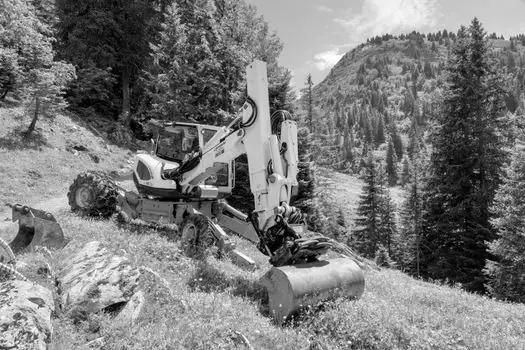
The global compact construction equipment market is valued at USD 36.7 billion in 2026 and is projected to reach USD 49.8 billion by 2036 at a 3.1% CAGR, with mini excavators leading the product type segment at a 38.0% share [S5].
Sub-5-ton equipment leads the operating weight segment at 47.0% share, sub-100 HP machines lead the power output segment at 52.0% share, and excavation application leads at 42.0% share, a configuration built around trailer-towable machines for utility and foundation work [S5]. Diesel power still holds 68.0% of the compact market, with no near-term displacement by battery-electric platforms in this segment [S5]. China is the fastest-growing national market at a 4.0% CAGR through 2036, followed by India at 3.7% CAGR, both driven by urban renewal and infrastructure spending rather than greenfield mega-projects [S5]. The compact buying pattern overlaps heavily with the construction tools category, where compact excavators and compact track loaders are increasingly bundled with hydraulic breakers, augers, and trenching attachments in dealer floor plans.
Selection Criteria: New vs. Used vs. Rental in 2026
For a contractor choosing between a new 2026 mini excavator, a 2- to 4-year-old used unit, or a project-based rental, the 2026 data supports a TCO-first decision: depreciation plus financing cost on a new 40 hp class machine is now the highest line item, while used units under 2,000 hours have stabilized at predictable residual values and rental absorbs peak demand without capital tie-up [S1][S3][S6].
A simple pre-purchase test, dealer response time within 24 hours, parts availability above 90% on common wear items, and telematics subscription cost, separates dealers that will protect uptime from those that will not [S5]. Buyers should also pressure-test attachment ecosystems, because a mini excavator that accepts a breaker, auger, and tilt bucket in under five minutes without leaving the cab materially raises utilization and resale value. Reference pricing on work lamps, beacons, and machine lighting for night-shift and roadwork bids lives in the lighting equipment and electric lamps section, and is increasingly rolled into the same OEM quote as the machine.
The verifiable next node to watch is the CNH Industrial construction-segment partnership decision, signalled for the second half of 2026 or early 2027, which would set the dealer count and product cadence for CASE and New Holland through 2028 [S2]. A second trackable signal is whether U.S. new financed mini excavator sales for the June 2026 to May 2027 reporting window return to flat or positive growth, since two consecutive down years would confirm the demand rotation to used is structural rather than cyclical [S1].