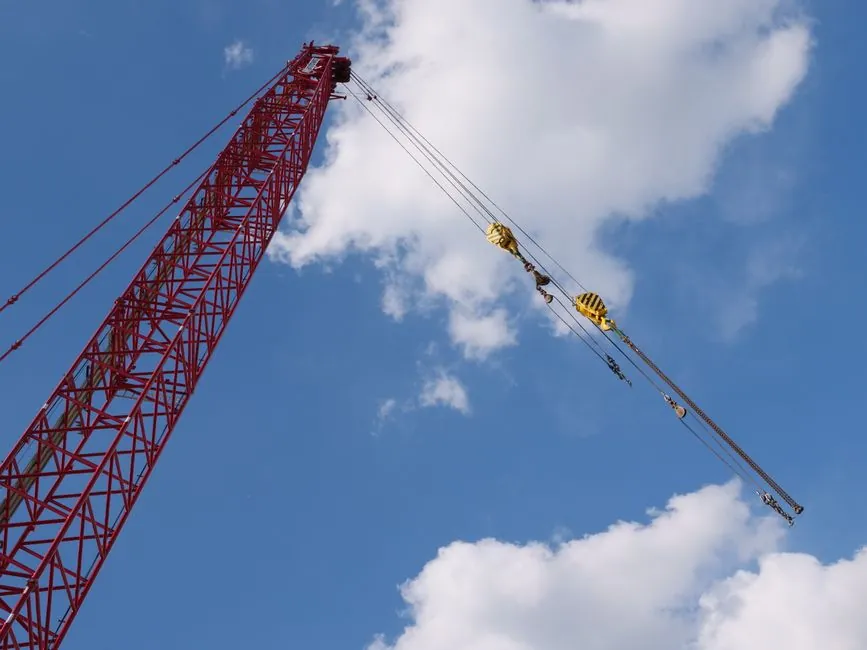
A tower crane is a fixed, self-erecting crane with a tall vertical mast and a rotating horizontal jib, used to lift and place heavy materials like structural steel, concrete, and equipment high above a construction site [S3]. A construction hoist is, in contrast, a comprehensive sturdy elevator built into a vertical tower on the building, used to carry personnel, tools, and materials up and down between floors [S1].
The two machines share a silhouette (a tall vertical tower on a jobsite) but solve different problems: the crane places loads with a hook on a moving trolley, while the hoist shuttles people and palletized goods in an enclosed cabin or rack. On most high-rise projects both run in parallel, and on a tower crane the first piece of equipment up is often the crane itself, while the hoist is erected shortly after to take over the steady stream of finishing trades and workers [S3][S4].
Core Definition and Scope of Each Machine
A tower crane, in the four-type taxonomy used by major rental fleets, comes in hammerhead (saddle jib), flat top (topless), luffing jib, and self-erecting variants; all share a fixed vertical mast and a horizontal or luffing arm that places loads on a hook [S3]. Maximum lift figures commonly cited for production tower cranes reach about 18 tons per lift with working heights up to roughly 265 feet, with the heavier models reserved for open sites where the full jib radius can swing [S6].
A construction hoist is referred to across the industry as a construction elevator, personnel hoist, man-lift, or material hoist depending on whether it is configured to carry workers, goods, or both [S2][S9]. Unlike a crane, a hoist's load is constrained to move essentially in one direction (vertically) along a guide tower anchored to the structure, and it is sized by platform dimensions and load rating rather than by hook reach [S7]. Material hoists such as the DOC platform are commonly rated around 8,000 lb (≈3,630 kg) per cycle and are built to handle loads over 20 ft long, including curtain wall and pipe [S5].
Selection Criteria: When the Spec Calls for Which Machine
The functional split on a real high-rise site is straightforward. A tower crane is the right call when the job needs to lift discrete heavy objects (steel members, formwork, gensets, concrete buckets) to a precise location at radius, and when the heaviest single pick plus the longest reach define the crane selection [S3]. Maxim's published guidance is explicit: lifting capacity and working height vary by make, model, and configuration, so the crane is matched to the heaviest lift and the longest reach the job requires [S3].
A construction hoist is the right call when the job needs continuous vertical transport of people and palletized materials between fixed floor landings. Cranes are not allowed to lift human beings, so once the structure is weather-tight and the hoist is in place, almost all personnel movement is transferred off the crane and onto the hoist [S4]. A side-by-side decision read: tower cranes for low-cycle, high-mass, high-precision placement; construction hoists for high-cycle, lower-mass, repeatable point-to-point shuttling of crews and materials [S1][S4][S7].
Who Each Machine Is For, and Who It Is Not For

Tower cranes are for projects with a defined structural frame (concrete, steel, or composite) that will run high enough to justify a fixed mast, and with a site footprint wide enough for the jib radius and a counter-jib tail swing. They are not the right tool for a one-story slab, an interior fit-out, or any job that needs personnel transport, since OSHA practice and the consensus of equipment insurers prohibit using crane hooks to carry workers [S4].
Construction hoists are for high-rise builds where crews and materials must keep moving to a fixed landing every few minutes. They are not a substitute for a crane on heavy picks: a hoist can typically carry a rated platform load in the few-thousand-pound range, not the 10-ton-plus lifts a tower crane is built for, and they have no horizontal reach, so they cannot place loads on a floor plan the way a jib can [S5][S7]. The most efficient high-rise sites use both, with the tower crane erecting the structure and the construction hoist handling the steady traffic of trades.
Side-by-Side Comparison on Four Decision Criteria
The four criteria that drive equipment selection on a high-rise are lift mass, reach, cycle speed, and what the machine is legally allowed to carry. A tower crane wins on the first two, a construction hoist wins on the last two. [S3]
Lift mass: production tower cranes are routinely specced to roughly 18 tons per pick at typical working radii [S6]; material hoists in common use sit around 8,000 lb per cycle (≈3.6 t) [S5]. Reach: a tower crane's jib can serve an entire floor footprint, with hammerhead and flat-top jibs running out to the full working radius and luffing jibs trading radius for tight-site access [S3]; a hoist has effectively zero horizontal reach, with loads only moved through a landing gate [S1]. Cycle speed: a hoist can cycle personnel and materials far faster than a crane tied to a hook, since the hoist runs in a dedicated guide tower and stops at every floor [S4]; a crane is a slow-moving placement tool by comparison. Legal use: a construction hoist is certified to carry workers, while a tower crane is not, and the standard practice is to keep the crane on heavy picks and route all personnel through the hoist once it is operational [S4][S2].
Real Use Cases on a High-Rise Schedule

On a typical concrete-frame high-rise, the tower crane is the first major machine on site, lifting rebar cages, column forms, and the hoist itself into place. As soon as the structure tops out beyond ground level, the construction hoist is anchored to the building and begins carrying crews and palletized materials to each floor landing [S1][S5].
Material-handling platforms such as the DOC system sit between the two, taking over the long-load and waste-stream work (curtain wall, pipe, drywall, debris) so the tower crane stays on structural picks and the construction hoist stays on people and small goods. The manufacturer's published throughput claim is roughly 3× more material moved per hour than a man-lift, with platform widths of 6.5 ft and 9.0 ft and an 8 ft outward extension to rotate loads into lower floors [S5]. On tight urban sites with shared overhead airspace, the luffing jib variant of the tower crane is the typical choice, and the hoist is then sited to clear the swing envelope of the jib [S3].
Limitations, Constraints, and Failure Modes
A tower crane's limitations are weather (wind speed limits, lightning standoff), tail-swing clearance, and the fact that it is slow on repetitive cycles; it is also barred from carrying personnel, so any crew that needs to ride up must use the hoist or staircase [S4][S3]. The hook-and-trolley design also means each lift is a discrete rigging event, so cycle time scales with the rigging crew, not just the crane's hoist line speed.
A construction hoist's limitations are platform size, rated load (the DOC-style material hoist is 8,000 lb), and dependence on a guide tower anchored to the structure; the hoist can also be a bottleneck on a single-tower site, which is why a common-tower landing can host up to eight hoists in one suite to relieve that constraint [S1][S5]. Hoists are also limited to up-and-down motion, so anything that needs to be placed off-axis on a floor still has to come off the hoist and be moved by hand cart or by the tower crane [S7].
Sourcing, Standards, and What to Verify Before Specifying
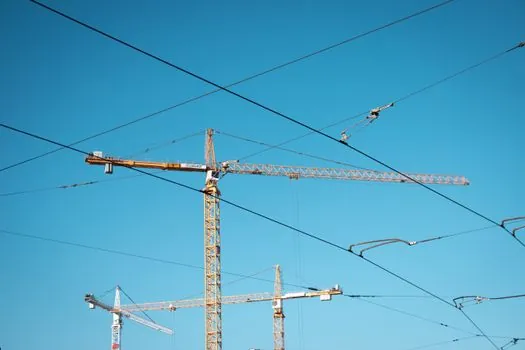
Both machines fall under the OSHA crane and hoist regulatory framework, and ANSI oversees the development of the underlying consensus standards (B30 series for cranes, A120.1 for powered platforms, A10.28 for construction hoists, among others) without writing them itself [S1]. For personnel hoists, the additional rule of thumb that operators and site safety professionals apply is the one stated in the insurance and legal literature: do not put people on a crane hook under any circumstance; once the hoist is operational, move all personnel onto it [S4].
On the engineering side, the spec checks that matter are: for the tower crane, the heaviest single pick and longest reach (these define the model and jib length), the wind envelope at the site, the jib clearance over adjacent structures, and whether a mobile assist crane can be staged for erection [S3]; for the construction hoist, the platform width and length, rated load (commonly 8,000 lb on modern material hoists), the number of landings, the available shaft or façade space, and whether a common-tower configuration is needed to consolidate multiple cars on a tight site [S1][S5]. The signal worth tracking into the next planning cycle is whether the spec calls for a luffing jib (tight urban site) or a hammerhead/flat-top (open site), since that single choice drives both the crane fleet and the hoist siting [S3].
Two trackable signals: (1) whether the project budget separates a dedicated material hoist from the personnel hoist, since vendors now publish direct throughput comparisons between the two for high-rise fit-out [S5]; (2) whether the crane supplier's engineering team is brought in before the hoist supplier, because the tower crane often erects the hoist's guide tower and that interface has to be coordinated early [S3][S4].
The underlying component specifications are covered under bucket elevator.
See also our earlier report, OSSD to Safety PLC: 2026 Wiring Rules for Light Curtains.