ABC dry chemical covers Classes A, B, and C, while BC dry chemical is rated only for Classes B and C [S5].
The comparison applies to portable dry-chemical extinguishers: Purple K uses fluidized, siliconized potassium bicarbonate for Class B and C fires, whereas ABC uses monoammonium phosphate for Class A, B, and C fires [S1][S2][S3].
Agent Chemistry and Fire Coverage
Purple K contains fluidized, siliconized potassium bicarbonate and is particularly effective against Class B flammable liquids [S2]. Class K extinguishers are a separate wet-chemical category intended for fires involving cooking oils and grease [S4].
ABC powder uses monoammonium phosphate and addresses Class A ordinary combustibles such as wood, paper, and trash, Class B flammable liquids, and Class C energized electrical fires [S4][S5]. The powder is corrosive and must be scrubbed from exposed surfaces after use [S4].
Class K cooking-oil and grease fires require a wet-chemical extinguisher based on potassium acetate, potassium carbonate, or potassium citrate, not Purple K [S4][S5]. Combustible-metal fires require a dedicated Class D powder; water and carbon dioxide can react violently with burning metals [S5].
Numerical Comparison of Portable Models
BC extinguishers are rated for Class B fires involving flammable liquids and Class C fires involving energized electrical equipment, without a Class A rating [S5].
The rating comparison shows why “Purple K versus regular ABC” is not a simple choice between a stronger and a weaker extinguisher. ABC dry chemical is suitable for Class A, B, and C fires, whereas BC dry chemical is rated only for Class B and C fires [S5].
Where Each Extinguisher Fits
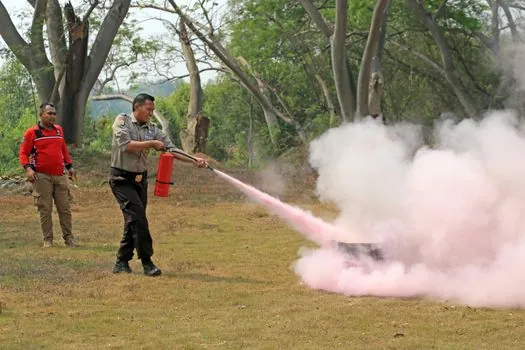
Select Purple K where flammable-liquid storage, dispensing, transfer, or spill hazards dominate and energized electrical equipment is also present. Suitable examples include petroleum products, oil-based paint, solvents, alcohol, tar, and flammable gases [S4]. A Purple K unit is also a reasonable portable complement to fixed suppression for hazardous-liquid work areas.
Select ABC where one unit must cover ordinary combustibles, flammable liquids, and electrical fires. ABC extinguishers are listed for use in offices, kitchens, garages, and vehicles, and are often found in schools and general office buildings [S4][S5]. An ABC extinguisher is the practical default for mixed hazards, provided its B rating is adequate for the expected liquid spill.
Neither portable powder type is the primary answer for Class D combustible-metal fires or Class K cooking-oil fires [S5]. These hazards need dedicated equipment, and fixed fire alarm control panel or suppression decisions should follow the hazard assessment rather than the extinguisher color.
Residue, Visibility, and Operating Constraints
Purple K is formulated for Class B performance rather than ordinary combustibles, and it is not a Class K agent despite its name [S4]. This naming point matters because a kitchen grease fire requires a wet-chemical agent, and misidentification can produce the wrong extinguishing method [S4][S5].
ABC powder leaves a corrosive monoammonium-phosphate residue that must be scrubbed from surfaces [S4]. That cleanup burden can influence selection around sensitive equipment, finished surfaces, vehicles, and production areas, although cleanup alone does not justify deleting the Class A rating from a mixed-hazard risk assessment.
Dry powder discharge is not appropriate for every space or hazard. Neither agent substitutes for a fixed suppression system designed for the protected enclosure, and neither is intended for combustible-metal or cooking-oil fires [S5]. For electronic equipment, evaluate the risk of discharge residue and the effect of obscuring vision during evacuation; a non-residue alternative can be compared separately in Halotron vs FM-200 for electronics fire protection.
Procurement and Rating Checks
Specify extinguishing capability by the model rating, not by the label “Purple K” or “ABC.” The site's extinguisher categories include sizes from 1.25 lb through 300 lb [S2].
For Purple K, confirm the listed B:C rating on the exact model and cylinder.
The selection record should identify the fire classes, physical extinguisher capacity, model number, agent type, listed rating, mounting location, and inspection or service program [S2][S3]. Training and signage remain part of the decision, because a correctly rated unit still depends on the operator identifying the fire class and deploying the correct agent [S3].
Decision Rules for Industrial Procurement
Use Purple K when the governing hazard is Class B liquids and no portable Class A coverage is needed, and use ABC when Class A combustibles are credible because ABC covers Classes A, B, and C [S5].
For a facility containing both ordinary combustibles and flammable liquids, specify the fire-protection basis of the design rather than replacing every ABC unit with Purple K. Many facilities need both agent types positioned by hazard, while fixed fire extinguisher equipment and suppression design must match the room, fuel, egress, and occupancy conditions.
The next procurement check is verifiable: obtain the exact model data label and listed rating, compare its A and B ratings against the site hazard inventory, and confirm that training covers the distinction between Class B, Class K, and Class D incidents [S3][S5].