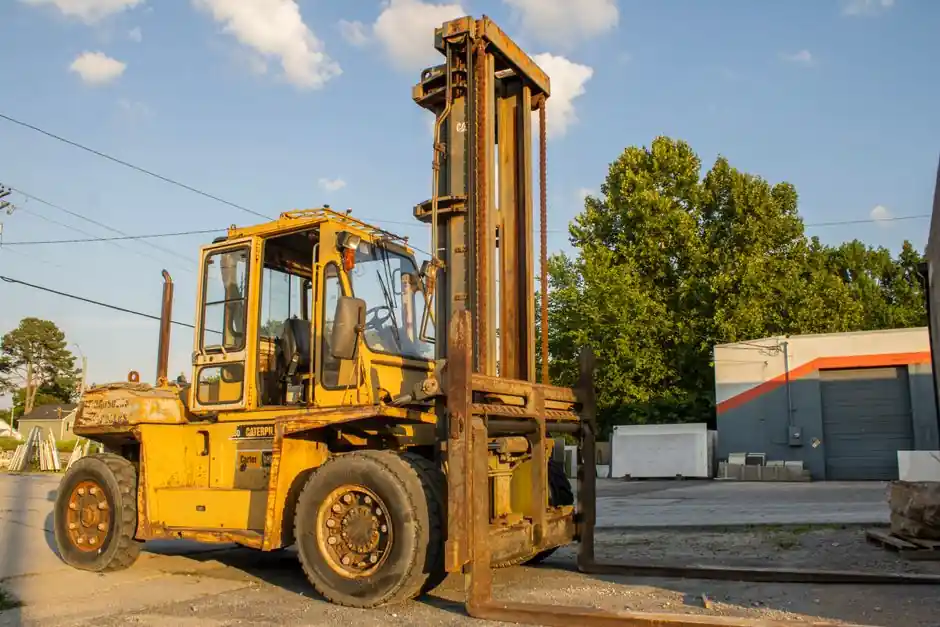
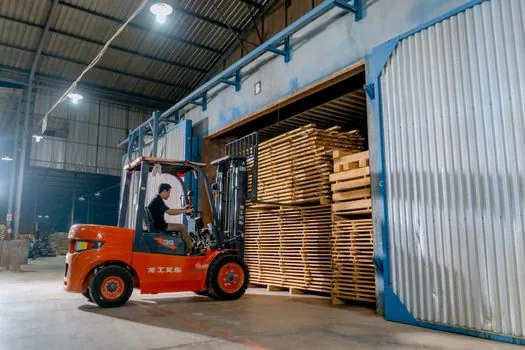
Forklift capacity is not a free pass to lift that weight in every setup. Manufacturer ratings are stated at a specific load center, usually 24 in from the face of the forks, and at a stated maximum lift height, so a 5,000 lb nameplate that is fine on a 48 in deep pallet can fail residual capacity on a long crate, at full mast height, or with a side shifter fitted [S3].
The 3,000 lb, 5,000 lb, and 15,000 lb bands sit in very different machine classes, and 3,000 lb trucks are usually electric cushion-tire riders, 5,000 lb is the sweet spot for general pneumatic and cushion IC trucks, and 15,000 lb is the entry of the heavy industrial and outdoor pneumatic range [S1][S4][S5]. Understanding how each class maps to load, environment, and cost prevents both over-spec and the more common under-spec that shows up three months after delivery.
The 3,000 lb Class: Electric, Indoor, Tight Footprint
The 3,000 lb class covers light indoor material handling on standard 48 in pallets, staging in narrow aisles, loading light delivery trucks, and occupied-building work where exhaust and noise are a problem [S5]. Most 3,000 lb rental units are electric, run on cushion tires for smooth concrete, and carry a lower overall machine height plus a tighter turning radius than 5,000 lb machines, which is why the class is the default for retail backrooms, event load-in, and small loading docks [S5].
Capacity is rated at 24 in load center, and on a uniform pallet the center of gravity sits near that 24 in mark, so the nameplate figure is a reliable planning number; move that center out with a long load, an attachment, or an offset stack, and effective lift drops below nameplate [S3]. The 3,000 lb class hits its ceiling fast on dense product: a standard pallet of concrete block, ceramic tile, bagged mortar, or steel hardware regularly weighs more than the truck can lift safely, which is the first reason buyers step up to 5,000 lb [S5].
The 5,000 lb Class: General Warehouse and Manufacturing Workhorse
A 5,000 lb capacity forklift is the default rating for general warehouse and manufacturing pallets, and the truck itself typically weighs 8,000–9,000 lb depending on fuel system, mast, and tire choice [S6]. The 5,000 lb nameplate covers most 48 in deep GMA pallets, standard drum handling, and typical 24 in load centers, which is why this class shows up in roughly every distribution center, parts warehouse, and light manufacturing dock [S3][S5].
Real residual capacity at 5,000 lb nameplate still depends on the data plate. A 5,000 lb @ 24 in truck is fine for standard pallets at low lift, but residual capacity can collapse on a long crate, at full 15–20 ft mast height, or once a side shifter or clamp is bolted on; the capacity plate, not the marketing sheet, governs the lift [S3]. Standard warehouse racking, common attachments like fork positioners, and seasonal peak SKUs all sit comfortably inside this class, which is why the 5,000 lb band is the highest-volume forklift sold and rented in North America.
The 15,000 lb Class: Steel, Lumber, and Outdoor Industrial Loads
Heavy duty forklifts handle loads from 15,000 lb up to 125,000 lb, and the 15,000 lb rating is the entry point of that heavy industrial range, covering lumber yards, steel service centers, concrete products, and large outdoor yards [S7]. Most 15,000 lb machines are Class V internal combustion pneumatic-tire trucks built for rough surfaces, with high-capacity IC pneumatic and reach-stacker container-handler variants sitting above them in the same class [S4].
For a 15,000 lb class truck, the load center stays at the same 24 in standard for uniform steel coils, but actual load centers on plate steel, rebar bundles, and oversized crates often exceed that, and the same nameplate-versus-residual rule applies at a larger scale; attachments and longer forks move the center out, and residual capacity falls off sharply above nameplate [S3][S7]. A typical heavy duty forklift for this range weighs roughly 25,000–30,000 lb, and the truck itself, plus the operator cab and counterweight, sets a much larger footprint than a 5,000 lb unit, which dictates aisle width, floor loading, and yard surface in the spec.
Side-by-Side Comparison: 3,000 lb vs 5,000 lb vs 15,000 lb
Three numbers matter when picking between the 3,000 lb, 5,000 lb, and 15,000 lb classes: typical load weight, environment, and the cost of being wrong. The table below lines them up on the criteria that actually drive a purchase or rental decision. [S3]
<strong>Typical load handled</strong>: 3,000 lb class handles light retail and warehouse pallets up to roughly 2,500 lb with margin; 5,000 lb class handles standard GMA pallets and most manufacturing units in the 3,000–4,500 lb band; 15,000 lb class handles steel coils, plate, lumber bundles, concrete products, and heavy industrial loads in the 10,000–14,000 lb working range [S3][S5][S7].
<strong>Power and tire</strong>: 3,000 lb is usually electric with cushion tires for smooth concrete; 5,000 lb is available in both electric cushion and IC cushion/pneumatic configurations for mixed indoor and outdoor use; 15,000 lb is predominantly IC pneumatic tire for rough terrain and outdoor yards [S1][S4][S5].
<strong>Typical machine weight</strong>: a standard 5,000 lb capacity forklift weighs 8,000–9,000 lb; a 3,000 lb electric rider comes in well under that, while 15,000 lb heavy duty units weigh roughly three times a 5,000 lb truck once counterweight and mast are included [S6][S7].
<strong>Environment fit</strong>: 3,000 lb for occupied buildings, narrow aisles, and event load-in; 5,000 lb for general warehouse, dock, and light manufacturing; 15,000 lb for lumber yards, steel yards, ports, and construction sites [S4][S5][S7].
<strong>Cost-of-error risk</strong>: over-rating a 3,000 lb truck on a dense pallet risks dropped loads and tip-overs; under-rating a 15,000 lb application with a 5,000 lb truck is the more dangerous failure mode, because operators compensate by lifting partially, side-loading, or running at speeds the truck was not designed for, and that is where stability-triangle margin disappears [S2][S3].
Selection Rules That Apply to All Three Classes

Three rules apply regardless of which capacity class you land on. First, size to the heaviest real load, including dunnage and seasonal peaks, and to the actual load center, which for non-uniform loads can run 36 in, 48 in, or more and cuts residual capacity well before nameplate weight is reached [S3]. Second, match mast class and free lift to the highest regularly used rack beam, because higher stacking reduces stability and the same 5,000 lb rating at dock height can be over capacity at 15–20 ft [S3]. Third, any permanent attachment such as a side shifter, clamp, rotator, or carpet pole requires an updated capacity plate that reflects the derated truck, and rental units should arrive with that plate already fitted [S3].
The same logic scales up: for a rough terrain forklift deployment in a lumber yard or port, capacity rating alone is not the spec to optimize, since tire type, ground clearance, and stability triangle on uneven ground are what decide whether a 15,000 lb nameplate is real-world usable. For indoor electric fleets, the forklift class boundaries and the measurement test procedures used to verify load weight and load center become the deciding data points once you are past the simple nameplate question.
Trackable Signals and Common Failure Modes
Two signals are worth watching as you size a 3,000, 5,000, or 15,000 lb purchase. First, attachment creep: a 5,000 lb truck that started life with forks and a side shifter often picks up a clamp, then a rotator, and the data plate is rarely re-issued, so field capacity drifts below nameplate without anyone noticing [S3]. Second, load-center drift in receiving: a yard that started handling uniform 48 in pallets starts receiving 60 in crates of steel stampings or 72 in crates of glass, and the same 5,000 lb nameplate now sits on a 36–48 in load center, which can cut effective lift by 30% or more before the operator feels anything wrong [S3][S5].
For 15,000 lb class trucks, the same checks apply at scale, plus tire and surface: pneumatic tires lose capacity on soft ground as the truck sinks, and a nameplate that is honest on concrete can be optimistic on compacted gravel, so the surface spec is part of the capacity spec. Across all three classes, OSHA stability-triangle rules and a current, attachment-aware capacity plate remain the legal floor; the 3,000, 5,000, and 15,000 lb numbers are only the start of that conversation, not the end of it [S2][S3].
This topic is covered further in Best Force Gauge for Food and Beverage: 2026 Spec-Anchored Selection.