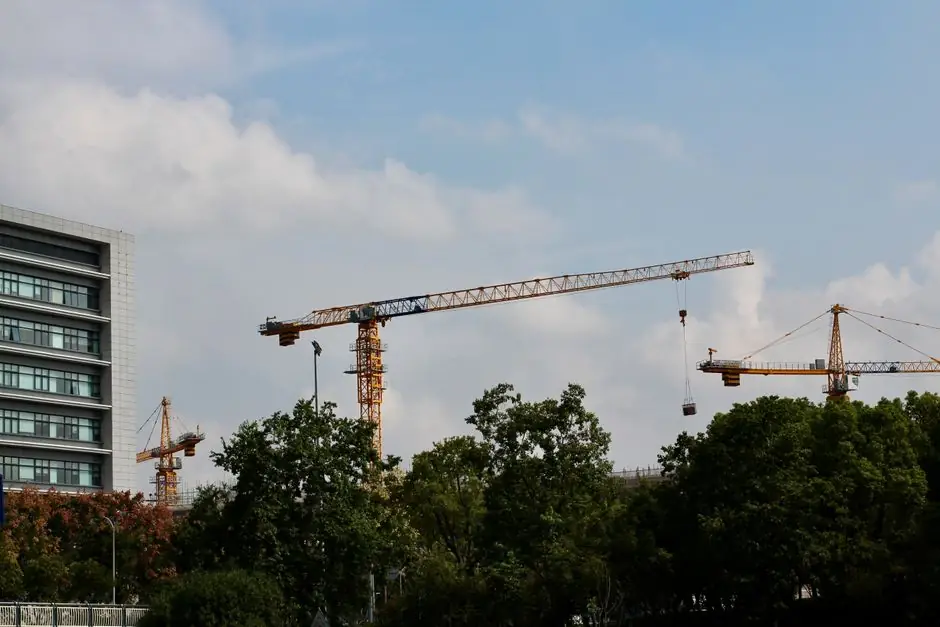
Tower cranes deployed along cross-country pipeline rights-of-way and at compressor/pump-station sites operate under a duty cycle that is harsher than typical high-rise work: long radius lifts of pipe segments, repeated trolley traverses, and exposure to weld-spatter, hydrocarbon residue, and sometimes marine-grade humidity if the spread ties into an LNG or offshore approach [S4][S5]. The legal floor is PUWER 1998 Regulation 5, which requires that work equipment be maintained in an efficient state, in efficient working order and in good repair, and HSE guidance L22 elaborates the expectation that maintenance frequency be increased when intensity, environment, or task variety exceed the OEM baseline [S4].
The performance envelope behind that duty is unforgiving: crane-related accidents are reported at 28.17% of all special-equipment incidents with a 27.54% fatality rate, and a large share is attributed to fatigue failure of load-bearing structural components, most often the lower chord of the jib, which simultaneously resists tensile lifting stress and serves as the rolling-contact track for the luffing trolley [S3]. On a pipeline spread, where crews may run 10 to 14 hours per day and cycle the same radius dozens of times per shift, that coupled load is the design point that drives the maintenance schedule.
Failure modes that drive the maintenance plan on a pipeline spread
The lower-chord fatigue/wear coupling identified in the 2026 MDPI framework is the headline structural risk: the Archard wear model combined with hybrid load spectra (dead weight, trolley weight, lifted pipe sections) shows that rolling-contact wear reduces section thickness and accelerates crack initiation under Type I/II combined stress fields typical of eccentric trolley loading [S3]. Acceptance practice in the field is to retire a jib section when visible wear depth exceeds OEM-issued limits or when magnetic-particle or ultrasonic testing reveals surface-breaking cracks longer than the threshold specified in the crane's maintenance manual.
Wire ropes remain the second dominant failure population. Weekly checks for broken wires, diameter reduction, and corrosion pitting are explicitly called out in industry best-practice guidance, alongside lubrication of all moving parts and functional testing of every safety device [S1].
Brake and limiter systems are the third. The torque limiter, maximum-load limiter, and hoist / slewing / travel limit switches are described as the crane operator's guardian angels, and verifying calibration, that sensors have not been bypassed, and that the anti-collision system still talks to neighbouring cranes on a multi-crane spread, is treated as the single most safety-critical step in any periodic inspection [S2]. On pipeline spreads, where two or three cranes frequently work in overlapping radii during stringing and lowering-in, an uncalibrated anti-collision zone is a documented precursor to collision incidents.
Frequency: daily, weekly, quarterly, and what the regulator expects
PUWER 1998 does not name calendar intervals; it sets the outcome (safe, efficient, in good repair) and leaves frequency to the OEM manual adjusted for site conditions [S4]. The Construction Plant-hire Association's TIN 021 lists the four mandatory adjustment factors: intensity of use, operating environment (corrosive or marine atmospheres shorten intervals), task variety, and risk profile of the location [S4]. A practical schedule derived from those factors, and consistent with the source material, is shown below.
Preventive vs. predictive: where the industry is moving

The shift from calendar-based preventive to condition-based predictive maintenance is the most consequential change in the sector. Modern tower cranes with onboard telemetry and IoT gateways record load cycles, attempted overloads, and per-motor operating hours, and the data lets the maintenance planner trigger a hoist-oil change or brake-pad inspection based on the actual duty the machine has seen rather than the OEM's generic hourly interval [S2]. The economic argument is Total Cost of Ownership: planned shutdowns of one to two hours are far cheaper than a five-day unplanned breakdown in the middle of a pipeline lowering-in window [S2].
For pipeline contractors running seasonal spreads, the practical hybrid is to keep a paper-based Planned Preventive Maintenance schedule as the regulatory baseline (it is what an HSE inspector will ask for) and overlay a predictive layer using the OEM telematics portal. When the two diverge, the more conservative interval wins. On sites without telematics, the same effect can be obtained by logging cycle counts on a manual tally tied to the operator's shift sheet and feeding that into the planner's spreadsheet [S2][S4].
Environmental stressors specific to pipeline and marine-adjacent lifts
Pipeline rights-of-way often cross terrain that accelerates corrosion: salt-laden air near coastal approaches, sour-gas service where H2S exposure is possible, and abrasive dust along desert or rock-trench spreads. The CPA guidance explicitly identifies working in or near marine environments and corrosive atmospheres as a factor that must increase maintenance frequency, and the broader industry guidance on marine-construction cranes reinforces the need for more aggressive inspection intervals and more frequent part replacement in those conditions [S4][S5].
In practical terms this means shorter wash-down cycles after every shift when working near saltwater, dedicated NDT windows every quarter instead of every six months on the jib lower chord, and grease specifications upgraded to marine-grade EP2 with increased re-lubrication frequency. A field rule of thumb consistent with the source material is to halve the calendar interval of every corrosion-sensitive task when the crane is within roughly 1 km of breaking surf or operating over sour-gas pipe sections [S4][S5]. For a deeper look at selection trade-offs in adjacent heavy-lift applications, the quarry crawler crane spec breakdown covers load-chart and ground-pressure logic that translates directly to pipe-yard duty.
Who does the work, who carries the legal exposure

Under PUWER and the Health and Safety at Work etc. Act 1974, the user of the crane on site retains the legal responsibility for ensuring that maintenance is carried out, even when the actual wrench-turning is delegated to the crane owner through a hire contract [S4]. On a pipeline spread this matters: the spread contractor is usually the user, the crane may be hired from a regional depot, and the OEM's own service interval is the floor, not the ceiling. Clear lines of responsibility from board level down to the on-site mechanic are required, and appointed persons must have sufficient knowledge and experience for the risks involved [S4].
The crane operator sits at the front of the line despite not being the appointed maintenance engineer. A pre-shift verification protocol (visual and functional checks of hooks, slings, limit-switch lamps, hydraulic leaks, unusual noise) is the daily safety net that catches what a quarterly inspection will miss if the fault develops between visits [S2]. NCCCO (or equivalent national) certification is the standard baseline for operator competence on North American sites, and most European contracts require CPCS or an equivalent [S1].
Comparison: preventive vs. predictive vs. breakdown on a pipeline spread
Three maintenance philosophies are in active use; the right choice depends on fleet size, telematics fit, and risk appetite. [S3]
When to repair, when to escalate, and what to do with the data

Repair in the field is appropriate for consumable replacement (rope, brake pads, shear pins, contactors, lamps) and for adjustments within the OEM maintenance manual. Escalation to a contracted service engineer is required for LMI re-calibration, slew-bearing bolt torque verification, slewing-ring raceway inspection, and any NDT that returns an indication above the acceptance class [S2][S3]. Replacement of the jib lower-chord section, the slewing ring, or the hoist gearbox is a structural decision that should be approved by a competent person with the original fatigue assessment on file, not by the on-site mechanic alone [S3].
The closing data discipline is to keep one document per crane: PPM schedule, deviation log, telematics exports, LMI calibration certificates, rope discard records, and structural NDT reports. When an inspector or auditor asks to see the maintenance evidence, that single binder (or its digital equivalent) is the answer. For adjacent reliability topics, the shotcrete machine maintenance field guide applies a similar acceptance-criteria framework to a different piece of pipeline-adjacent plant, and the underlying construction machinery and equipment reference grounds the terminology used across this article. A broader process view of how cranes fit into pipeline-side construction tooling sits under the construction tools overview, while the structural and load-chart primitives in scope here are catalogued on the tower crane reference page.