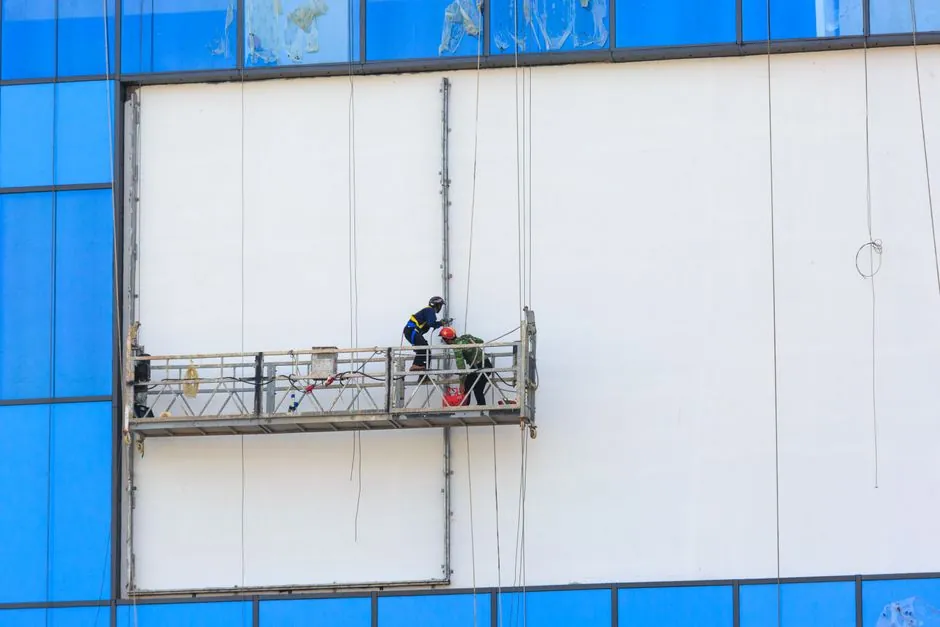
Aerial work platforms (AWPs) on U.S. job sites must comply with OSHA 29 CFR 1926.453 (construction) and 29 CFR 1910.67 (general industry), with the ANSI/SIA A92.2, A92.3, A92.5, and A92.6 series cited as the underlying equipment design standards [S1]. Both rule sets require that only trained workers in general industry and authorized workers in construction operate an aerial work platform.
NIOSH data cited by industry training material records 1,380 worker incidents on elevated aerial-lift equipment between 2011 and 2014, driven by falls, tip-overs, and electrocution from overhead power lines [S5]. That incident base is the reason a boom lift or scissor lift cannot be used as an ad-hoc crane, on a slope beyond its rated limit, or without fall protection.
Which Standards Apply and What Equipment Is in Scope
OSHA defines an aerial lift as any vehicle-mounted device used to elevate personnel, and the rule covers extendable boom platforms, aerial ladders, articulating (jointed) boom platforms, vertical towers, and any combination of these, whether or not the unit can rotate around a vertical axis [S1]. The same rule applies to platforms made of metal, fiberglass-reinforced plastic, or other materials, and to powered or manually operated units [S1].
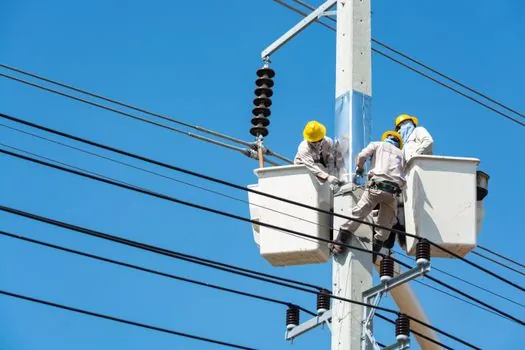
For construction sites the binding OSHA sections are 1926.20(b) (accident prevention), 1926.21 (safety training), and 1926.453 (aerial lifts); for general industry the binding sections are 1910.67 (vehicle-mounted elevating and rotating work platforms) and 1910.333(c)(3) on work near overhead lines [S1]. The 29 CFR 1910.333 / 1926 Subpart K electrical sections matter because the listed hazards include electrocution from contact with energized lines, one of the leading fatal classes in the NIOSH dataset [S1][S5].
Pre-Shift Inspection and Tilt / Level Limits
OSHA-aligned safe operating procedure requires a pre-shift visual and functional inspection by the operator, with any defect locked out and repaired before elevation [S2]. The platform may only be raised on a firm, level surface, and most rough-terrain units are designed to operate at no more than 5 degrees out of level, which equals roughly 10 inches of rise across a 10 foot wheel span, with a mandatory tilt alarm that activates past 5 degrees [S2].
Outriggers and stabilizers required for the specific aerial work platform must be deployed, the worksite swept for debris, and the unit never stabilized against another building or object [S2]. Refueling is permitted only with the engine off, and battery charging must take place in a well-ventilated area away from open flame [S2]. These are not advisory items, they are the load-bearing controls behind the 1,380-incident NIOSH count [S5].
Fall Protection, Guardrails, and Body Belt Plus Lanyard
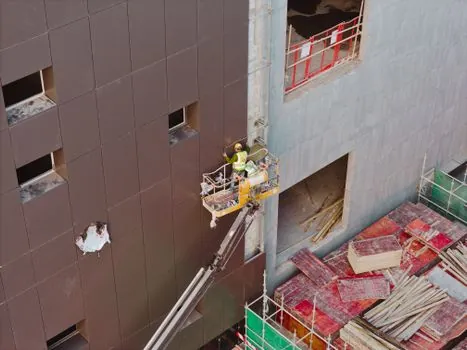
OSHA requires guardrails on scissor lifts, and operators must close the lift-platform chains, bars, or gates and verify the guardrails before raising the unit [S7]. The historical fall-protection rule, still cited in OSHA training guidance, states: "A body belt shall be worn and a lanyard attached to the boom or basket when working from an aerial lift" [S8].
Operator conduct inside the platform is tightly constrained: stand firmly on the platform floor, do not climb on or lean over guardrails or handrails, do not use planks, ladders, or other devices to gain extra height, and do not step on guardrails or gate rungs [S1][S3][S5]. A fall limiter is preferred over a fixed-length lanyard where the working envelope allows it, because it limits free-fall distance if the operator is ejected [S2].
Hazards on the Platform: Falling Objects, Welding, and Horizontal Forces
The OSHA-listed hazard catalogue for aerial lifts includes fall from elevated level, objects falling from lifts, tip-overs, ejections from the platform, structural failures (collapses), electric shock, entanglement, contact with objects, and contact with ceilings or other overhead objects [S1]. Each maps directly to a procedural control: capacity plates and load stowage for tip-overs, tethering of small tools and hardware for falling objects, and overhead sweep before driving or elevating for the contact and electrocution classes [S2][S6].
Two task-specific rules deserve callout. First, if welding is performed while the unit is on an aerial lift, do not use the platform as the return path, the platform itself must not be energized [S4]. Second, avoid horizontal forces from work tasks that could cause the platform to sway and become unstable, which is the failure mode that produces most ejections in the NIOSH data [S4][S5]. Loose objects on the work surface must be cleared, and any small tools or hardware must be secured to prevent falling-object injuries to personnel below [S6].
Weather, Surface, and Environmental Cut-Outs
Aerial platforms are not for use outside in bad weather or high winds, and operators must not raise the platform on surfaces that are soft, uneven, or sloping beyond the machine's rated limit [S2][S3]. Manufacturer manuals stay on the machine, the rated capacity plate must be respected, and load weights plus any tooling must be within the published envelope for stability calculations to hold [S2].
Night or low-light work needs proper area lighting, and slippery ground, lightning, and rain are documented cut-out conditions on every OEM safety page reviewed [S3][S5]. In practice, the same 5 degree tilt alarm that protects against a slow slope also protects against a surface that has been softened by rain, so the two controls are inseparable on a real site [S2].
Training, Authorization, and Who Must NOT Operate
OSHA is explicit: only trained workers in general industry and authorized workers in construction may operate an aerial lift, and the employer must verify that each operator can run the specific model [S1]. A qualified instructor must confirm the operator has read and understood the equipment's safety and operating instructions, including all warning decals and labels mounted on the machine [S2].
Specialized training is required per model, not just per "aerial lift" as a category, because the controls, capacity, and outrigger logic differ between a vertical-tower scissor lift, an articulating boom, and a telescoping boom [S2]. An untrained or unauthorized worker is a documented incident vector in the NIOSH sample, and the same rule set that requires training also requires that workers show they can use the lift properly before solo operation [S1][S5].
Comparison of Common AWP Types Against Decision Criteria

Selection on a real site is a four-axis decision: working height, outreach, indoor/outdoor duty, and surface tolerance. Telescoping and articulating booms cover the 12-40 m working height range and add horizontal outreach, but require the strictest outrigger discipline [S1][S2]. Scissor lifts give a larger platform area at the cost of outreach, and are the only type where OSHA explicitly mandates guardrails as the primary fall control [S7].
Vertical towers and low-level scissor lifts are the indoor default on slab floors, while rough-terrain scissor lifts and boom lifts absorb uneven ground up to the 5 degree limit with a required tilt alarm [S2][S3]. For welding or hot-work tasks, none of these platforms may be used as the electrical return path, and any task that imposes sustained horizontal force on the platform must be re-engineered, because it directly drives the sway-to-ejection failure mode [S4][S5].
For procurement, the same construction equipment category page that lists AWPs also surfaces related safety gear such as harnesses, lanyards, and platform lighting, which keeps the PPE and the machine on the same specification sheet during bid review. Trackable signals to watch over the next planning cycle: any update to ANSI A92.22 (training) and A92.24 (operator qualification) referenced by OSHA, and any new NIOSH aerial-lift fatal-incident summary covering 2022-2025 data.