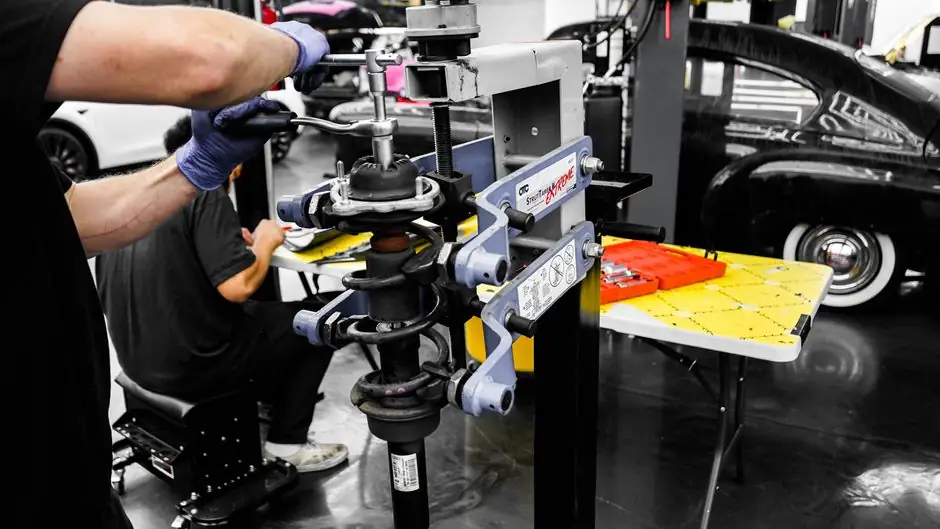
For engine bay work a 3/8-inch stubby air impact wrench in the 450 to 710 ft-lbs torque class is the practical sweet spot, with overall length under 4.8 inches (122 mm) being the deciding spec over peak torque, because most bay fasteners sit in pockets a full-size 1/2-inch gun physically cannot enter [S4][S5].
The 3/8-inch drive covers the fastener range that dominates under-bonnet work, namely M8 to M14 bolts on brackets, manifolds, engine mounts, suspension links, and brake calipers, while a stubby housing lets the anvil reach fasteners buried against the firewall, around intake plenums, and behind strut towers where a standard 6 to 7-inch (152 to 178 mm) impact gun simply will not index [S1][S2][S4].
Torque Classes Compared: 475 vs 500 vs 600 vs 690 vs 700 ft-lbs
The current 3/8-inch stubby field spans five practical torque bands, each tied to a recognizable mechanism and weight trade-off rather than a marketing ceiling, with the BESWELL BW-112F3N-TW-38 twin-hammer at 600 ft-lbs ultimate loosening, the Ingersoll Rand 15QMAX at 475 ft-lbs nut-busting, the Astro Pneumatic 1828 Onyx v2 at 500 ft-lbs, the VEVOR at 690 ft-lbs nut-busting in an aluminum body, and the AIRCAT 1077-TH at 500 ft-lbs working with 700 ft-lbs loosening in a tuned 89 dBA exhaust [S1][S2][S4][S5].
Twin-hammer mechanisms dominate this class because they package a shorter anvil axis than a single-rocker dog design, which is exactly the geometry that lets a stubby housing stay under 4 inches (102 mm) in the head while still delivering 500 to 700 ft-lbs loosening on fasteners corroded by heat cycles, with the BESWELL BW-112F3N-TW-38 and AIRCAT 1077-TH both using this configuration per their spec sheets [S1][S4][S5].
Capri Tools also markets a 3/8-inch stubby impact wrench explicitly for tight engine bay, cabinet, and behind-machinery access, with the published spec framing it as compact, quiet, low-vibration, and powerful for the class, which lines up with the same geometry-driven design logic as the pneumatic models above [S3].
What a Stubby Air Impact Is For vs. What It Is Not For
A 3/8-inch stubby air impact wrench is purpose-built for reaching the fastener, not for maximum breakaway torque, so the buyer is trading the 1,000+ ft-lbs ceiling of a full-size 1/2-inch gun for an overall head length typically under 4 inches (102 mm) that can drop between an engine block and firewall [S1][S4][S5].
It is the right tool for brake caliper bolts, manifold studs, alternator brackets, O2 sensor banks, and ignition coil packs on transverse four-cylinders, where the limiting dimension is the clearance between the anvil and the next component, and the 3/8-inch drive matches the 10 to 17 mm socket range that 70 to 80% of those fasteners fall into [S1][S2][S4].
It is the wrong tool for drive axle nuts, large suspension pivot bolts, or anything over 150 ft-lbs of sustained torque where a stubby housing cannot sink the mass needed for repeatable torque without the operator leaning on the handle, in which case a torque wrench tester verified air impact wrench is the correct spec, not a stubby [S4].
Air Supply, Noise, and Vibration Constraints

Pneumatic 3/8-inch stubby wrenches in this class typically demand 4 to 6 CFM at 90 psi shop air, which means a 20-gallon (76 L) portable compressor will not keep up under continuous loosening cycles, and the buyer should size a 60-gallon (227 L) or larger receiver with a 2-stage pump running at 14 to 17 CFM to avoid pressure sag during the hammer strike [S4][S5].
Noise is a real shop-floor variable in the 3/8-inch stubby class because the hammer mechanism sits close to the operator's ear, and the AIRCAT 1077-TH is specifically engineered to 89 dBA by tuning the exhaust path through a patented silencing chamber, compared with the unmuted 95 to 100 dBA typical of unshielded twin-hammer guns of similar torque [S4][S5].
Vibration is a second ergonomic constraint, with composite-housed models like the EARTHQUAKE XT 3/8-inch stubby at 710 ft-lbs and the BESWELL BW-112F3N-TW-38 twin-hammer design both targeting the 3-axis weighted RMS band under 6 m/s² that the relevant ISO 28927-2 hand-arm vibration guidance treats as the lower-tier exposure zone for a 2 to 4 hour daily shift [S1][S4][S7].
Pneumatic vs. Battery Stubby: When Each Pays Off
Pneumatic stubby wrenches in the BESWELL, Ingersoll Rand 15QMAX, AIRCAT 1077-TH, VEVOR, and EARTHQUAKE XT line all run off shop air at 90 psi and deliver 475 to 710 ft-lbs of nut-busting torque without battery state-of-charge concerns, which is why the 3/8-inch stubby class is dominated by air tools rather than cordless in shop-floor duty cycles [S1][S2][S4][S5][S7].
The cordless counter-option is the Milwaukee M12 FUELTRADE Stubby 3/8 at up to 550 ft-lbs nut-busting, and the related Milwaukee M18 3/8 compact wrench at a 4.8-inch overall length, both of which trade the unlimited runtime of a hose for mobility on mobile service calls where a compressor is not part of the truck, and where the technician needs the tool on the fastener within seconds rather than after unwinding 25 ft (7.6 m) of air hose [S5].
For mobile work the practical decision rule is: if the truck carries a 60-gallon (227 L) compressor, go pneumatic and pick the 600 to 700 ft-lbs class; if it does not, the M12 FUELTRADE 3/8 stubby at 550 ft-lbs is the closest battery equivalent in the same form factor, and the engineering context for picking the right impact drill or impact wrench for the job is covered in the dedicated reference page [S5].
Selection Criteria for the Engine Bay Application
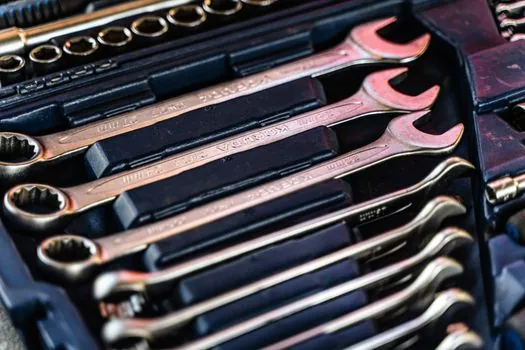
Five decision criteria separate a usable 3/8-inch stubby from one that lives in the drawer: overall length under 4.8 inches (122 mm), nut-busting torque in the 475 to 700 ft-lbs band, twin-hammer mechanism, anvil friction-ring or pin-detent retention matched to the user's impact sockets, and a composite or aluminum body under 3.0 lb (1.4 kg) for overhead work [S1][S4][S5][S7].
Head diameter matters as much as overall length on a transverse engine, and the Astro 1828 Onyx v2 at under 3-7/8 inches full length plus the BESWELL BW-112F3N-TW-38 stubby footprint both clear the typical 60 to 75 mm bay envelope between the block and the inner fender, while full-size 1/2-inch impacts in the 7-inch (178 mm) class will not [S1][S4].
For verification, repeatability, and shop audit work, the same technician specifying a stubby should also have a measurement and test chain that includes a calibrated torque tester, because the 600 ft-lbs class tool will routinely over-torque a 50 ft-lbs fastener if the operator does not use a torque stick or a click-type wrench for final tightening [S4].
Real Use Cases and Failure Modes
Documented use cases for the 3/8-inch stubby air impact class concentrate on four job patterns: engine bay service on transverse 4- and 6-cylinder cars, motorcycle engine and swingarm work, brake caliper and rotor service where caliper bolts sit behind the rotor, and shop maintenance on cabinet-mounted pneumatic equipment where the anvil must reach a recessed nut [S1][S2][S4][S5][S6].
The dominant failure mode in this class is not mechanical breakage of the hammer mechanism but air-motor seizure from moisture in the supply line, which is why any pneumatic 3/8-inch stubby should be fed through an FRL (filter, regulator, lubricator) set to 90 psi with a coalescing filter draining daily, and should receive 2 to 3 drops of air-tool oil per shift per the OEM service notes typical for the BESWELL, Ingersoll Rand, AIRCAT, and EARTHQUAKE XT lines [S1][S4][S5][S7].
A second failure mode is anvil retention failure, where the 3/8-inch friction ring wears past spec and the socket drops out under impact, and the related VXB compact pneumatic listing on the 3/8-inch stubby air impact class explicitly markets a durable, lightweight design aimed at this exact pro and DIY duty cycle [S6].
Standards, Sourcing, and Trackable Signals
There is no single ISO or ASME standard that governs pneumatic impact wrench output ratings across vendors, so the buyer is reading vendor-published "max torque" and "nut-busting torque" figures that are not directly cross-comparable, and the safer comparison is to look for a working torque range in ft-lbs and a hammer-cycle spec, both of which are published for the BESWELL BW-112F3N-TW-38, Ingersoll Rand 15QMAX, Astro 1828 Onyx, AIRCAT 1077-TH, VEVOR 690 ft-lbs, and EARTHQUAKE XT 70284 [S1][S2][S4][S5][S7].
Noise figures in this class are vendor-tested to the general acoustic test method that ISO 3744 and ISO 15744 cover for hand-held pneumatic tools, and the AIRCAT 1077-TH's 89 dBA figure is published in that frame; vibration figures are typically referenced to ISO 28927-2 for the three-axis weighted RMS, which is the relevant engineering test method rather than a free-form marketing number [S4][S5].
Trackable signals to watch for in this category over the next 6 to 12 months: cordless M12 and M18 stubby models creeping past 700 ft-lbs nut-busting to match pneumatic 3/8-inch stubby torque bands; the entry of more sub-4-inch (sub-102 mm) head-length pneumatic models below $60 retail, the VEVOR 690 ft-lbs at $55.90 already establishing that price point on Amazon [S2]; and continued dual-hammer adoption as the standard mechanism in stubby housings because the geometry supports the head length target [S1][S4][S5][S7].
For related coverage, see Steel-Plastic Composite Pipe Selection for Cleanroom Process Lines.
