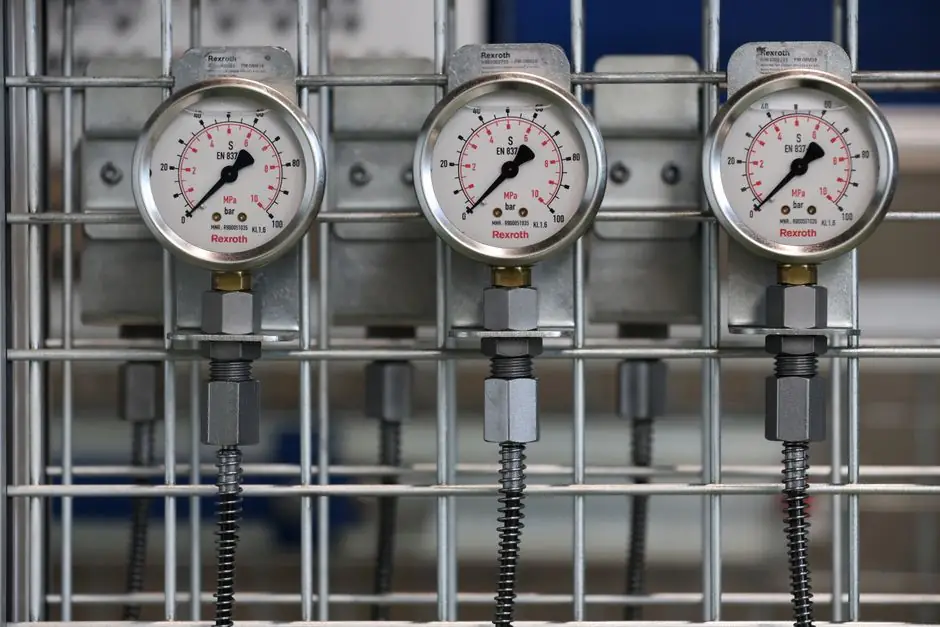
Switching a 200 bar inert gas cylinder fleet to 300 bar stores more gas per vessel at the same water capacity, which reduces the number of cylinders and the gas cylinder storage footprint needed for a given duty [S1].
The same volume argument works in reverse: to deliver identical gas, a 300 bar vessel can be physically smaller than a 200 bar vessel, freeing up racking and handling area in plants with constrained plant rooms [S1]. Material limits, not pressure-rating, drive the choice: aluminium cylinders cap near 200 bar (2900 psi), so any 300 bar inert gas service requires composite or high-strength steel construction [S4].
Pressure classes, materials and the 50% volume rule
Inergen (IG-541) cylinder labels are colour-coded by pressure, with 200 bar marked yellow or black and 300 bar marked green or black, a quick visual cue for gas cabinet inventory control [S5].
Material is the hard constraint. Aluminium alloys used for standard gas cylinders yield above roughly 200 bar (2900 psi), and 300 bar ratings require either quenched and tempered chromium-molybdenum steel or a full composite wrap over a polymer liner [S4]. ADR (the European Agreement concerning the International Carriage of Dangerous Goods by Road) sets the relationship between test pressure and working pressure, with the test pressure consistently higher than the service pressure to verify vessel integrity under elevated stress [S1].
Footprint math: fewer cylinders, less handling, lower test cost
For a fixed gas demand, 300 bar service cuts the cylinder count by 33% compared with 200 bar, which the OEM Ikaros attributes to the higher mass per vessel and the resulting reduction in changeover events [S1]. Translated into floor area, three 200 bar cylinders in a storage cage collapse to two 300 bar cylinders of the same water volume, a one-third reduction in the linear metres of cylinder rack required. Ikaros also reports a maintenance cost reduction of up to 33% on retest, repaint and valve-replacement lines, because fewer cylinders cycle through periodic inspection [S1].
Handling weight does not scale down linearly. A standard 12 L aluminium diving cylinder at 200 bar weighs about 14 kg; the same volume rated for 300 bar weighs about 17 kg, roughly 21% heavier, due to thicker walls needed for the higher test pressure [S2]. Plan storage and handling layouts with that mass penalty in mind: 300 bar cylinders concentrate more gas but more kilograms per footprint square metre, which matters for floor loading and crane ratings.
Downstream and supply-side constraints
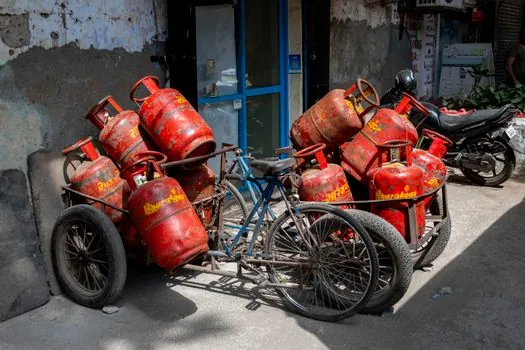
First-stage regulators on DIN-type cylinder valves are widely rated for 300 bar inlet pressure, so the breathing-gas side of the problem is largely solved; the bottleneck is the fill supply chain [S2]. Portable and small-shop compressors typically cannot push a cylinder to 300 bar, which is why 200 bar remains the default for remote or low-volume sites and 300 bar is feasible only where bulk high-pressure compressors or cascade banks are available [S2].
Label discipline, valve selection and piping class must follow the rated pressure. Cylinder body labels for Inergen systems explicitly differentiate the two classes with yellow/black (200 bar) versus green/black (300 bar) markings, and valves with integrated pressure reducers (VIPRs) are typically ordered for the specific working pressure rather than being field-swapped [S1][S5]. For a 33% footprint gain, the specifier must confirm compressor capability, regulator inlet rating, and the test-pressure ratio required by ADR for the chosen cylinder design before committing to a 300 bar fleet.
Decision matrix: pick by site conditions
Choose 300 bar when: plant room area is constrained, the site has a high-pressure compressor or manifold, cylinder count is the dominant maintenance cost, and the operating discipline accepts composite/Chromoly steel cylinders. Choose 200 bar when: fill supply is limited to portable compressors, cylinder mass and ease of manual handling dominate, aluminium vessels are mandated, or the user base is small and changeover frequency is low [S1][S2][S4]. For a related material trade-off in rotating equipment, see the 0.27 mm vs 0.35 mm NGO steel lamination comparison.