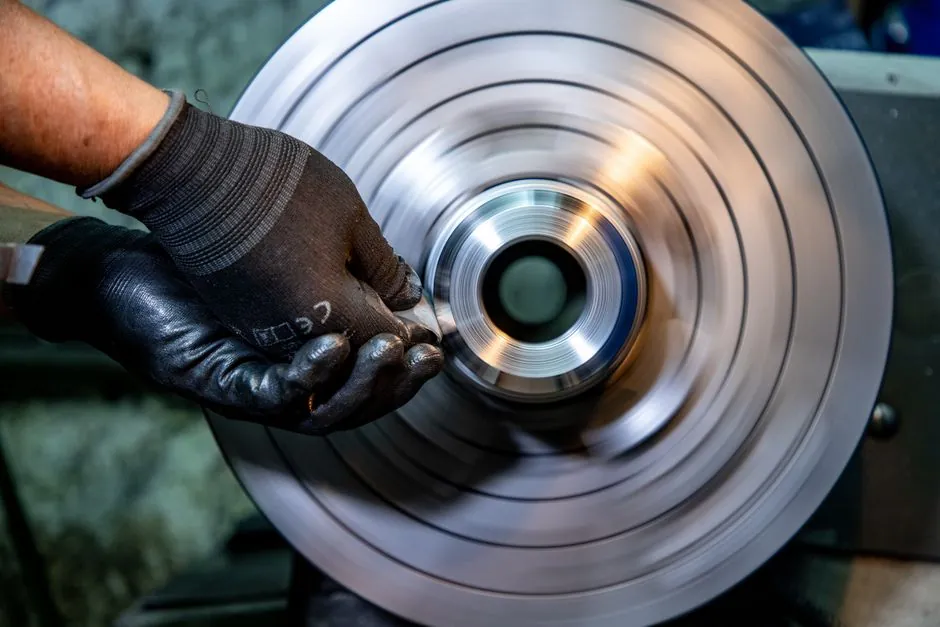
Type 303 is a sulfur-modified variant of 304 austenitic stainless, engineered specifically for free-machining, while 304 remains the general-purpose alloy with better corrosion resistance and full weldability [S1][S2].
The trade-off is mechanical and electrochemical: 303 gains roughly 30+ MPa in tensile strength over 304 (620 MPa vs 586 MPa per typical supplier data) but loses chloride pitting resistance and is generally considered unweldable in standard practice [S4][S1]. For shops choosing between the two, the decision is driven by production volume, machining equipment, and service environment, not by raw mechanical strength alone.
Composition and How Sulfur Changes the Alloy
304 stainless contains a minimum of 18% chromium and 8% nickel, the so-called 18/8 chemistry, with low carbon (typically 0.08% max) for weldability [S4]. 303 keeps the same Cr-Ni austenitic base but adds a minimum of 0.15% sulfur (or selenium in the 303Se variant) to introduce manganese-sulfide inclusions that fracture chips during cutting [S4][S2].
Those MnS inclusions are the entire reason for the grade: they act as stress concentrators and chip-breakers, which is why 303 produces short, broken chips instead of the long, stringy chips that 304 is notorious for on Swiss-type and CNC lathes [S2]. The same inclusions, however, become initiation sites for pitting corrosion in chloride-bearing media, which is the root cause of 303's lower corrosion rating relative to 304 [S3][S1]. A 303Se variant uses selenium in place of sulfur for similar machinability with slightly better surface finish, but it is rarely produced today [S2].
Mechanical Properties Side by Side
Both grades share austenitic (non-magnetic in the annealed condition) structure, similar density (~8.0 g/cm³), modulus of elasticity (~193 GPa), and identical yield strength of 241 MPa (35,000 psi) per common supplier tabulations [S4]. The notable divergence is in ultimate tensile strength: 303 is rated at 620 MPa (90,000 psi) versus 304 at 586 MPa (85,000 psi), a roughly 6% advantage for 303 [S4].
Hardness differs slightly as well, with 303 at Rockwell B84 and 304 at Rockwell B80 in the annealed condition [S4]. Elongation and formability, however, favor 304: 303 has lower yield-to-tensile spread and reduced ductility because the sulfide inclusions disrupt the matrix, so 304 is the better choice for deep drawing, spinning, and severe forming [S2]. Neither grade can be hardened by heat treatment; both respond only to cold working [S1].
Machinability: Where 303 Earns Its Premium

303 is described by multiple sources as the most machinable austenitic stainless, and in shop-floor terms that means shorter cycle times, longer tool life, and better surface finish on turned parts [S1][S3]. The MnS inclusions let chips break cleanly rather than wrapping the tool, which directly addresses the built-up edge problem that plagues 304 [S2].
304, by contrast, work-hardens rapidly, especially under light cuts and slow feeds, demanding rigid tooling, positive feed, lower cutting speeds, chip breakers, and abundant coolant to keep the tool cutting below the work-hardened layer [S2][S5]. For a high-volume CNC screw-machine or Swiss turning job producing thousands of identical parts, 303 typically pays back its higher per-pound cost through faster cycle times and fewer tool changes. For prototype or low-volume work, the cost premium for 303 rarely justifies the gain. The MISUMI 300-series comparison puts 303's use case as bushings, bearings, nuts, and bolts, where tight tolerances and high machining throughput matter more than corrosion margin [S4].
Corrosion Resistance and Weldability: Where 304 Wins Back
304 has demonstrably better corrosion resistance because the absence of sulfur keeps the passive chromium oxide layer continuous, giving 304 the edge in chloride-bearing environments, food contact, chemical handling, and architectural exposure [S1][S3]. 303 still qualifies as corrosion resistant in mild atmospheric and freshwater service, but the MnS stringers act as pitting initiation sites in warm chloride solutions, so it is not the right pick for marine, de-icing salt, or bleach exposure [S1].
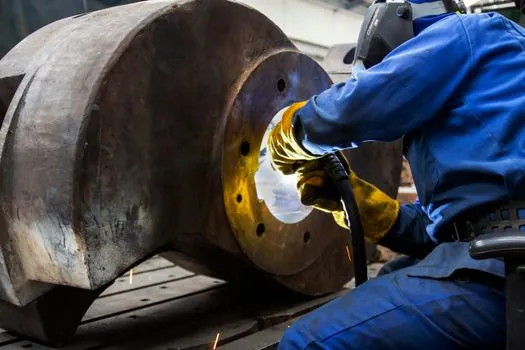
Weldability is the cleanest separator: 304 is readily weldable by all common processes (TIG, MIG, resistance) without cracking, while 303 is for practical purposes considered unweldable because the sulfur content causes hot cracking in the heat-affected zone [S1][S2]. If the finished part requires any post-machining welding, a fitting boss, or a braze joint, 304 (or 304L for heavier sections) is the correct specification, not 303. The same logic rules out 303 for any fabrication that subsequently passes through a heat-affected process.
Application Decision Matrix
The decision breaks down cleanly on four criteria: machining volume, corrosion exposure, welding requirement, and cost [S1][S3][S4].
Pick 303 when the part is a high-volume turned component (screws, nuts, bolts, bushings, aircraft fittings, gears, electrical hardware), runs on automatic screw machines or Swiss lathes, will not be welded after machining, and operates in a non-chloride environment. Pick 304 when the part or assembly will be welded, exposed to chlorides, acids, food contact, or sanitary washdown, needs deep drawing or forming, or runs in low volume where the 303 cycle-time advantage does not pay back the per-pound premium [S1][S3][S4]. For reference, our broader stainless-grade selection context, including the related 18/8 vs 18/10 chemistry question, is covered in 18/8 vs 18/10 stainless composition and spec choice. The ductwork and ducting comparison in single wall vs double wall stainless spiral duct construction is another place where 304's weldability versus cost often drives the call.
Limitations and Failure Modes to Watch
The most common 303 misapplication is specifying it for a marine, pool, or chemical-duty fastener, where the MnS inclusions pit through within months and the part fails by SCC or crevice corrosion in chloride media [S1][S3]. The most common 304 misapplication is high-volume screw-machine production, where the work-hardening behavior burns through carbide tools and pushes cycle times beyond economic range, and a switch to 303 would have cut tooling cost by half [S2][S5].
Neither grade is magnetic in the annealed condition, so a magnet test cannot distinguish 303 from 304, a frequent point of confusion at incoming inspection; the reliable field test is a positive sulfur print, since only the free-machining grade will give a strong sulfur response [S6]. If corrosion resistance and free-machining are both required, the correct escalation is 316 (which adds 2% molybdenum for chloride resistance) rather than 303, accepting that 316 is slower to machine than 304 [S4]. For more on the material trade-off when chlorides enter the picture, see our stainless steel grade reference and the related stainless pipe selection notes.
Trackable signals for buyers: (1) request the mill test report and confirm S or Se content is at or above 0.15% when 303 is specified, since some lots are dual-certified 303/304 and behave like 304 in service; (2) verify post-machining weld procedures are absent before locking in 303 for any subassembly; (3) watch for switch recommendations to 303Se if surface finish requirements tighten, though availability remains limited [S2].
Spec-level background on the components involved: pressure transmitter.