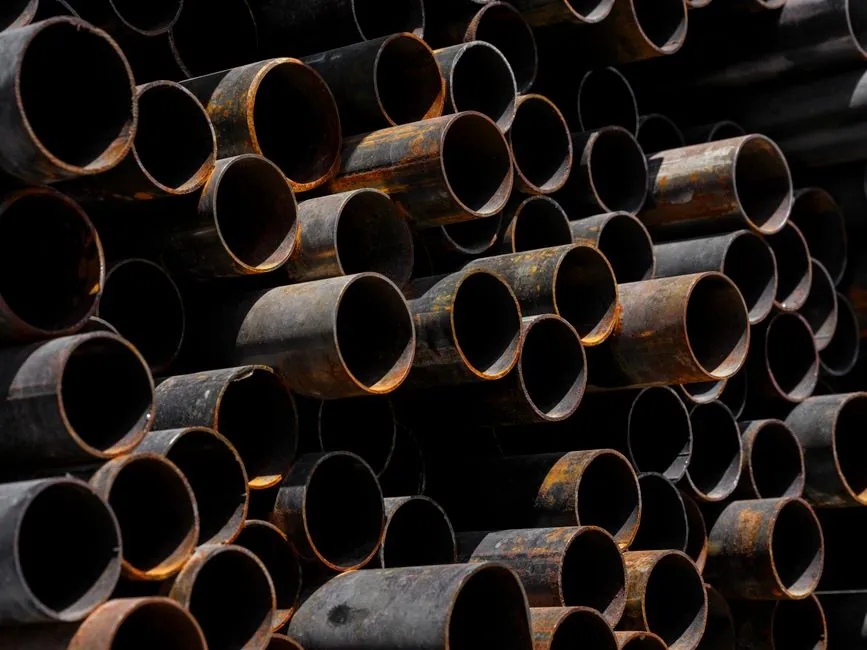
For precision shaft keys, bushings, and screw-machined components, the practical choice between 303 and 316 hinges on three measurable variables: tensile strength (303 sits around 620 MPa versus 316 at roughly 580-586 MPa), free-machining rating, and chloride pitting resistance [S2][S4].
303 is a sulfurized variant of 304 with 0.15-0.35% S added, making it the most readily machinable austenitic grade; 316 substitutes 2-3% Mo for a portion of the nickel content, raising pitting resistance in saltwater and chemical service at the cost of tool life and tensile rating [S1][S4][S5]. Both grades remain non-magnetic in the annealed condition and both fall under the stainless steel family tree that defines the austenitic 300 series.
Composition and Why It Drives the Trade-Off
303 carries 17.0-19.0% Cr, 8.0-10.0% Ni, and 0.15-0.35% sulfur or selenium; 316 carries 16.0-18.0% Cr, 10.0-14.0% Ni, and 2.0-3.0% Mo with sulfur held to a normal 0.03% max [S4]. The sulfur in 303 forms manganese-sulfide inclusions that act as chip breakers during turning, milling, and key-way cutting, which is why the grade is the default pick for shaft key blanks produced on automatic screw machines [S2][S4]. 316's molybdenum addition stabilizes the passive film against chloride attack, raising the pitting resistance equivalent number well above that of either 303 or 304 [S5].
Tensile and Yield Numbers Across Sources
Reported tensile strength clusters tightly across manufacturers: 303 measures 600-620 MPa with 240-241 MPa yield, 304 measures 586-620 MPa with 241-250 MPa yield, and 316 measures 580-586 MPa with 241-290 MPa yield [S2][S4]. Hardness readings show 303 at 160-190 HB, 304 at roughly 187 HB, and 316 climbing to about 217 HB because the Mo addition and higher nickel push work-hardening response [S3][S4]. For a key stock application that transmits torque through a press fit, the relevant spec is shear capacity, and 303's higher tensile value combined with its tighter machining tolerance is the reason it dominates square and rectangular key production runs.
Machinability vs Weldability
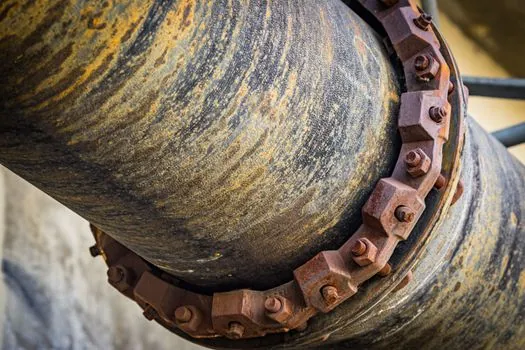
303 is the most machinable austenitic stainless; 316 machines 60-70% as fast on a relative rating and builds heat faster at the cutting edge, which shortens tool life on small-diameter key stock [S1][S3][S4]. Weldability reverses the picture: 303 is rated poor because sulfur promotes hot cracking in the heat-affected zone, while 316 welds cleanly and retains corrosion resistance in the as-welded condition [S4]. For fabrications that need both weld joints and machined features, designers typically specify 304 or 316 for the weld zone and switch to 303 only on parts that are produced as bar stock and never welded.
Corrosion Behavior in Real Service
303 performs adequately in mild atmospheric and fresh-water exposure but shows visible rust staining in marine splash zones and chloride-rich wash-down environments [S4][S6]. 316 resists pitting and crevice corrosion in saltwater, hot water systems above 60 deg C, and chemical process streams containing chlorides or organic acids, with the 2-3% Mo specifically raising resistance to pitting initiation [S5][S7]. Operating temperature also separates the two: 316 retains mechanical integrity at sustained service up to roughly 870 deg C (1600 deg F) intermittent, while 303 loses toughness once the sulfur-bearing inclusions oxidize at elevated temperature [S2][S5].
Selection Matrix: Pick by Application, Not by Grade
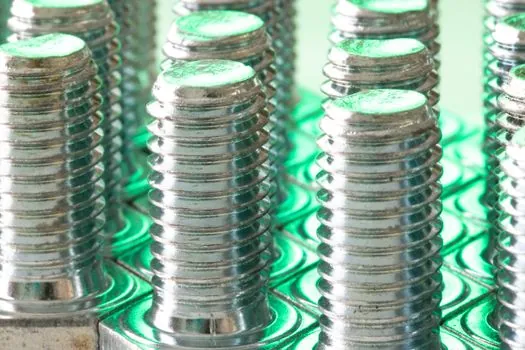
Use 303 when the part is a high-volume machined component, a stainless pipe fitting blank, or a key stock where tight dimensional tolerance and tool-room productivity outweigh corrosion needs; use 316 when the part sees chlorides, food-grade wash-down, pharmaceutical or marine exposure, or any field where pitting would cause a leak or a safety finding [S1][S4][S7]. A common working rule of thumb in machine shops: 303 for anything turned on a screw machine, 316 for anything that lives outdoors or in a chemical plant. Engineers comparing square key stock options should note that key dimensions follow ANSI B17.1, but the material choice inside that envelope is where 303 versus 316 is decided. For architectural balustrade hardware where 316 strand and bar work together, the matching rationale is detailed in this 316 balustrade strand spec guide.
Failure Modes and What to Watch For
303 in chloride service fails first as crevice corrosion under key seats and around set-screw threads where moisture sits against the manganese-sulfide stringers; once the passive film is breached, pitting propagates along the inclusion bands [S4][S7]. 316 in machined components fails first as galling on threads and key flats because the work-hardening response raises friction at the contact interface, which is why anti-seize or a galling-resistant coating is standard on 316 fasteners [S1][S5]. If a part requires both heavy machining and chloride exposure, the right call is often 304 (good machinability compromise, no sulfur cracking risk) rather than either extreme, or moving to a duplex grade [S1].
Cost, Availability, and Trackable Signals

303 key stock and round bar are stocked as standard sizes by most industrial suppliers because the screw-machine industry drives volume; 316 key stock is a special-order item at most service centers and typically runs 30-50% higher per kilogram than 303 in 2026 spot pricing [S1][S3]. For procurement verification on the next buying cycle, two signals are worth tracking: ASTM A582 publication updates covering 303 free-machining bar (current revision is the controlling document for chemistry and mechanical limits) and any addition of low-sulfur 316L variants aimed at closing the machinability gap without sacrificing chloride performance. Engineers who need a deeper dive on square key length tolerance when sourcing either grade can reference the 0.250 x 0.250 x 1.37 in square key spec sheet for the dimensional envelope that both 303 and 316 bars must meet.