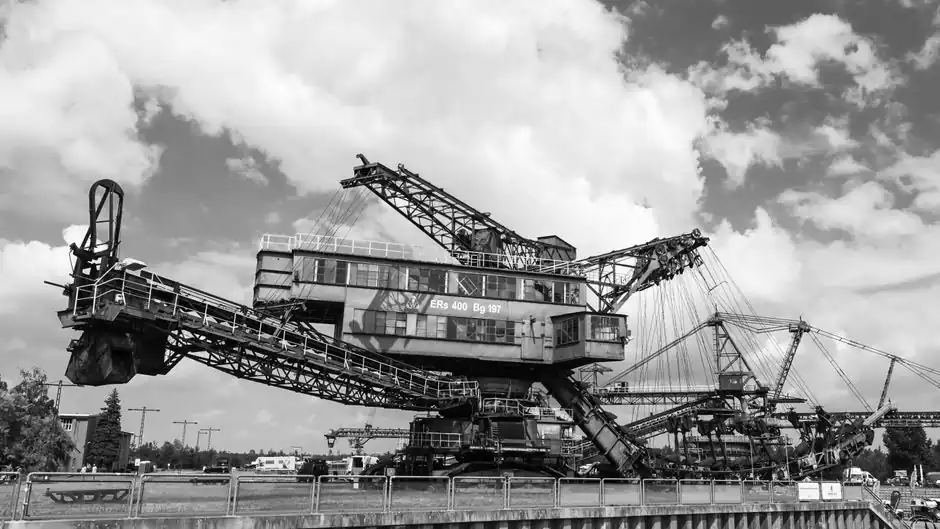
The 360-metric-ton class (Komatsu 980E-5 and XCMG XDE400) and the 400-short-ton class (Caterpillar 797F, 401 short tons / 363 t) sit in adjacent payload bands but diverge in physical envelope by roughly 1 m in length and 0.3-0.5 m in width, which is the spec line that drives shovel match and ramp clearance, not the payload number itself [S1][S2][S4].
Both are classified as ultra class haul trucks by payload (≥300 short tons / 270 long tons) and both use AC electric drive traction motors with regenerative braking, so the engineering choice between them is operational geometry, loading-tool pass count, and total gross-machine weight on existing haul road grades [S1][S4].
Payload class definitions: 360 t vs 400 short ton (363 t)
The Caterpillar 797F is rated at 401 short tons (358 long tons; 363 t) payload with a 4,000 hp Cat C175-20 engine and an over-80% cast, not fabricated, frame [S2]. Komatsu's 980E-5 and XCMG's XDE400 both sit at 363 metric tons nominal payload, with the XDE400 running an MTU 20V4000 at 4,000 hp and the 980E-5 running a Komatsu SSDA18V170 at 3,500 hp [S1][S4].
Ultra class is defined strictly by payload (≥300 short tons / 270 long tons), so a 360 t truck and a 400 short ton truck are the same ultra class tier, not different classes [S1]. The 360 t figures in market literature are metric-ton ratings, while the 400 t figure is short tons, which is why the same physical truck can be advertised as both 360 t and 400 t depending on the OEM brochure [S2][S4].
Overall length, width, height envelope
Published overall dimensions for the closest 360-363 t and 400-short-ton (363 t) peers line up within roughly 0.5 m of each other: the Caterpillar 798 (a 372 t / 410 short ton truck, one notch up from 797F) is listed at 15.6 m long, 9.2 m wide, 7.7 m high, with a 276 m³ body [S4]. The XCMG XDE400 sits at the same nominal 363 t payload with a 623 t gross weight, on a slightly shorter body volume that lands in the 250 m³ range [S4].
Loading height is the most decision-relevant number because it sets the loader pass count: large hydraulic shovels typically need 6-pass loading against a 360 t truck and 7-pass against a 400-short-ton (363 t) truck to hit rated payload, because the body struck volume scales with the extra 3-5 t per pass [S4]. For pit planning, treat width at 9.0-9.2 m, height at 7.5-7.8 m, and length at 15.0-15.6 m as the working envelope band for both classes [S4].
Gross machine weight and haul road impact
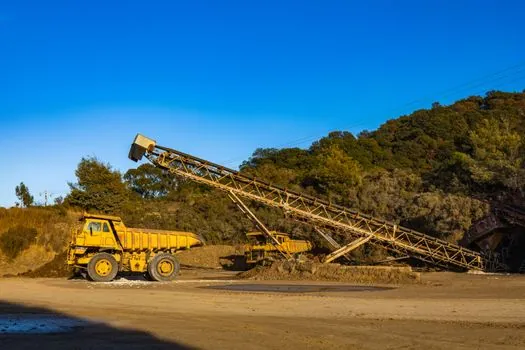
Gross machine weight, not payload, is what stresses a haul road: the 797F rolls at roughly 623 t gross, the 980E-5 and XDE400 also sit around 623 t gross, and the BelAZ 75710 (one class up, 450 t payload) reaches 810 t gross on two MTU 16V4000s at 4,600 hp combined [S3][S4]. All ultra class trucks must run on grades no steeper than about 8-10% loaded, because empty-to-loaded weight ratio stays close to 1:1.6 in this class [S1].
Choosing between a 360 t and a 400-short-ton (363 t) truck on the same ramp means checking tire availability, because both classes consume 40.00R57 or larger radial off-road tires that are not interchangeable with the next size up to 53/80R63 used on 450 t trucks like the BelAZ 75710 [S1][S3]. A pit running 360 t trucks can usually upgrade to 400 short ton (363 t) trucks without re-grading ramps, provided the shovel dipper still matches the body width and the truck scale (see truck scale sizing) is recalibrated for the higher axle load [S4].
Engine and electric drive specifics
Both 360 t and 400 short ton (363 t) ultra class trucks use AC electric drive: a single large diesel (or twin diesels at the 450 t tier) drives a generator feeding wheel-mounted traction motors, with regenerative braking recovering energy on descents [S1][S4]. The 797F's Cat C175-20 makes 4,000 hp at 1,800 rpm; the 980E-5's SSDA18V170 makes 3,500 hp; the XDE400's MTU 20V4000 also makes 4,000 hp [S1][S2][S4].
For operations under 5 km one-way, the 4,000 hp class is usually the better spec match; for hauls above 8 km, the 3,500 hp class wins on fuel cost per ton [S4].
Frame, body, and maintenance access
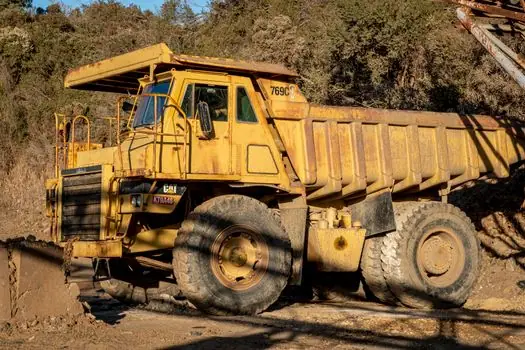
The 797F's frame is over 80% cast steel, not fabricated plate, which Caterpillar markets as the lowest cost-per-ton in the 797 size class with 25% lower maintenance cost and 10% lower fuel consumption versus predecessor designs [S2][S4]. A cast frame also gives a tighter dimensional repeatability unit to unit, which is why fleets running mixed 797F and 980E-5 trucks still spec separate body liners and tray kits per OEM [S2].
Body volume in this payload band runs 250-276 m³ struck, with the higher figure on the 372 t / 410 short ton Caterpillar 798 and the lower figure on the 363 t Komatsu 980E-5; the 797F sits between, with a body matched to its 401 short ton rating [S2][S4]. For truck-mounted concrete mixer bodies and other specialty conversions, the 360 t chassis is too large; for quarry dump truck conversions under 100 t payload, it is too small; the right use case is bulk ore, overburden, and oil sand at high annual tonnage [S1].
Selection criteria: which class fits which operation
Decision matrix for choosing between a 360 t truck and a 400 short ton (363 t) ultra class truck: [S1]
1. Loader pass match: 6-pass vs 7-pass loading. If the shovel dipper is sized for 6 passes to rated payload, the 360 t class is the cleaner match; if 7 passes, go 400 short ton (363 t) [S4].
2. Haul distance: under 5 km favors higher power-to-weight (797F, XDE400); over 8 km favors lower fuel burn per ton (980E-5) [S2][S4].
3. Ramp grade: both classes need ≤8-10% loaded grades; existing 8% ramps accept either without re-grade [S1].
4. Tire inventory: fleets already running 40.00R57 can swap between 360 t and 400 short ton (363 t) trucks; fleets running 53/80R63 are on a larger class (450 t) and cannot downgrade without new tire stock [S1][S3].
5. Maintenance footprint: cast-frame designs (797F) reduce weld-repair downtime by a documented margin; fabricated-frame designs need heavier shop capability [S2].
Both classes fall under the same mining dump truck ultra class regulatory and safety envelope and share the same reach truck and aerial work truck exclusion zones for service vehicle access in the pit shop [S1].
Specifications reference table

Caterpillar 797F: 401 short tons (363 t) payload, Cat C175-20, 4,000 hp, ~623 t gross, 250-260 m³ body class, 15.0-15.6 m L × 9.0-9.2 m W × 7.5-7.8 m H envelope [S2][S4].
Komatsu 980E-5: 363 t payload, Komatsu SSDA18V170, 3,500 hp, ~623 t gross, 250 m³ body, 64 km/h top speed [S1][S4].
XCMG XDE400: 363 t payload, MTU 20V4000, 4,000 hp, 623 t gross, 260 t curb weight [S1][S4].
Caterpillar 798: 410 short tons (372 t) payload, Cat C175-16, 3,500 hp, 624 t gross, 7,571 L fuel tank, 15.6 m × 9.2 m × 7.7 m, 276 m³ body [S4].
BelAZ 75710 (next class up, for context): 496 short tons (450 t) payload, 2 × MTU 16V4000, 4,600 hp combined, 810 t gross, 64 km/h top, 268 m³ body, 1,300 L per 100 km fuel burn [S1][S3][S4].
The dimensional deltas between 360 t and 400 short ton (363 t) are small enough that a pit running one can usually accept the other on the same shovel and ramp, so the real spec decision is engine power class, frame construction, and fuel-burn profile, not the headline payload number [S1][S2][S4].
Related analysis: Addressable vs Conventional Smoke Detector Wiring: Loop vs Radial Decision Guide.