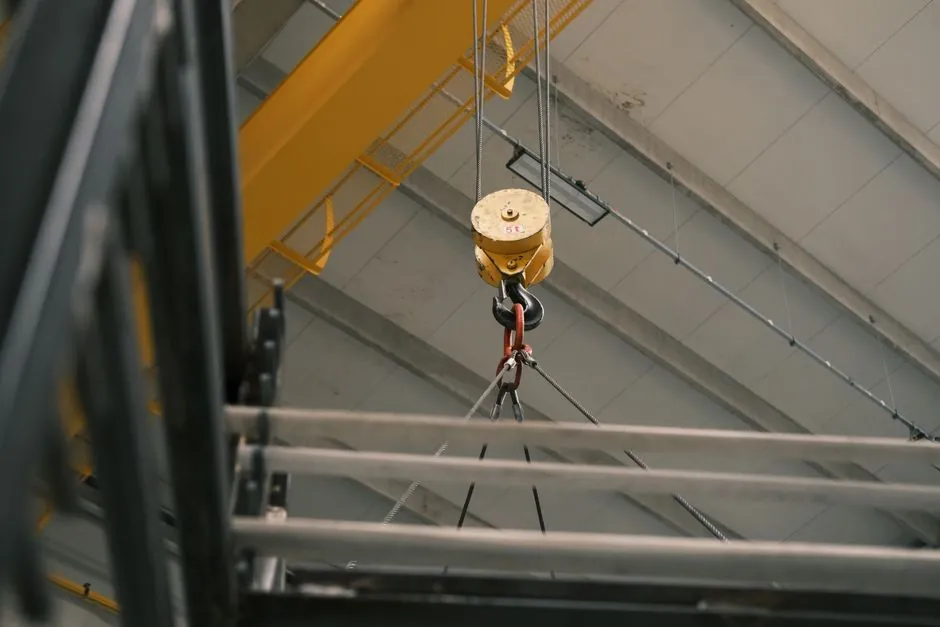
For long-load handling, twin-hoist arrangements are typically specced on single girder crane bridges with each hoist rated at 75% of bridge capacity, so a 20-ton bridge carries two 15-ton hoists that share a single load via a spreader bar [S4].
The practice is driven by a recurring problem: when a long machine or steel member exceeds 13 ft between pick points, a single hook cannot engage both sling legs without forcing the hook block to sit too high above the floor [S4]. Two hoists on the same bridge let the operator set pick points independently and keep the load near the deck, which is exactly the geometry fabricators, riggers, and machine shops describe in current field threads dated October 8, 2026 [S4].
Why Two Hoists Beat One on a Long Load
Two equal-capacity hoists on one bridge give independent lateral pick-point control, which is the controlling parameter for a 30+ ft long part on a 4-point sling; a single 20-ton hook cannot place two widely spaced pick points without re-rigging [S4]. Forum consensus on October 8, 2026 is that the auxiliary hoist on a long-load bridge is not optional: every shop crane the respondents operate daily has one, and it is used for turning loads and accurate placement on machine tools, not just for light lifts [S4].
The 75%-per-hoist rule has a structural reason, not just a safety margin: a single girder bridge with paired hoists is engineered so the rated bridge capacity equals 2 × 0.75 × single-hoist capacity, and a load applied to both hooks simultaneously cannot exceed the bridge rating, which is the envelope most CMAA Class C and Class D shops work inside [S4][S3]. On an overhead bridge crane, the bridge itself is the single beam the trolley rides along, so the girder section modulus sets the hard ceiling on what the two hoists can lift together [S1].
Single Girder vs Double Girder: Where Twin Hoists Fit
A single girder crane uses one bridge girder with the hoist trolley riding the bottom flange, while a double girder crane uses two parallel girders with the trolley running on top of them [S1][S8]. For twin-hoist long-load work, the structural comparison is direct: a double girder bridge typically lifts greater than 15 tons in a constant duty cycle and gives better hook approach because the hoist sits on top of the girders, not below them [S2].
Single girder systems cap out at lighter capacity, commonly 0.5 to 20 ton with custom builds up to 32 ton, spans of 7.5 to 31.5 m, and lifting height of 6 to 30 m at CMAA-equivalent working class A3 to A5 [S5]. Double girder systems push higher in capacity and span, which is why heavy steel and foundry work overwhelmingly uses them [S2][S7]. For long loads that are awkward rather than heavy (a 20-ton, 30-ft lathe bed, for example), the single-girder twin-hoist layout is often the right economic answer, because you do not pay for the second girder [S4].
CMAA Duty Class, Span, and the Hoist Pairing Rule
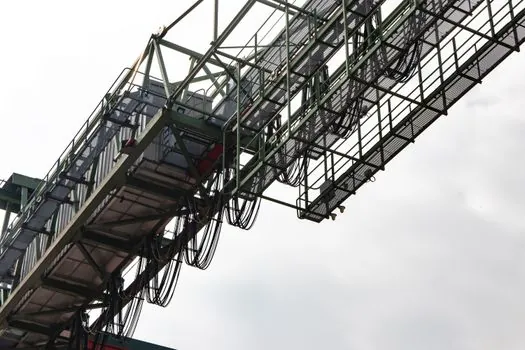
Bridge cranes in the U.S. are classified by the Crane Manufacturers Association of America (CMAA) on a scale from A (standby) to F (continuous severe service at near capacity), and a process crane for steel-mill coil handling typically lands in Class D, E, or F at 10+ lifts per hour at 50-75% capacity [S3]. Standardized single girder bridge cranes are usually CMAA Class A, B, or C at 5-10 lifts per hour at 40% capacity, which is the working envelope for the typical twin-hoist machine-shop application [S3].
Standardized crane offerings top out at 200 ton capacity and 150 ft span, with the actual deliverable span for a given hoist pair set by the runway length and the building column grid [S3]. The twin-hoist rule, two hoists at 75% of bridge capacity each, only works when the bridge itself is rated for the combined load; the rated bridge capacity is the ceiling, not the sum of the two hoist nameplates [S4]. For a 20-ton bridge with two 15-ton hoists, the bridge is the bottleneck: lifting 30 tons on both hooks simultaneously is a structural overload, regardless of hoist nameplate [S4].
Hook Approach, Headroom, and Long-Load Geometry
Hook approach (the minimum distance from the hook to the runway centerline) and headroom are the two geometric numbers that decide whether twin hoists fit the application [S2]. A double girder crane improves hook approach because the hoist sits on top of the girders, lifting taller and longer objects in a fixed work area than a single girder with an under-hanging trolley [S2].
For long loads, the under-hanging trolley on a single girder is actually an advantage in low-headroom shops, because the hoist hangs below the beam instead of riding on top, which keeps the system compact and the hook higher for a given building height [S1]. A shop with 30 ft ceilings, typical of the October 8, 2026 forum discussion about a 20-ton bridge for 35,000-lb machines, can use a single-girder under-hung twin-hoist layout and still get the slings over a 13-ft pick-point height, because the hook block sits below the bottom flange [S4]. The tradeoff is reduced trolley speed under the beam and a lower CMAA duty class envelope than a top-running double girder of the same capacity [S5][S1].
Failure Modes and What Twin Hoists Cannot Fix

Twin hoists do not lift more than the bridge rating; they redistribute a single load across two pick points, which is the correct way to handle a long, low-density member, but the wrong way to try and exceed the bridge nameplate [S4]. Operators in the field also flag headroom loss as a hidden cost: underslung hoists eat vertical clearance over production machines, and even a 30 ft ceiling can become surprisingly tight once the trolley, hook block, and sling are stacked under the girder [S4].
A second failure mode is synchronized lift: if the two hoists are not electrically interlocked or operated by a single pendant channel, an unbalanced reeving leaves one hoist carrying more than its share, and the 75%-per-hoist derate assumes a level lift on both hooks [S4]. For a pressure sensor-equipped load monitoring system or a load cell on each hoist, the standard practice is to wire both hoist motors to a single VFD or to specify matched hoists from one OEM, so the operator cannot command unequal speeds from independent pendants.
Selection Criteria: When to Pick Twin Hoists on a Single Girder
The decision matrix has four inputs: load weight, pick-point spread, headroom, and duty cycle. If load weight is under 20 ton, pick-point spread exceeds 10 ft, headroom is tight, and duty cycle is below CMAA Class C, a single-girder twin-hoist layout is the cost-effective answer, with two 10-ton hoists on a 15-ton bridge or two 15-ton hoists on a 20-ton bridge as the typical configurations [S4][S5].
If any one of those inputs fails (heavier load, longer span, Class D or higher duty, or need for the absolute best hook approach), the industrial valve-class answer is to step up to a double girder crane with paired hoists, accepting the higher steel cost and the larger building column loads in exchange for a top-running hoist and a higher CMAA rating [S2][S1]. Buyers comparing quotes should also verify runway rail size, end-truck wheel load, and bridge deflection at full load, because the bridge section modulus, not the hoist nameplate, sets the real working capacity of a twin-hoist rig [S3][S5].
Sourcing and Standards References
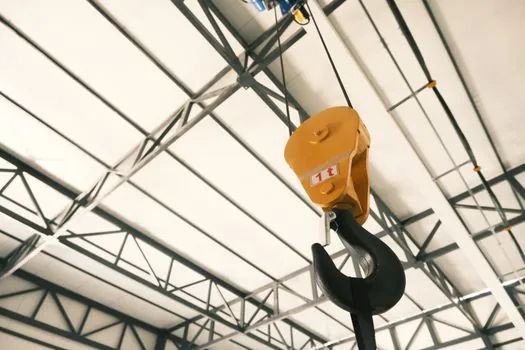
For long-load twin-hoist work, the controlling U.S. reference is the CMAA crane classification, with most machine-shop twin-hoist bridges sitting in Class C (moderate service, 50% capacity, 5-10 lifts per hour) and most steel-mill process cranes sitting in Class D, E, or F [S3]. For capacity sizing, the 75%-per-hoist pairing rule is field convention, not a code clause: it is what builders and riggers apply to keep the bridge from being overloaded by two hoists pulling on the same load [S4].
Standardized single girder cranes commonly run at 380V/50Hz three-phase, with bridge travel speeds of 20-30 m/min, trolley speeds around 20 m/min, and a working temperature range of -25°C to +40°C, which is the envelope for indoor and outdoor non-explosive, non-corrosive service [S5]. For facilities considering a used or repurpose twin-hoist bridge, the practical sourcing signals to track are bridge serial plates (capacity, span, CMAA class), end-truck wheel-load ratings from the building column engineer, and VFD or pendant interlock documentation, all of which determine whether the second hoist can be commissioned safely on the existing runway. Related reading on outrigger geometry and lift clearance for truck-mounted work can be found in our outrigger and confined-space guide.