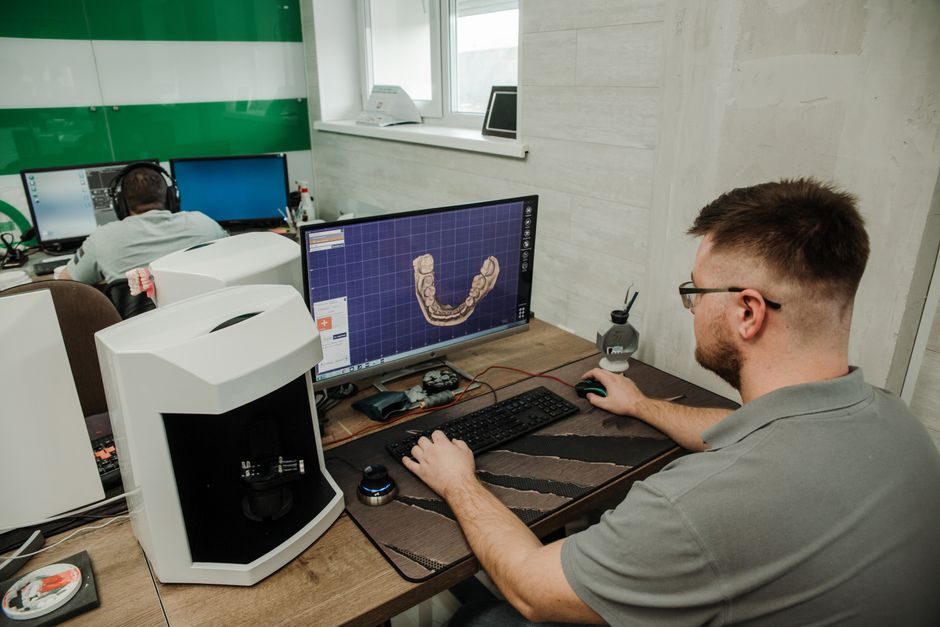
WINSOK's 2026 application note identifies 3D printers and Industry 4.0 manufacturing equipment as a discrete category within its smart-industry MOSFET portfolio, with digital technology material printers deployed in mold manufacturing and industrial design [S1].
Semiconductor suppliers are now segmenting 3D-printer drive stages by voltage class — low-voltage (0–30 V) MOSFETs for stepper and hot-end heaters, mid-voltage (30–100 V) for heated-bed and chamber control, and high-voltage (100–800 V) for laser-diode and sintering power — which mirrors how printer OEMs are aligning bill-of-materials with Industry 4.0 connectivity stacks [S1].
Defining the Scope: Additive Manufacturing Inside the Industry 4.0 Stack
Industry 4.0 in additive manufacturing is the convergence of IoT-enabled printer telemetry, cyber-physical control loops, cloud-based job queues, and AI-driven process analytics over the same digital thread that runs the rest of the factory [S2][S7].
The Springer literature frames 3D and 4D printing as an emerging Industry 4.0 technology for automotive, aerospace, and biomedical applications, where cyber-physical systems orchestrate build preparation, in-situ monitoring, and post-processing [S7]. A separate systems-theory study on SME supply-chain financing under Industry 4.0 highlights that adoption maturity is no longer just an engineering question — financing models, IoT data governance, and digital identity for NFTs of build records are now part of the spec [S2].
Selection Criteria: Connectivity, Intelligence, and Flexible Automation
McKinsey's Digital Manufacturing Global Expert Survey, conducted across 700 companies in Brazil, China, France, Germany, India, Japan, and the USA (each with ≥50 employees and ≥$10 M annual revenue), breaks Industry 4.0 pursuits into three sub-domains: Connectivity (digital performance management, augmented-reality SOPs), Intelligence (advanced analytics, AI-driven quality and demand forecasting), and Flexible Automation (robotic post-processing) [S3].
For 3D-printing buyers, the same three buckets translate into: OPC UA / MQTT connectivity to the PLC-level cell controller, inline melt-pool or layer-imaging analytics feeding a manufacturing execution system, and robotic depowdering, support removal, or automated FlexiFinish-style post-processing [S3]. Apium's P400 high-performance-polymer printer illustrates the trend — it is positioned specifically as a leading-edge Industry 4.0 platform for high-performance thermoplastics used in aerospace, automotive, and engineering builds [S8].
Who 3D-Printing-Industry-4.0 Is For — And Who It Is Not For
Industrial OEMs with stable part portfolios, aerospace tier-1s needing low-volume certified parts, and biomedical implant producers benefit most from digital-thread integration because part genealogy, machine parameters, and powder-batch traceability are auditable per build [S7].
Conversely, job shops running commodity PLA or hobby-grade FFF machines without IoT layers, and SMEs without IoT-driven supply-chain financing instruments, will struggle to recoup the integration cost — the McKinsey survey explicitly identified an SME adoption gap where 92% of respondents claim to lead or match competitors in Industry 4.0 strategy, yet the rollout-versus-pilot ratio remains low [S3]. McKinsey's COVID-era follow-up also documented a divergence between technology haves and have-nots, with adoption widening along pre-existing capability lines [S4].
Comparison: Three 3D-Printing Industry 4.0 Archetypes Against Decision Criteria
Three archetypes now compete for Industry 4.0 mindshare. (1) RepRap-class desktop FFF wired with low-voltage MOSFET hot-ends and basic MQTT telemetry — lowest cost, lowest process data, suitable for prototyping only. (2) Industrial high-performance-polymer printers such as the P400, with sealed build chambers, thermal management, and OEM-grade data interfaces — mid-cost, high repeatability, fit for end-use aerospace and automotive parts [S8]. (3) Powder-bed fusion cells with robotic post-processing, in-situ monitoring, and full MES integration — highest capex, highest audit depth, mandatory for certified serial production [S3][S7].
On four decision criteria — connectivity depth, process-data density, post-processing automation, and auditability — archetype 1 scores 1/2/1/1, archetype 2 scores 3/3/2/3, and archetype 3 scores 4/4/4/4 on a 1–4 ordinal scale where 4 is best (synthesised from [S3] and [S7]). The "pilot purgatory" described by McKinsey partner Richard Kelly — "companies are experiencing significant activities underway, but they are not seeing meaningful bottom-line results" [S3] — is precisely the failure mode of archtype-1 retrofits that try to skip archtype-2 maturity.
Real Use Cases and the Pilot-to-Rollout Math

McKinsey's 2018 survey found that while the majority of 700 manufacturers were already piloting digital manufacturing solutions, the rollout-versus-pilot ratio was sharply lower, and two-thirds of respondents nevertheless ranked digitising the production value chain as a top priority [S3].
Concrete deployment cases include the MTC's automated FlexiFinish post-processing system for additive parts and INTAMSYS' digital supply chain for 3D printers, both cited as canonical Industry 4.0 pilots that close the loop between build job and downstream finishing [S3]. Service providers such as Sara Infoway bundle additive manufacturing with IoT, automation, and HCI infrastructure under ISO 9001, ISO 14001, and ISO 27001 certifications, treating 3D printing as a node inside a wider Industry 4.0 stack rather than a standalone cell [S5].
Limitations, Failure Modes, and the AI-Adoption Drag
The same McKinsey research arm found AI adoption lagging within Industry 4.0 — only 20% of "AI-aware" businesses claimed actual AI deployment, which constrains the Intelligence layer of the 3D-printing stack that depends on inline quality analytics [S3].
Engineering constraints remain: powder-bed fusion still requires inert atmosphere and depowdering, high-performance-polymer printing needs controlled chamber temperatures, and IoT-connected printers expose new attack surfaces that must be addressed per ISO 27001-style controls when the cell is integrated into a wider plant network [S5][S8]. For pressure-sensor and flow-meter feedback inside enclosed build chambers, calibration drift across thermal cycles remains a documented source of part-to-part variation in serial production.
Sourcing, Standards, and Buyer Checklist
Buyers specifying 3D-printing Industry 4.0 cells should validate three artefacts: (a) an OPC UA or MQTT companion spec from the printer OEM, (b) a documented pilot-to-rollout KPI set (connected machines, jobs/MES, post-processing yield), and (c) cybersecurity and quality certifications from the system integrator, with ISO 9001, ISO 14001, and ISO 27001 being the baseline triad cited by current service providers [S5].
IndustryARC's market sizing placed the global Industry 4.0 market at $70–75 billion in 2018 with a forward CAGR projection as the IoT/cyber-physical/cloud stack scaled [S6] — useful as an order-of-magnitude reference even though the headline number dates to 2018. The 2024 SME financing literature further formalises a systems-theory model for how Industry 4.0 tools, including digital additive cells, integrate with working-capital and receivables financing for smaller manufacturers [S2]. Track McKinsey's annual Digital Manufacturing survey and SME financing academic literature for the next signal on whether pilot purgatory has converted to scaled rollout across 3D-printing cells.
For related coverage, see Vibrating Fork Level Switch vs Dock Leveler: Spec-First Decision Map.