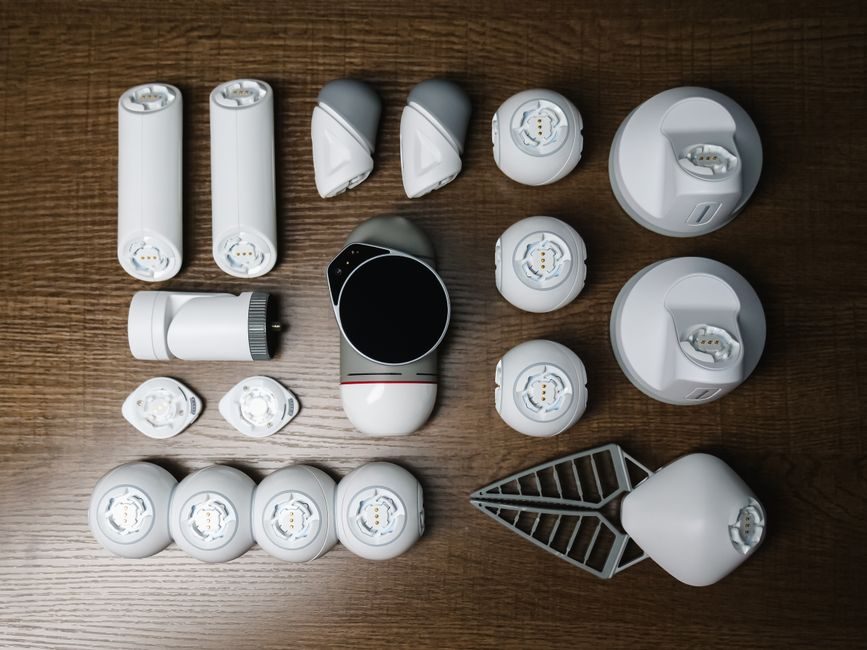
For process engineers specifying or auditing a robot cell, the BOM is the cleanest artefact to anchor cost, lead time and risk discussions: it forces the conversation away from "which brand" and onto "which part number, with what MTBF and what service network" [S2]. A typical articulated robot uses one motion controller, six servo drives, six servo motors, six RV reducers in the base / shoulder / elbow and four harmonic reducers in the wrist axes, plus an absolute encoder per axis and a pressure sensor stack on the hydraulic or pneumatic balance circuit where present.
The actuation stack is where the BOM becomes dense and where the cost curve is steepest: a single RV reducer on a medium-payload arm (20-50 kg) lands in the USD 1,200-2,800 band, while a CSG / CSF harmonic-drive unit for the wrist axes sits at USD 350-900 per axis [S1][S2]. Servo motors sized for the same payload class are typically MS1H / HG-SR / 1FK7 frame sizes with 200-750 W continuous rating, and the matched drive is a single-axis AC servo amplifier in the 1.5-3 kW class with EtherCAT or PROFINET on the bus side.
The transmission group — gears, couplings, ball screws, linear guides, ball splines and timing belts — is small in dollar share but carries disproportionate failure-rate weight when the robot is run near rated payload for >80% of cycle time.
Sensing subsystem: encoders, 6-axis F/T and cell-level instrumentation
Each axis of a modern industrial robot carries one absolute encoder (typically 23-bit single-turn or 25-bit multi-turn, battery-backed) and most new builds also fit a 6-axis force / torque sensor at the wrist flange for assembly and polishing duty — quoted accuracy is ±0.5 N on force and ±0.005 Nm on torque at the cross-axis channels. The sensing stack also touches the cell, not just the arm: a pressure transmitter on the pneumatic supply (0-10 bar range, 4-20 mA + HART) and a vacuum switch on the gripper circuit are standard in pick-and-place cells drawing parts from suction tooling. [S1]
Process engineers should treat the sensing BOM as a separate line of defence from the motion control loop: a worn encoder cable shows up as position-error faults long before a servo alarm, and a drifted F/T sensor offsets the entire compliance model. A flow meter on the coolant or air curtain line and an industrial valve on the pneumatic drop are common additions when the cell has to clear a quality audit under IATF 16949 or GMP.
Control and power subsystems: controller, safety PLC, I/O and bus
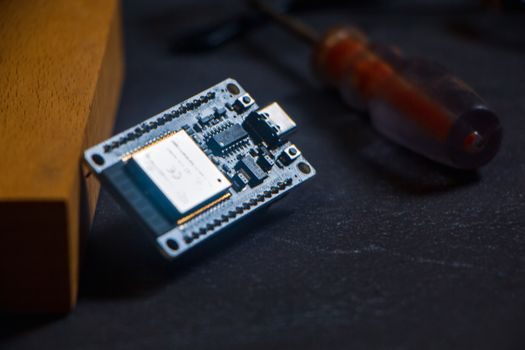
The motion controller BOM line is usually a PLC-class industrial PC or a vendor-proprietary unit (IRC5 / KRC4 / R-30iB / DX200 class), backed by a separate safety PLC rated to IEC 61508 SIL 2 or SIL 3, plus a 24 VDC power supply sized to the worst-case I/O load plus a 25% margin. Fieldbus choices on 2026-vintage cells are converging on EtherCAT and PROFINET for the motion ring, with EtherNet/IP or OPC UA on the cell-level supervisory network; safety is usually PROFIsafe or CIP Safety on the same physical media. [S2]
Battery sizing and hold-up for the encoder backup is a frequently under-spec'd line — a 3.6 V lithium primary cell of 1.2-2.6 Ah keeps the multi-turn absolute encoders alive across 5-7 years of typical shift loading. Power distribution on the harness side uses a shaft-key-type motor-to-reducer coupling or a precision collet clamp depending on the joint, and the harness itself is usually a chainflex-grade continuous-flex cable rated for >10 million bend cycles in the dress pack.
Structure and transmission: castings, linear guides and the failure-rate ledger
The structural BOM group is dominated by cast iron or welded steel arm castings (typically GGG-40 / GGG-60 ductile iron or Q235 / Q345 welded fabrications), the ball spline or LM-rail linear guides on the long-axis joints, and the cable carrier / dress pack assembly. Linear guides on prismatic axes or in the wrist typically land in the HSR / SHS / THK-LMF class with 25-45 mm rail width; preloaded (C1 / C0 class) for assembly cells, plain clearance (C3) for material handling where cycle stiffness matters less. [S3]
Two practical pointers from the field: first, robot castings made of GGG-60 ductile iron absorb vibration noticeably better than welded mild-steel equivalents at the same weight, and that delta shows up as reduced servo-tracking error at high acceleration; second, a precision ball spline on the wrist Z-axis has about half the rolling-element population of a comparable crossed-roller slide and therefore halves the grease-rebuild interval, which is a real maintenance BOM saving over 5 years.
Sourcing bands 2026: lead time, regional supply and what is actually short
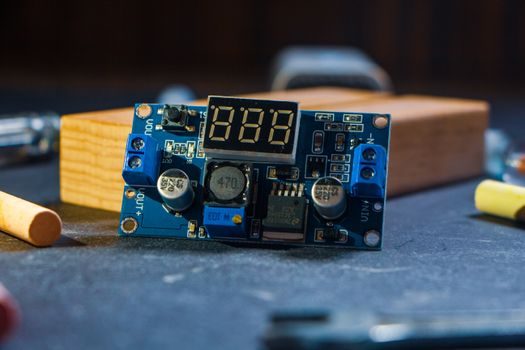
On the 2026 sourcing market, RV reducers and harmonic reducers lead the critical-path list with 12-24 week lead times for new orders of premium Japanese supply (HD / Nabtesco class), and 6-10 weeks for Chinese domestic supply at a 30-50% cost reduction but with a wider backlash tolerance band (typically 1-3 arc-min vs <1 arc-min for premium). Servo motor + drive pairs are closer to stock: 3-6 weeks for European or Japanese supply, 2-4 weeks for Chinese supply at the same IEC frame sizes. [S4]
The controllers and safety PLCs are the most stable BOM line on lead time — most major platforms are shipped from regional stock with 1-3 week delivery. Where the market is genuinely tight in 2026 is the high-precision encoder market (25-bit multi-turn absolute) and the F/T sensor market at the wrist: order windows of 8-14 weeks are common, and engineering teams should plan a 12-month BOM horizon rather than the 3-month horizon that worked in the 2018-2022 supply environment. Reserve a second-source line in the BOM for every encoder and F/T sensor, even at a 5-10% accuracy penalty, to keep a cell rebuild from turning into a 3-month line stop.
Closing node: a defensible 2026 robot cell BOM should carry (1) dual-source entries for the reducer, encoder and F/T sensor lines, (2) an explicit IEC 61508 SIL level declared on the safety PLC, and (3) a 12-month horizon on the critical-path long-lead items — track those three signals every time the cell is reviewed.