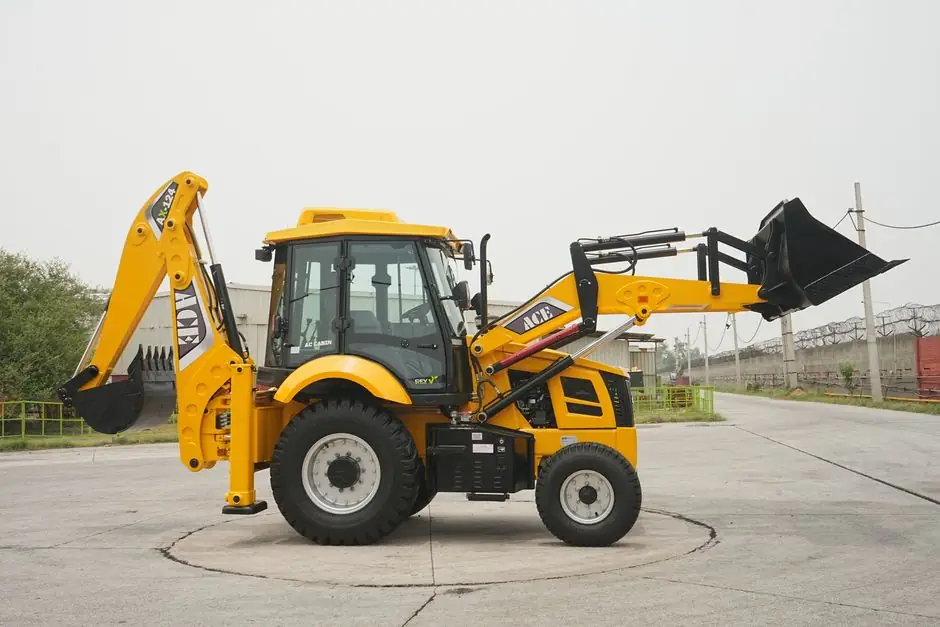
A 4-in-1 bucket on a backhoe loader is a single shell split along the backplate that opens and closes under hydraulic pressure, letting one attachment do the work of a loader bucket, a dozer blade, a clamshell grab and a light scraper, while a standard bucket is a single-piece welded shell designed to do one job well: scoop, carry and dump [S2][S4].
On a backhoe loader the trade is paid for in three places, tare weight, lift capacity and a second hydraulic circuit, and the right choice tracks the work cycle: pure truck-loading rewards a standard bucket, while mixed demo, brush cleanup and grading on a single machine swings the decision to the 4-in-1 [S1][S6][S8].
How the Two Buckets Actually Differ on a Backhoe Loader
A standard loader bucket is a one-piece welded shell, with a curved cutting edge, a single lip and a fixed backplate; a 4-in-1 adds a hinged jaw in front, a hydraulic ram and an extra set of hinge pins, which is why a 4-in-1 weighs 100-300 kg more than a plain bucket of the same width [S2][S4]. On Implements Direct's 2026 John Deere-fit range, a 1.55 m 4-in-1 lists at $4,995 against a comparable plain bucket at roughly half that, a price gap that mostly reflects the extra steel, the ram and the jaw machining [S2]. The jaw is the whole point: opened flat, the 4-in-1 works as a dozer or scraper; closed, it clamps a log, a boulder or a bundle of rebar; partially open, it can be used to doze a thin layer while rolling the machine forward [S2][S4][S9].
On a backhoe loader the same shell is also used as a light dig tool because the back half of the jaw can crowd into a trench before the operator swings the machine off, which is the function Gardner Engineering's Australian-made 4-in-1 buckets are designed around for 1.5 t to 50 t+ machines [S3]. A standard bucket cannot do any of that, and that is also its strength: fewer hinges, fewer pins, one less hydraulic cylinder to leak, and a smoother scoop that fills cleanly on a single curl pass [S4][S6].
Selection Criteria: Weight, Hydraulics, Width and Work Cycle
Four criteria actually decide this, and they are measurable. First, tare weight versus the backhoe loader's lift curve: a 4-in-1 will eat roughly 100-300 kg of usable payload before the first bucketful is even loaded, and on a sub-compact backhoe-loader such as a 25 HP class machine, that is the difference between a full bucket of wet sand and a half bucket that stalls the curl [S2][S4]. Second, hydraulics: a 4-in-1 grab function only works if the loader has a second hydraulic circuit run to the bucket; tilt-and-curl-only machines can still use the 4-in-1 as a plain shovel but cannot close the jaw, which is the most common 2026 buying mistake called out in the field guide [S2].
Third, width matched to lift rating: in the JD-fit range, 1.27 m (50 in) is the sub-compact limit, 1.55 m is the safe pick for most compact tractor loaders, and 1.85 m only fits larger units with the lift capacity to carry the extra steel; sizing to the biggest bucket that fits the budget instead of the loader spec sheet is the second most common mistake [S2]. Fourth, work cycle: when most operating hours are truck-loading a single uniform material, a standard bucket is faster per cycle, whereas for mixed brush, demo, grading, and grab work the 4-in-1 removes attachment changes [S1][S6].
A quick rule from the field: "if you are trying to dump into a truck that exceeds the lifting height capacity of your machine, you can simply open the jaws of a 4-in-1 bucket and let material flow out," which removes the need to raise a partially full load to full dump height and is one of the clearest productivity wins for the design on a backhoe loader [S7].
Decision Matrix: 4-in-1 vs Standard Bucket by Criterion
Compared head-to-head on the criteria that matter on a backhoe loader, the 4-in-1 wins on versatility and clamping, loses on tare weight and unit cost, and ties on the basic scoop-and-carry task. Cost runs roughly $3,950-$5,995 for a 1.27-1.85 m 4-in-1 in the 2026 JD-fit range, against a lower price for an equivalent-width standard bucket; tare runs 100-300 kg heavier for the 4-in-1, which directly cuts usable payload [S2]. Function count is 4 for the 4-in-1 (load, doze, grab, scrape) versus 1 for the standard bucket, and attachment-change time on a single-rig job site drops to zero for the 4-in-1 because the operator never dismounts to swap tools [S2][S4][S9].
On truck-loading speed the standard bucket still wins per cycle, because a one-piece shell fills and dumps in a single clean motion; the 4-in-1 trades a small amount of that speed for the ability to spread, doze and clamp in the same pass [S1][S6]. On hydraulic fitment, the 4-in-1 requires a second circuit; a standard bucket runs off the existing tilt-and-curl pair, so it is the right call for older or simpler loaders that were never plumbed for a third function [S2].
Use-Case Recommendations: Who Should Pick Which
Pick the 4-in-1 if the backhoe loader spends its day switching between tasks on a single site: clearing brush after an excavator has grubbed, dozing a pad, grabbing demo debris, and loading out mixed loads into a truck that is sometimes too tall to clear [S1][S3][S7]. Land-clearing contractors, small demo crews, and farm operators handling firewood, fence posts, bale residue and light scraper work on one machine fit this profile, and the MultiCat NZ guidance is explicit: "if you could only ever fit one attachment to your wheel loader, the 4-in-1 combination bucket would be the right call for most NZ operators" doing mixed work [S9].
Pick the standard bucket if the work cycle is bulk truck-loading of a single uniform material, such as bedding sand, topsoil, aggregate or feed, where fill speed and clean dump matter more than clamping or dozing, and where every kilogram of bucket weight is a kilogram of payload lost [S1][S6]. Fleet owners running a dedicated loading rig, quarries moving uniform aggregate, and operators who already own a separate dozer, grapple or forks on the site also fall on the standard-bucket side of the line, because the 4-in-1 cannot out-muscle a dedicated brush grapple or bale grab on a single-function job [S2].
Known Failure Modes and Field Limits on a Backhoe Loader
The 4-in-1's main weakness on a backhoe loader is jaw twist under side load: operators have reported jaws twisted enough that the machine could not pick up bedding sand for pipe-laying after a day of tree work, because the 4-in-1 grips a log at one end only and any prying at the other end loads the frame in torsion [S1]. The same threads also report jaw release under relief-valve pressure over a bump, with logs dropping mid-travel on a poorly set hydraulic circuit, which is why positive-lock jaws on a heavier-built 4-in-1 matter more than the spec sheet suggests [S1].
On a sub-compact backhoe loader in the 18-25 HP class, the second limit is lift: the extra 100-300 kg of tare, combined with a 4WD machine that is already lift-limited, can leave the operator half-loading every cycle to keep the front end on the ground [S2][S4]. Tire damage is a third limit on brush work, where a stob through a loader tire on a standard wheel-loader setup is the kind of damage no bucket choice prevents, but a 4-in-1 is the bucket that lets the operator pick the stob up instead of driving over it [S1].
Integration Notes: Brackets, Hydraulics and Quick-Attach
For a John Deere Hook and Pin quick-attach loader, the 4-in-1 fits directly across the JD 1, 2, 3 and 4 series front-end loaders; on any other mount, a weld-on bracket adds about $180 and is cheaper than buying the wrong bucket and finding out at first fit-up [S2]. A second hydraulic function, usually a pair of quick-couplers at the loader arm, must be plumbed back to a tractor-side diverter or a third selective control valve, and the Kubota B26B-class sub-compact backhoe loader is a useful reference because it ships with a front 4-position valve ready for exactly this kind of added function [S4].
On the wider backhoe-loader family, the same 4-in-1 logic applies to skid steers and compact track loaders, where the multipurpose bucket has been a popular attachment for decades because it consolidates loading, grading, clamping and dozing into one quick-attach tool; for a deeper look at how a backhoe loader frames this choice against a wheel loader or a skid steer loader on the same job site, the rest of the catalog covers the host-machine side of the decision [S7].
Track the following signals before specifying: confirm the loader has (or can be plumbed for) a second hydraulic circuit; weigh the bare bucket and subtract it from the loader's rated lift at full height; and decide on the work-cycle mix, not on the brochure, because the 4-in-1 only pays back when the cycle is genuinely mixed [S2][S6][S8].
This topic is covered further in Seven-Wire PC Strand in Pre-Tension vs Post-Tension Concrete.