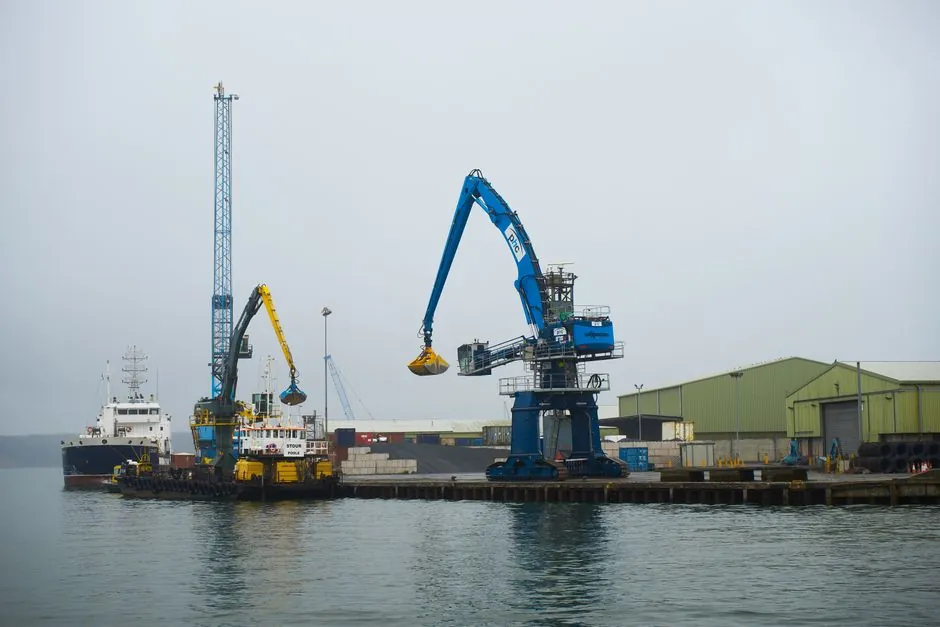
A 5-tonne load at a 12-metre working radius sits in the mid-range sweet spot for telescopic boom truck-mounted cranes in the 30-50 tonne rated class, with full outriggers deployed and a four-section boom extended into its mid-to-upper range [S4][S5].
Folding-knuckle (articulated) boom trucks on standard commercial chassis generally top out below 12 m of horizontal reach at any useful capacity, which makes the telescopic-on-heavy-chassis layout the realistic answer for that envelope [S4]. Specifiers should treat any "5-tonne crane" claim as a 1 m or 2 m figure, not a 12 m figure, until the published load chart is checked [S5].
Why "5-tonne crane" is a radius-dependent statement
Published load-chart data for a 6-tonne rated truck crane shows 6,000 kg at a 1 m working range but only 2,000 kg at 3.5 m with the basic boom, and a 12-tonne rated unit drops to 2,000 kg at 10 m (medium-long boom) and 1,620 kg with the boom fully extended [S5]. The ratio of roughly 1:3 between close-in and mid-radius capacity is typical for telescopic hydraulic booms, and the curve steepens again past 60% of maximum boom length because the moment arm grows faster than the hydraulic sections can compensate [S4][S5].
For 5 t at 12 m specifically, the working-radius reduction means the machine must be rated at least 15-20 t at close range so that the 12 m chart line still clears 5 t with margin; buying a 5 t rated crane to lift 5 t at 12 m is a guaranteed overload [S5].
Telescopic on heavy-duty chassis: the configuration that fits
A four-section full-power telescopic boom on a reinforced heavy-duty chassis, with hydraulic outriggers at full extension, is the baseline configuration for the 5 t / 12 m duty cycle [S4]. Reference data for this class shows that at 20 m boom length the rated payload is 25 t, dropping to 18 t at 30 m, 12 t at 40 m, and 8 t at 50 m, with outrigger spreads between 5.6 m and 7.5 m required to stabilise those ratings [S4].
The boom length to working-radius ratio is not 1:1; a 30 m boom delivers a maximum reach of 26 m at the rated angle, so a 5 t at 12 m duty is met by a boom in the 18-22 m extended range rather than a fully extended unit, which leaves a useful capacity reserve of 2-3 t above the 5 t target [S4]. For buyers cross-shopping on a truck scale for axle compliance, note that 30-50 t class crane carriers typically run 8x4 or 10x4 chassis with front and rear axles rated near 18,000 lb each, which constrains counterweight and boom length combinations on road-legal moves [S1].
Knuckle-boom and articulated alternatives: when they do and do not fit
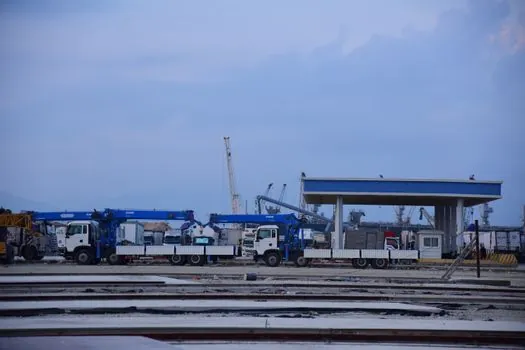
Knuckle-boom (articulated) truck cranes fold tight for transport and shine in urban logistics where the lift is short, the angle is awkward, and the operator needs to work close to the cab [S4]. Their folding geometry, however, caps horizontal reach well below 12 m at any useful load, so they are the wrong topology for the 5 t / 12 m brief unless a tip-extension jib or auxiliary fly-jib is added, which then re-introduces the load-chart de-rating problem at the new tip radius [S4].
Articulated units with wireless remote control and onboard ECU load-moment monitoring do improve precision and operator safety in confined builds, but the underlying reach envelope is set by boom geometry, not the control system, so they remain a secondary option for the 5 t / 12 m case [S4].
Boom-truck (boomtruck) class: a borderline option
Boomtruck cranes in the 40-50 ton lifting capacity class offer booms from 105 ft (32 m) to 142 ft (43.3 m) and maximum tip heights of 160 ft (48.8 m) to 207 ft (63.1 m), with on-board digging torques up to 20,000 ft-lbs and a 44 ft digging radius when configured as a digger derrick [S3]. At a 12 m working radius these units are well within their strong zone, with capacity headroom typically 3-5x the 5 t target when outriggers are fully deployed [S3].
The trade-off versus a purpose-built truck crane is carrier speed and on-road manners: a 75-tonne hydraulic truck crane can cruise at up to 62.8 mph (101.1 km/h) and travel on-site with full counterweight at 1.3 mph (2.1 km/h), which makes it faster between jobs but heavier to permit [S1].
Outrigger spread and stability envelope
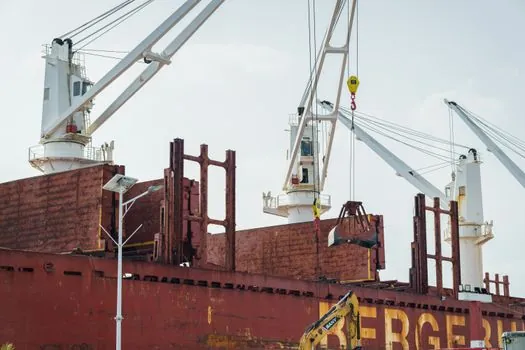
For a telescopic truck crane rated 25 t at 20 m boom / 18 m reach, the published outrigger spread is 5.6 m; that grows to 6.2 m at 30 m boom, 7.0 m at 40 m, and 7.5 m at 50 m, and lifting capacity at any radius is conditional on those spreads being achieved on firm, level ground [S4]. On a 5 t / 12 m lift, the required spread is closer to the 5.6 m figure, but specifiers should still verify the load-chart entry for the exact boom length rather than interpolating, because the chart curve is not linear between data points [S4].
Three outrigger stages (retracted, intermediate, fully extended) are common in this class, and the intermediate setting typically delivers 60-75% of the fully extended capacity, which is useful in confined sites but inadequate for the 5 t / 12 m envelope if full extension is not possible [S1].
Spec-check checklist before committing to a configuration
Four numbers settle the question: maximum boom length, working radius, rated payload at that radius, and outrigger spread, all of which must be read off the manufacturer's load chart for the exact machine being offered, not from a generic class table [S5]. A "12-tonne crane" that lists 2,000 kg at 10 m will not lift 5 t at 12 m, and a 75-tonne crane with 75 t at 9 ft (2.5 m) radius still needs its 12 m chart line checked, because capacity falls off rapidly past the close-in zone [S1][S5].
Buyers should send the manufacturer the load weight, working radius, lift height, and site footprint, and ask for the matching load-chart page; any vendor that quotes a single tonnage figure without a radius attached is signaling that the chart has not been read [S5]. For related lifting and rigging reference work, see this walkthrough of wheeled excavator outriggers vs dozer-blade stabilisers for comparable stability trade-offs, and this spec-first guide to truck scale sizing for 80,000 lb GVW compliance for the carrier-axle side of the same problem.
Trackable signals to watch over the next two quarters: OEM publication of revised load-chart software that interpolates between radii (Liebherr, Tadano, Manitowoc, and Elliott all maintain such tools), and any update to mobile-crane stability standards that tighten outrigger-spread requirements for the 30-50 t class, both of which would directly change the 5 t / 12 m specification.
Detailed specification references: dump truck.